

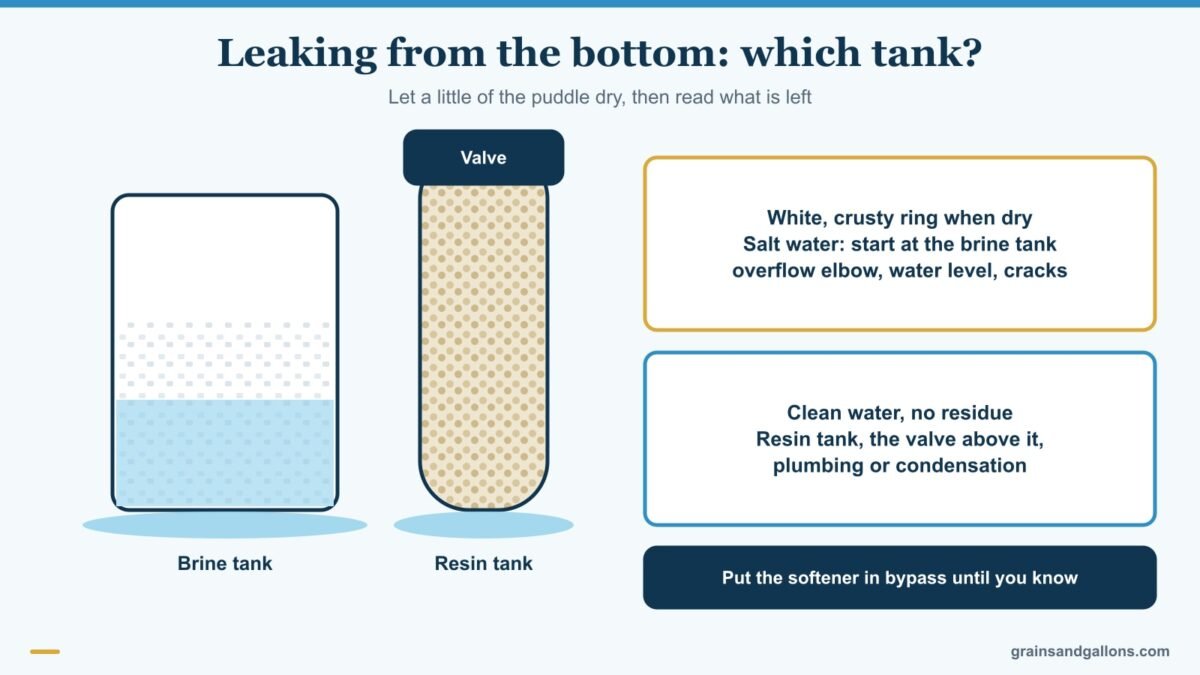
Quick Answer: A water softener leaking from bottom is usually the brine tank: an overflow elbow with no hose, a tank that overfilled past a stuck float, or a crack. Under the tall resin tank, dry it top to bottom first, because most "bottom" leaks there are water running down from the valve. A resin tank that leaks through its shell can't be patched and has to be replaced. Put the softener in bypass until you know which one it is.
Disclosure: As an Amazon Associate, Grains & Gallons earns from qualifying purchases.
A water softener leaking from bottom is confusing because water travels. It runs down tank walls, wicks along the floor and pools at whatever corner sits lowest. So a puddle at the base can mean five different things, and only two of them are bad news. First, put the softener in bypass and unplug it if water is anywhere near the outlet. Then work out which tank the water belongs to.
In this guide
Which tank is the puddle under?
Most home softeners have two tanks: a tall, narrow resin tank (also called the mineral tank) with the control valve on top, and a wider, shorter brine tank holding salt. All-in-one cabinet models hide the resin tank inside the salt tank, which makes this harder. On those, treat the whole cabinet like a brine tank for now.
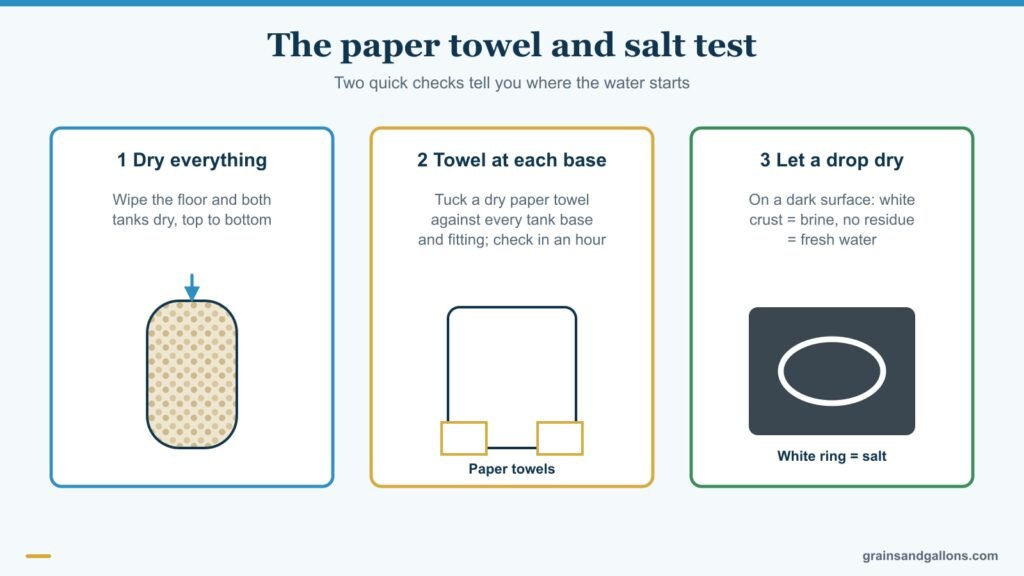
- Dry everything. Wipe the floor and both tanks dry, top to bottom.
- Towel each base. Tuck a dry paper towel against the base of each tank and under every fitting. Check back in an hour, and again after the next regeneration.
- Do the salt test. Let a little of the puddle dry on a dark surface. A white, crusty ring means salt water, which points to the brine tank. Clean water that dries without residue is more likely from the resin tank, the valve above it, the plumbing or condensation.
If the brine tank is the source, our step-by-step guide to a leak under the brine tank uses food coloring to pin down the exact spot.
Fastest checks first
| What you see | Most likely cause | What to do |
|---|---|---|
| Water at the brine tank base, near a fitting on the side | Overflow elbow dripping because the tank overfilled, or the hose is loose or missing | Check the brine tank water level; see below |
| Brine tank water level far above normal | Stuck safety float or a valve stuck in refill | Bypass the softener and fix the overfill |
| Normal water level, wet spot at one side or underneath | Crack in the brine tank | Confirm, then repair or replace the brine tank |
| Water only on regeneration nights | Drain line or refill problem | Watch a manual regeneration |
| Streaks running down from the top of the resin tank | Leak at the valve, bypass or tank neck above | Find the top leak first |
| Resin tank dry at the top, wet at the base, water returns after wiping | Failed resin tank shell or base | Replace the resin tank |
| Fine droplets over every surface on humid days | Condensation | Dehumidify, insulate cold lines |
If the floor is only wet the morning after a regeneration, the cause is almost always the drain side or a brine tank overfill. Our guide to a softener leaking during regeneration only walks through watching one cycle to catch it.
Brine tank overflow and cracks
The overflow elbow: the most common bottom leak
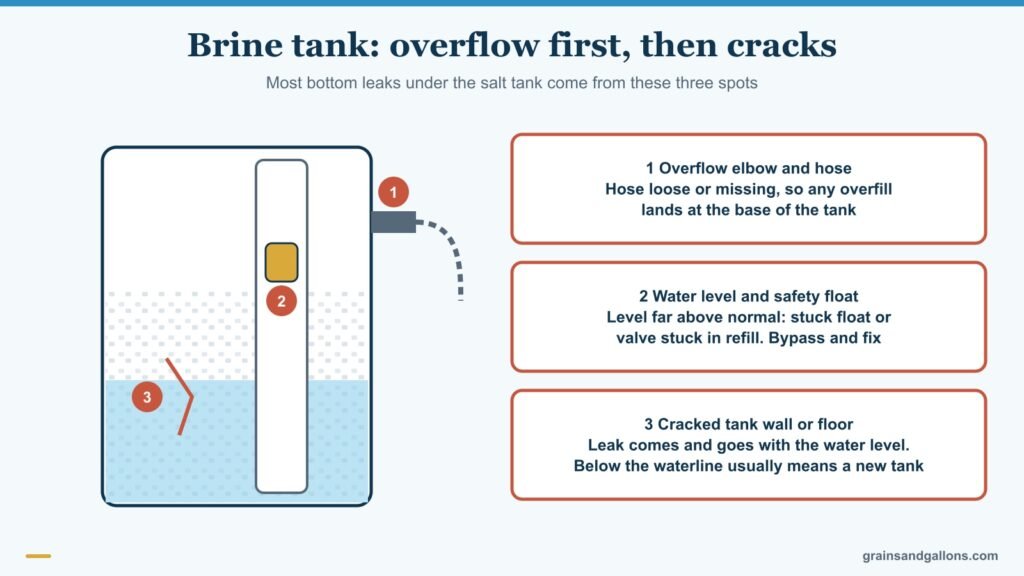
Most brine tanks have an overflow fitting a few inches below the rim. It's a safety outlet: if the tank fills too high, water spills out there instead of over the top. It's supposed to have its own hose running downhill to a floor drain or standpipe. Two things go wrong:
- The hose isn't connected, or has popped off. Every overflow then lands on the floor at the base of the tank. GE's softener manual notes the overflow hose is a safety drain that shouldn't be teed into the valve's drain hose. Our guide to brine tank overflow line requirements covers routing.
- The tank keeps overfilling. The real problem is upstream. The safety float in the brine well should shut off refill, and if it's crusted with salt or broken, water keeps coming. A valve stuck in the refill step does the same.
Look into the brine tank. If the water is well above where it normally sits, bypass the softener and work through our guide to a brine tank full of water or overflowing, or test the float with our stuck brine tank float guide. A cracked or gummed-up float is a cheap part; our picks for the best replacement brine tank safety floats cover common styles.
A cracked brine tank
Brine tanks are usually polyethylene and fairly tough, but they crack. Common causes are an impact, freezing in a garage, age, and jabbing too hard at a salt bridge with a broom handle. Cracks near the bottom often leak only once the water level rises above them during refill, so the leak seems to come and go.
To confirm, scoop the salt to one side, look and feel along the inside walls, and shine a flashlight from inside the tank in a dark room. Small cracks above the waterline can sometimes be sealed. Cracks below the waterline or in the floor of the tank usually mean a new brine tank, which is far cheaper than a new softener. Our guide to a cracked brine tank covers repair versus replacement and measuring for a new one.
When the resin tank leaks at the base
Resin tanks are usually a plastic liner wrapped in fiberglass, sitting in a plastic base. They hold full house pressure all the time, and they don't last forever.
Rule out water from above first
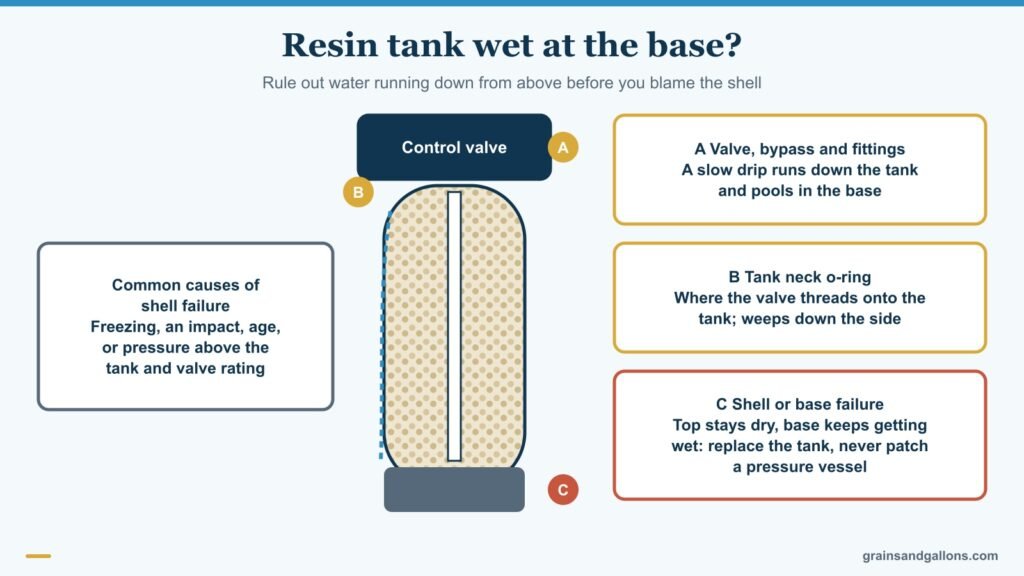
A slow drip at the valve, bypass or tank neck runs down the side of the tank and collects in the base, so the bottom looks like the source. Dry the tank from top to bottom, then put a dry paper towel at the valve, at each bypass nut and where the valve threads onto the tank. Our guide to a softener leaking from the top shows how to find that kind of leak, and our o-ring leak guide covers replacing the seals.
Go easy on the plastic nuts. The Clack WS1 service manual says its valve and bypass nut connections are hand-tighten only, and that if one of those o-ring joints leaks, tightening the nut won't stop it. Take the joint apart and check the o-ring for damage or misalignment instead.
Freeze damage and pressure

The Fleck 5600SXT manual says water pressure must not exceed 125 psi and the unit cannot be subjected to freezing conditions. A softener in an unheated garage or crawl space can crack its tank, base or valve in one cold night, and the leak may not show until spring. Pressure above the rating, or repeated pressure spikes, stresses the shell over years. Our guide to softener placement covers protecting a unit in those spots.
If the shell is failing
If the top stays dry and the base keeps getting wet, the tank itself is leaking. A pressure tank leak isn't something to patch with epoxy or tape; it's holding the full water pressure of your house. Your options:
- Replace the resin tank only. Move the valve, and the resin if it's healthy, to a new tank of the same size. It's a reasonable DIY job if you're handy, but it involves draining and lifting a heavy tank. If the softener is fairly new, check the warranty before you buy anything.
- Replace the whole softener. If the unit is old, the resin is tired or the valve is outdated, a new system often makes more sense. Our list of the best 48,000-grain water softeners is a good starting point for a typical 3 to 4 person home.
Until it's fixed, keep the softener in bypass. A failing tank can get worse quickly.
Puddles that aren't a tank leak
Some water at the base of a softener has nothing to do with the tanks:
- Condensation. On humid summer days, cold water inside the tanks makes them sweat. Water beads up everywhere and drips to the floor. The signs are droplets over every surface instead of one wet spot, worse on muggy days, gone in dry weather, and no salt crust. Our guide to brine tank sweating covers the fixes, mostly dehumidifying and insulating cold lines.
- The drain line. On many softeners the drain line leaves the valve and runs down along the tank toward a floor drain. A loose drain fitting drips down the tubing and lands at the base. Our guide to a softener leaking from the drain line covers that fitting.
- Nearby plumbing. A water heater relief line, a supply line to a laundry sink or a pipe above can drip onto the floor near the softener. Check anything plumbed within a few feet.
FAQ
Why is my water softener leaking from the bottom of the brine tank?
Usually the tank overfilled and water came out of the overflow elbow with no hose attached, or the tank is cracked. Check the water level first: if it's far above normal, the safety float or refill is the problem. If the level is normal, look for a crack below the waterline.
Can a leaking resin tank be repaired?
Not safely. The resin tank holds full house water pressure, so epoxy or tape won't hold. Rule out drips from the valve or tank neck first. If the shell itself leaks, replace the tank, or the whole softener if it's old.
Water softener leaking from bottom: should I bypass it?
Yes. Bypass stops house water from flowing into the softener while you find the leak, and you still have water, just hard water. If the leak is at an inlet connector upstream of the bypass, close the main shutoff instead.
Is condensation under a water softener normal?
It's common in humid basements in summer and isn't a leak. The water is clean, spread across every surface, and goes away in dry weather. Persistent condensation can still damage floors, so a dehumidifier helps.
How do I find a slow leak under my water softener?
Dry everything, tuck paper towels at each tank base and fitting, and check back in an hour and after the next regeneration. A white salt ring when the water dries points to the brine tank; clean water points to the resin tank, valve or plumbing.
Bypass first, then find the leaking tank
A water softener leaking from bottom is fixable more often than not. Overflow hoses, stuck floats and loose valve nuts are cheap repairs, and even a cracked brine tank is a modest replacement. Only a leaking resin tank shell means a new tank or a new softener. Bypass the unit, run the towel and salt test, and fix the cheap causes before you price the expensive one. While you sort it out, a battery water alarm on the floor between the tanks, like the Basement Watchdog water alarm, sounds off as soon as water reaches the sensor.