

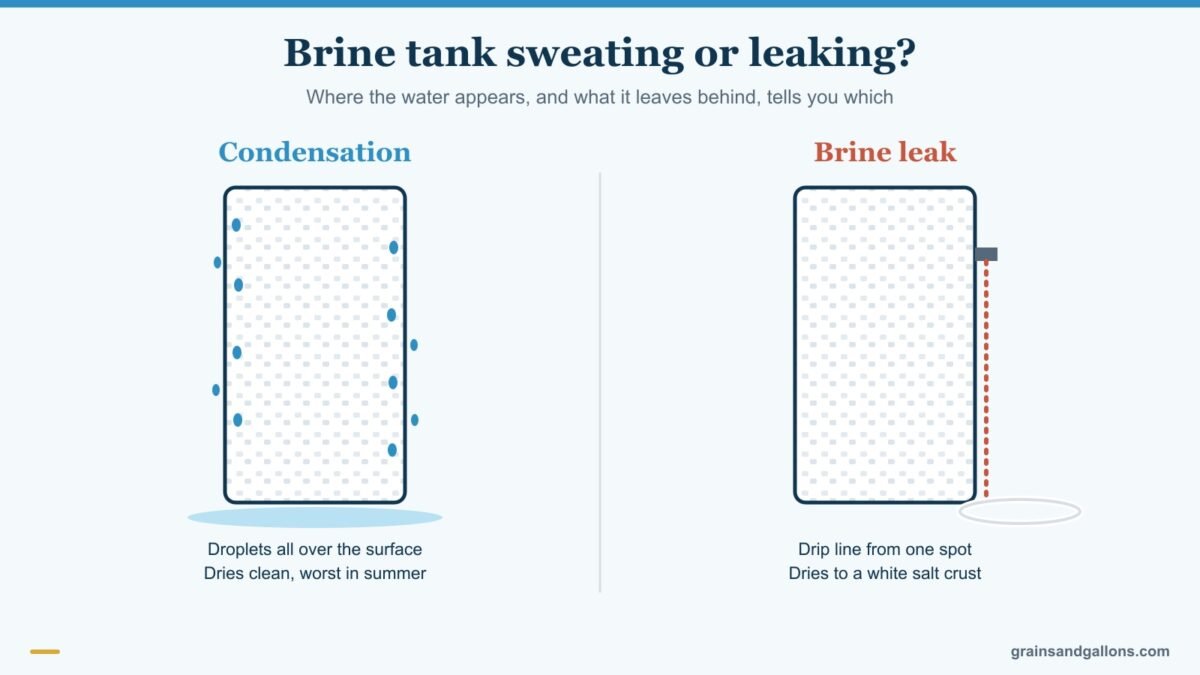
Quick Answer: Brine tank sweating is condensation: the tank and the water in it are colder than the humid air around it. To confirm, dry the tank and floor, then check in a few hours. Even droplets over the surface that dry clean are condensation; a wet spot from one place that dries to a white, salty crust is a brine leak. Fix condensation by lowering room humidity and insulating cold surfaces, such as with a neoprene jacket like the Oceanic sweat jacket on the resin tank.
Disclosure: As an Amazon Associate, Grains & Gallons earns from qualifying purchases.
July, a humid basement, and a ring of water around the softener. Brine tank sweating is the usual explanation, but salty water on concrete or near drywall does damage over time, so spend ten minutes making sure it isn't a leak.
In this guide
Why brine tank sweating happens at all
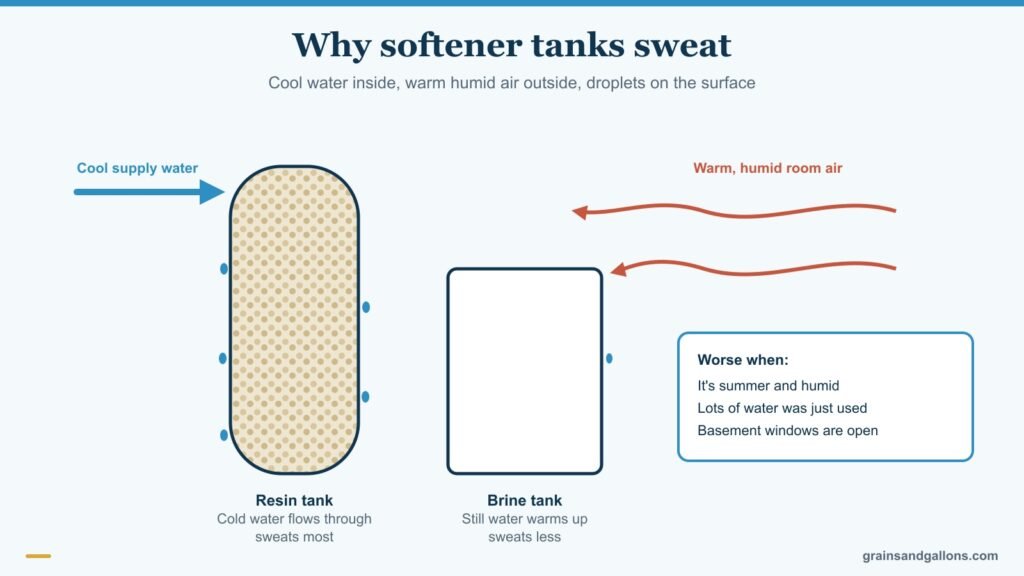
Condensation forms when warm, moist air touches a surface colder than its dew point. Water in the resin and brine tanks sits close to the temperature of the incoming supply, and well water and many city supplies arrive cool even in summer. On a humid day, the air right next to the tanks cools below its dew point and water beads up, just like a glass of iced tea on a porch.
Typical patterns:
- It's seasonal. Bad in summer, gone in winter.
- The resin tank sweats more than the brine tank. Fresh cold water flows through it whenever you use water, while the brine tank sits still and warms toward room temperature between regenerations.
- It's worst after heavy water use, like laundry day or long showers.
If the brine tank drips heavily while the resin tank stays dry, be suspicious. That's backwards for condensation.
The crust test: condensation or brine?
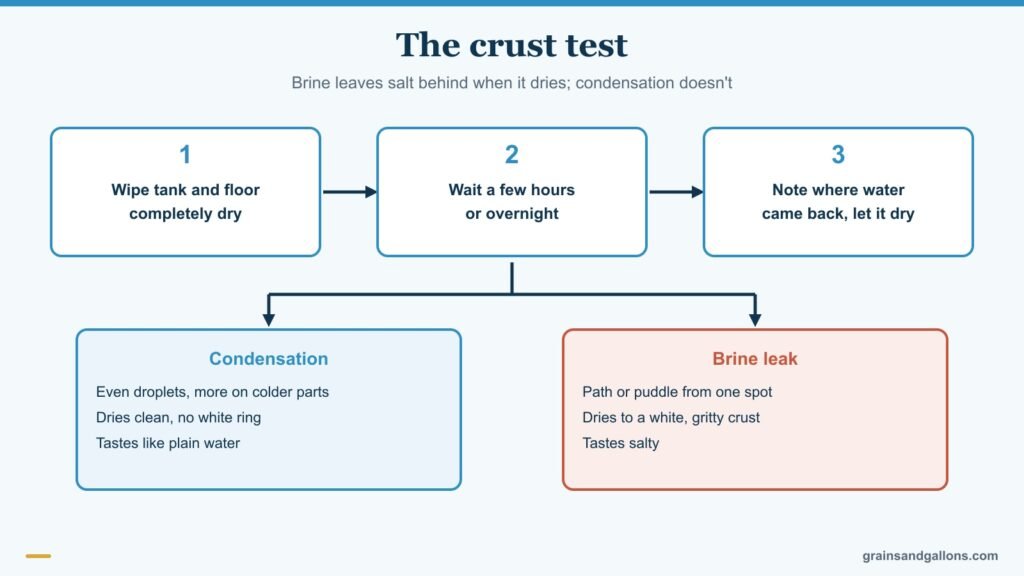
Brine leaves salt behind when it dries. Condensation doesn't.
- Wipe the tank and floor completely dry.
- Wait a few hours, or overnight.
- Look at where the water came back. Even droplets on the tank, more on the colder parts, mean condensation. A path, drip line or puddle starting at one spot (a fitting, a seam, the overflow elbow) means a leak.
- Let a damp floor spot dry fully. A white, gritty ring is salt, so brine got out.
- Still unsure? Touch a fingertip to the water and taste it. Salty means brine.
If it's brine, it's a leak
Then the next stops are:
- Around the overflow elbow or out of the overflow line: the tank is overfilling. Work through a brine tank full of water or overflowing; a stuck or worn safety float is often part of it, and our replacement brine tank safety float picks cover common styles.
- From the bottom or a seam: possibly a cracked brine tank.
- At the brine line fitting: a loose or cracked compression fitting.
Our guide to a puddle under the brine tank covers each source in detail.
Quick reference
| What you see | Most likely | Next step |
|---|---|---|
| Droplets all over, drying clean, mostly in summer | Condensation | Dehumidify, insulate resin tank and pipes |
| Puddle from one spot, white crust when dry | Brine leak | Find the source: overflow, crack, fitting |
| Water running from the overflow fitting | Overfilling brine tank | Check float, refill setting, brine valve |
| Wet floor only after regeneration | Drain line or connection leak | Check drain tubing and air gap |
Stop condensation: dry the air, then insulate

Bring the room humidity down
This is the real fix, and it protects the rest of the house. The EPA recommends keeping indoor relative humidity below 60 percent, ideally between 30 and 50 percent (EPA guide to mold and moisture). In a basement that usually means:
- A dehumidifier with a continuous drain if you can arrange one. ENERGY STAR's dehumidifier guidance notes it's better to oversize than undersize, and certified models use about 20 percent less energy. A cheap hygrometer tells you whether it's working.
- Dryer vents that exhaust fully outside with no leaks into the room.
- Closed windows on muggy days. Opening them lets humid outdoor air in to condense on cold surfaces.
Insulate the cold surfaces
The EPA's guide also suggests insulating cold surfaces such as cold water pipes. For a softener:
- Resin tank: a fitted neoprene jacket keeps humid air off the cold fiberglass. The Oceanic jacket is sized for a 10×54 tank; measure yours (diameter x height, often on the tank label) first. A snug fit matters, since loose wraps leave gaps where moisture still collects.
- Cold water pipes in and out of the softener: foam pipe insulation, sealed at the seams.
- Brine tank: usually needs nothing. If it sweats, it's typically mild, and fixing humidity is enough.
Protect the floor in the meantime
Set the softener on a drip tray or raised-edge mat if the floor is finished, keep cardboard and salt bags away from the base, and consider a leak alarm in a closet or finished room. If you can't control humidity in that spot, see our guide to a softener in a basement, garage, crawl space or closet. For carports and sheds, an outdoor cover or enclosure shields the tanks from humid air and sun.
FAQ
Is it normal for a water softener to sweat?
Some condensation is normal in humid weather, especially on the resin tank, because cool water inside chills the surface below the room's dew point. Heavy dripping from one spot, or water that leaves a salty crust, is not condensation.
Why is my brine tank sweating but not the resin tank?
That's unusual, because the resin tank normally runs colder. Check for a brine leak with the crust test, and look for an overflowing tank, a seam crack or a loose brine line fitting.
Can a sweating softener tank cause damage?
Constant dripping can stain or warp flooring, rust nearby metal and feed mold in a humid room. Lowering humidity and insulating the resin tank and cold pipes usually stops it.
Should I wrap my brine tank in insulation?
Usually not. The brine tank sweats less than the resin tank, and fixing room humidity is enough. If you insulate anything, start with the resin tank and the cold water pipes, using a snug-fitting jacket rather than loose wrap.
Dry air beats a damp floor
Brine tank sweating is a humidity problem, not a softener problem: confirm it with the crust test, then bring the room to 30 to 50 percent humidity and insulate the resin tank and cold pipes. If the water dries to a salty crust instead, treat it as a leak and find the source.
More help: Puddle under the brine tank · Brine tank full of water or overflowing · Best outdoor water softener enclosures