

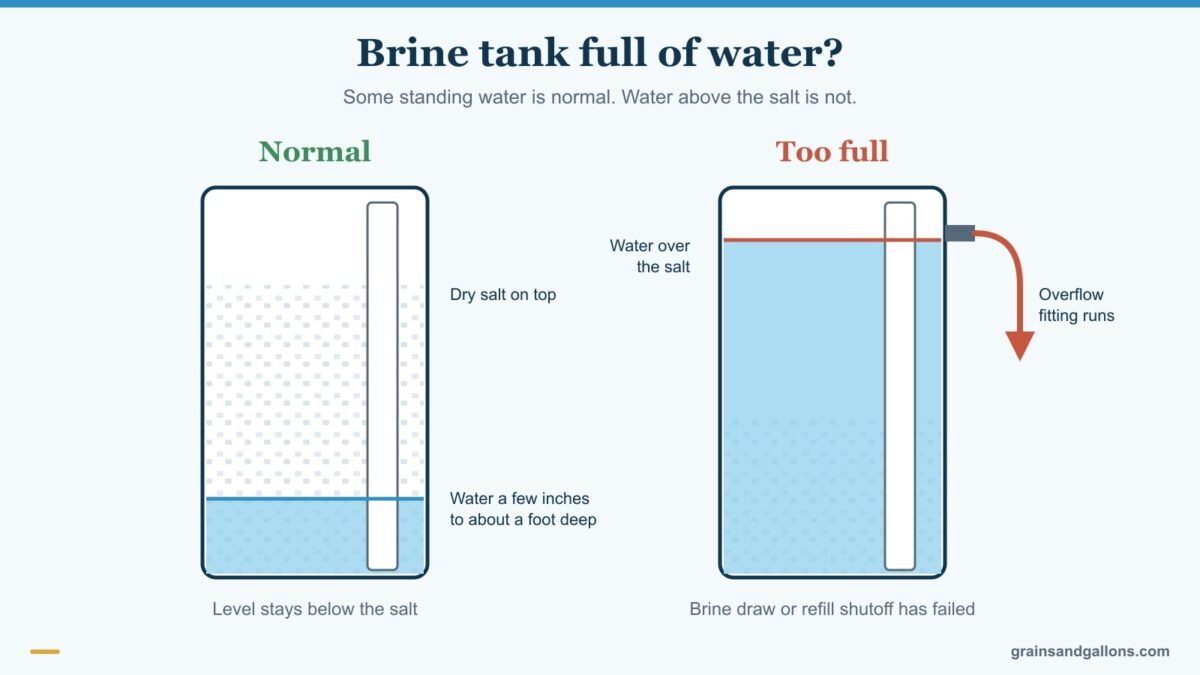
Quick Answer: A brine tank full of water or overflowing means the softener either can't suck brine out during regeneration or can't stop refilling. Many softeners normally hold a few inches to about a foot of water, so first confirm the level is above the salt. Then run a manual regeneration: if the level doesn't drop during brine draw, clean the injector and check the drain line; if it drops but refills too high, the float or brine valve is at fault.
Disclosure: As an Amazon Associate, Grains & Gallons earns from qualifying purchases.
If your brine tank is full of water or overflowing, you probably found it when you lifted the lid to add salt. There's no salt on top, just water with a few mushy pellets floating in it, a foot or two higher than it should be. Or there's a puddle on the floor and the overflow hose is wet. Either the part of the cycle that pulls water out of the brine tank has stopped working, or the part that lets water in won't shut off.
It matters beyond the mess: extra water means weak brine or brine that never leaves the tank, and hard water soon comes back. The checks below go from free and quick to "you might need a part."
In this guide
- How much water belongs in a brine tank?
- Run a regeneration test to find the failing step
- Suction problems that stop brine draw (checks 2 to 5)
- Refill problems when the brine tank is full of water or overflowing (checks 6 and 7)
- Salt bridges and mush can hide the real water level
- Getting the extra water out
- When it's coming out the overflow
- FAQ
- Find the step that fails, then fix that part
How much water belongs in a brine tank?
Not every softener keeps the brine tank dry. Many common designs, including lots of Fleck and Clack valve systems, refill the tank right after regeneration so the salt has hours to dissolve. On those you'll normally see standing water several inches deep, sometimes up to about a foot, depending on tank size and salt dose. Other designs refill just before the next regeneration, so the tank looks nearly dry most of the time.
Your manual tells you which design you have. As a rough guide:
- Probably normal: water level steady and below the top of the salt, no overflow, softened water still soft.
- A problem: water above the salt, the level rising between regenerations, or water running out the overflow fitting.
Probe with a broom handle before you panic. If the salt looks dry on top but the handle hits a hard crust and there's water and empty space below it, you have a salt bridge, not an overfill. For how much salt belongs in the tank, see how full a brine tank should be.
Run a regeneration test to find the failing step
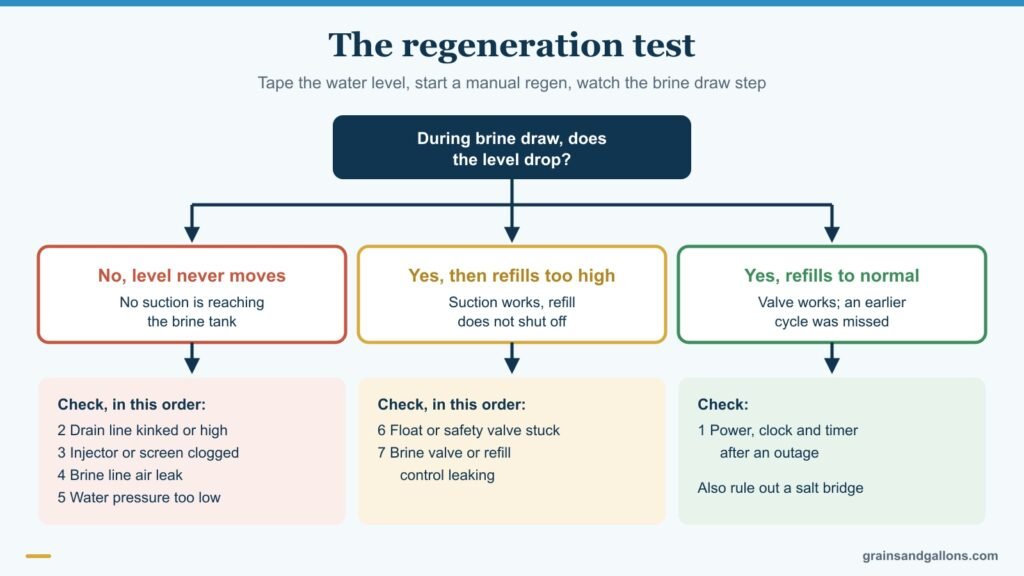
Before you buy parts, watch what the softener does when it's asked to pull brine. Put a strip of tape on the outside of the tank at the current water level, then start a manual regeneration (usually a "regen" button held for a few seconds or a knob turned by hand). Most valves run backwash first, then brine draw. Brine draw often lasts close to an hour, and the water level should drop noticeably while it runs.
- Level drops, then refills to a normal height: the softener works. The earlier overfill was probably a missed or interrupted regeneration. See check 1 below.
- Level doesn't move during brine draw: no suction is reaching the tank. Go to checks 2 through 5.
- Level drops, then refills too high: suction works but refill doesn't stop. Go to checks 6 and 7.
Before you take anything apart, put the softener in bypass and unplug it.
Check 1: the softener skipped regenerations
A power outage, a tripped GFCI or a timer that reset to the wrong time can mean the softener never reached brine draw, or got interrupted after refilling. Check that the display shows the right time and the unit has power. One interrupted cycle can leave a tank of extra water behind, and one complete regeneration usually clears it.
Suction problems that stop brine draw (checks 2 to 5)
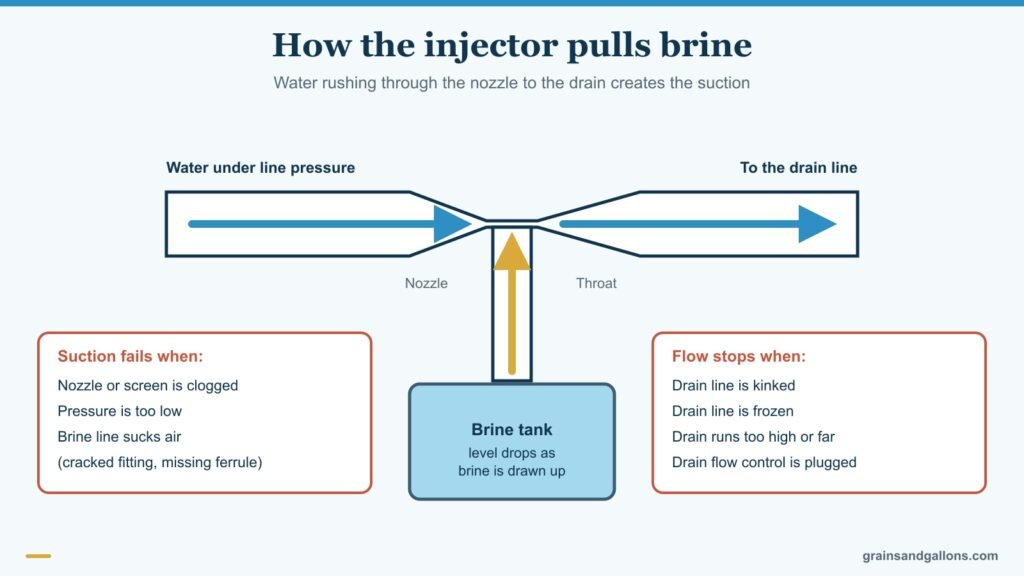
If the water level never moved during brine draw, the injector isn't creating suction. These four causes cover almost every case.
Check 2: the drain line is kinked, frozen or raised too high
The injector makes suction by forcing water through a small nozzle and out to the drain. If the drain line is kinked behind the softener, frozen in a garage, plugged at the drain line flow control, or run too high or too far, there's no flow, so there's no suction. Manufacturers publish rise and length limits that depend on your water pressure; our guide to drain lift height lists them for common valves.
Follow the line from the valve to the drain. Pull the end out of the drain and run a regeneration: you should see strong flow during backwash and a steady trickle during brine draw.
Check 3: the injector or its screen is clogged
This is the most common cause of a softener not drawing brine. The injector has tiny openings that sediment, iron and salt fines block easily. On many valves it sits under a small cap on the side of the valve body and comes out by hand or with a screwdriver. Clean the screen, nozzle and throat with warm water and a soft brush or a toothpick, never a metal drill bit that could enlarge the opening. Our guide on cleaning a water softener injector shows where it hides on Fleck and Clack valves, and the Fleck SXT service manual lists the injector size your valve was built with if you need a replacement.
Check 4: the brine line is leaking air or partly blocked
The small tube from the valve to the brine tank has to be airtight. A cracked fitting, a missing ferrule or a nick in the tube lets the injector suck air instead of brine. Watch for bubbles in the line during brine draw and check both compression fittings. While the line is off, blow through it to make sure salt crust isn't choking it. Brine line air leak walks through the fitting-by-fitting check.
Check 5: water pressure is too low

Injectors need pressure to make suction. Manufacturers list a minimum operating pressure in the manual, often around 20 psi. If you're on a well and the pump is struggling, or someone runs water during regeneration (which is usually scheduled at 2 a.m. for a reason), brine draw can fail. Watch the pressure gauge during the cycle if you have one, and see water softener pressure requirements for typical ranges.
Refill problems when the brine tank is full of water or overflowing (checks 6 and 7)
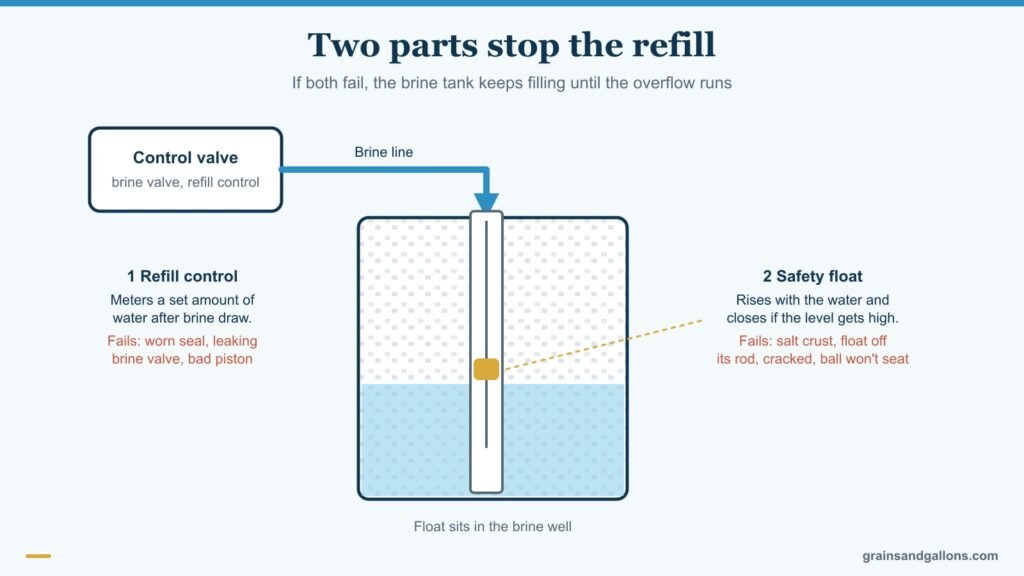
If brine draw worked but the tank refilled too high, one of two shutoffs has failed.
Check 6: the float or safety valve is stuck
Inside the brine well (the tube standing up in the brine tank) there's usually a float assembly. On many systems it's a safety shutoff that closes if the water gets too high. If salt crust has locked it in the down position or the float has slipped off its rod, it can't stop an overfill. Lift it out and make sure it slides freely; a rinse in warm water often fixes it. If it's cracked or the check ball won't seat, it's a cheap part.
For Fleck 2310-style brine wells, the Fleck 2310 safety valve assembly is the common replacement; check your valve model before ordering. Our picks for replacement brine tank safety floats cover Clack and Fleck options, and brine tank float stuck explains how to free one without breaking it.
Check 7: the brine valve or refill control is leaking
If the level keeps creeping up between regenerations even with a working float, water is getting past the valve into the brine line. On Fleck valves this is often the brine valve or the refill flow control; on others it's a seal or the piston. This repair means opening the valve, and it's where many owners call a dealer or swap the head. If the valve is old and parts are hard to find, a new head can cost less than piecemeal repairs; our guide to replacement control valves covers which Fleck and Clack heads fit standard tanks.
Salt bridges and mush can hide the real water level

Two salt problems make a tank look wrong without any part failing. A salt bridge is a hard crust that forms across the tank, leaving a gap underneath; water sits below it, the salt above stays dry, and the softener makes weak brine. Salt mush is dissolved salt that recrystallizes into a sludge at the bottom, which can block the brine well and slow brine draw.
Break a bridge gently with a broom handle, working from the center outward and keeping clear of the tank walls and brine well. Scoop out heavy mush. Both are more common with high humidity and tanks filled to the brim.
Getting the extra water out
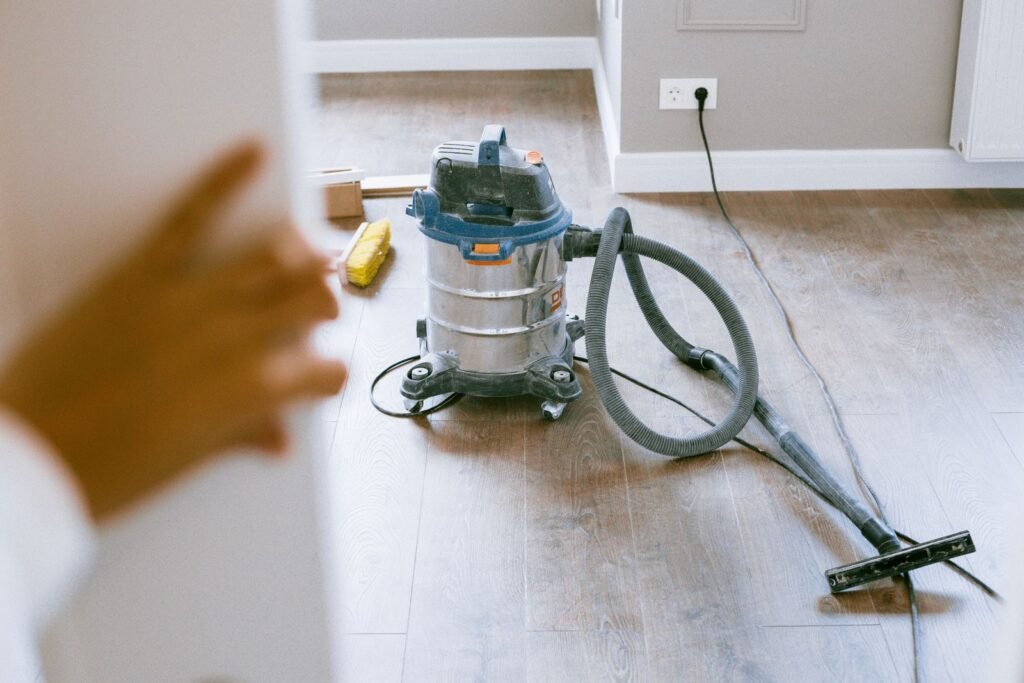
Once the cause is fixed, you can let the next regeneration draw the tank down, or speed things up:
- Put the softener in bypass and unplug it.
- Scoop or wet-vac the water and mushy salt out until you're at a normal level. Dump the salty water down a drain, not on the lawn.
- If salt has set into a solid mass at the bottom, break it up gently with a broom handle; don't stab at the tank walls.
- Plug the softener back in, return it to service and run one full regeneration to confirm the level drops and refills correctly.
Penn State Extension's water softening guide explains how the brine and regeneration cycle works if you want the background.
When it's coming out the overflow
An overflowing tank means the overflow fitting is doing its job. If water reached the floor instead of a drain, the overflow hose is missing, kinked or routed uphill. That hose needs to run downhill to a drain by gravity, separate from the valve drain line. See brine tank overflow line requirements to set it up correctly.
FAQ
Should there be water in my brine tank?
Usually, yes. Many softeners keep a few inches to about a foot of water in the bottom so salt can dissolve between cycles. Some designs refill only just before regeneration and look almost dry. Water above the top of the salt is the warning sign.
Why is my brine tank full of water or overflowing instead of draining?
Almost always because the softener isn't creating suction during brine draw. The usual causes are a clogged injector or screen, a kinked or blocked drain line, an air leak in the brine line, or low water pressure. Run a manual regeneration and watch the level to confirm.
How do I get excess water out of a brine tank?
Fix the cause first, then either let a regeneration draw it down or put the softener in bypass and remove the water with a wet vac, bucket or cup. Break up any hardened salt, return the unit to service and run a full regeneration.
Can too much water in the brine tank stop the softener from working?
Yes. If the softener can't draw brine, the resin never gets recharged and hard water returns. If the tank refills with too much water, the brine can be weaker than the softener is programmed for, which also leaves the resin only partly recharged.
Is an overflowing brine tank dangerous?
It isn't a safety hazard, but salty water damages flooring and drywall, and a leaking valve wastes water and salt. Route the overflow hose to a drain and fix the cause.
Find the step that fails, then fix that part
A brine tank full of water or overflowing is a symptom, not a diagnosis. Tape the level, run one regeneration and watch brine draw: no drop points to the injector, drain line, brine line or pressure; a drop followed by an overfill points to the float or brine valve. Most owners fix it with a cleaned injector or a freed float rather than a new softener.
More brine tank help: How to clean a water softener injector · Brine tank float stuck · Water softener salt bridge · Best replacement brine tank safety floats