

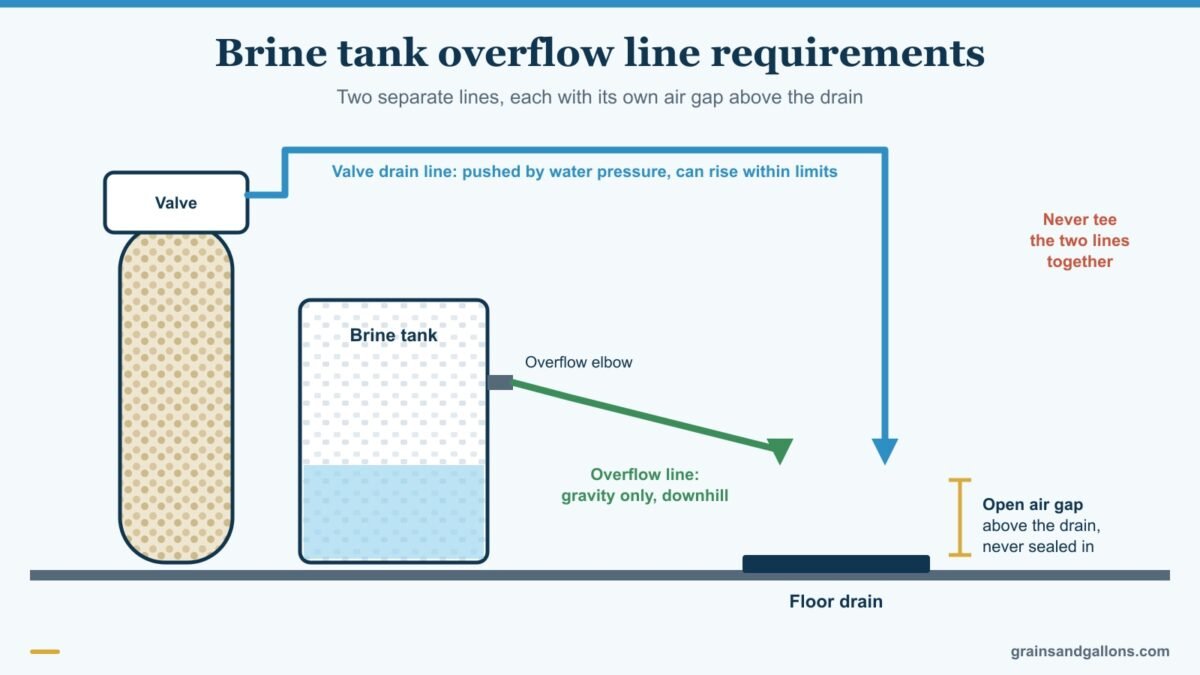
Quick Answer: The main brine tank overflow line requirements are simple: the hose must run downhill the whole way to a drain lower than the overflow elbow, it must never be teed into the softener valve's drain line, and it should end above the drain with an open air gap rather than being sealed into the pipe. Use the hose size your manual calls for (Whirlpool's elbow takes 3/8" or 1/2" inside diameter) and keep it free of kinks and loops.
Disclosure: As an Amazon Associate, Grains & Gallons earns from qualifying purchases.
Brine tank overflow line requirements trip people up because a typical softener has two hoses that look alike. The valve drain line carries water under pressure during regeneration, so it can go up and over things within limits. The overflow line has no pressure behind it at all. It's a backup path for water that has risen too high in the brine tank, and it only works if that water can fall the whole way to the drain.
Almost every rule below comes from that one fact.
In this guide
Five brine tank overflow line requirements and the reason behind each
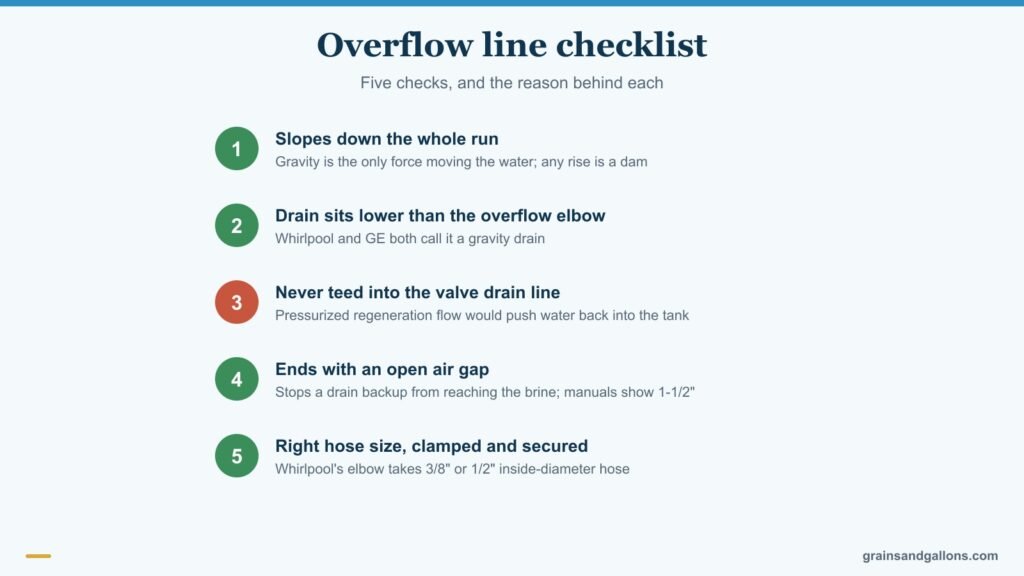
1. It has to slope downward the entire run. Water in the overflow line moves only by gravity. Any section that rises, even a small loop draped over a pipe, becomes a dam. The tank has to fill above that high point before anything drains, and by then it may be leaking from under the lid. Some installers aim for a steady drop of about 1/4 inch per foot; the point is that no part of the run should ever climb.
2. The drain has to be lower than the overflow fitting. Same reason. Whirlpool's installation manual says to route the overflow hose to a floor drain or other drain point "no higher than the drain fitting on the salt storage tank" and calls it a gravity drain (Whirlpool softener manual). GE's manual puts it more bluntly: do not elevate the hose higher than the elbow on the brine tank. In practice, a laundry standpipe 30-some inches up the wall usually won't work for the overflow, while a floor drain does.
3. It must not tee into the valve drain line. The valve drain line is under pressure during regeneration. Tie the overflow into it and that flow can push water backward up the overflow and into the brine tank, flooding it. Whirlpool's manual says not to connect the valve drain tubing to the overflow hose, and GE's installation instructions print it in capitals: "DO NOT TEE OVERFLOW HOSE TO VALVE DRAIN HOSE."
4. It needs an air gap at the end. The hose should end above the drain opening with open air between them, not stuffed down into the drain pipe or taped in. If the drain backs up, an air gap stops sewer water from being siphoned or pushed back into the tank of salt your softened water depends on. Plumbing codes generally treat softener discharge as indirect waste that needs an air gap, commonly at least twice the diameter of the discharge line. Whirlpool and GE both call for a 1-1/2" gap at the drain for the valve drain hose, and the same spacing is a sensible target for the overflow. Your local code is what counts. Our explainer on water softener backflow protection covers the code side in more detail.
5. Use the right hose size and secure it. Whirlpool's overflow elbow accepts either 3/8" or 1/2" inside-diameter hose, and the manual has you clamp it in place. Fasten the far end too, so it can't flop out of the drain when water finally comes through.
Overflow line vs. valve drain line
| Overflow line | Valve drain line | |
|---|---|---|
| Where it starts | Elbow on the side of the brine tank | Drain port on the control valve |
| What moves the water | Gravity only | Water pressure during regeneration |
| Can it rise overhead? | No | Within the manufacturer's height limit |
| When it flows | Only if something has failed | Every regeneration |
| Can the two be joined? | No | No |
| Air gap at the end? | Yes | Yes |
Both lines can end at the same floor drain, as long as each has its own air gap and neither feeds into the other. For the valve side, including how high it may rise, see water softener drain line requirements.
How to install the overflow elbow and hose
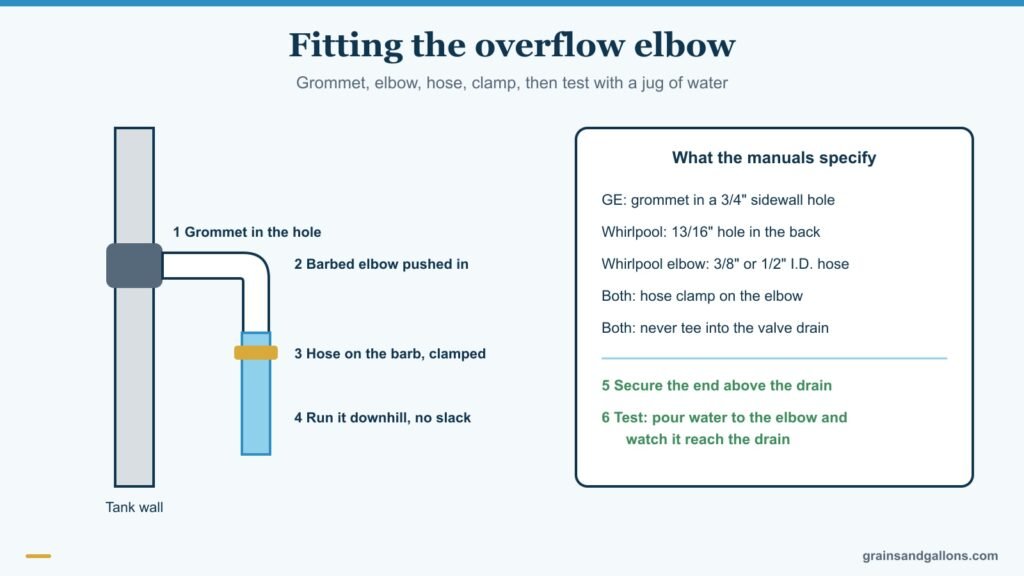
Most freestanding brine tanks and all-in-one cabinets come with a small overflow kit: a rubber grommet, a barbed elbow and a hose clamp. GE's and Whirlpool's instructions follow the same basic sequence:
- Fit the grommet into the pre-drilled hole in the brine tank sidewall (GE's is a 3/4" hole; Whirlpool's is 13/16"). Don't drill a new hole unless your tank has none and the manual tells you where.
- Push the elbow into the grommet so it seats firmly and points toward the drain.
- Slide the hose on the barb and tighten a hose clamp over it.
- Route the hose downhill to the drain, cutting it so there's no slack to droop into a low loop and climb again.
- Secure the end above the drain with your air gap, using a clip, tie or purpose-made fitting.
- Test it. With the softener in bypass, pour a jug of water slowly into the brine tank until it reaches the elbow, and watch it run to the drain without backing up.
If you're connecting the valve drain at the same time, our guide to connecting water softener drain tubing covers the fittings on that side.
Where the overflow line can end
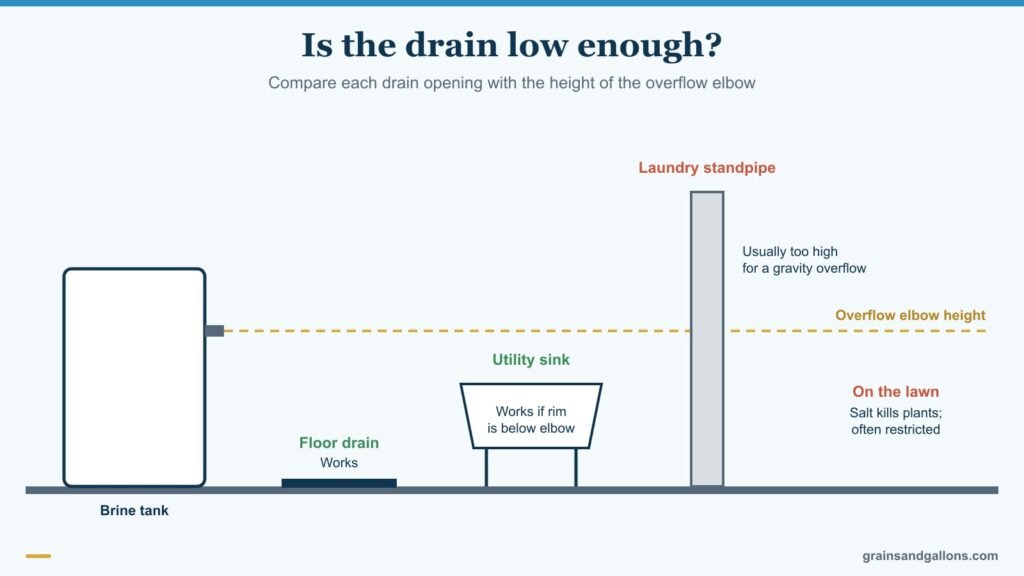
- Floor drain: The easiest choice. Run the hose to the drain and secure it a couple of inches above the grate.
- Laundry sink or utility tub: Works if the rim of the sink is lower than the overflow elbow. Many brine tanks have the elbow fairly low, so measure.
- Standpipe: Usually too high for a gravity overflow, unless the standpipe is unusually short or the softener sits on a raised platform. When the height does work, an air gap fitting made for softener standpipes, such as the Mr. Drain universal air gap, gives you a clean, code-friendly termination. Our roundup of air gap fittings for softener drain lines compares single and dual-line versions.
- Sump pit: Some homeowners do this, but sump pumps often discharge outdoors, and local rules on putting softener discharge there vary. Check with your local building department first.
- Outdoors on the ground: Generally a bad idea for brine. Salty water kills grass and plants, and some areas restrict it.
- No drain lower than the tank: You can raise the brine tank on a sturdy platform, or skip the overflow and rely on a working brine safety float, which some manufacturers allow. Ask your installer or check your manual. Our guide on where a water softener can drain covers trickier basements.
Overflow routing mistakes that cause floods
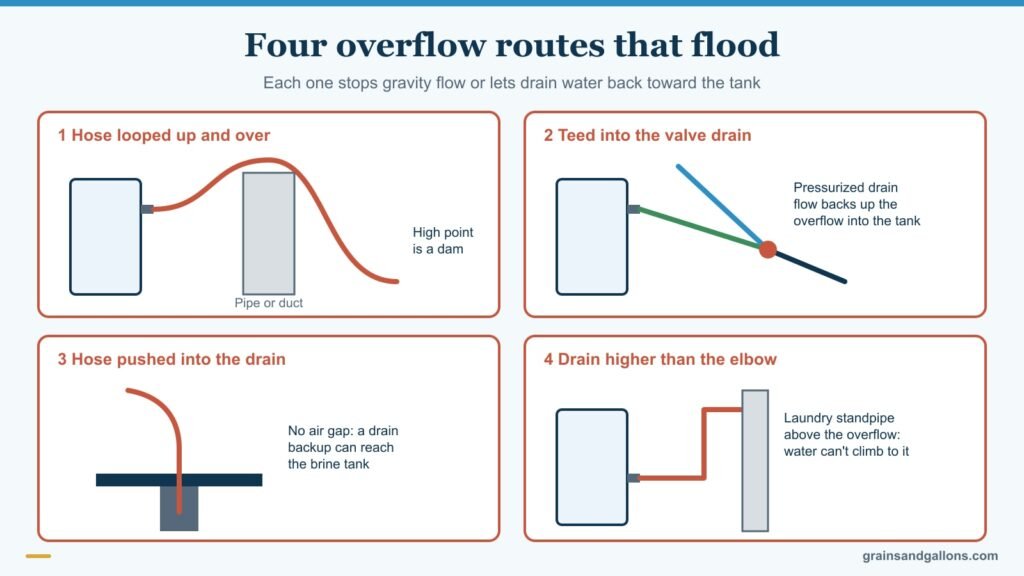
- Overflow hose tied into the valve drain line with a tee to save running a second hose. This floods the brine tank. Separate them.
- Overflow hose missing entirely. The elbow is left open or capped, so water ends up on the floor when the tank overfills.
- Hose routed up and over a water heater or ductwork. It looks neat, but it can't drain.
- Hose pushed several inches down a floor drain. That's not an air gap. Pull it back up and fasten it.
- Drain point higher than the elbow, usually a laundry standpipe. Water can't climb to it.
- Brine tank moved after installation. People shift the tank to clean around it and the hose kinks or lifts. Check the run whenever you add salt.
If you're doing a fresh install, an installation kit usually includes the valve drain fittings and tubing, but the overflow hose and clamp may be separate. Check the parts list.
Do you need an overflow line if you have a safety float?
The overflow and the safety float are two layers of the same protection. The float, which sits in the brine well, is supposed to shut off refill water before the tank gets too full. The overflow line is the backup if the float sticks, cracks or gets buried in salt crust. GE's manual describes the overflow drain as "for safety only," which is the right way to think about it: it does nothing on a normal day and saves your floor on a bad one.
If you have a drain lower than the elbow, connect the overflow. If you don't, keep the float in good condition and check it whenever you add salt; our picks for replacement brine tank safety floats cover common Fleck and Clack styles.
When overflow water actually shows up
An overflow line that carries water is a symptom, not a fix. It means the brine tank filled higher than it should have, usually because the softener can't draw brine out (clogged injector, blocked valve drain line) or can't stop refilling (stuck float, leaking brine valve). If you find water on the floor or the overflow hose is wet, work through brine tank full of water or overflowing to find out why.
FAQ
Can the brine tank overflow connect to the softener drain line?
No. The valve drain line is pressurized during regeneration, and teeing the overflow into it can force water back into the brine tank. Both Whirlpool and GE manuals prohibit it. Run each line separately; they can end at the same floor drain with separate air gaps.
What size hose does a brine tank overflow need?
Use what your manual specifies. Whirlpool's overflow elbow accepts 3/8" or 1/2" inside-diameter hose, and many other tanks use one of those two sizes. Clamp it to the elbow and secure the far end at the drain.
Does the brine tank overflow need an air gap?
Yes. Ending the hose above the drain with open air between them prevents sewer water from backing up into the brine tank. Manufacturer manuals typically show a 1-1/2" gap at the drain, and local plumbing codes may set their own minimum.
Can the overflow hose run uphill?
No. The overflow is a gravity drain with no pressure behind it, so any rise in the hose blocks flow until the tank fills above that point. The drain must also sit lower than the overflow elbow.
Can I cap the overflow elbow if I don't have a low drain?
Some manufacturers allow skipping the overflow and relying on the brine safety float, but a capped elbow means any float failure ends up on the floor. Raising the brine tank on a sturdy platform or using a lower drain point is the safer fix.
Keep the overflow downhill, separate and open
All the brine tank overflow line requirements come down to gravity: a hose that falls the whole way, a drain lower than the elbow, no tee into the pressurized valve drain, and an open air gap at the end. Get those four right, keep the safety float working, and the overflow line will sit dry for years, which is exactly what it should do.
More drain and brine tank help: Water softener drain line requirements · Where can a water softener drain? · Water softener backflow protection · Best air gap fittings for softener drain lines