

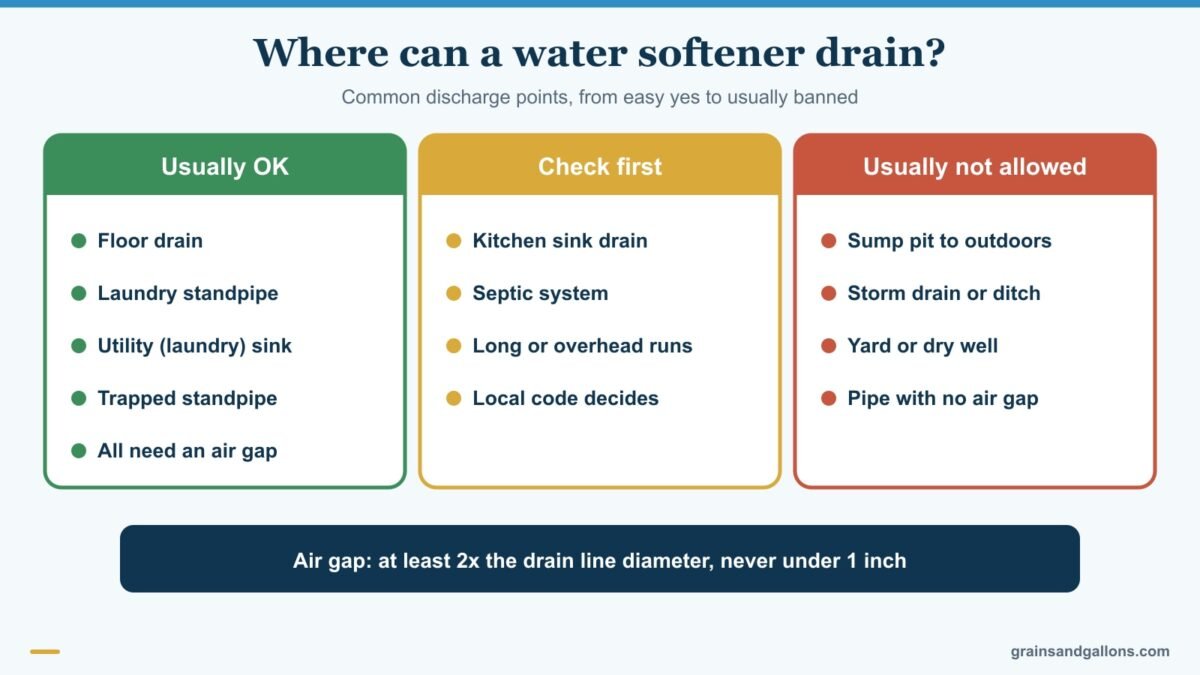
Quick Answer: Where can a water softener drain? Usually into a floor drain, a laundry standpipe, a utility sink, or another trapped drain that goes to the sewer or septic system, as long as there's an air gap between the end of the drain hose and the drain. It can't be plumbed straight into a drainpipe without that gap, and many areas don't allow it to discharge into a sump pit that pumps outdoors, a storm drain or the yard. Local plumbing code has the final word.
You've found the perfect spot for the softener, and now you're holding a drain hose and wondering where can a water softener drain without failing inspection. That one decision affects whether brine ends up in the sewer or on your lawn, and whether you ever deal with a backup or a cross-connection.
In this guide
- Every softener drain needs an open air gap
- So where can a water softener drain inside the house?
- Why sump pits, storm drains and yards are usually ruled out
- How far and how high the drain line can run
- Keep the brine tank overflow on its own gravity line
- FAQ
- Use a trapped indoor drain and leave the gap open
Every softener drain needs an open air gap
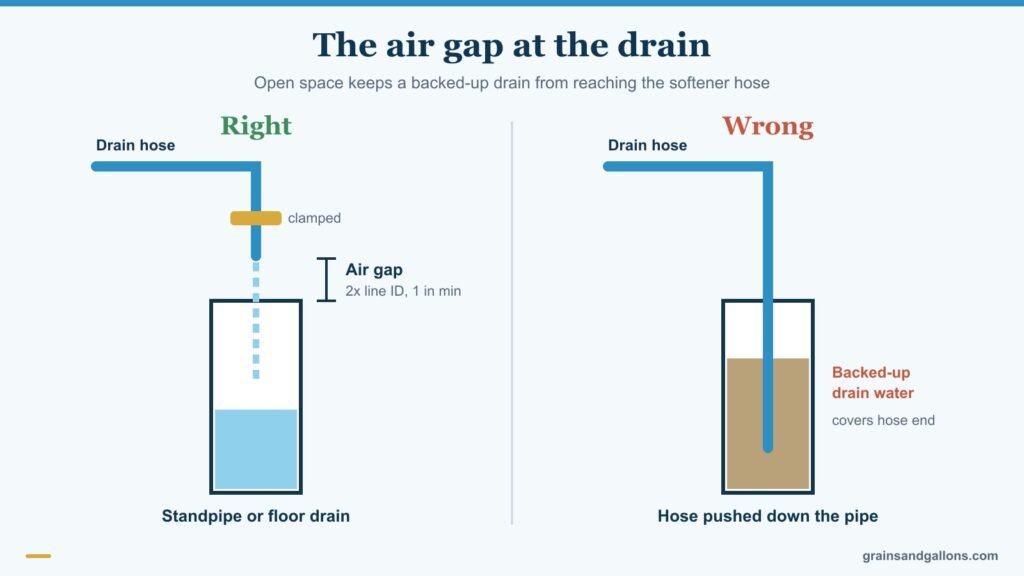
During backwash and rinse, the softener pushes water out under pressure. If the drain it empties into ever backs up, a sealed or submerged connection could let dirty water siphon back toward the softener and your drinking water. The fix is an air gap: a physical open space between the end of the drain line and the top of whatever it drains into.
The Fleck 5600SXT downflow manual is a good example of the usual rule. It calls for an air gap of twice the drain line pipe diameter, with a minimum of 1 inch. Some local codes and some other manuals ask for more, so check both.
Two ways to get it:
- Hold the hose above the drain with a clamp or bracket so it can't slip down into the water.
- Use an air gap fitting that mounts on a standpipe, with the hose feeding into the top. Our picks for the best air gap fittings for softener drain lines cover several styles.
Expect force, not a trickle. A Wisconsin utility's softener cross-connection brochure points out that softener discharge "flows fast" and shows an installer notching a floor drain cover so the stream doesn't splash everywhere. Shoving the hose a foot down a standpipe to stop the splash is the most common mistake. Secure the end so it can't creep down, and see how to connect water softener drain tubing for the fittings.
So where can a water softener drain inside the house?
Here are the usual water softener drain options, from easiest to never:
| Drain option | Usually OK? | Watch for |
|---|---|---|
| Floor drain | Yes | Air gap, trap that stays primed |
| Laundry standpipe | Yes | Air gap, washer and softener draining at once |
| Utility (laundry) sink | Yes | Hose secured above the flood rim |
| Dedicated standpipe with trap | Yes | Height, trap and venting per code |
| Kitchen sink drain | Sometimes | Proper air gap device, local approval |
| Septic system | Usually | Local rules, tank and drainfield capacity |
| Sump pit | Often not | Many sumps discharge outdoors |
| Storm drain, ditch or yard | Rarely | Usually prohibited; brine harms soil |
| Directly into a drainpipe, no gap | No | Cross-connection risk |
Floor drain
This is the simplest choice if one is nearby. The discharge goes to the sanitary sewer like other household water. Make sure the floor drain's trap stays filled, or sewer gas can come up. A floor drain that rarely gets water dries out, and regular softener discharge actually helps keep it primed.
Laundry standpipe
Very common, and fine with an air gap. The issue is volume. During backwash a softener can send several gallons a minute down the drain. If the washing machine pumps out at the same time, a smaller standpipe can overflow. Setting regeneration for the middle of the night mostly avoids this.
Utility sink
Clip the hose to the edge of the sink so the end sits well above the flood rim. Make sure it can't flip out of the sink when water surges through it. Zip ties work, but a proper bracket is better. Keep the sink drain clear of lint and debris, since a partly blocked sink will fill during a long backwash.
Dedicated standpipe
If no existing drain is close, a plumber can add a trapped, vented standpipe tied into the drain stack. It's the cleanest permanent setup and the one inspectors like best.
Kitchen sink drain
It's possible, but it's not the first choice. You'll need an air gap device similar to the ones used for dishwashers, and some areas have specific rules. It's mostly used in condos or apartments with no other drain nearby.
Septic system
Most softeners can drain to a properly working septic system. The bigger worry is hydraulic load: Penn State Extension estimates about 50 gallons of water per regeneration cycle and tells septic owners to weigh the extra load on the drainage field. Some states or counties have their own rules, and an older or undersized tank is a separate concern. Our guide to running a water softener with a septic system goes through the research and what to ask your septic pro.
Why sump pits, storm drains and yards are usually ruled out
A sump pit usually pumps out to the yard, a storm drain or the street. That means brine reaches groundwater or surface water instead of a treatment plant or septic system. Many local codes prohibit it for that reason. A sump that is plumbed to the sanitary sewer is a different case, so find out where yours actually goes before you rule it in or out.
Even where outdoor discharge isn't explicitly banned, salty water can burn grass and plants near the outlet and build up in the soil. Discharging to a dry well or straight to the ground is allowed in some rural areas and banned in others.
Some places go further and restrict salt-based softener discharge altogether, mainly where chloride in treated wastewater is a problem. Parts of California are the best-known example. Our article on water softener brine restrictions explains why. Call your building department or check your local plumbing code before planning any outdoor discharge.
Two other connections to rule out: a sewer cleanout and a toilet flange. Both are direct openings into the drain system with no air gap, so they create exactly the cross-connection the air gap rule exists to prevent.
How far and how high the drain line can run

Softeners push their discharge under water pressure, so the drain can be some distance away and even somewhat higher than the valve. Limits vary by model. The Fleck 5600SXT manual, for example, calls for a residential drain line of at least 1/2 inch, stepping up to 3/4 inch for runs over 20 feet or backwash rates over 7 gpm. Cabinet-style softeners sold at big-box stores often list their own maximum hose length and lift height in the install section of the manual.
Going higher or longer than your manual allows can reduce backwash flow and cut the brine draw short, which leaves you with hard water. If the drain is overhead, see water softener drain lift height, and for sizing details see water softener drain line requirements.
A few practical points:
- Avoid sharp kinks, sags and loops in the hose.
- Use rigid tubing or PEX for long runs so the line can't collapse.
- Keep the drain line from freezing in garages and crawl spaces. A frozen drain line stops regeneration.
- Leave the drain line flow control (DLFC) fitting on the valve. It sets the backwash rate, so the hose size downstream of it shouldn't be smaller than the manual calls for.
Keep the brine tank overflow on its own gravity line
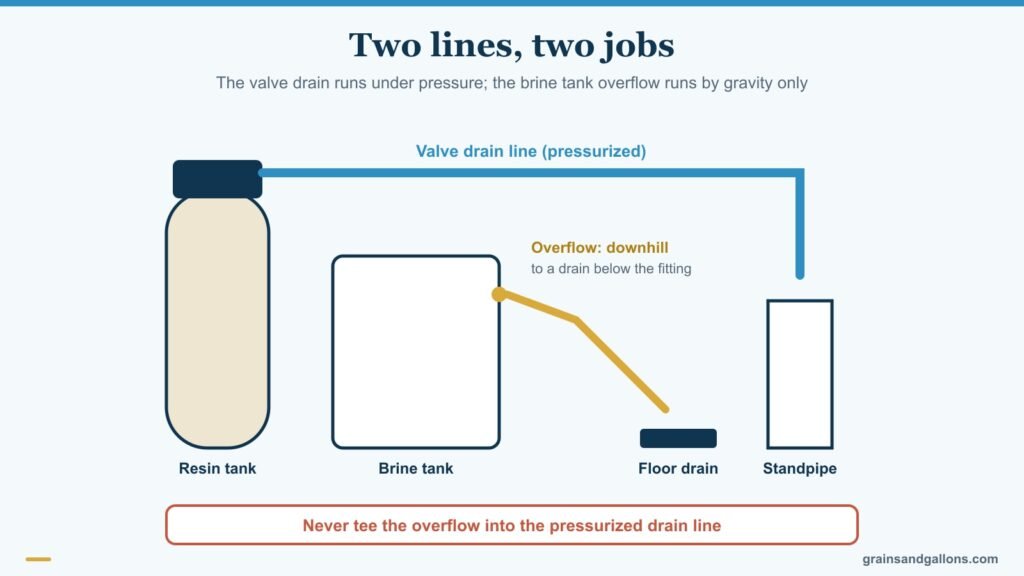
Most brine tanks have an overflow fitting on the side. That line works by gravity only, so it must run downhill to a drain below the fitting. Don't tee it into the softener's pressurized drain line, which carries water under pressure during backwash.
If the overflow can't go anywhere lower, check your manual for what the maker allows. Leaving it unconnected means you're relying entirely on the brine tank's safety float, so make sure that float works. Our guide to the best brine tank safety floats shows what a working one looks like.
FAQ
Can a water softener drain into a sump pump?
Only if your local code allows it and the sump discharges to the sanitary sewer. Most sump pumps send water outdoors to the yard or a storm drain, and many codes prohibit softener brine from going there. Check where your sump empties and ask your building department.
Can the softener and washing machine share a laundry standpipe?
Yes, with an air gap on the softener hose. The risk is both draining at once and overflowing a small standpipe. Schedule regeneration for the middle of the night, when the washer isn't running.
How much water goes down the drain during regeneration?
Penn State Extension estimates about 50 gallons per regeneration cycle. It varies with the softener's size, its backwash rate and how often it regenerates, so a softener that regenerates less often sends less water to the drain each week.
What if there's no drain anywhere near the softener?
You can move the softener closer to a drain, add a trapped standpipe, or use a pump rated to lift softener discharge. We cover those choices in water softener with no drain or outlet.
Can I run the drain line into a sewer cleanout?
No. A cleanout is a direct opening into the sewer with no trap and no air gap, so it creates a cross-connection risk. Use a floor drain, standpipe or sink with a proper air gap instead.
Use a trapped indoor drain and leave the gap open
So, where can a water softener drain? In most homes, the answer is a floor drain, laundry standpipe, utility sink or dedicated standpipe that goes to the sewer or septic system, with the hose clamped above it and an air gap of at least twice the line's diameter. Keep the brine tank overflow on its own downhill line, size the drain line for the run, and treat sump pits, storm drains and yards as off limits until your local code says otherwise. If you're putting together the parts list now, our roundup of the best water softener installation kits shows what typically comes in a kit and what you'll buy separately.