

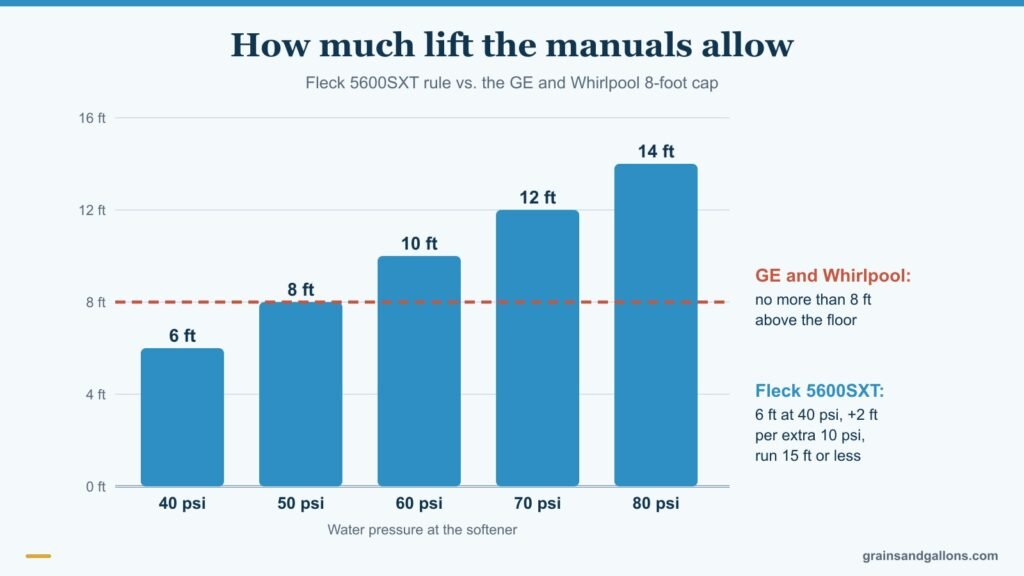
Quick Answer: Water softener drain lift height is limited by your water pressure, because line pressure is what pushes regeneration water up and out. The Fleck 5600SXT manual allows 6 feet of rise on a run of 15 feet or less at 40 psi, plus 2 feet for every extra 10 psi. GE and Whirlpool tell you not to raise the hose more than 8 feet above the floor, because the back pressure can cut brine draw. Your own manual's number is the one that counts, so measure your pressure before you plan the route.
The softener is going in the basement, and the only drain is the laundry standpipe 3 feet up the wall, a utility sink upstairs, or a line across the ceiling. Can the drain line run uphill to get there? Usually yes, within limits. This guide shows what the manuals allow, how to measure your own setup, and what to do when the drain is simply too high.
In this guide
- Why a softener drain can go uphill at all
- Lift limits in the Fleck, GE and Whirlpool manuals
- How to measure water softener drain lift height and pressure
- Signs the drain line is lifted too high
- Options when the only drain is too high
- Finish the high end with an air gap
- FAQ
- Keep the lift low and the brine draw strong
Why a softener drain can go uphill at all
During backwash and rinse, the control valve sends water through the resin bed and out the drain port under line pressure. That pressure lifts the water up and over to the drain. The brine tank overflow is different: it has no pressure behind it, so it must run downhill the whole way, and it's never joined to the valve drain line.
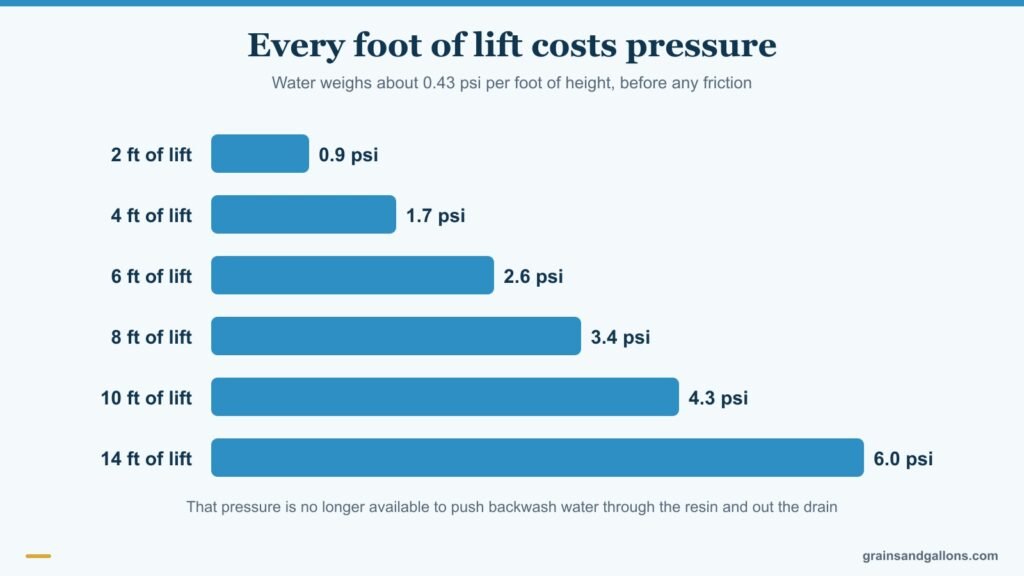
Every foot of lift costs pressure. A column of water weighs about 0.43 psi per foot of height, so 10 feet of rise needs over 4 psi just to hold the water up, before friction in the tubing and the drain line flow control are counted. When there isn't enough pressure left, two things go wrong:
- Backwash flow drops. The resin doesn't lift and clean properly, so sediment and iron stay in the bed.
- Brine draw weakens. Most softeners pull brine with an injector that relies on water flowing freely to the drain. Back pressure from a high drain line slows that flow, so less salt reaches the resin. Both the GE and Whirlpool manuals warn about exactly this.
Lift limits in the Fleck, GE and Whirlpool manuals
| Source | Lift limit | Run length | Conditions |
|---|---|---|---|
| Pentair Fleck 5600SXT system manual | Up to 6 ft | 15 ft or less | At least 40 psi at the softener; add 2 ft for each extra 10 psi |
| GE softener manual (GXSF23Z, PNSF35B) | No higher than 8 ft above the floor | Not stated | Elevating the hose may reduce brine draw |
| Whirlpool softener manual (WHES series) | Avoid more than 8 ft above the floor | Avoid runs over 30 ft | Elevated hose can cause back pressure that stops brine draw |
The Pentair 5600SXT manual also says the unit should be above and no more than 20 feet from the drain, with at least 1/2-inch drain line, and 3/4-inch if the run is longer than 20 feet. The GE owner's manual and the Whirlpool WHES manual both put the cap at 8 feet above the floor. Other brands publish their own numbers, and they vary. If your manual gives a figure, use it instead of anything here.
A worked example with the 6-foot rule
Say you have a Fleck 5600SXT in the basement and want to drain into a utility sink on the floor above.
- Static pressure at the softener: 60 psi.
- Rise needed: the sink rim is 9 feet above the softener's drain port.
- Run length: 14 feet.
Start with the base allowance of 6 feet at 40 psi. You have 20 psi more, which is two 10-psi steps, so add 2 feet twice: 6 + 4 = 10 feet of allowed lift. Nine feet fits, and the run is under 15 feet. This works on paper.
Now change one thing: your pressure is 45 psi instead of 60. You only get the base 6 feet, because the extra 5 psi doesn't reach the next 10-psi step. A 9-foot lift is over the limit, and you'd need a lower drain or another plan.
That's static pressure. If regeneration runs while someone is showering, or a well pump is near its cut-in point, pressure at the softener is lower. Leave yourself some margin.
How to measure water softener drain lift height and pressure
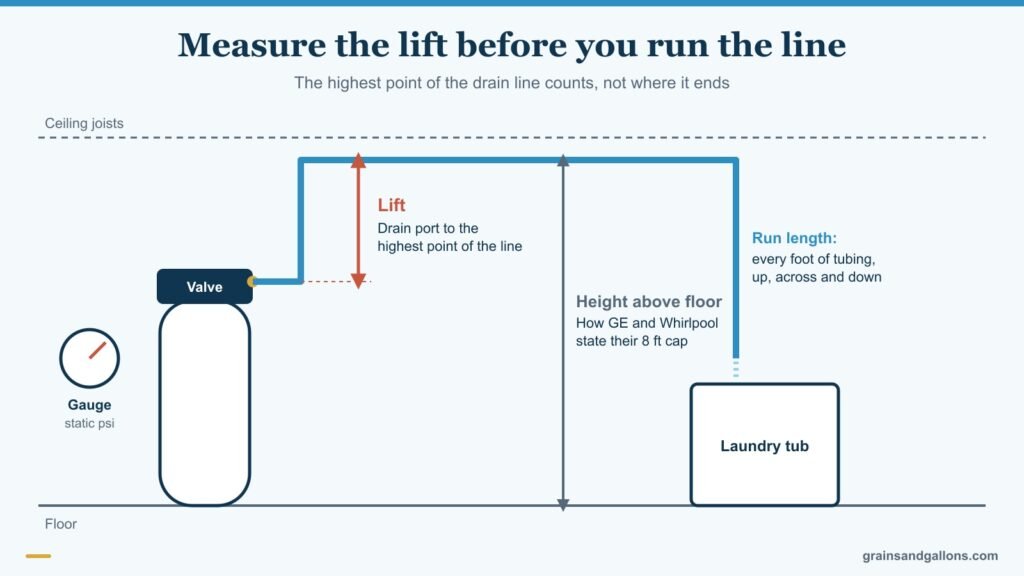
Lift is measured to the highest point of the line, not to where it ends. If the tubing climbs to the ceiling joists and then drops into a laundry tub, the climb to the joists is your lift. The Fleck rule counts from the softener's drain connection; the GE and Whirlpool caps are stated as height above the floor. Measure both and check against whichever your manual uses.
Run length is every foot of tubing: up, across and back down. Long runs add friction, which acts like extra lift.
Static pressure is easy to read with an inexpensive screw-on gauge on a hose bib, laundry faucet or the water heater drain valve, with no water running in the house. On a well, read it just after the pump shuts off and again at the moment it kicks on; plan with the lower number. Our guide to water softener pressure requirements covers the usual minimums and maximums.
Signs the drain line is lifted too high
You won't get a flood or an error message. You'll get a softener that slowly works worse:
- Hard water between regenerations, because weak brine draw leaves the resin only partly recharged.
- Salt piling up in the brine tank while usage seems low, or water left standing in the brine tank after a cycle.
- Salty taste after regeneration, when slow rinse leaves brine in the bed.
- A weak trickle at the drain end during backwash instead of a strong, steady stream.
- Gurgling or hammering in a drain line that's fighting gravity.
To check, start a manual regeneration and watch the drain end during backwash. Whirlpool's troubleshooting steps say you should see a fast flow from the drain hose at that stage. If you're seeing these symptoms on an existing install, measure the lift. Our guide on backwash not working covers the other causes to rule out, such as a plugged drain flow control.
Options when the only drain is too high
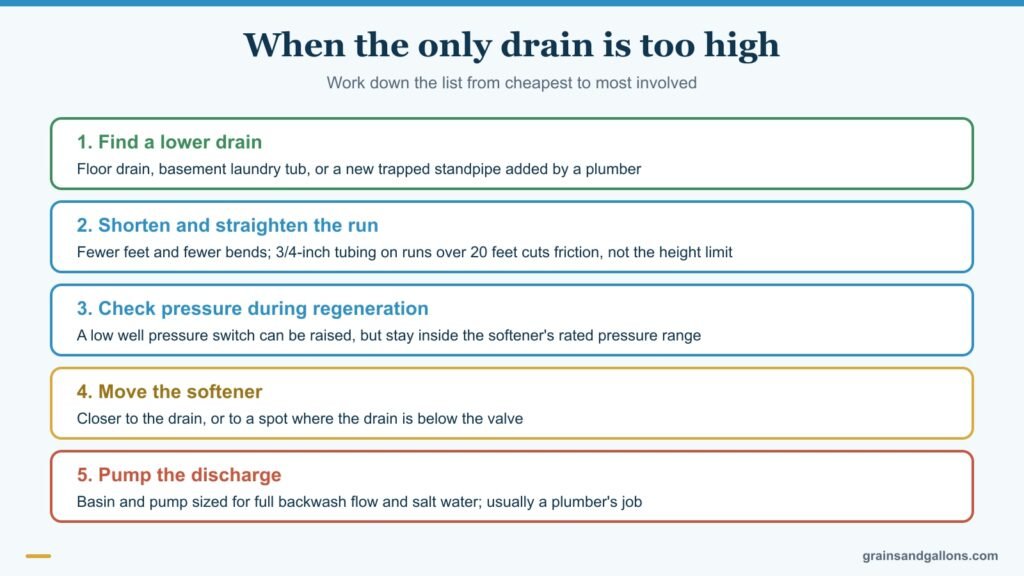
Find a lower drain. A floor drain, a basement laundry tub, or a new standpipe with its own trap closer to floor level. Our guides on where a water softener can drain and the drain line requirements cover what each connection needs.
Shorten and straighten the run. Fewer feet and fewer tight bends cut friction. Going from 1/2-inch to 3/4-inch tubing helps on long runs, as the Fleck manual requires past 20 feet. It doesn't change the height limit, but it helps you stay inside it. Our guide on how to connect water softener drain tubing covers fittings and sizes.
Raise the pressure, within reason. If a well pressure switch is set low, a modest increase may give you the margin you need, as long as the house stays within the softener's rated range.
Move the softener. Sometimes the simplest fix is putting the unit closer to the drain, so the line runs flat or downhill.
Pump it. Some installs send the discharge into a small basin with a pump, such as a laundry tray pump. The pump and basin must handle salty water and the full backwash flow rate for the whole cycle. That's usually a plumber's job, and some areas require a permit. If there's no drain at all, see installing a softener with no drain or outlet nearby.
Finish the high end with an air gap
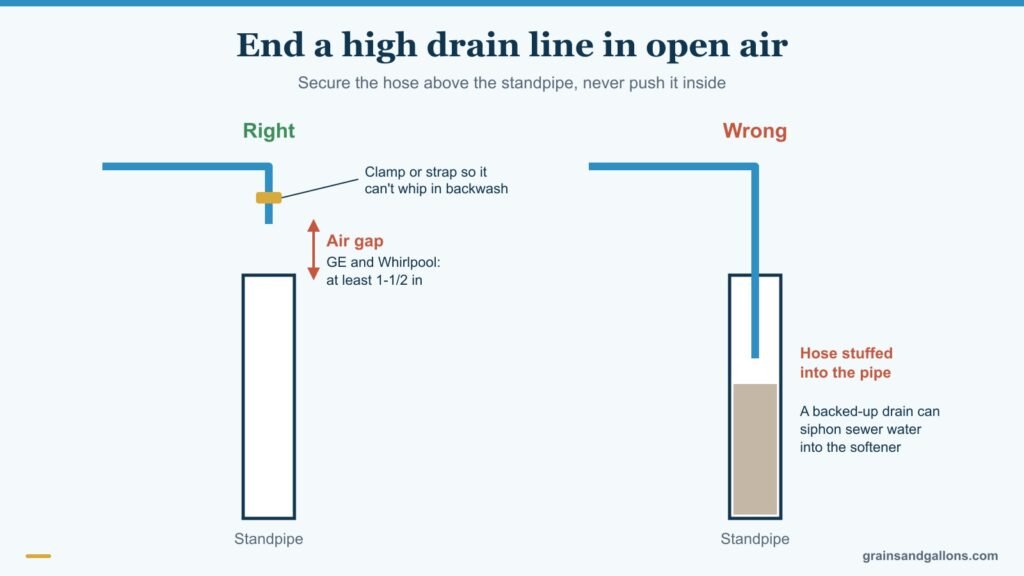
Wherever the line ends, it should end above the drain opening with open air between, not stuffed down into the pipe. GE and Whirlpool both call for an air gap of at least 1-1/2 inches so a backed-up sewer can't siphon into the softener. Local plumbing code may ask for more.
On a high standpipe, secure the hose so it can't whip out under backwash flow; the GE manual says to tie or wire it in place. When the line rises overhead and then empties into a drain below the valve, the Fleck manual calls for a 7-inch loop at the far end, with the bottom of the loop level with the drain connection, to act as a siphon trap. A purpose-made fitting holds the hose and the gap in one piece; our picks for softener drain air gap fittings include standpipe-mount models. If you're buying tubing, clamps and fittings together, our roundup of water softener installation kits shows what's typically included.
FAQ
How high can a water softener drain line go?
It depends on the model and your water pressure. The Fleck 5600SXT allows 6 feet at 40 psi with 2 more feet per extra 10 psi, on runs of 15 feet or less. GE and Whirlpool cap the hose at 8 feet above the floor. Check your manual for the exact figure.
Can a water softener drain into a laundry standpipe?
Yes, a laundry standpipe is one of the most common drain points. Keep the hose secured above the opening with an air gap, and make sure the standpipe can take the backwash flow along with the washer's discharge.
Does a higher drain line affect salt use?
Indirectly, yes. Back pressure from a high or long drain line can reduce brine draw, so the resin gets less salt than it should. The softener may then run out of capacity early, and hard water shows up before the next regeneration.
How long can a softener drain line be?
Whirlpool says to avoid runs longer than 30 feet. The Fleck rule assumes 15 feet or less when the line is elevated, and Fleck and Clack both call for 3/4-inch line once the run passes 20 feet. Shorter is always better.
Can I use a pump for a softener drain?
Yes. A laundry tray pump or similar basin pump can lift softener discharge to a high drain, as long as it's rated for the flow and salty water. Check local code, since some areas require a permit or a plumber for pumped drains.
Keep the lift low and the brine draw strong
Water softener drain lift height comes down to pressure: enough left over at the drain end to backwash the resin and pull a full dose of brine. Measure your static pressure, measure the rise to the highest point of the line, and compare both with your manual. If you're close to the limit, find a lower drain or shorten the run instead of hoping it works. The softener will regenerate fully, and you won't be chasing hard water a few months later.