


Quick Answer: To troubleshoot a water softener backwash not working, start a manual regeneration and watch the end of the drain line. Almost nothing coming out usually means a clogged drain line flow control or a kinked, frozen or overlong drain hose; clean the flow control washer and straighten the hose. If water flows but the valve never enters backwash, or never leaves it, look at the motor, piston and backwash time setting instead.
Backwash is the step that lifts and loosens the resin bed and flushes out sediment. It happens out of sight, so most people only find out it's failing when the water turns hard, the softener leaks at the drain, or the resin packs solid. One manual regeneration, a bucket and a timer tell you most of what you need.
In this guide
What backwash is supposed to do
During service, water flows down through the resin. During backwash, the valve reverses the flow: water goes down the center distributor tube, back up through the bed and out the drain. That upward flow fluffs the resin, carries off silt and fines, and resets the bed so water won't channel through it.
The flow rate is set by a small part called the drain line flow control (DLFC), usually a rubber washer with a sized hole. Too little flow and the bed doesn't lift. Too much and resin washes out the drain. The Fleck 5600SXT parts list, for example, offers flow washers from 0.6 to 6.0 gpm, because the right one depends on tank diameter. Pentair's 5600SXT system specs pair them like this: a 9 x 48 inch tank (1.0 cu ft of resin) runs a 2.0 gpm washer, a 10 x 54 inch tank (1.5 cu ft) runs 2.4 gpm, and a 12 x 52 inch tank (2.0 cu ft) runs 3.5 gpm. If you ever swap the head, for example with one of the best replacement control valves, size the flow control for your tank, not just whatever ships in the box.
Run a manual backwash and read the drain
Step 1: Start a manual regeneration
On a Fleck 5600SXT, the Pentair service manual says to hold the Extra Cycle button for five seconds. On a Clack control, the Clack reference guide says to press and hold REGEN until the valve motor starts, typically about 3 seconds; some older three-button Clack controls use the up and down arrows instead. Other brands vary.
What you should see: the motor runs briefly, the display shows backwash or a BW code, and within seconds water runs from the drain line. Pentair's start-up procedure has you check that drain flow stays steady for 10 minutes or until the water runs clear.
Display changes but nothing moves: the motor isn't turning the valve. Listen for a hum or click.
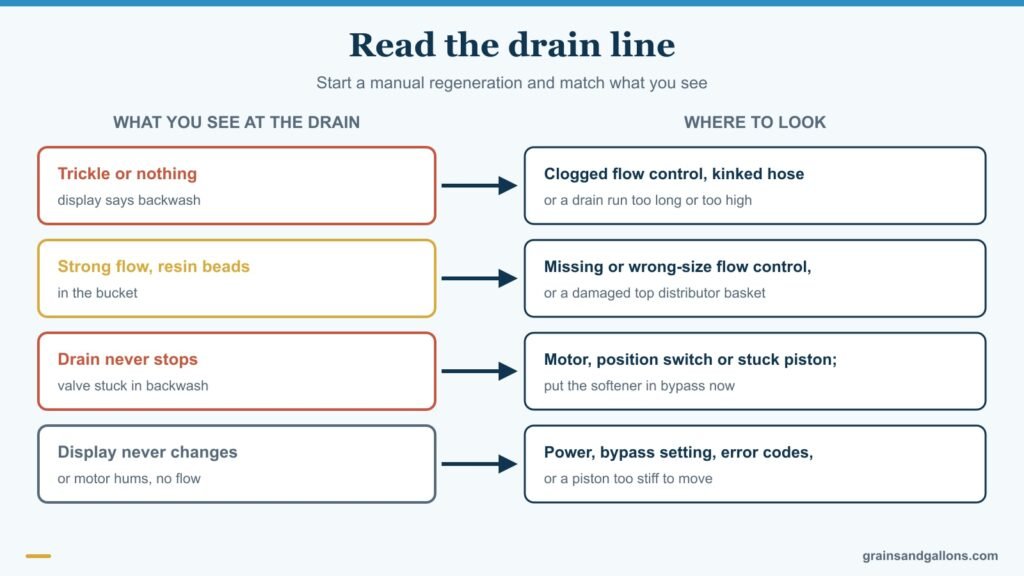
Nothing changes at all: check power, whether the unit is in bypass, and any error on the display.
Step 2: Measure drain flow

Put the drain end into a 5-gallon bucket and time how long it takes to reach a known mark. Gallons divided by minutes gives gpm. Compare that with the flow control rating for your tank, which is often stamped on the washer or listed on a sticker or in your manual.
- About right: backwash flow is fine. If problems continue, look at resin condition and backwash time.
- Much lower, or a trickle: something is restricting it. Work through the next section.
- Higher than expected, with resin beads in the bucket: the flow control may be missing or the wrong size, or the distributor basket at the top may be broken.
Step 3: Watch the color, then the hand-off
Backwash water often starts cloudy, rusty or gritty, then clears. That's backwash doing its job. Water that stays dirty the whole time points to heavy sediment or iron, a backwash time that's too short, or a need for pre-filtration. When the backwash time runs out, the valve should advance to brine draw. If it sits in backwash and the drain keeps running, put it in bypass to stop wasting water.
When water softener backwash flow is weak

Check these in order, from the valve outward:
- Clogged flow control. Iron, scale and sediment build up on the washer and cut flow a little more every month. Bypass the softener, relieve pressure, remove the drain fitting and clean the washer. Don't enlarge the hole. Our walkthrough of a clogged drain line flow control shows the steps.
- Kinked or crushed drain hose. Run your hand along the whole length. Hoses behind the water heater or under shelving get pinched.
- Drain line too long, too high or too small. The 5600SXT manual calls for a 1/2-inch residential drain line at minimum, and a 3/4-inch line when backwash flow exceeds 7 gpm or the run is longer than 20 feet. Our guide to drain line requirements covers the usual limits.
- Frozen line. A drain run through a garage or outside can freeze in winter.
- Low house pressure or a weak well pump. Backwash needs steady flow; if the pump can't keep up, pressure sags and drain flow falls. Our article on well pump flow and backwashing has a bucket test for your pump. After any plumbing work, also confirm the inlet, outlet and bypass valves are fully open.
If the valve won't go into backwash, or won't leave it

This is a mechanical or programming problem inside the control valve.
- A stuck piston. Scale or iron can freeze the piston in one position, so the motor strains or stalls. Some valves throw an error code when the piston doesn't reach a position in time. Our guide to a stuck piston covers removing and cleaning it.
- Worn seals and spacers. Water leaks between ports, so backwash flow drops even with the piston in the right place.
- A motor or position switch fault. If the motor doesn't turn, or turns and never stops, check the motor, switch and wiring before replacing the whole valve.
- Backwash time set to zero. The 5600SXT manual says each cycle step can be set from 0 to 199 minutes, and a step set to 0 is skipped. After a reset or programming mistake, backwash may simply not run. Check the BW setting against what your installer or seller supplied.
Always put the softener in bypass, unplug it and relieve pressure before opening the valve.
Signs backwash has been failing for weeks
- Hard water even though the softener regenerates on schedule.
- A pressure drop through the softener.
- Packed, clumped or silty resin when you open the tank.
- Discolored water during regeneration that lasts longer than it used to.
If sediment or iron is the root cause, a cleaner backwash only gets you part of the way. A spin-down sediment filter ahead of the softener takes a big load off the resin and the valve.
A water softener backwash not working is usually a drain problem
Most of the time, a water softener backwash not working comes down to the drain side: a scaled flow control washer, a pinched or frozen hose, or a run that's too long or too high. Those are cheap fixes, so rule them out with a bucket test before you touch the valve. If the valve won't enter or leave backwash, check the backwash time setting, then the piston, seals and motor. When several of those need work, or parts are hard to find for an older head, replacing the control valve is often the more sensible repair; match the tank thread and distributor tube and size the flow control for your tank.
FAQ
Why is there no water coming out of my softener drain during backwash?
Usually a clogged drain line flow control washer or a kinked, frozen or blocked drain hose. If the display shows backwash but the motor never moved the valve, the motor or piston is the problem instead.
How long should a water softener backwash last?
It depends on the valve and how it's programmed; each cycle step has its own time setting. Pentair's 5600SXT start-up check runs backwash until drain flow is steady for 10 minutes or the water runs clear. Use the times your installer or manual lists for your tank.
Can I clean the drain line flow control myself?
Yes. Bypass the softener, relieve pressure, remove the drain fitting and clean scale and grit off the washer. Don't drill out the hole, because that changes the backwash rate and can wash resin out.
What happens if a water softener stops backwashing?
Sediment and fines stay in the resin, the bed packs and channels, softening capacity drops and pressure through the unit falls. Over time you get hard water even though the softener still regenerates.
Why is my water softener stuck in backwash?
The control isn't advancing, usually because of a stuck piston, a failed motor or position switch, or a programming error. Put the unit in bypass to stop the drain, then check the motor and piston.