


Quick Answer: With a water softener piston stuck, unplug the valve, put the softener in bypass and relieve the pressure, then pull the piston (and on most valves, the seal and spacer stack) and inspect it. A light iron or scale film cleans off with dilute sodium bisulfite or vinegar. Swollen seals, scoring or heavy crust mean new parts, usually as a kit like this Fleck 5600 rebuild kit. Use only silicone lubricant when you reassemble.
Disclosure: As an Amazon Associate, Grains & Gallons earns from qualifying purchases.
The piston does the switching inside a softener valve. It slides through a stack of seals, and its position decides whether water goes through the resin to your house, backward to the drain, or through the brine injector. When a water softener piston is stuck, the whole softener stops mid-cycle with it.
In this guide
Is your water softener piston stuck? Check these signs
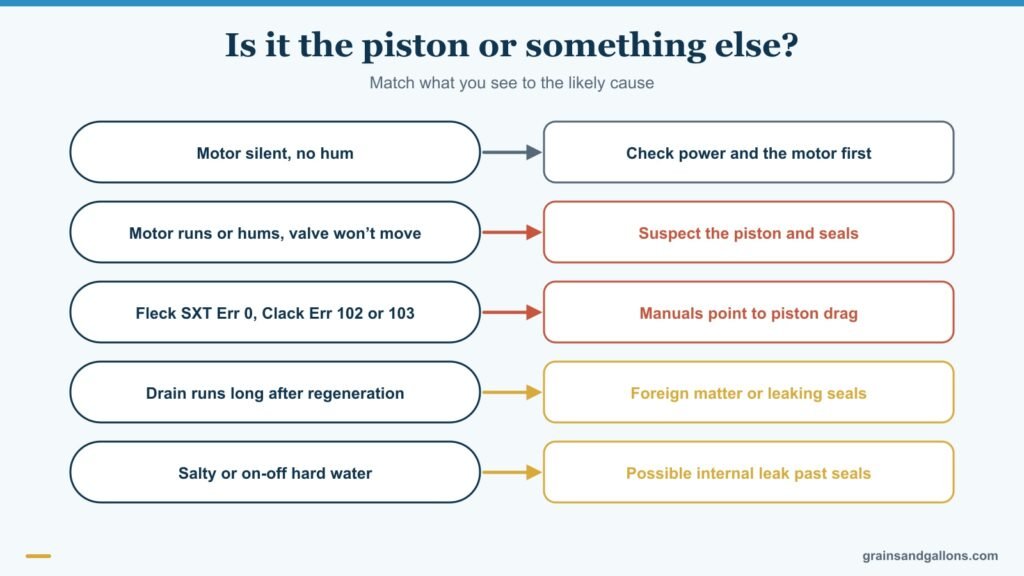
- The motor runs or hums but the valve doesn't move.
- A position error. On a Fleck 5600SXT, Err 0 means the drive took longer than six minutes to reach the next position, and the Pentair 5600SXT manual tells you to verify the piston travels freely. On a Clack WS1, Err 102 (stalled) lists foreign material and mechanical binding, and Err 103 (ran too long) lists "foreign matter built up on piston and stack assemblies creating friction and drag."
- Water runs to the drain continuously. Pentair lists foreign material in the control and an internal leak, with the fix of inspecting the bore or replacing seals and piston.
- Salty or on-and-off hard water with no other obvious cause, which can mean water slipping past worn seals.
If the motor is completely silent, check it first with our guide to a motor that won't turn. For code details, see Fleck 5600SXT error codes or Clack WS1 error codes.
Why softener pistons jam
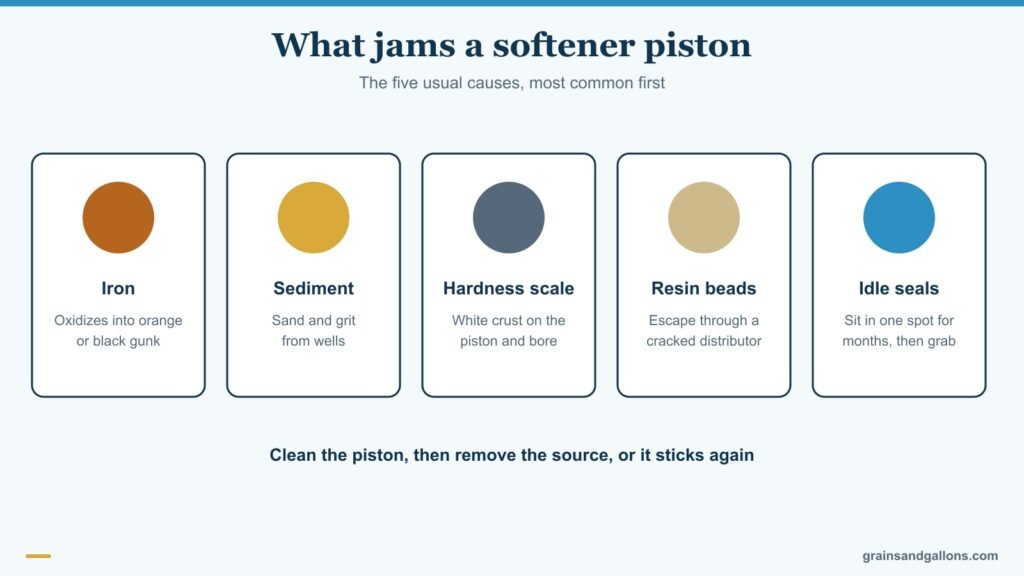
Iron is the big one: clear-water iron oxidizes inside the valve into orange or black gunk. Well sediment comes next, then hardness scale, then resin beads escaping through a cracked distributor (if you see beads at the drain, read resin beads in the drain line). Seals that sit in one position for months can also swell and grab, which is common in seasonal homes.
Pull the piston on a Fleck 5600SXT
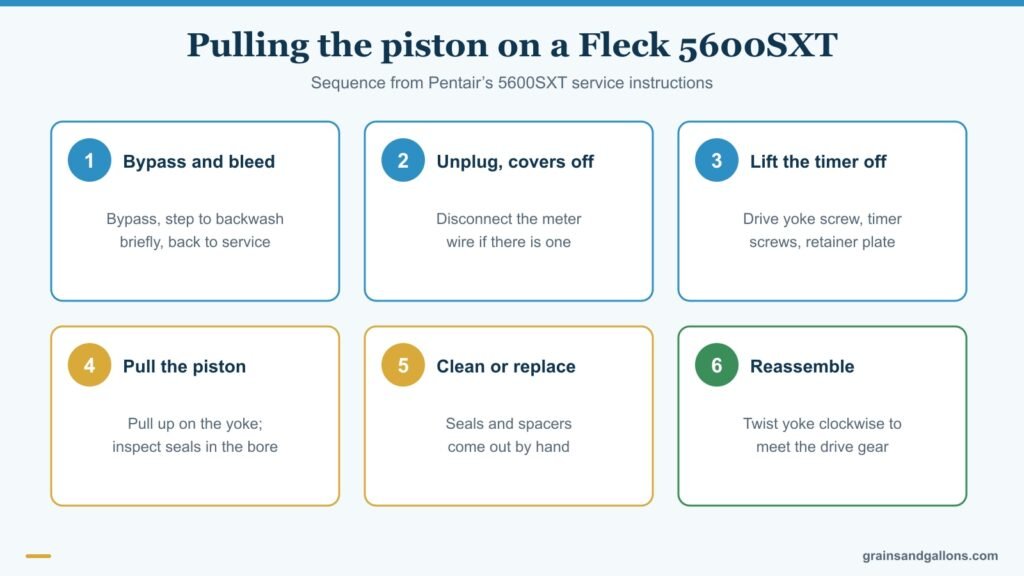
Pentair's service steps:
- Turn off the water. Put an integral bypass in bypass, then relieve pressure by stepping the control into backwash briefly and back to service. Unplug the valve.
- Remove the back and front covers and disconnect the meter signal wire.
- Remove the drive yoke screw and washer and the timer mounting screws. The timer lifts off. Remove the end plug retainer plate.
- Pull upward on the piston yoke until the assembly is out. Look into the bore to check that all seals and spacers are in place with no debris.
- Clean or replace. A clean piston is smooth and shiny; run a fingernail along it, and if it catches, it's scored. Seals and spacers can be replaced at this point; the 5600SXT parts list calls for piston kit 60102-71 and seal and spacer kit 60125.
- Reassemble. Push the piston in by the end plug, twist the yoke clockwise to align with the drive gear, refit the plate and timer, and make sure the drive pin engages the yoke slot.
Pentair says not to use petroleum-based lubricants such as Vaseline and to use only 100% silicone. A silicone compound like Molykote 111 is a common choice for the O-rings.
Pull the piston and stack on a Clack WS1
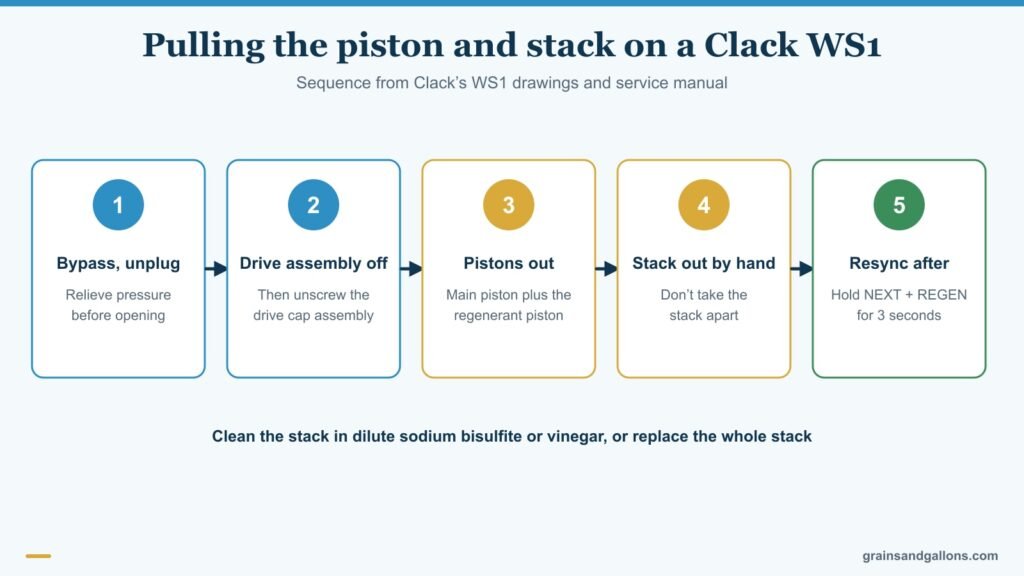
Clack's WS1 service manual uses a screw-driven piston and a one-piece spacer stack:
- Bypass, relieve pressure and unplug.
- Remove the drive assembly, then the drive cap assembly.
- Remove the main piston and the regenerant piston (backwash-only filters don't use one).
- Pull the spacer stack out by thumb and forefinger. Don't take it apart. Inspect the black O-rings and clear lip seals, and replace the whole stack if they're worn.
- Clean the stack in dilute sodium bisulfite or vinegar, or wipe it with a soft cloth. Push it back in by hand.
Afterward, Clack says to hold NEXT and REGEN for 3 seconds to resynchronize the board with the piston position. Use only silicone-based lubricant, never Vaseline, oils or spray silicone, and don't lubricate the drive gears.
Clean the piston or replace it?
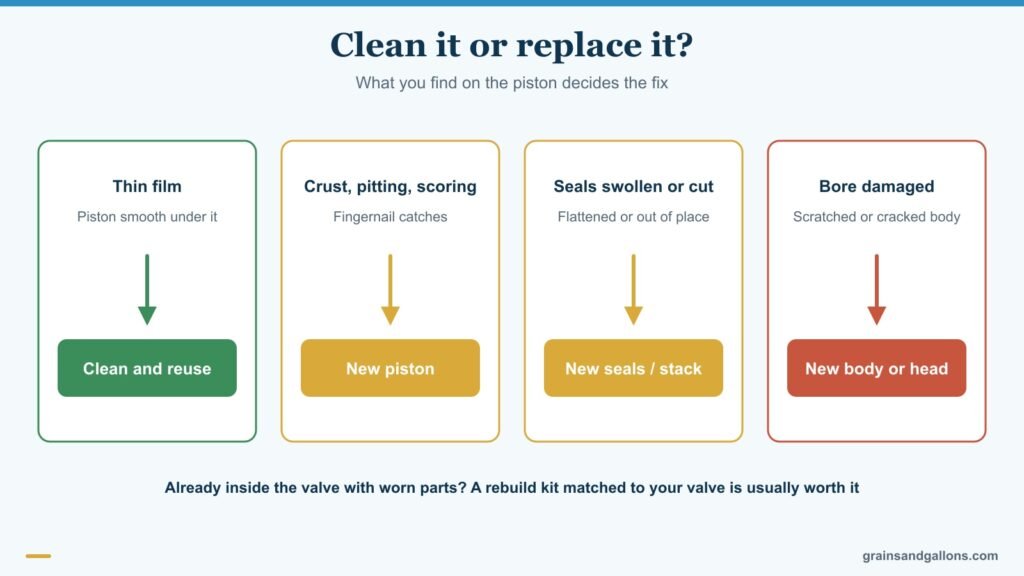
| What you find | Do this |
|---|---|
| Thin film, piston smooth underneath | Clean, rinse well and reuse |
| Heavy crust, pitting or scoring | Replace the piston |
| Seals swollen, cut, flattened or out of place | Replace seals and spacers (Fleck) or the stack (Clack) |
| Valve body bore scratched or cracked | Replace the body or the whole head |
If you're already inside the valve, a full kit usually makes sense. Pistons differ between models and between softener and filter versions, so match the kit to your valve: this 5600SXT rebuild kit or this 2510 rebuild kit. If the body is cracked or parts are hard to find, see our best replacement control valves.
Free the piston, then remove what jammed it
A water softener piston stuck by iron, grit or tired seals usually comes free with an hour's work: pull it, clean or replace it and the seals, lubricate only with silicone and resync the valve. Then deal with the cause. A spin-down sediment filter keeps grit out, a regular resin and iron cleaner keeps iron from building up, and a manual regeneration after a long absence moves the piston through its full stroke. For everything else in the head, see servicing a softener control valve. If the valve is under a dealer warranty, call the dealer first.
FAQ
Can I free a stuck softener piston without taking the valve apart?
Sometimes a manual regeneration or a power reset gets it moving again, but if debris or swollen seals caused the jam, it will stick again. Pulling the piston to inspect and clean it is the real fix.
What should I clean a softener piston with?
Clack's manual allows dilute sodium bisulfite or vinegar, or a soft cloth. Rinse well before reassembly. Avoid abrasives that scratch the piston, and use only silicone lubricant on O-rings.
How often do softener pistons and seals need replacing?
There's no fixed schedule. They wear faster with iron, sediment and frequent regeneration. Replace them whenever you find scoring, swollen seals or recurring position errors.
Can I use Vaseline on a softener piston?
No. Pentair warns against petroleum lubricants such as Vaseline, and Clack says hydrocarbons damage parts with O-rings or plastic. Use a 100% silicone lubricant.