


Quick Answer: Servicing a water softener control valve starts with the cheap part: clean the injector and its screen. If water still trickles to the drain when the softener isn't regenerating, or it won't draw brine, replace the seals, spacers and piston. On a Fleck 5600SXT, a kit like this 5600SXT rebuild kit (piston, seals and spacers, brine valve) covers it; match the piston part number to your valve first.
Disclosure: As an Amazon Associate, Grains & Gallons earns from qualifying purchases.
Water running to the drain at 3 a.m., a brine tank that keeps filling, or hard water despite plenty of salt: servicing a water softener control valve fixes most of these with a few wear parts. The steps below use the Fleck 5600SXT and come from Pentair's 5600SXT downflow service manual. For what each part does during regeneration, see how a water softener control valve works.
In this guide
Which symptom points to which part?

- Won't draw brine, or brine tank overfilling. Fleck's troubleshooting table points to a plugged injector, injector screen or drain line flow control first. Our guide on how to clean a water softener injector walks through it. Still no draw? An internal leak (seals, spacers, piston) is next.
- Constant flow to the drain. Fleck lists a valve that isn't programmed or positioned correctly, foreign material in the control, or an internal leak. Check program and cycle position first; see also brine draining constantly through the drain line.
- Stuck valve or straining motor. Often debris or a worn piston binding in the seals; see stuck piston in the control valve.
- Low pressure through the softener. The manual lists iron buildup and an inlet plugged by debris "broken loose from pipes by recent work." Clean the control, use a resin cleaner, and consider a sediment prefilter before a softener.
Shut off, depressurize and unplug first
- Put the bypass in Bypass or close the inlet and outlet valves.
- Relieve pressure: step the control briefly into Backwash, then back to In Service.
- Unplug the power cord.
- Have a towel, a bucket and silicone lubricant ready. Both Fleck and Clack call for silicone only; Clack's manual warns that hydrocarbon lubricants damage O-rings and plastic parts.
Clean the injector and swap the brine valve

On the 5600SXT, both live in the injector body on the side of the valve.
- Disconnect the brine tube and drain line, remove the two injector body screws and lift the assembly out. Discard the old O-rings.
- Injector: remove the cap and screen, unscrew the nozzle and throat, then clean or replace them and fit a new screen. Use a toothpick, not a metal pick; enlarging the nozzle changes brine draw.
- Brine valve: pull it out, replace the O-ring at the bottom of the hole, lubricate, and press the new valve in until the bushing shoulder sits flush with the body.
- Reassemble with new lubricated O-rings on the cap and the three bosses, refit the screws, and reconnect both lines.
Rebuild the Fleck 5600SXT seals, spacers and piston
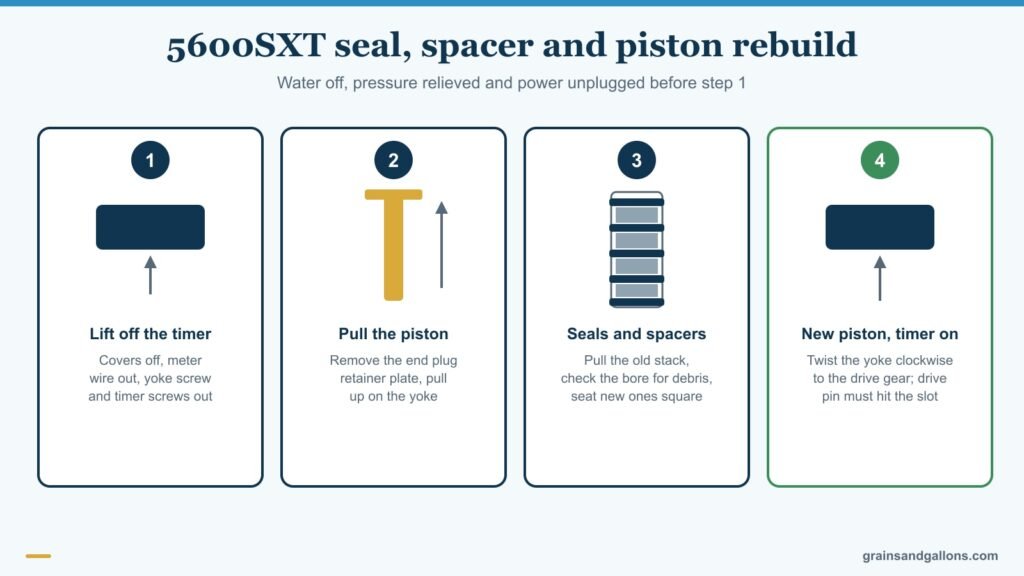
- Remove both covers, disconnect the meter signal wire and feed it back through the control.
- Remove the drive yoke screw and the timer screws and lift off the timer, then the end plug retainer plate.
- Pull up on the piston yoke to draw out the piston.
- Remove the seals and spacers. Inspect the bore for missing pieces and debris. A seal puller or bent wire hook helps with stuck seals; don't scratch the bore.
- Install the new seals and spacers, lightly lubricated, each pushed in square.
- Push in the new piston, twist the yoke clockwise to align it with the drive gear, and refit the retainer plate.
- Refit the timer so the drive pin engages the yoke slot, then the screws, wire and covers.
Match part numbers. Pistons differ between 5600 versions and between softener and filter valves. Check the number on your old piston or in the manual's parts list.
Put the softener back in service and test it
Open the bypass slowly so air bleeds out, check every seal for leaks (including the drain in Backwash), plug in, confirm time and program, and run a regeneration. Test hardness at a cold tap a few hours later.
Servicing a water softener control valve beats replacing it, most of the time
Fleck 2510: same idea, larger valve; a Fleck 2510 rebuild kit includes piston, seals and spacers and brine piston.
Clack WS1: the piston and spacer stack come out as assemblies under the drive cap (the WS1 service manual lists the V3005-02 spacer stack, V3011 downflow piston and V3174 regenerant piston). The Clack WS1 interior rebuild kit with wrench includes the cap wrench.
Servicing a water softener control valve stops making sense when the body is cracked, the board is failing too, or an old proprietary (big-box) head needs discontinued parts. On a standard tank thread, a replacement Fleck or Clack head fits your existing tank, and our best Fleck valve water softeners keep you on an easy-to-service valve. Call a plumber if the valve can't come off without cutting pipe.
FAQ
How often should softener valve seals and spacers be replaced?
There's no fixed schedule; replace them when symptoms such as constant drain flow appear. Sediment and iron wear them faster.
Can I use plumber's grease on softener O-rings?
No. Fleck and Clack both specify silicone lubricant. Petroleum-based grease can swell and damage O-rings and plastic parts.
Should I replace the piston when I replace the seals?
Usually, yes. A scored or worn piston wears new seals quickly, and rebuild kits pair them.
Why is my softener still running to the drain after a rebuild?
Check the program and cycle position, that no seal or spacer is missing or crooked, and that the drive pin engaged the yoke slot.