


Quick Answer: Here is how to clean a water softener injector: bypass the softener and relieve pressure, open the injector cap (on the side of the valve on Fleck and Clack, under the top cover on cabinet units), and remove the screen and injector or "nozzle and venturi." Soak them in warm soapy water or white vinegar, clear the holes with a soft brush or compressed air (never a pin), grease the O-ring, reassemble hand-tight, and run a regeneration to confirm the brine tank level drops.
The injector is the small plastic part that lets your softener pull brine out of the tank. Water rushes through a narrow nozzle, then into a slightly wider throat. That jump creates suction (the venturi effect) that draws brine up the brine line. When grit, iron or salt sludge partly plugs it, there's no suction, no brine reaches the resin and the softener stops softening even though it still "regenerates."
In this guide
Is the injector really the problem?
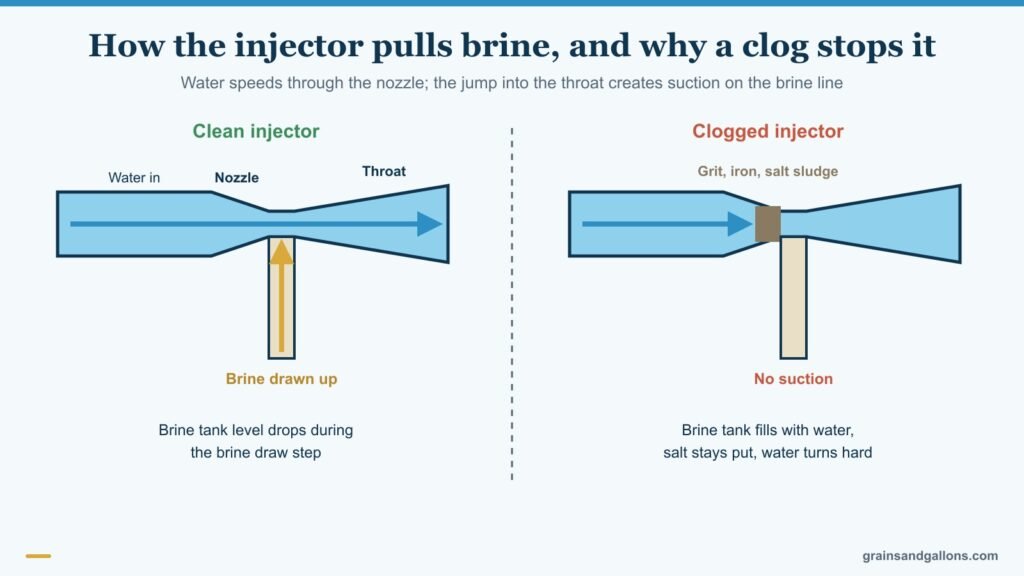
A clogged injector usually shows up as some combination of these:
- The brine tank fills with water and the level keeps rising after each regeneration.
- Salt isn't going down, even though the softener runs its cycles.
- Hard water.
- The brine draw step does nothing. During a manual regeneration, the brine tank level doesn't drop.
Other faults look the same: a salt bridge, an air leak in the brine line, low water pressure (Pentair's Fleck troubleshooting chart says to raise line pressure to 20 psi when it's too low), a plugged drain line flow control, or a stuck brine valve. If you're not sure, a brine tank full of water or overflowing walks through the full elimination order. If you hear sucking or see bubbles in the brine line, check for a brine line air leak first.
Prep and tools for any valve
- Put the softener in bypass.
- Make sure the valve is in service, not mid-regeneration.
- Relieve remaining pressure. Briefly advance into backwash with the water bypassed, or open a softened tap. Follow your manual.
- Have towels ready and take photos of each part's orientation.
Tools: a soft brush, small screwdriver, white vinegar, silicone grease and a flashlight.
How to clean a water softener injector on Clack, Fleck and cabinet valves

Cleaning is the same everywhere: soak, brush, rinse, blow out. Access is what changes.
Clack WS1: injector cap on the side
Per the Clack WS1 drawings and service manual:
- Unscrew the injector cap (Clack's plastic wrench or pliers if it's tight). The screen comes off with it; clean it if fouled.
- Pry out the injector, and the plug in the other hole, with a small screwdriver.
- Clean the injector with vinegar or sodium bisulfite and blow the holes out with air. Clack warns that sharp objects can score the plastic, and that "increasing the diameter of the hole could change the operating parameters of the injector."
- For a downflow softener, the injector goes back in the "DN" hole and the plug in the "UP" hole. Push them firmly in, replace the screen, and hand-tighten the cap.
Injectors are color-coded by size; match the color if you replace one.
Fleck 5600: nozzle and throat in the injector body
On a Fleck 5600 the injector body sits on the side of the valve where the brine line connects. The Fleck 5600SXT service manual covers it under "Replacing Brine Valve, Injectors and Screen":
- Bypass the softener and relieve pressure by stepping the control into backwash for a moment, then back to service. Unplug the valve.
- Disconnect the brine tube and drain line at the injector body, then remove the two mounting screws.
- Remove the injector cap and screen, then unscrew the nozzle and throat.
- Soak them in vinegar, rinse, blow out, and screw them back in snugly. Fit a clean screen and a lightly greased O-ring, reassemble, and check every seal for leaks.
Nozzle and throat are sized to the tank diameter, so match them on replacement.
Whirlpool and GE cabinet units: the nozzle and venturi
All-in-one softeners from Whirlpool, GE and similar brands put the injector under the top cover and call it the nozzle and venturi. Following Whirlpool's WHES18 and GE's GXSF40H manuals:
- Remove the top cover, bypass the softener, and confirm it's in service with no pressure at the nozzle and venturi.
- Unscrew the cap (keep the O-ring), then lift out the screen, the nozzle and venturi disc, gasket and any flow plugs.
- Wash the parts in warm, soapy water with a small brush, without scratching or bending them.
- Reassemble in order; GE notes the gasket's small holes must line up with the housing. Grease the O-ring, hand-tighten the cap, and return to service.
If a soft brush won't clear the orifice, WaterBoss's troubleshooting chart suggests a wooden toothpick on the nozzle and throat.
Prove the fix with a brine draw test
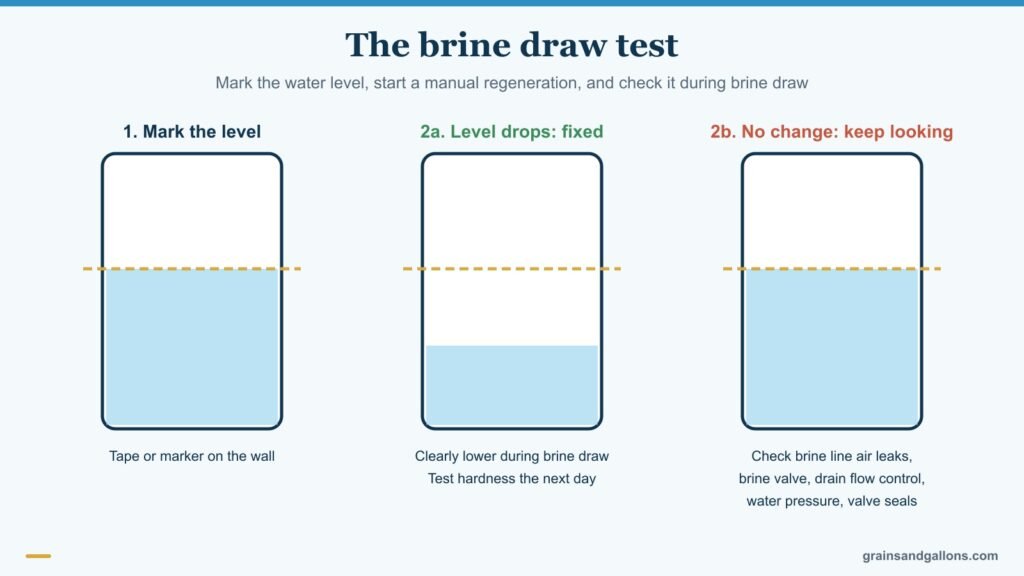
- Mark the water level in the brine tank.
- Start a manual regeneration. After 15 to 20 minutes of brine draw, the level should be clearly lower.
- Let the cycle finish and test hardness a day later.
If the level still doesn't move, the clog may be in the brine line, brine valve or float, or the valve's seals and spacers may be worn. Servicing a water softener control valve covers the next steps. If the valve body is cracked or parts are discontinued, the best replacement water softener control valves can save you from buying a whole new system.
What keeps clogging it
- Sediment from a well. Grit settles in the passages. A prefilter catches it; see the best spin-down sediment filters.
- Dirty salt. Rock salt carries insoluble material that gets pulled through the injector. Switch to high-purity pellets.
- Iron. Iron deposits in the injector and screen; use resin cleaner per your manual.
- Brine tank sludge. A dirty tank feeds a dirty injector. Here's how to clean a water softener brine tank.
FAQ
How often should a water softener injector be cleaned?
There's no fixed interval. Check it whenever the brine tank stops draining, and during annual service if you have well water, iron or rock salt. On clean city water it can go years.
Can I use vinegar to clean a softener injector?
Yes. Clack's manual lists vinegar or sodium bisulfite for cleaning its injector. Rinse well and never mix vinegar with bleach.
Can I poke out a clogged injector with a paper clip?
No. Metal scratches or widens the orifice, and Clack warns that a bigger hole changes how the injector performs. Use a soft brush, compressed air or a wooden toothpick.
Why is my brine tank still full after cleaning the injector?
Check for a brine line air leak, a stuck brine valve or float, a plugged drain line flow control, low pressure or worn valve seals.
Do I need to replace the injector instead of cleaning it?
Replace it if the plastic is cracked, the orifice is scored or enlarged, or a clean injector still won't draw.
A soft brush and a brine test finish the job
That's how to clean a water softener injector without making it worse: bypass and depressurize, take the parts out in order, soak and brush them without metal tools, then prove the fix by watching the brine tank level drop.