


Quick Answer: A brine line air leak shows up as a steady stream of bubbles in the clear brine tubing during the brine draw while the tank still has water in it. Usually it's the compression nut at the control valve: bypass the softener, cut a fresh square end on the tube, make sure the plastic insert is inside it, and retighten by hand plus a gentle snug. If every fitting is tight, the air check or brine valve in the brine well is cracked or stuck open.
Disclosure: As an Amazon Associate, Grains & Gallons earns from qualifying purchases.
A brine line air leak is one of the sneakiest reasons a water softener stops softening. The injector in the control valve uses water rushing past a nozzle (a venturi) to create suction, and that suction pulls brine up the tubing like a drinking straw. Poke a hole in the straw and you get air instead. The regeneration still runs and the display looks happy, but almost no brine reaches the resin, and within days the water goes hard.
In this guide
Why a pinhole is enough to stop the brine draw
Air flows far more easily than brine through a gap, so even a small opening lets the suction short-circuit through the leak instead of lifting liquid from the tank. Inspectapedia's softener troubleshooting notes that a small leak can also let brine drain back to the tank and put air into the valve.
There's a second effect. The softener still refills the brine tank after every regeneration, so if the draw fails, refill water piles on top of brine that was never used and the level creeps higher each cycle.
Signs you have a brine line air leak
- Salt level barely drops over weeks.
- Brine tank water level stays high, or creeps up after each refill.
- Hard water even though the softener regenerates on schedule.
- Gurgling or sputtering from the valve during regeneration. Our guide to brine tank gurgling covers which noises are normal.
- Air spitting from faucets after a regeneration.
A clogged injector or a clogged brine line looks similar, so watch the draw to be sure.
The 15-minute brine draw test

- Make sure the brine tank has water in it. A dry tank shows nothing.
- Start a manual regeneration and advance to brine draw (backwash usually runs first). Our guide to manually regenerating a water softener covers the common valves.
- Watch the tubing near the valve. A healthy draw is a solid column of liquid.
- Look for air bubbles in the brine line. A steady train while the tank still has water is the sign; where they start is your leak.
- Check the brine tank level. It should drop steadily.
A few bubbles at the very end of the draw are normal as the air check closes. No bubbles and no level drop means a suction problem, not air: Fleck's 5600SXT service manual lists a plugged injector or screen, a plugged drain line flow control and line pressure below 20 psi as causes of no brine draw.
Four leak points, from valve to tank
1. The compression fitting on the control valve
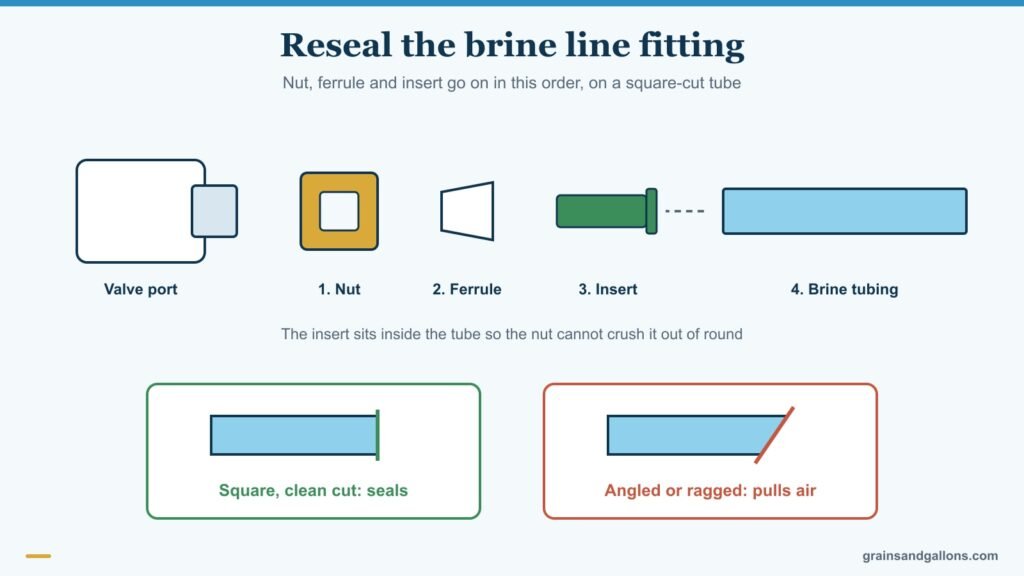
The most common leak point. The line seals with a nut, a plastic ferrule and a tube insert, a small sleeve inside the tubing that stops the nut crushing it (Fleck lists it as a separate 3/8-inch part). Without it the tube squashes and leaks.
To reseal:
- Put the softener in bypass and unplug it.
- Loosen the nut and pull the tube out.
- Cut the end off cleanly and square, about half an inch back, with a sharp utility knife or tube cutter. An angled or ragged end leaks.
- Slide on the nut, then the ferrule, and push the insert into the tube.
- Push the tube fully into the fitting and tighten the nut by hand, then a gentle snug. Plastic nuts crack if forced.
A thin film of food-grade silicone grease on the ferrule helps it seal. Skip thread tape: the ferrule makes the seal, not the threads.
2. The brine tubing itself
Old poly tubing gets brittle near heat or sunlight, and a tight kink can crack it. Look along the full length for whitish stress marks or splits. Replacement tubing is cheap; match the outside diameter (3/8" is common, but check yours).
3. The brine valve fitting in the brine well
The other end connects to the float assembly inside the brine well with the same nut, ferrule and insert. Lift the assembly out and check it the same way.
4. A cracked or stuck air check valve
The air check at the bottom of the float assembly lets brine flow up and closes before air gets sucked in. If its body is cracked or the check ball sticks open, the system pulls air early. It's often part of the safety float assembly, so the fix is replacing the whole assembly. A Fleck 2310 safety brine valve is a common replacement on Fleck-valve systems; confirm the part number in your manual first. Our roundup of the best replacement brine tank safety floats covers other valves.
One catch: some control valves have a built-in air check, and adding a second one in the tank can close the draw too early.
Bonus suspect: the injector cap and O-rings
A loose injector cap or nicked injector O-ring creates the same symptom. If every fitting is tight and bubbles still start at the valve, inspect the injector. Our injector cleaning guide shows where it sits, and Pentair's 5600SXT system manual has a service section on replacing the brine valve, injector and screen.
Confirm the seal held

Run another manual regeneration and watch the draw: a solid column of brine, a dropping tank level, no steady bubbles. Test hardness at a cold tap a day later. Penn State Extension's guide to water softening explains that once the resin is spent, brine flushed through it carries the hardness away, so a full draw is what brings soft water back.
A long-running leak may have overfilled the tank; see our guide to a brine tank full of water if it's near the overflow. If the draw works but the salt still won't go down, check for a salt bridge.
FAQ
Can a brine line air leak cause the brine tank to overflow?
Yes. The draw doesn't empty the tank, but the refill still adds water, so the level climbs each regeneration until it reaches the safety float or overflow fitting.
Is it normal to see some air bubbles in the brine line?
A few at the very end of the brine draw, yes. A constant stream while the tank still holds plenty of water points to a leak.
How tight should the brine line nut be?
Hand tight plus a gentle snug. Plastic fittings crack if overtightened. If it leaks at hand tight, recut the tube and check the insert rather than cranking harder.
Can I use Teflon tape on a brine line fitting?
Not on the compression connection. The ferrule pressing on the tubing makes the seal, and tape can stop the nut seating fully.
Why is my water softener not drawing brine if there are no bubbles?
The line is probably airtight and the injector isn't creating suction. Clean the injector and screen, check the drain line for kinks, and confirm pressure is at least 20 psi.
A square cut and a seated insert fix most brine line air leaks
Most brine line air leaks come down to the fitting at the valve: an angled cut, a missing insert or a nut that loosened. Watch one brine draw, find where the bubbles start, recut and reseat that fitting, then prove it with a second regeneration. If the fittings are perfect, replace the air check or float assembly before blaming the valve.