

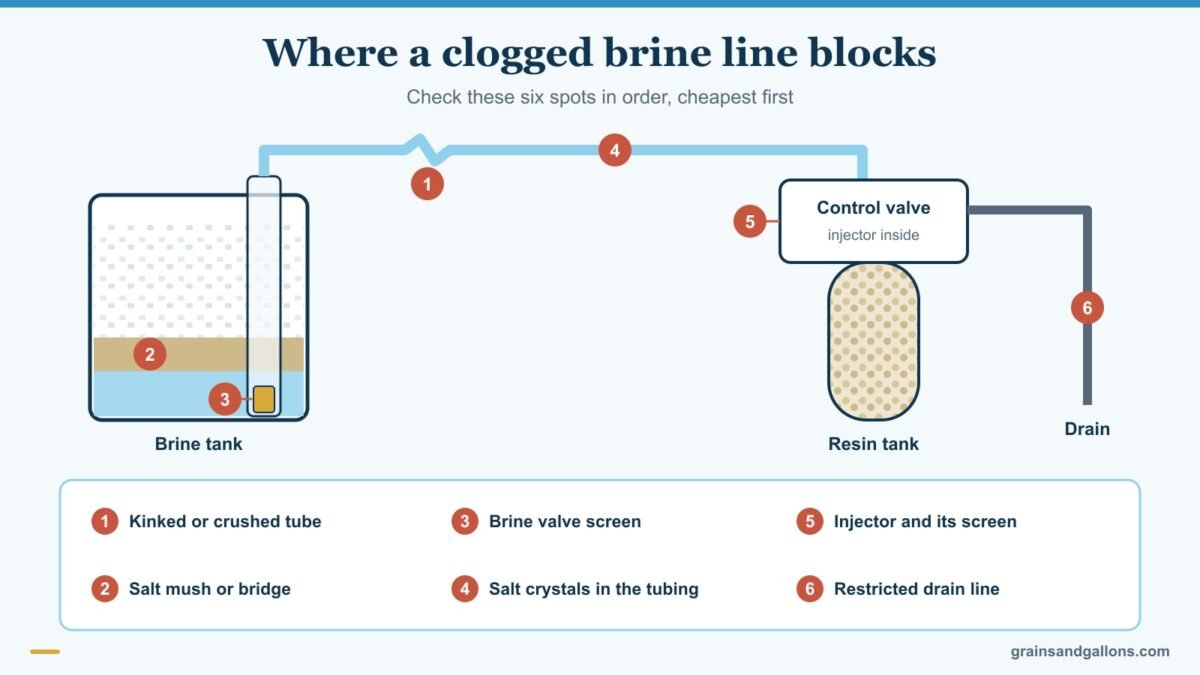
Quick Answer: A brine line clogged with salt mush or grit shows up as salt that stops going down, a rising brine tank water level and hard water. Bypass and unplug the softener, disconnect the brine line at the valve, and flush warm water through it toward the tank. If it flows freely, the tube was never the problem: clean the injector and its screen, then the screen on the brine valve in the brine well. Salt mush and grit from low-grade salt cause most of these clogs.
When a brine line is clogged, the softener keeps going through the motions. The clock turns, the motor whirs at 2 a.m., the drain runs. What it can't do is pull brine. Nothing dramatic happens at first, which is why people usually find the problem after a week of hard water and a salt level that hasn't budged. The good news: "brine line clogged" usually means one of the two ends is blocked, not the tube itself, and the fixes are cheap.
In this guide
Clogged, leaking, or something else?

Clogged brine line symptoms look like this:
- Salt isn't going down, even though the softener regenerates on schedule.
- Brine tank water level is high or rising, because the tank refills after each regeneration but nothing gets drawn out.
- Hard water that gets worse over several days.
- No movement in the tubing during a brine draw, and no bubbles either.
That last point separates a clog from a leak. Start a manual regeneration, advance to brine draw and watch the clear tubing. Steady bubbles mean the injector is pulling air, so read our guide to a brine line air leak instead. No bubbles and no liquid moving means something is blocking the suction path.
Six suspects, cheapest to check first
The brine path runs from the screen at the bottom of the brine well, up the tubing, through a small flow control at the valve, into the injector, and finally out the drain line, which has to flow freely for the injector to create suction. Work along it in this order.
1. A kinked or crushed tube
Follow the tubing from the valve to the brine tank. A line pinched under the lid, folded behind the tank or stepped on can close completely. Straighten it; if it stays flattened or creased, replace it with tubing of the same outside diameter.
2. Salt mush or a bridge at the bottom of the tank
Push a broom handle down through the salt. A crust with a gap underneath is a bridge. A thick, oatmeal-like paste at the bottom is mush, and it gets drawn toward the brine well during each draw and packs around the screen. Our guide to salt mushing in the brine tank explains how to clean it out. If salt is packed inside the brine well itself, see brine well packed with salt.
3. A clogged brine valve screen
Inside the brine well is the brine valve (float assembly), usually with a small screen or the air check at the bottom. Pull the assembly straight up. If the screen is caked in salt crystals, sediment or iron sludge, soak it in warm water and brush it with a soft toothbrush. Check the check ball moves freely. If the assembly is cracked or brittle, replacing it is cheap; our roundup of the best brine tank safety floats covers common replacements by valve.
4. Salt crystals inside the tubing
Less common than people assume, but brine left sitting in a line can dry and crystallize, especially in warm, dry rooms or after the tank ran empty. Fine sediment and resin fragments can also lodge in a fitting. The flush below clears it.
5. A plugged injector or injector screen
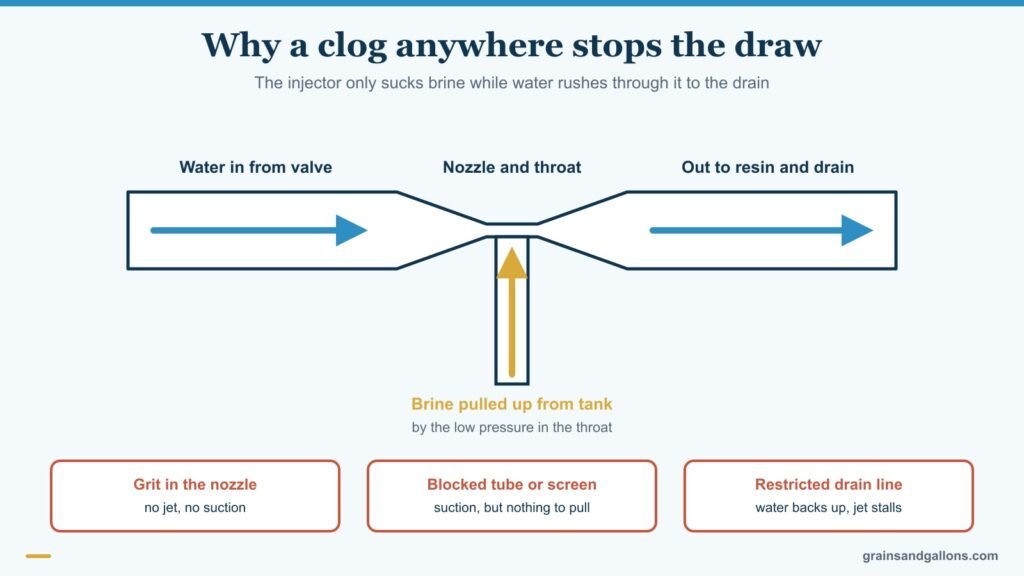
If the line flushes freely and the brine valve screen is clean, look at the injector. It's a tiny nozzle and throat inside the control valve, the narrowest point in the brine path, so debris ends up there. Clack's WS1 service manual lists a plugged injector as the first cause when the valve fails to draw regenerant, and its injector screen sits under the hand-tightened injector cap. Our step-by-step for cleaning a water softener injector covers removing the cap, screen and nozzle.
6. The drain line and the small flow controls
The injector only creates suction when water flows out the drain unrestricted. A kinked, frozen or clogged drain line kills the draw even with a spotless brine line; see our guide to a drain line backing up. The Fleck 5600SXT service manual also lists a plugged drain line flow control, foreign material in the brine line flow control and line pressure under 20 psi as causes of no brine draw. Clack's manual asks for at least 25 psi. The brine line flow control is a small washer in the brine elbow at the valve that most guides skip, and it clogs with the same grit as the screen.
Flush a brine line clogged with salt crystals

- Put the softener in bypass and unplug it.
- Loosen the nut at the control valve and pull the tube out. Keep track of the nut, ferrule and insert.
- Attach a large syringe or funnel to the loose end.
- Push warm tap water through the line toward the tank. Warm water dissolves salt crystals much faster than cold.
- If it won't push through, disconnect the brine valve end and flush the tube on its own into a bucket. A stubborn blockage means it's time for new tubing.
Don't suck on a brine line. Even aside from the salt, brine tanks can harbor bacteria.
Reconnect and prove the draw works
Cut a fresh, square end on the tube if the old one is chewed up, and make sure the insert is inside the tube before you tighten the nut, hand-tight plus a gentle snug. Then:
- Put the softener back in service and plug it in.
- Run a manual regeneration and watch the brine draw step. The brine tank level should drop steadily.
- Test hardness the next day.
If the tank overfilled while the line was clogged, the level should settle over the next regeneration or two. Penn State Extension's overview of water softening explains that spent resin is recharged by flushing brine through it, so a weak draw leaves the resin partly spent.
What the clog tells you about the cause
| What you found | Most likely reason | Prevention |
|---|---|---|
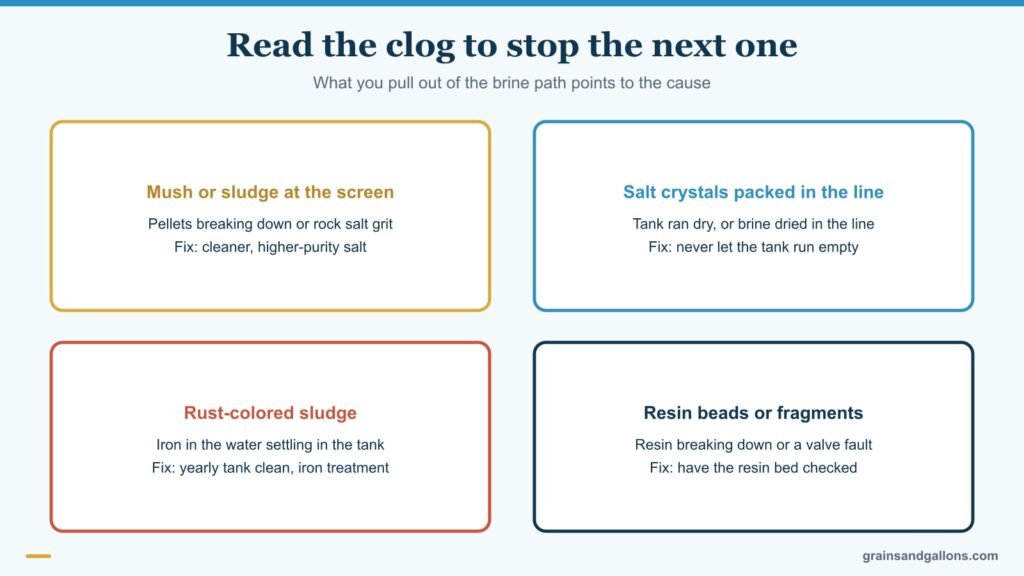
| Sludge or mush around the screen | Pellets breaking down, or rock salt grit | Switch to a cleaner, higher-purity salt |
| Salt crystals packed in the line | Tank ran dry or line sat with brine and dried | Keep salt and water in the tank; don't let it run empty |
| Rust-colored sludge | Iron in the water settling in the tank | Clean the tank yearly; consider iron treatment upstream |
| Resin fragments | Resin breaking down or an internal valve problem | Have resin condition checked |
Salt quality matters more than people think. Low-grade salt leaves more insoluble material, and pellets with lots of fines break down into mush. Our guide to the best water softener salt covers cleaner options.
FAQ
How do I know if my brine line is clogged?
The salt level stops dropping, the brine tank holds more water than usual, and the water turns hard. During a manual brine draw, nothing moves in the tubing and the tank level stays put.
Can I blow through a brine line to clear it?
You can push air or water through it once it's disconnected at both ends, but warm water works better because it dissolves salt crystals. Never use your mouth on the line; brine tanks can harbor bacteria.
Can vinegar unclog a water softener brine line?
Warm water is enough for salt crystals. Vinegar helps on hard mineral scale in the injector nozzle, which you can soak and then clear with a soft, non-metal tool. Rinse it thoroughly before reassembly.
Will a clogged brine line make the brine tank overflow?
It can. The draw empties nothing, but each regeneration still refills the tank, so the level climbs until the safety float shuts the refill off or water reaches the overflow fitting.
How often should I check the brine line?
Look at it whenever you add salt, and clean the brine valve screen and injector when you clean the brine tank. Systems on iron-rich well water or cheap rock salt clog faster and need more frequent checks.
Most "clogged brine lines" are blocked at the ends
A brine line clogged along its length is the exception. Far more often the blockage is mush around the brine valve screen, grit in the injector or a restricted drain line. Check them in order, flush the tube with warm water to rule it out, and prove the fix with a manual regeneration. Then switch to cleaner salt so it doesn't come back.