

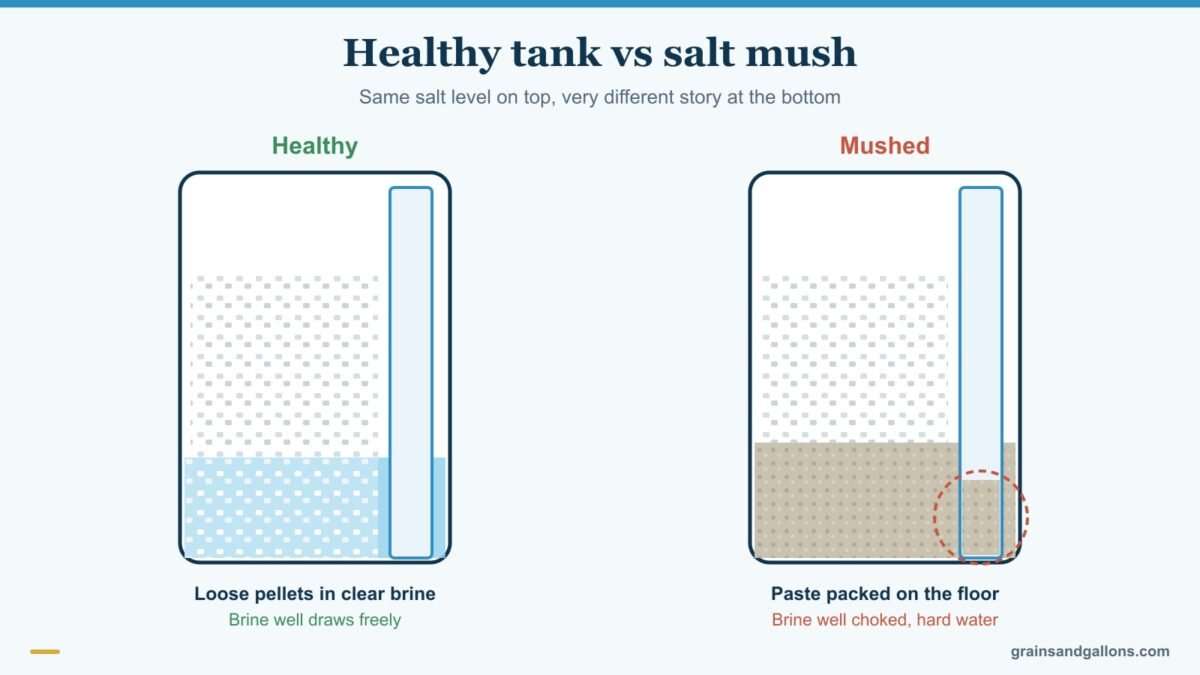
Quick Answer: Salt mushing is dissolved salt recrystallizing into a thick sludge on the floor of the brine tank, where the softener can't draw clean brine through it. Breaking it up doesn't work; you have to remove it. Bypass the softener, scoop or wet-vac the sludge out, rinse the tank and brine well, refill with a few inches of water and high-purity evaporated pellets, then run a manual regeneration.
Salt mushing is one of the most common reasons a softener with "plenty of salt" stops softening. Push a broom handle down through the pellets and it stops a few inches above the tank floor, sinking into something like wet cement or slushy sand. The water has been hard for days, yet the tank looks full. That paste is the problem, and it won't go away on its own.
In this guide
Salt mushing at the bottom of the tank, and why it stops brine draw
EcoWater describes mushing as what happens when dissolved salt recrystallizes and forms a sludge on the bottom of the brine tank. Fine particles from crumbling pellets, plus any insoluble grit in the salt, settle under the waterline and cement together into a dense layer.
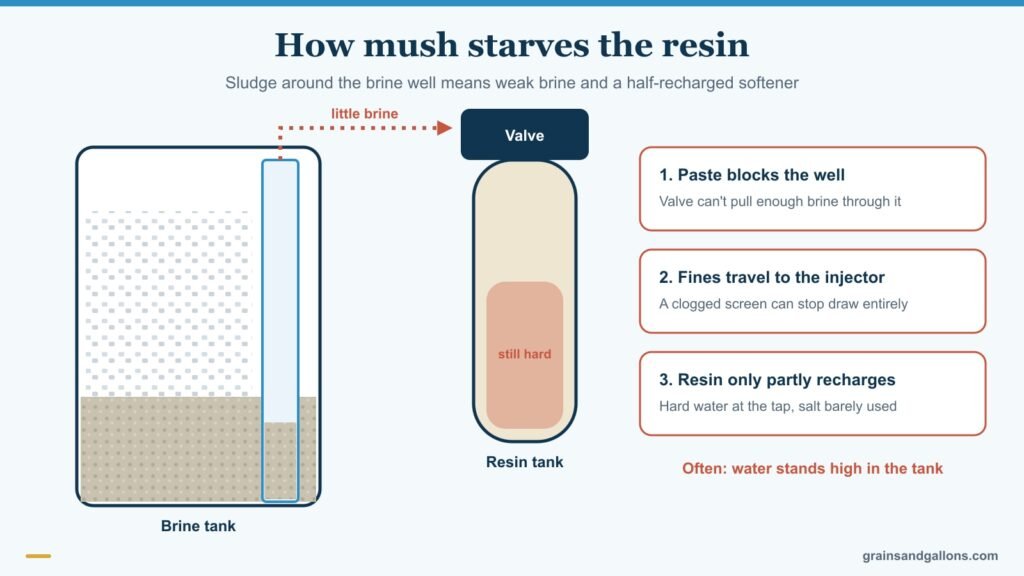
During regeneration, the control valve draws brine out of the tank through the brine well, the narrow tube at one side, and sends it through the resin. Penn State Extension's water softening guide explains that this brine flush is what carries the trapped hardness minerals off the resin. Mush breaks that process two ways:
- It blocks flow. The sludge packs around the bottom of the brine well and the float, so the valve can't pull enough brine through it. Less salt reaches the resin, the resin only partly recharges, and hard water follows.
- It clogs parts downstream. Fines get drawn toward the injector screen and brine valve. A partly clogged injector can stop brine draw altogether, which often shows up as a tank that holds far more water than it should. If pellets or paste have filled the well itself, see our guide to a brine well clogged with salt.
Other warning signs: water standing high in the tank after a regeneration, salt level that barely drops week to week, and cloudy or murky water sitting in the salt.
Mush or bridge? They need different fixes
People mix these up because both leave salt in the tank and hard water at the tap.
| Salt bridge | Salt mush | |
|---|---|---|
| Where it is | A hard crust or dome near the top or middle, with a hollow gap underneath | A dense, wet paste at the bottom, under the waterline |
| What the broom handle does | Hits something solid, then may punch through into empty space | Sinks into something soft and sticky, like wet sand |
| Water level | Water sits below the crust, usually without salt in it | Water is mixed into the sludge and may look cloudy |
| Fix | Break the crust and let it fall | Remove the sludge entirely |
If it's a bridge, our guide on breaking a water softener salt bridge is what you want. Breaking up mush and leaving it doesn't work. It packs right back down, which is why EcoWater says draining the tank and replacing the salt is the only real fix.
Dig out the sludge in 8 steps
Allow an hour or two. You'll need a bucket, a scoop or old saucepan, gloves, and ideally a wet/dry shop vac.
- Put the softener in bypass. You stay on (hard) water while you work, and a regeneration can't start mid-cleanup. Unplug the valve if it has a cord.
- Remove loose pellets from the top. Keep them in a clean bucket if they look clean and dry; toss anything discolored or crumbly.
- Scoop or vacuum out the sludge and water. Wet salt sludge is heavy, so empty the vac often. Work down to the tank floor, or to the salt grid if your tank has one.
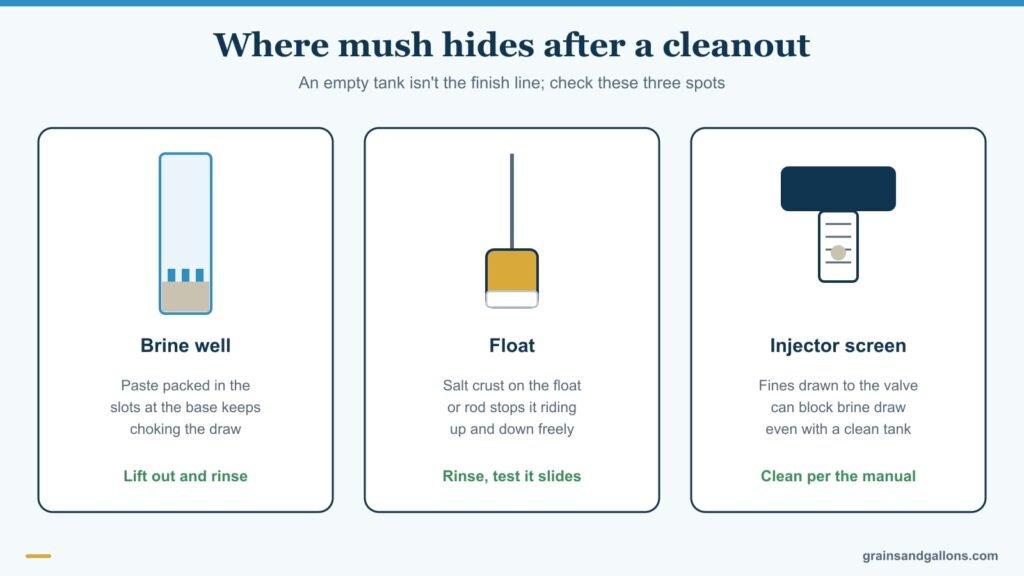
- Lift out the brine well and float if your design allows it, and rinse them. Crusted salt on the float can stop it moving freely, and paste packed into the well's slots will keep choking the draw.
- Rinse the tank. Warm water and a stiff brush are enough. Our walkthrough on how to clean a brine tank covers sanitizing if the tank smells; Penn State advises reading the manufacturer's instructions before adding any chemicals.
- Check the injector screen if the softener wasn't drawing brine before the cleanup. Our guide to cleaning a water softener injector shows where it sits. EcoWater suggests cleaning the venturi (injector) twice a year anyway.
- Reassemble and add a few gallons of water, roughly enough to cover the grid or the bottom few inches if you have no grid. Then add fresh salt.
- Plug in, return to service and run a manual regeneration. Test the water at a cold tap a few hours later to confirm it's soft.
Where the sludge goes: small amounts can usually go down a utility sink or floor drain with plenty of water. Check local rules if you're on a septic system or dumping a lot, and never spread it on lawns or garden beds, because salt kills plants.
Still hard after the cleanup? If you've cleared the mush, added good salt, run a regeneration and the water still tests hard, look beyond the tank. Check that the brine line is attached and not sucking air, the injector is clean, and the hardness setting matches your water. If all of that checks out, the resin may have taken a hit from fines or from weeks of weak brine, and a resin cleaner followed by a couple of regenerations is worth trying before anything drastic.
Five reasons salt turns to sludge
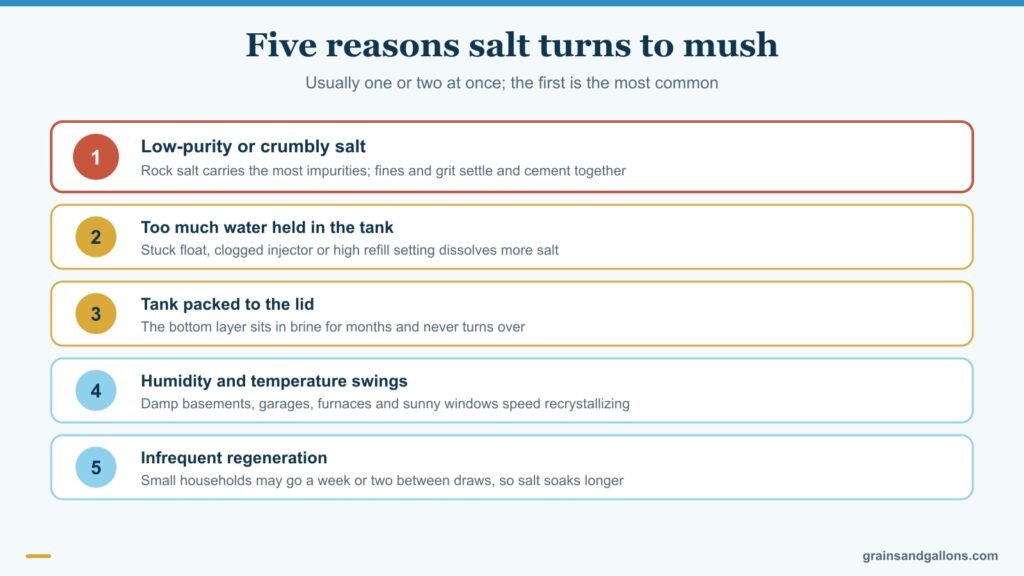
It's usually one or two of these together.
1. The salt itself. The most common cause. Pellets that crumble, or salt with more insoluble material, break down into fines that settle and cement. EcoWater notes that rock salt is the cheapest but carries the most impurities, while evaporated salt is the purest at 99.99% sodium chloride. Our rock salt in a water softener guide explains the sludge it leaves, and the salt pellets vs crystals comparison covers how each form behaves in the tank.
2. Too much water sitting in the tank. Many modern softeners keep only a little water in the tank between regenerations and refill shortly before brining. If the tank holds more water than it should, more salt dissolves and recrystallizes. A stuck float, a clogged injector or a refill setting that's too high can all cause this.
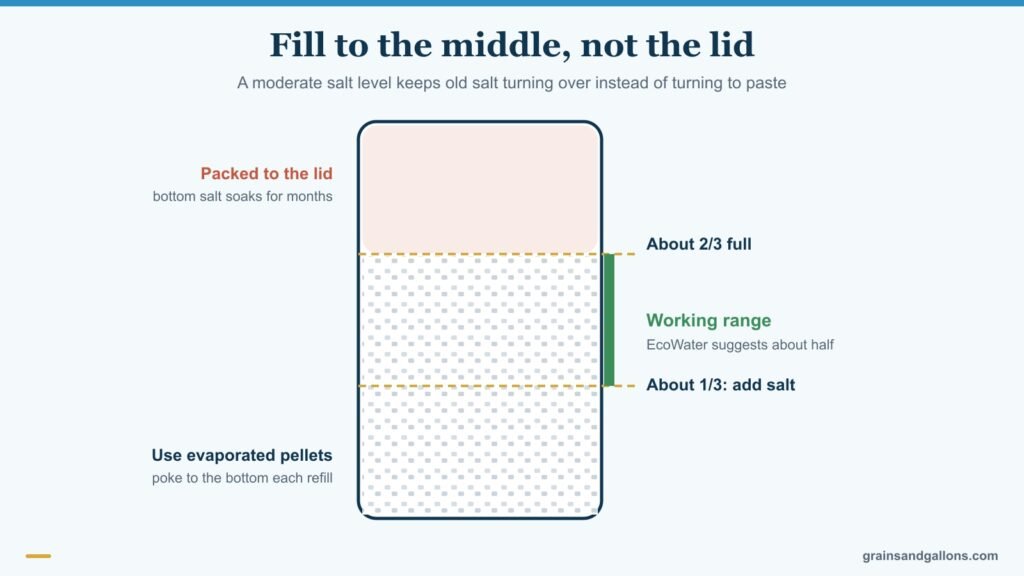
3. Packing the tank to the lid. When the tank is always full, the bottom layer sits in brine for months and never turns over.
4. Humidity and temperature swings. Damp basements and garages make salt clump and recrystallize more easily. A tank next to a furnace, a dryer vent or a sunny window cycles between warm and cool.
5. Infrequent regeneration. A small household may regenerate only every week or two, so salt sits in brine much longer between draws.
Keep the tank half full and the salt pure
Prevention is mostly habit:
- Buy high-purity evaporated pellets. Our roundup of the best water softener salt leans that way. Don't stretch a bag by mixing in rock salt.
- Keep the level moderate. EcoWater recommends keeping the tank about half full so older salt doesn't stick to the walls, and many guides use one-third to two-thirds as the working range. Let it run down before you top up. See how full a brine tank should be.
- Poke the salt when you add a bag. A broom handle pushed to the bottom tells you early whether paste is forming.
- Check the water level after a regeneration against your manual. If the tank holds far more water than it should, look at the float, injector and refill setting before the next bag goes in.
- Clean the tank about once a year, sooner if you've had mush before or the softener sits somewhere humid.
- Move or shade the tank if it's beside a heat source or in direct sun.
FAQ
What causes salt mushing in a water softener?
Mostly low-purity or crumbly salt, combined with salt sitting in brine too long. Excess water in the tank, overfilling, humidity and infrequent regeneration all make it worse. High-purity evaporated pellets are the single biggest fix.
Can I just break up salt mush with a broom handle?
No. Breaking up a salt bridge works because the salt falls into the water and dissolves. Mush is already sitting in the water as paste; stirring it just lets it settle and pack again. It has to come out.
Will salt mushing damage my water softener?
The tank itself is fine, but mush can clog the brine well, float and injector, and weeks of weak brine leave the resin under-regenerated. Clearing it promptly usually avoids any lasting harm.
Do salt crystals mush more than pellets?
It depends more on purity than shape. Crumbly, low-grade salt of any shape breaks into fines. Solar crystals and evaporated pellets both work in most softeners; check your manual, since some tank designs prefer one form.
How often should I clean the brine tank to prevent mush?
Once a year suits most homes. If you've had mush before, use lower-purity salt or keep the softener in a damp space, check it every few months.
Clear out salt mushing completely, then change the salt
Salt mushing won't fix itself, and stirring only buys a few days. Bypass the softener, dig the sludge out down to the floor, clean the brine well, float and injector, and refill with high-purity evaporated pellets to about half full. Then keep the tank from overfilling, check the water level after regenerations, and give the tank a yearly cleanout so the paste never gets a chance to set.