


Quick Answer: Rock salt in water softener brine tanks is not an emergency if the bag says it's made for water softeners: the unit will still regenerate, but rock salt leaves more insoluble grit, so clean the tank sooner and switch to pellets or solar salt next time. If the bag says ice melt, de-icer, or lists calcium chloride or magnesium chloride, bypass the softener and get it out of the tank before the next regeneration.
Finding rock salt in water softener tanks usually starts with a mix-up in the garage. The bags look alike, someone grabbed "salt" at the hardware store in January, and now 40 pounds of it is sitting in the brine tank. One bag of the wrong salt rarely ruins a softener if you act on it now.
In this guide
- Read the bag before you touch the brine tank
- Rock salt in water softener tanks: why it leaves sludge
- Softener-grade rock salt can stay in the tank
- Got ice melt in the brine tank? Do this before it regenerates
- Where the grit goes after a bag of rock salt
- Rock salt in water softener tanks costs cleanups, not the softener
- FAQ
Read the bag before you touch the brine tank

Everything else depends on this. Find the empty bag, or look the product up by name.
Softener-grade rock salt. Some bags are mined rock salt sold for water softeners. It's sodium chloride, just less refined than evaporated pellets or solar crystals, so it carries more insoluble material such as shale, clay and other minerals. It will make brine and regenerate the resin.
Ice melt or road salt. This is made for sidewalks and driveways. Some of it is plain rock salt, but much of it is a blend with calcium chloride, magnesium chloride or potassium salts, plus colorants or anti-caking agents. None of that belongs in a brine tank.
Unknown. If you can't tell, treat it as ice melt. Getting it out takes an afternoon; leaving it can cost you a clogged valve.
Rock salt in water softener tanks: why it leaves sludge

A softener only uses the part of the salt that dissolves. Whatever doesn't dissolve sinks and stays. That's the core problem with rock salt: the grit has nowhere to go, so it builds a muddy layer on the tank floor, around the brine well and on the safety float.
Manufacturers are blunt about it. The Whirlpool softener owner's manual recommends nugget, pellet or coarse solar salt "with less than 1% impurities" and lists rock salt, "high in impurities," under salt not recommended, alongside block, table and ice-melting salt. The Morton softener manual uses nearly the same wording.
How the three softener salts compare:
| Salt type | How it's made | What it leaves behind |
|---|---|---|
| Evaporated pellets | Brine is evaporated and the salt pressed into pellets | The least residue of the three |
| Solar salt | Seawater or brine evaporated by sun and wind | Some sediment over time |
| Rock salt | Mined and crushed with little refining | The most insoluble grit and sludge |
If you're deciding between the two cleaner options, our comparison of salt pellets vs crystals covers bridging, mushing and cost.
Softener-grade rock salt can stay in the tank
You don't have to empty the tank. The softener will regenerate normally because the brine is still sodium chloride. What changes is the maintenance schedule:
- Sludge will build up on the tank floor faster than with pellets.
- That sludge can coat the safety float, plug the screen on the brine pickup, and travel up the brine line to the injector.
- Lift the salt aside and look at the bottom of the tank after a couple of months. When you see a layer of muck, clean it out.
Let this batch run down, then refill with evaporated pellets or high-purity solar salt. Our picks for the best water softener salt focus on purity, and if you're choosing between the two biggest brands, see Diamond Crystal vs Morton.
Got ice melt in the brine tank? Do this before it regenerates
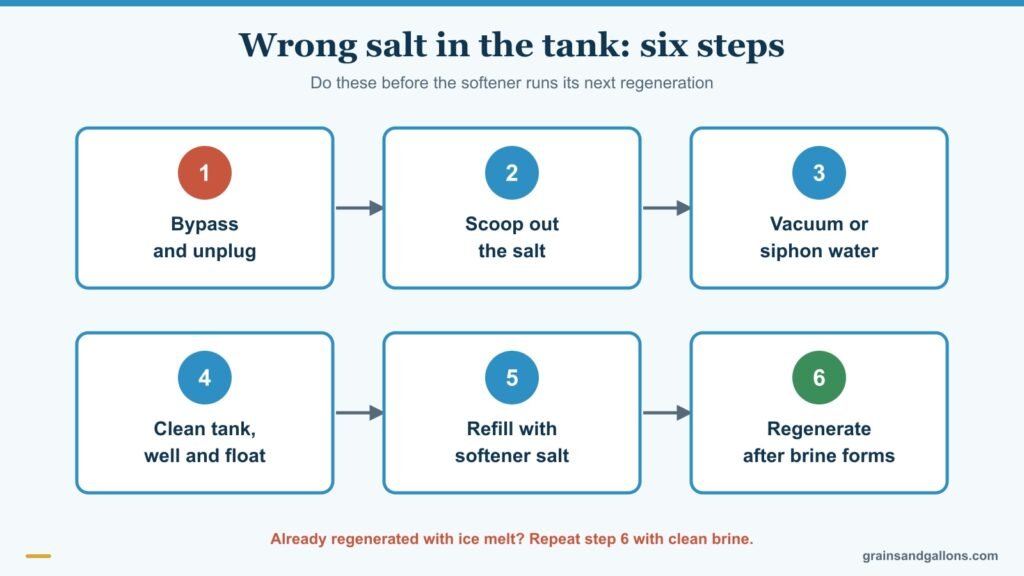
Speed matters here. If the brine contains calcium chloride or magnesium chloride, regeneration pushes calcium and magnesium into the resin, which is exactly the hardness the softener is supposed to remove. Dyes and other additives can foul the resin or the valve.
- Put the softener in bypass and unplug it so it can't start a cycle.
- Scoop out everything you can. A plastic dustpan or small bucket works. Wear gloves; brine stings small cuts.
- Remove the water. A wet/dry shop vac is fastest. You can also siphon with a hose to a floor drain or outside, depending on local rules.
- Clean the tank. Rinse out residue, wipe down the walls, and clean the brine well and float. Our guide on how to clean a water softener brine tank goes step by step.
- Refill with proper softener salt. Add a few gallons of water so brine can form, or let the valve add it on the next refill, per your manual.
- Plug in, return to service, and regenerate once the new brine has had several hours to form. See how to manually regenerate a water softener.
If it already regenerated with the wrong salt
Do all six steps, then run a second regeneration with clean brine. That gives the resin another full dose of sodium to push off whatever went in. Test the water a day later. If it still isn't soft after two clean regenerations, the resin may need a cleaner treatment or professional service.
Where the grit goes after a bag of rock salt
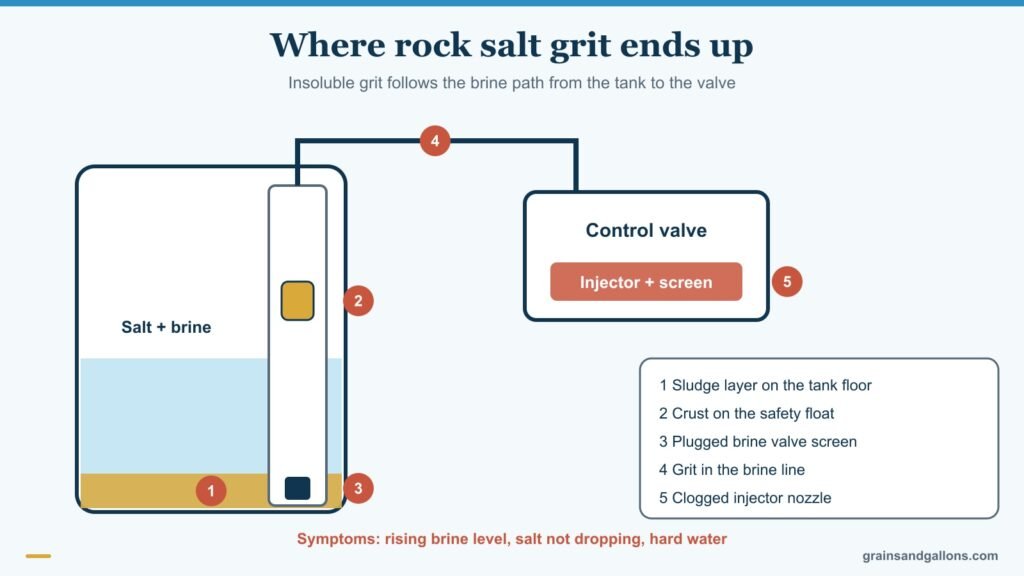
Whether it was rock salt or ice melt, insoluble grit can end up in the small parts that make regeneration work. Watch for these symptoms over the next few weeks:
| Symptom | Likely spot | Where to read more |
|---|---|---|
| Water level in the brine tank keeps rising | Brine line or injector clogged | Clogged brine line |
| Salt level not going down, hard water | Injector screen or nozzle | How to clean a softener injector |
| Tank won't refill, float stuck | Grit and crust on the safety float | Clean the float with the tank |
| Hard water with plenty of salt | Any of the above, or resin fouling | Start with the brine line and injector |
The injector's tiny openings are where rock salt residue causes the most trouble.
If the resin itself is fouled, Penn State Extension's guide to water softening notes that commercial resin cleaners are available, but read the manufacturer's instructions before adding any chemical to the unit.
Rock salt in water softener tanks costs cleanups, not the softener
Some owners run softener-grade rock salt for years because it's cheap where they live. If your manual allows it and you don't mind cleaning the brine tank more often, it works. The trade-off is time: more cleanouts, more chances of a clogged injector, and more risk of a missed regeneration you don't notice until the water turns hard. For most homes, a bag of pellets pays for itself in skipped maintenance.
Ice melt is different. It has to come out before the softener regenerates, every time.
To keep it from happening again, store softener salt and ice melt in different spots, label the softener salt shelf, and if someone else buys salt for you, send them a photo of the exact bag.
FAQ
Can you use rock salt in a water softener?
You can use rock salt sold for water softeners, and the unit will regenerate. Most manufacturers, including Whirlpool and Morton, list rock salt as not recommended because its insoluble impurities build sludge in the brine tank and can clog the injector and brine line.
What happens if you put ice melt in a water softener?
If the ice melt contains calcium chloride or magnesium chloride, the softener loads hardness minerals into the resin during regeneration instead of removing them, and you get hard water. Additives and dyes can also foul the resin and valve. Remove it before the next regeneration.
Do I need to empty the brine tank after adding rock salt?
Not if it's softener-grade rock salt. Let it run down and clean the tank sooner than usual. If it's ice melt, road salt or anything unknown, empty and clean the tank.
How do I know if rock salt clogged my softener?
Watch for a brine tank water level that keeps rising, salt that stops going down, or hard water even though the tank is full of salt. Those point to a clogged injector, brine valve screen or brine line.