

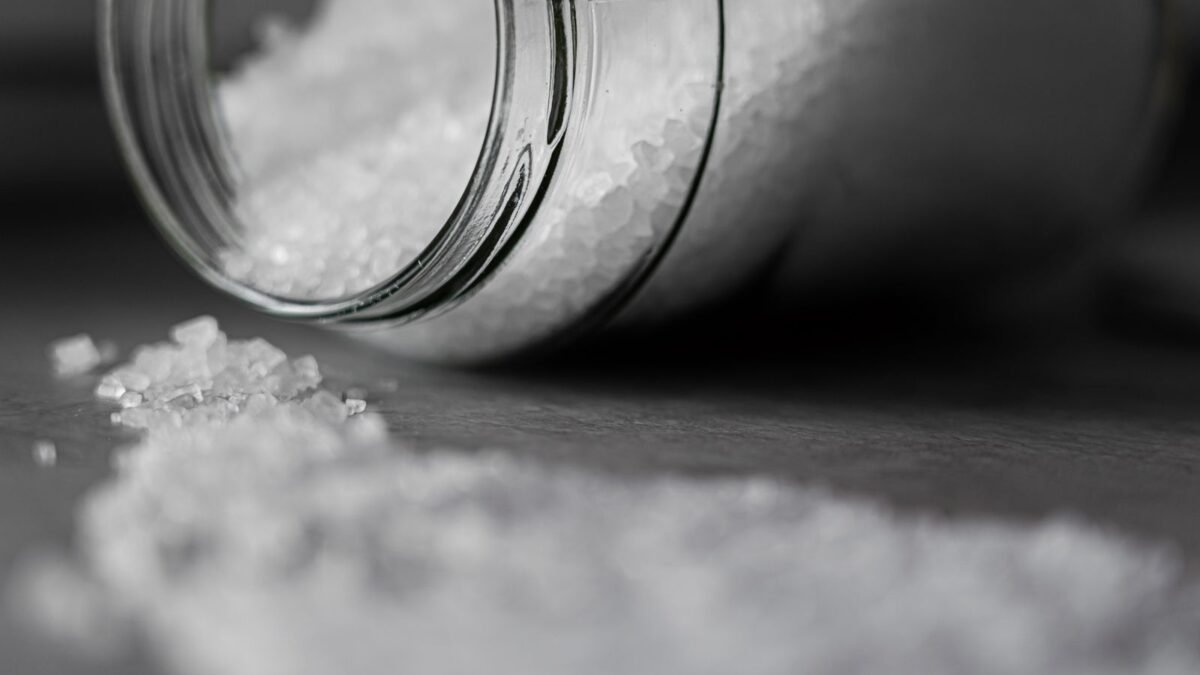
Quick Answer: "Crystals" and "solar salt" are usually the same thing: sea or brine water evaporated by the sun. So the real choice is pellets or crystals, and your brine tank decides it. If you have a cabinet softener (one box with a salt lid), buy pellets such as Diamond Crystal Bright & Soft. If you have a two-tank softener with a tall, separate brine tank, crystals such as Diamond Crystal Solar Naturals work just as well and usually cost less. Don't use mined rock salt in a home softener.
Disclosure: As an Amazon Associate, Grains & Gallons earns from qualifying purchases.
| Pellets | Solar salt / crystals | Rock salt | |
|---|---|---|---|
| How it's made | Evaporated salt, recrystallized and pressed into pillow shapes | Seawater or brine evaporated in open ponds by sun and wind | Mined from underground deposits |
| Typical purity (Diamond Crystal figures) | 99.8% (Bright & Soft) | 99.6% (Solar Naturals, Sun Gems) | Not published for softener use, and noticeably dirtier |
| Leftover grit | Very little | A bit more over time | A lot (clay, gypsum, debris) |
| Best in | Any softener, especially cabinet units | Two-tank softeners with open brine tanks | Ice on your driveway, not your softener |
| Relative cost | Highest of the three | Usually lower than pellets | Lowest |
Winner for most homes: pellets. They work in every softener and leave the least residue. Crystals win for two-tank owners who want to spend less and will rinse the brine tank every year or two.
In this guide
- First, look at your softener, not the bag
- "Crystals" vs "solar salt": the naming problem
- Where the 0.2% difference ends up
- Mush and bridges: which form causes what
- Rock salt: the cheap bag to walk past
- The four bags worth buying
- Where potassium pellets fit in
- Does the form change how much salt you use?
- Switching forms without trouble
First, look at your softener, not the bag
You don't need a chemistry lesson to make this choice. You need to look at your softener for a few seconds.
One cabinet, salt lid on top, resin tank hidden inside? That's a cabinet unit. Most big-box softeners are built this way. The salt compartment is short and narrow, and the brine well sits right in the salt. Use pellets. Irregular crystals pack more tightly in a small space, and a cramped compartment is where salt bridges tend to form.
A tall resin tank with a valve on top, plus a separate round or square brine tank next to it? That's a two-tank system. Fleck and Clack valve softeners and most older dealer units look like this. Either form works. Crystals are usually the better value here.
Not sure, and the manual is long gone? Buy pellets. They're the form that works in any softener.
"Crystals" vs "solar salt": the naming problem
This is where most people get confused in the store aisle.
- Solar salt describes how it's made. Seawater or brine is left in shallow ponds until the sun and wind evaporate the water. Diamond Crystal's Solar Naturals and its larger Sun Gems crystals are made this way.
- Crystals describes the shape: irregular chunks instead of pressed pillows. In softener salt, most products sold as "crystals" are solar salt.
- Morton Pure and Natural is sold as "crystals." Morton's lineup page calls it high-purity, all-natural salt but doesn't say how it's produced or give a purity percentage. In practice, treat it as the Morton equivalent of Solar Naturals.
So a question like "solar salt vs crystals?" almost always compares the same thing under two names. The real comparison is pellets against everything else.
Where the 0.2% difference ends up
Every bag of decent softener salt is more than 99% sodium chloride. The rest is mostly insoluble matter, which never dissolves and settles to the bottom of the brine tank.
Here's an example. A family of four with 15 gpg water and a softener that uses roughly 40 lb of salt a month:
- Pellets at 99.8%: about 1 lb of insoluble material a year
- Solar crystals at 99.6%: about 2 lb a year
Two pounds of grit isn't a disaster. But it builds up in the same place the brine well draws from. If you skip cleaning for four or five years, you can end up with a sludge layer thick enough to cause trouble. That's why crystal users should plan to clean out the brine tank every year or two, and pellet users can usually go longer.
This isn't about one form being "dirty." It's a maintenance difference you can plan for.
Mush and bridges: which form causes what
Two failures send people back to the salt aisle:
- A bridge is a hard crust of salt with a hollow gap underneath. The tank looks full, but the brine underneath is weak or gone, and your water slowly gets hard again. Humidity, overfilling and a tank that's never allowed to run low are the main causes. Form matters less than people think.
- Mush is a sludgy layer of recrystallized salt at the bottom. If it keeps coming back, switching to a different form of salt is a common fix. See our guide on salt mushing for the cleanup.
Either way, don't keep the tank packed to the lid. A half to two-thirds full tank is easier to check and less likely to crust over. For the details, see how full a brine tank should be.
Rock salt: the cheap bag to walk past
Rock salt is mined, not evaporated. It has more insoluble material than either pellets or crystals: clay, gypsum and other debris. In a softener, that grit doesn't stay in the brine tank. It can foul the brine valve and injector and add to the sludge layer much faster.
Our view: the money you save is gone the first time a clogged injector stops your softener from drawing brine. If you've already used it, read our guide on rock salt in a water softener before you buy anything else.
The four bags worth buying
Diamond Crystal Bright & Soft pellets: the safe choice for any softener
Typical 99.8% purity and more than 99.7% water soluble, with no additive and no fragrance. This listing is a 50 lb bag with two handles, which makes it easier to lift into a tall brine tank. It's the plainest, lowest-residue option and works in cabinet and two-tank units alike.
- Buy it if: you have a cabinet softener, you don't know what type you have, or you want to clean the tank as rarely as possible.
- Downside: it costs more per bag than crystals, and some areas stock it less than Morton.
Diamond Crystal Solar Naturals crystals: the value pick for two-tank systems
Solar-evaporated, with a typical 99.6% purity. The link is a pack of three 40 lb bags.
- Buy it if: you run a two-tank system and don't mind rinsing out the brine tank every year or two.
- Downside: it's not a good match for short cabinet units, and it leaves a little more sediment than pellets.
Morton Clean and Protect pellets: if you want an additive
Morton's mainstream pellet has an additive that Morton says reduces buildup and makes cleaning easier. It's a reasonable pick for a cabinet unit that keeps getting dirty. The downside: Morton doesn't publish a purity percentage, and the additive isn't fully explained on its product page.
This listing is a pack of two 40 lb bags.
Morton Pure and Natural crystals: the crystal you'll see in more stores
This is Morton's crystal salt, with no additive listed. Buy it instead of Solar Naturals when it's cheaper or easier to get, and you want to stay with one brand. Like any crystal, it's best suited to two-tank systems. This listing is a pack of four 40 lb bags.
Where potassium pellets fit in
Potassium chloride comes in pellet form too, but it isn't really part of the pellets-vs-crystals choice. It's a separate decision about cutting added sodium, and it costs more per bag. If you choose potassium, the form advice above still applies: pellets suit any tank. The bigger change is that you'll usually need to raise the softener's salt-dose setting, because potassium chloride doesn't regenerate resin as efficiently pound for pound. Check your manual before switching.
Does the form change how much salt you use?
Not directly. Your softener's salt-dose setting decides how many pounds of salt go into each regeneration, whatever the form. What changes is how evenly it dissolves. Pellets dissolve slowly and consistently. Crystals tend to dissolve a bit faster. So a crystal-filled tank may look like it's going down at a different rate even when the softener is using exactly the same amount. Judge by the weight you buy over a few months, not by how full the tank looks week to week.
Switching forms without trouble
Switching from crystals to pellets (or back) is fine. It's also the standard fix when one form keeps bridging or mushing. To do it cleanly:
- Let the tank run down to a few inches of salt.
- Break up any crust with a broom handle and scoop out mush.
- Add the new form. Don't top up old crystals with pellets, or the reverse, if the old salt was causing trouble.
- Check the level weekly for the first month. A new form can dissolve at a different rate.