

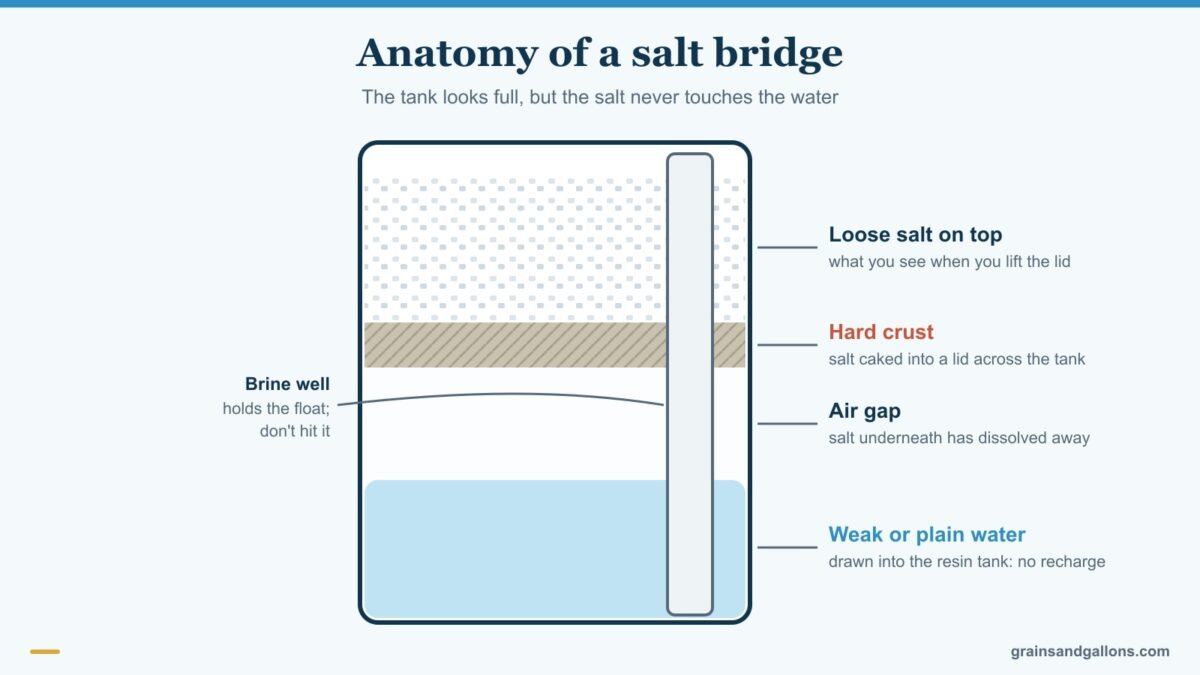
Quick Answer: A water softener salt bridge is a hard crust of salt that forms across the brine tank above the water, leaving an air gap so the salt can't dissolve. If the salt level hasn't dropped in weeks but your water feels hard, push a broom handle straight down through the salt. If it stops on a hard layer and then breaks into empty space, that's a bridge. Bypass the softener, tap the crust apart from the edges, wait a few hours for brine to form, then run a manual regeneration.
The salt hasn't gone down in a month. That feels like good news until the shower starts feeling squeaky and a hardness strip turns dark. A water softener salt bridge is why those two things go together: the salt you can see is sitting on a crust, not in the water, so the softener is making brine from almost nothing. Here's how to confirm it, break it without damaging the tank, and keep it from forming again.
In this guide
What a salt bridge does inside the brine tank

A brine tank works by keeping a few inches of water at the bottom in contact with salt. After every regeneration, the valve refills that water, it dissolves salt into brine, and next time the softener draws that brine through the resin to strip out the hardness minerals it has collected.
A bridge forms when salt near the waterline gets damp, partly dissolves and then hardens into a solid cake. As the salt underneath dissolves away, the cake stays put and spans the tank like a lid. Culligan describes it as a hardened layer of salt above the water in the brine tank. Now there's an air gap between the crust and the water. Refill water sits below the crust, picks up little or no salt, and the softener rinses its resin with weak brine or plain water. The resin doesn't recharge, and hard water comes through.
From above, the tank looks full the whole time. That's what makes bridges easy to miss.
Signs your brine tank has bridged
Most people notice the water before they notice the tank. Watch for these together:
- The salt level doesn't move. A tank that normally takes a bag every few weeks hasn't needed one in a month or more. Culligan notes that a salt level that stays the same over time can mean a bridge is stopping salt from dissolving.
- Hard-water symptoms come back. Soap stops lathering, spots and film return on dishes and glass shower doors, skin and hair feel dry, and scale shows up on faucets.
- A hardness test reads high. Test strips or a drop test at a cold tap show hardness well above what your softener normally delivers.
- The softener still runs normally. It regenerates on schedule, the display looks fine and nothing is leaking. That rules out most mechanical failures and points to the salt.
If the salt has gone down to the tank floor instead, you're out of salt, not bridged; see what to do when a softener ran out of salt.
Do the broom-handle test, then rule out mushing
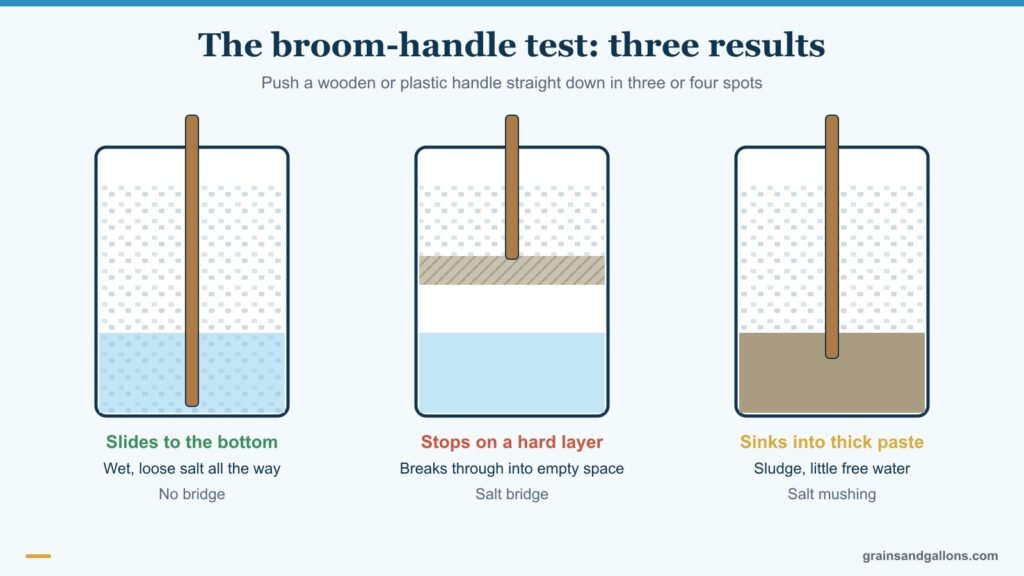
EcoWater's maintenance guide suggests the same check most technicians use: if the tank looks full but the water isn't soft, take a broom handle and carefully push on the top of the salt.
- Lift the lid and find the brine well, the tube that holds the float, so you don't hit it.
- Push a wooden or plastic broom handle straight down through the salt. Don't use a metal bar.
- Try three or four spots, including near the walls.
What you'll feel:
- The handle slides to the bottom through wet, loose salt: no bridge.
- The handle stops on a hard layer, and a firm push breaks through into empty space or water: a bridge.
- The handle sinks into thick, wet paste with little free water: that's mushing, a different problem.
| What you find | What it is | What to do |
|---|---|---|
| Hard crust with an air gap below | Salt bridge | Break it up (next section) |
| Sludge like wet cement on the bottom, little free water | Salt mushing | Scoop it out; usually a full tank cleanout |
| Salt packed solid inside the brine well | Brine well clogged with salt | Clear the well and check the float |
| Salt dropping normally but water still hard | Not a salt problem | Check the brine draw, injector and settings |
| Bare tank floor | Out of salt | Refill and regenerate |
Bridges and mushing often show up in the same tank, especially with lower-grade salt in a humid spot. EcoWater says that if the salt won't break up when you push on it, mushing is probably the cause, and the fix is to drain the tank, remove all the old salt and refill. If you break a bridge and find sludge underneath, deal with both.
Break the water softener salt bridge without cracking the tank
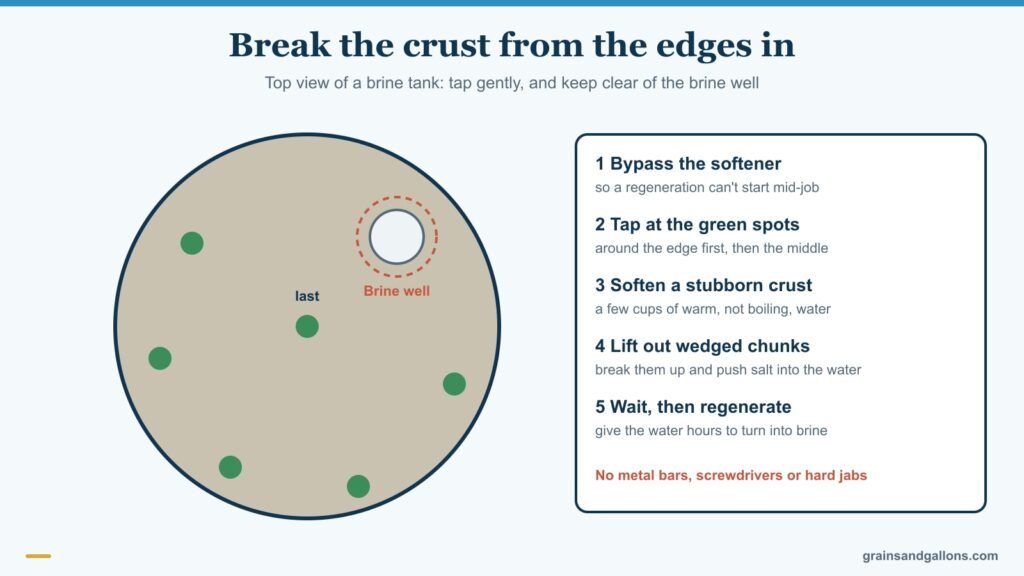
Brine tanks are polyethylene. They're tough, but a hard jab with a metal tool against the wall or bottom can crack them, and the brine well is thinner still. Culligan's advice is to check your owner's guide first, then gently loosen the salt with a blunt, nonmetal tool and remove large pieces.
- Put the softener in bypass so a regeneration can't start while you're working.
- Tap, don't stab. Use the broom handle to tap the crust from several points around its edge, then the middle. It usually cracks into chunks and drops into the water.
- Soften a stubborn crust. Pour a few cups of warm, not boiling, water over it, wait a few minutes and try again. Don't add so much that the water level rises much; you're softening the crust, not flooding the tank.
- Lift out wedged chunks. Break up any pieces jammed against the wall and push the loose salt down into the water.
- Give the brine time, then regenerate. The water at the bottom has been sitting nearly unsalted, so it needs a few hours to become strong brine. Clack's owner reference guide says that if a brine tank had no salt, you should fill it and wait at least 2 hours before regenerating, and the same logic applies here. Then return the valve to service and run a manual regeneration. If the bridge was there for weeks, run a second one the next day.
If you end up scooping out most of the salt, it's a good moment for a full cleanout. How to clean a water softener brine tank walks through it.
Why your tank keeps bridging

Bridges have a short list of causes, and most homes have at least one:
- Humidity and temperature swings. EcoWater lists high humidity and temperature changes around the softener as common causes. Garages, crawl spaces and laundry rooms next to a dryer are classic bridge locations, because moist air condenses on the salt and cakes it.
- Overfilling. The more salt stacked above the waterline, the more weight pressing down and the more surface for a crust to form. EcoWater recommends keeping the tank about half full.
- The wrong salt. Rock salt has more insoluble material than evaporated salt; the University of Nebraska's guide to water softening notes that rock salt may have high levels of soluble or insoluble impurities. EcoWater recommends high-purity pellets to reduce problems. See rock salt in a water softener and our pellets vs crystals vs solar salt comparison.
- Low water use. A softener that rarely regenerates leaves the salt sitting for weeks. Vacation homes and one-person households bridge more often.
- Constant topping off. Adding a few pounds every week keeps fresh salt pressed onto damp salt. Let the level drop, then add a full bag.
Culligan adds that if bridges keep forming, home humidity, salt type or tank size may be involved, and a service visit can help pin it down.
Habits that keep bridges away
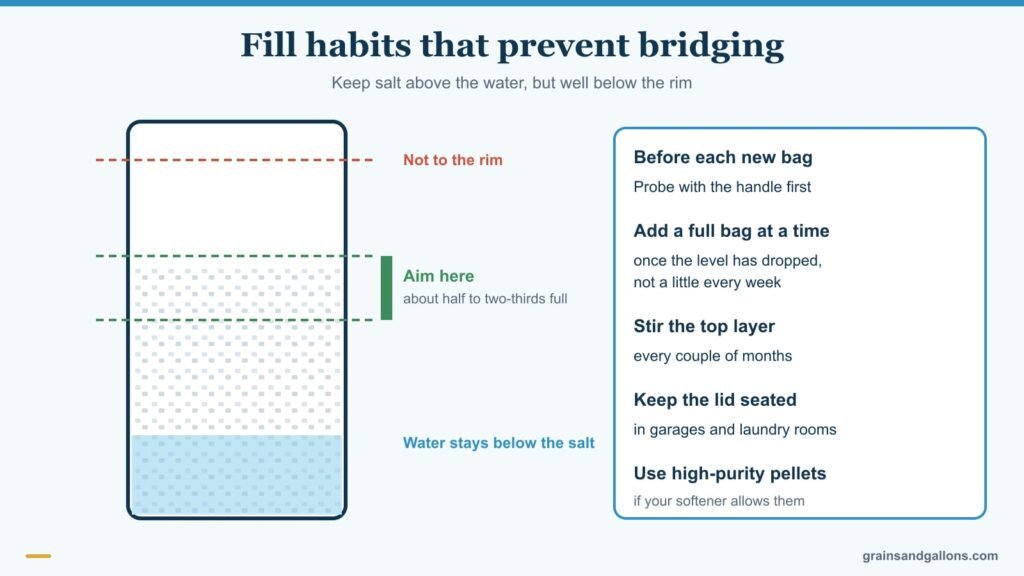
- Fill to about half or two-thirds, not to the rim. Keep the salt above the water level. How full a brine tank should be covers the details by tank design.
- Probe before every new bag. The broom-handle check takes a minute and catches a bridge before it costs you weeks of hard water.
- Stir the top layer every couple of months, even if it isn't fully bridged.
- Keep the lid seated in damp garages and laundry rooms, and don't store the softener next to a dryer vent if you can avoid it.
- Switch salt if the problem follows you. If you're on rock or solar salt and still bridging, try high-purity evaporated pellets. Our picks for the best water softener salt are a good starting point.
- Consider a salt level sensor. A sensor won't see a bridge directly, but an alert that the level hasn't changed in weeks is a useful prompt; see our salt level sensor picks.
A one-minute check beats weeks of hard water
A water softener salt bridge doesn't damage anything by itself. It's the weeks of unnoticed hard water that hurt your fixtures, water heater and skin. Make the broom-handle test part of every salt refill, keep the tank around half full, use clean salt in a dry spot, and you'll rarely have to break one again.
FAQ
How do I know if I have a salt bridge in my water softener?
The salt level stops dropping while hard-water signs come back. Push a broom handle down through the salt: if it hits a hard crust and then breaks through into empty space or water, you have a bridge.
Can I use hot water to break up a salt bridge?
Use a few cups of warm water to soften a stubborn crust, then tap it apart. Avoid boiling water, which can stress plastic tank parts, and don't add so much that you raise the water level in the tank.
How often should I check for a salt bridge?
Check every time you add salt, and at least once a month in humid locations such as garages and laundry rooms. The broom-handle test takes about a minute.
What's the difference between a salt bridge and salt mushing?
A bridge is a hard crust near the top with an air gap below it. Mushing is a sludge of recrystallized salt at the bottom of the tank. A bridge breaks apart with gentle tapping; mushing usually means draining the tank and replacing the salt.
Will a salt bridge damage my water softener?
Not directly. The softener keeps regenerating, but with weak brine, so the resin doesn't recharge and hard water reaches your plumbing and appliances. The damage comes from the scale that builds up while the bridge goes unnoticed.