

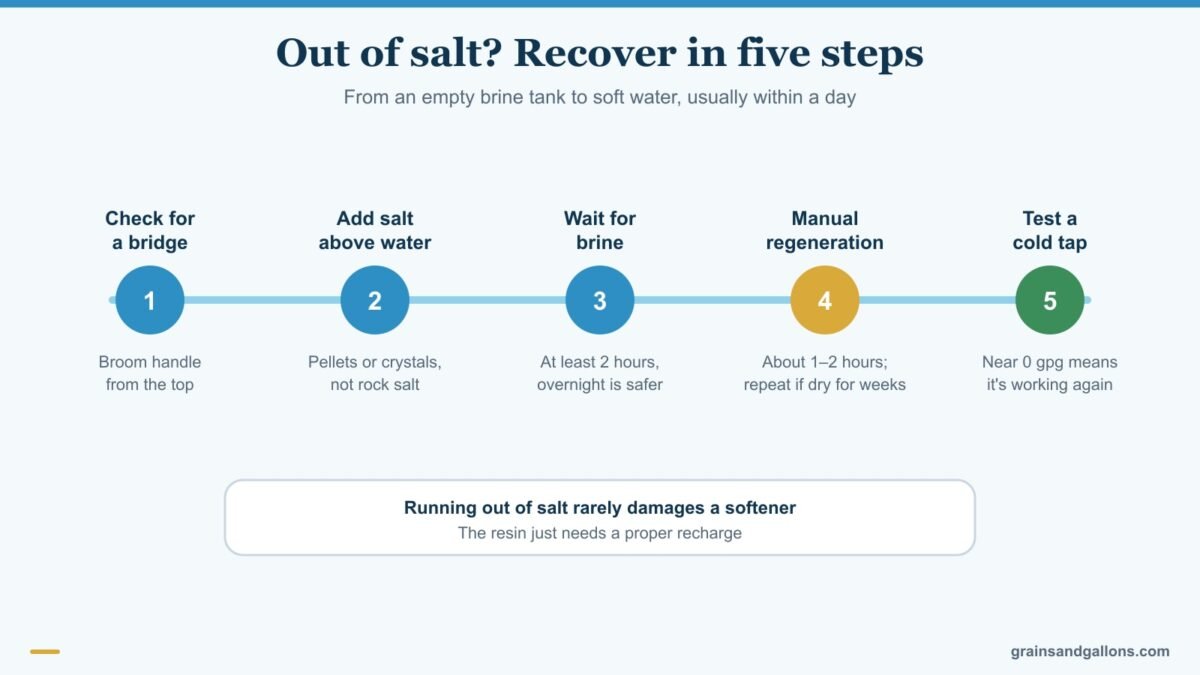
Quick Answer: If your water softener ran out of salt, refill the brine tank with softener salt, wait at least a couple of hours (overnight is better) so the water in the tank turns into strong brine, then start a manual regeneration. If it ran dry for weeks, run a second regeneration the next day. Running out of salt almost never damages a softener; the resin has just been passing hard water since its last real recharge.
When a water softener ran out of salt, you usually notice it in the shower first, or the dishes come out spotted, or you lift the brine tank lid and see bare plastic and a few inches of plain water. The softener kept regenerating on schedule, but with no salt to make brine it rinsed the resin with plain water and called it a day.
As Penn State Extension's water softening guide explains, once resin has given up its sodium it's "spent" and has to be regenerated with brine before it can soften again. Nothing is broken. Here's how to recover.
In this guide
Signs your softener is out of salt

Hard water comes back gradually as the last good charge wears off, so the clues pile up over a few days:
- Soap and shampoo don't lather the way they did, and skin feels tacky after a shower.
- Glasses come out of the dishwasher spotted or cloudy.
- White crust starts reappearing on faucets and showerheads.
- A hardness test strip at a cold tap reads well above zero.
- Some electronic valves show a low-salt or "no brine" message.
The quickest confirmation is the lid: if you can see the bottom of the tank or plain water with no salt in it, you've found the problem.
Check for a salt bridge before you refill

Before dumping in a bag, make sure the tank is actually empty. Push a broom handle down from the top. If it stops on a crust with empty space underneath, that's a salt bridge, not an empty tank, and pouring more salt on top makes it worse. Pentair's 5600SXT manual says to pound the bridge apart with a broom handle or similar rod, wait 2 hours, then start a regeneration, adding that a second recharge may be needed.
If the tank really is empty, look at the water level. A few inches to about a foot of water at the bottom is normal for most designs. If the tank is nearly full of water with no salt, you have a second problem, usually a stuck float or a refill that won't shut off, and it's worth sorting out before you add salt.
Getting soft water back after the water softener ran out of salt

Add salt, but not to the brim
Pour in enough softener salt to sit well above the water line. Pentair says its system's salt tank works best with the salt level below half-full, because overfilling invites bridging. How much salt to keep in a brine tank covers other tank types.
Use pellets or crystals made for softeners. The Fleck 5600SXT downflow manual says not to use granulated or rock salt, and Pentair's system manual warns that rock or snow-melting salt contains dirt and chemicals. Our picks for the best water softener salt compare the cleaner options.
Give it time to make brine
Fresh salt dropped into plain water doesn't instantly make saturated brine. Regenerate immediately and the softener may draw weak brine and only partly recharge the resin. Two hours is the minimum Pentair gives after breaking up a bridge; waiting overnight is the safe bet. Many people add salt in the evening and start the manual regeneration the next morning.
Brine looks just like water. If you dip a finger in and taste it (then rinse your mouth), it should be intensely salty.
Run a manual regeneration
Every control valve has a way to start an immediate regeneration, usually a button you hold for a few seconds or a knob you turn. Use your manual or our guide to manually regenerating a water softener, which covers the common valves.
A full regeneration typically runs an hour or two. Avoid using hot water during that time; on most single-tank systems the house gets unsoftened water while it regenerates. You should see water going to the drain and the brine tank level dropping as brine is drawn out, then refilling.
Decide whether you need a second regeneration
If the tank was only empty for a day or two, one good regeneration is usually enough. If it ran dry for weeks, the resin is fully exhausted, and a second regeneration the next day makes sure the bed is fully recharged. On metered units, it also keeps you from running out of soft water before the meter catches up.
Test, then let the hard water flush out
Test a cold tap after regeneration. A reading near zero means the softener is working again. Your water heater is still full of hard water, though, and it turns over in a day or so of normal use, so expect a few lingering spots until then.
If you still test hard after two regenerations with good salt, the problem isn't salt. Check whether brine is actually being drawn and work through softener still not working after adding salt.
Did running out of salt damage anything?
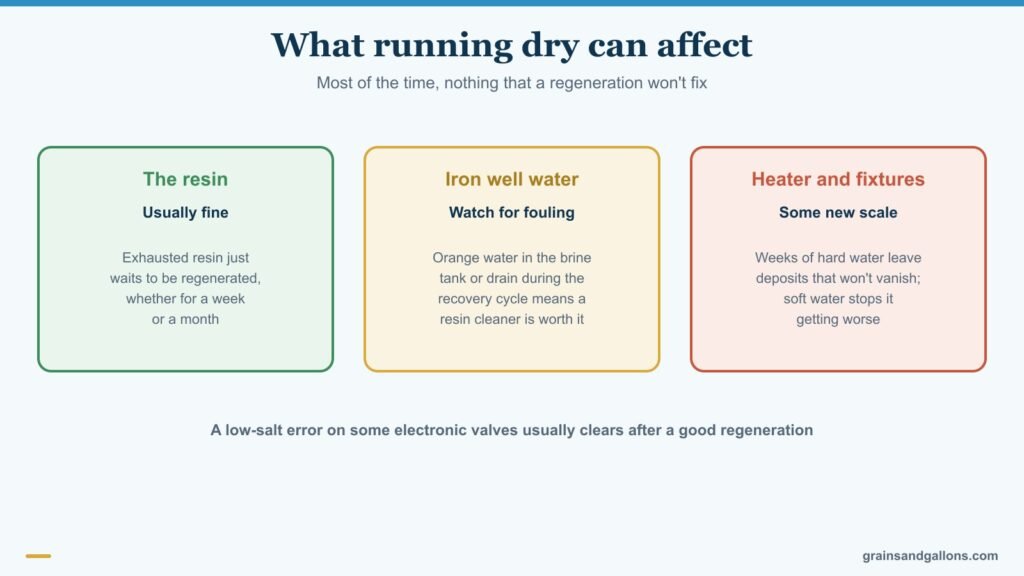
Usually not. Ion-exchange resin doesn't care whether it sits exhausted for a week or a month; it just waits to be recharged. A few edge cases are worth knowing:
- Iron in your water. Penn State notes that oxidized iron clogs resin. If the brine tank or drain water looks orange during the recovery regeneration, follow up with one of the resin and iron cleaners made for softeners.
- Water heater and fixtures. Weeks of hard water mean some new scale. It won't disappear by itself, but soft water keeps it from getting worse.
- Error codes. A few electronic units show a low-salt warning after a dry regeneration. It usually clears once salt is back and a good regeneration runs; if not, the manual explains the reset.
Keep the brine tank from running dry again
Lift the lid once a month. Mark each refill date on the lid with a marker, and after a few refills you'll know exactly how long a bag lasts in your house. If you tend to forget, a salt level sensor sends a phone alert before you run low, which helps most with softeners in a crawl space or garage. Top up before a long trip, too; water feels hard after vacation covers what happens while you're away.
FAQ
What happens if a water softener runs out of salt?
It keeps regenerating, but with plain water instead of brine, so the resin never recharges. Hard water flows through to the house until you add salt and run a proper regeneration. The softener itself is almost never harmed.
How long after adding salt will my water be soft?
Allow at least a couple of hours for brine to form (overnight is better), then about one to two hours for a manual regeneration. Most homes have soft water at the taps within a day.
Do I need to regenerate after adding salt?
Yes, if the tank ran empty. The next scheduled regeneration would eventually do it, but a manual regeneration after the brine has formed gets soft water back sooner. Run two if it was dry for weeks.
Can running out of salt damage the resin?
Not usually. Exhausted resin simply waits to be recharged. The exception is iron-bearing well water, where the resin can foul while it sits; a softener resin cleaner usually fixes that.
How full should the brine tank be?
Keep salt above the water line but don't pack it to the rim. Pentair says its system works best with the salt below half-full, which also reduces the risk of salt bridges.
Refill, wait for brine, then regenerate
When a water softener ran out of salt, the fix takes a day, not a service call. Rule out a salt bridge, add softener salt to about half full, give it time to make brine, and run a manual regeneration, plus a second one if it sat dry for weeks. Then test a cold tap, and put a monthly salt check on the calendar so it doesn't happen again.