


Quick Answer: How much salt in a brine tank is enough? Keep it at least a quarter full, and aim for about half to two-thirds full, with the salt always sitting a few inches above the water line. Refill before it drops below a quarter. Don't pack it to the lid, especially in a humid basement, because a tall, damp column of salt is more likely to bridge. If you use potassium chloride, many manuals say not to fill past halfway.
You lifted the lid, looked down at a pile of salt and some water, and realized you don't know what "right" looks like. That's normal. The softener's manual usually covers this in one line, and most people never see that line. Here's how the tank works, what you should see, and what should make you look closer.
In this guide
What the salt in the tank is actually doing

The brine tank isn't feeding salt to the softener continuously. It's a storage bin with a small pool of water at the bottom. After each regeneration (or just before, on some valves), the control refills that pool with a measured amount of water. The water sits in contact with the salt and dissolves it until it's saturated brine, which takes a few hours.
Saturated brine holds roughly 3 pounds of salt per gallon of water. You can see that number in Fleck's own parts data, which rates its brine refill flow controls in both gallons per minute and pounds of salt per minute: a 0.5 gpm refill control is listed at 1.5 lbs of salt per minute (Fleck 5600 service manual). So the amount of refill water sets the salt dose. The pile of salt above it is just your supply.
That's why there's no benefit to cramming the tank full. As long as undissolved salt sits in that pool of water, the brine reaches full strength. More salt on top only means fewer trips to the store, plus a bit more risk of bridging.
How much water should be in there?
It depends on the softener. On many conventional softeners, the tank refills after regeneration, so there's always some water at the bottom, often several inches to about a foot deep depending on the salt dose and tank diameter. Some valves refill shortly before regeneration instead, which leaves the tank looking dry most of the time. Both are normal.
What isn't normal is a lot of water standing above the salt, or water creeping toward the overflow fitting. That usually means the softener isn't drawing brine during regeneration, or the refill isn't stopping. Our guide on a brine tank full of water or overflowing works through those causes.
How much salt in a brine tank, level by level

| Level | What it means | What to do |
|---|---|---|
| Salt below a quarter full | You're getting close to running dry | Refill now. Whirlpool's manuals say "always add if less than 1/4 full" |
| Half to two-thirds full | Comfortable working range | Nothing; check again in a few weeks |
| Packed to the lid | Fine on a dry day, riskier in humid spaces | Next time, fill a little less and a little more often |
| Water visible above the salt | Either the salt is low or the tank is overfilling with water | Add salt, then watch the water level after the next regeneration |
| Salt looks full but water level is high and the salt feels hollow | Possible salt bridge | Probe it with a broom handle (see below) |
The quarter-full minimum exists because salt has to stay in contact with the refill water. Let it drop below that and the next refill may not find enough salt to make full-strength brine, so the resin is only partly regenerated and hardness creeps through. Once it's out completely, you'll get hard water within a cycle or two.
If you want to mark your own tank with refill and stop lines, our guide to how full a water softener salt level should be shows how to do it in a few minutes and how many bags fit between the lines.
How often you'll be adding salt
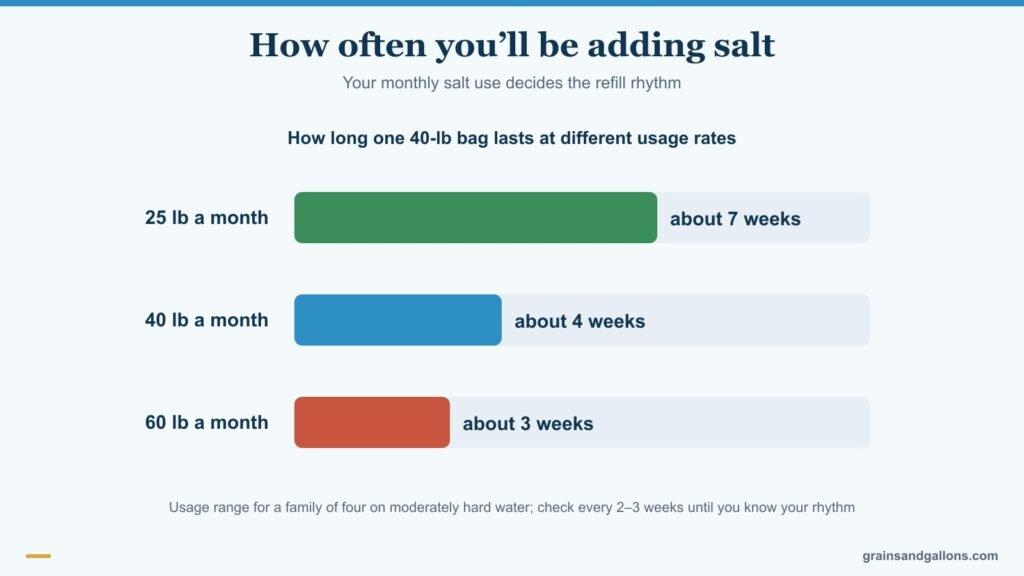
Divide the salt you add by how much your softener uses per month. A family of four with moderately hard water on an efficient setting might use around 25 to 60 pounds a month, so a 40-lb bag could last anywhere from about three to seven weeks. Our explainer on how much salt a water softener uses shows how to work out your own monthly number.
A big tank could go months between refills, but most people find it easier to add one bag every few weeks than to wrestle five bags in at once, and smaller top-ups also keep the salt column shorter and drier. Until you know your rhythm, Whirlpool's manuals suggest checking every two or three weeks (Whirlpool owner's manual example). Once you've seen how fast it drops, set a recurring reminder.
If you'd rather not lift the lid at all, sensors that sit in the tank can warn you when salt drops below a set level. We compare a few in the best water softener salt level sensors.
Humid basements call for less salt, more often

The manuals for GE and Whirlpool cabinet softeners both say the same thing about humid areas: fill with less salt, more often. Moisture wicks up through the salt pile. Near the water line the salt dissolves; higher up, it can dissolve slightly and then re-harden into a crust. That crust is a salt bridge, and it can leave an empty cavity between the salt and the water.
From the top, a bridged tank looks full. But the water below isn't touching any salt, so regeneration runs on weak brine and you start getting hard water. A tall column of salt in a damp room gives moisture more surface to work on, which is why a half-full tank refilled often bridges less than a packed one refilled rarely.
Probe for a hidden salt bridge before you pour
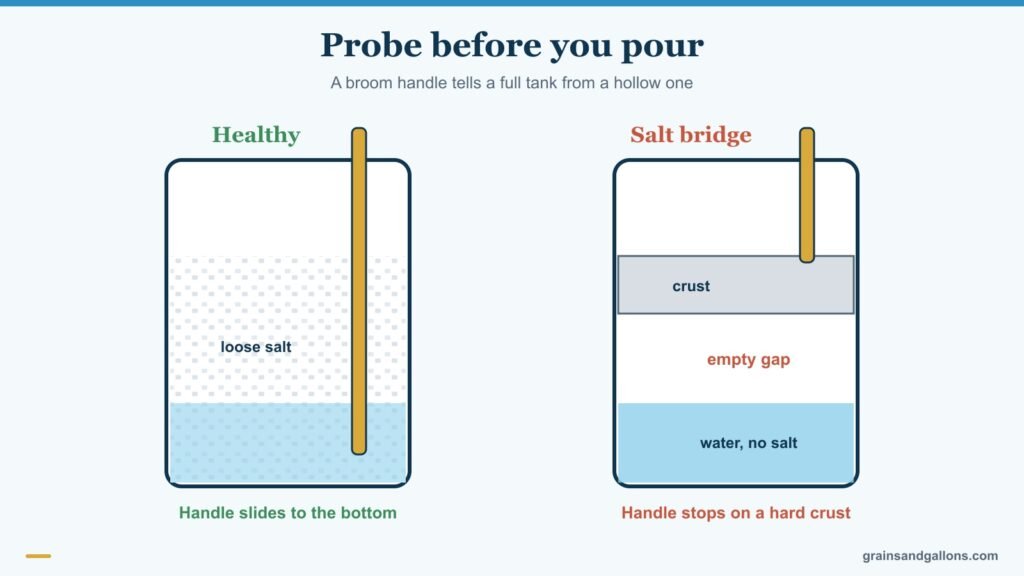
Push a broom handle straight down into the salt before each refill. Salt should be loose all the way to the bottom. If the handle hits something solid partway down, and especially if it then drops into empty space, you've likely got a bridge.
Break it up gently from the top, working the handle around the crust, and don't pound on the tank walls; plastic tanks crack. See how to break up a water softener salt bridge for the full process, including what to do after a bridge has left you with hard water.
The type of salt changes the safe fill level
Pellets are the most forgiving. They hold their shape, stack loosely and let water circulate. If you're not sure what to buy, start there.
Solar crystals work well in many softeners but can be more prone to bridging in some tanks, especially in humid conditions.
Potassium chloride is a sodium-free alternative. It's more likely to cake, and Whirlpool's manuals say not to fill past halfway (or past a specific mark on the brine well decal on some models). Follow your model's limit.
Rock salt, block salt and table salt aren't recommended in most home softeners. Rock salt carries dirt and insoluble material that settles in the tank, and finer salts can compact and turn to sludge. If you've already got a gray, oatmeal-like layer in the bottom, our guide on salt mushing in the brine tank explains how to clear it. For a side-by-side on brands and types, see the best water softener salt.
Refill at a quarter, stop at two-thirds
That's the whole answer to how much salt in a brine tank: enough to stay above the water, never so much that it's packed to the lid. A routine that keeps it there:
- Let the level drop to about a quarter full.
- Probe with a broom handle and break up any crust before adding new salt.
- Add salt until the tank is roughly half to two-thirds full, keeping it away from the top of the brine well.
- Close the lid fully to keep out dust, moisture and bugs.
- Once a year or so, let it run low and check the bottom for sludge. If there's a thick layer, clean the tank.
FAQ
Can I put too much salt in a brine tank?
You won't oversalt the water by piling more on, because the refill water sets the dose. But a tank packed to the lid in a humid space bridges more easily, and with potassium chloride many manuals set a halfway limit.
Should the salt in the brine tank be wet?
The bottom layer sits in brine and will be wet. Damp, crusty salt high up near the lid isn't ideal; that's where bridges form.
Do I need to add water to my brine tank?
Normally no. The softener adds its own measured water. If the tank has no water at all after a regeneration on a valve that refills afterward, something in the refill path needs attention.
How much salt should be above the water line?
Keep the salt a few inches above the water at all times. If you can see water standing above the salt, either you're low on salt or the tank is taking on too much water.
Is it bad to let the brine tank run out of salt?
Yes. Without salt in contact with the refill water, the softener regenerates with plain or weak brine and hard water returns within a cycle or two. Refill, wait for the brine to saturate, then run a manual regeneration.