

Quick Answer: For most softeners, a high-purity pellet is the safe default. Morton Clean and Protect and Diamond Crystal Bright & Soft both work in nearly any brine tank. If you own a separate-tank softener and want to spend less per bag, Diamond Crystal Solar Naturals crystals are a good match. If your water has a little iron and the bottom of the brine tank turns orange, switch to Diamond Crystal Iron Fighter.
Disclosure: As an Amazon Associate, Grains & Gallons earns from qualifying purchases.
Here's something the salt aisle won't tell you: as long as the salt is the right form for your brine tank and reasonably pure, your softener can barely tell one bag from the next. Every bag on this list is at least 99% sodium chloride. The real differences are the shape of the salt, whether it carries an additive, and how much insoluble grit it leaves behind. Those are the things that cause problems in year two or three.
So the right question isn't "which brand is best?" It's "which salt won't bridge, mush or foul in my tank?" The rest of this page answers that.
In this guide
- Pellets or crystals? Let your brine tank decide
- At a glance
- Morton Clean and Protect: the default if you just want it to work
- Diamond Crystal Bright & Soft: plain salt, very little grit
- Diamond Crystal Solar Naturals: crystals for the classic two-tank setup
- Morton Pure and Natural: the crystal option from the brand you'll find everywhere
- Diamond Crystal Iron Fighter: for modest iron only
- How we narrowed it down
- Three mistakes that cost more than the salt
- Quick picks by situation
Pellets or crystals? Let your brine tank decide
Pellets are evaporated salt that's been compressed into pillow-shaped pieces. They're very pure, dissolve evenly and suit almost any softener. That includes the all-in-one cabinet units sold at big-box stores, where the brine well sits inside a small, cramped salt compartment.
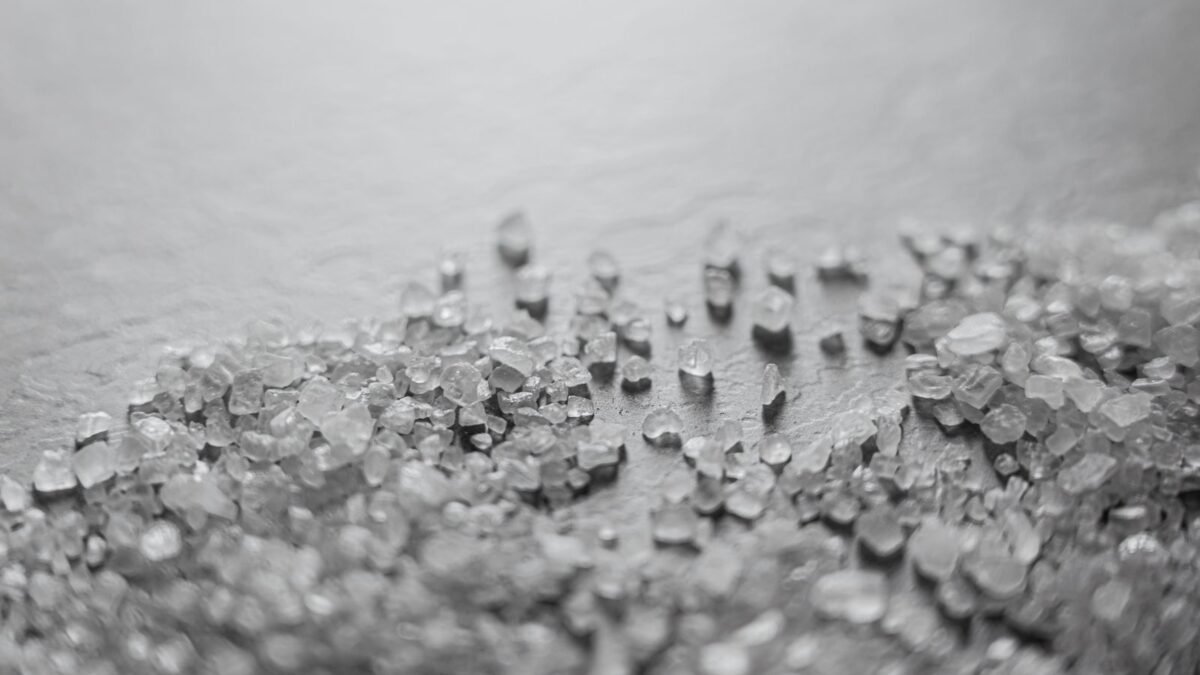
Crystals (often sold as "solar salt") are made by evaporating seawater or brine in open ponds. Diamond Crystal rates its Solar Naturals at a typical 99.6% purity, a hair lower than its pellets. Crystals cost less per bag in many areas. They work best in a traditional two-tank softener, where the brine tank is tall and open.
Here's the rule of thumb:
- Cabinet-style softener (one box, salt lid on top): use pellets unless the manual says otherwise. A small salt compartment is more prone to salt bridging, and many cabinet manuals call for pellets.
- Two-tank softener (resin tank plus a separate brine tank): either form works. Crystals are often the better value, and they're less likely to turn into sludge if your tank is prone to mush.
- Your tank keeps forming a sludge layer at the bottom: try a different form of salt before you blame the softener. Diamond Crystal's own FAQ suggests switching between crystals, pellets and cubes when bridges or mush keep coming back. Our guide to salt mushing covers the cleanup.
At a glance
| Salt | Form | Additive | Best for |
|---|---|---|---|
| Morton Clean and Protect | Pellet | Yes, tank-cleaning additive | Almost any softener, especially cabinet units |
| Diamond Crystal Bright & Soft | Pellet | No | Anyone who wants plain, high-purity salt |
| Diamond Crystal Solar Naturals | Crystal | No | Two-tank systems, value buyers |
| Morton Pure and Natural | Crystal | No | Two-tank systems where Morton is easier to find |
| Diamond Crystal Iron Fighter | Pellet | Yes, iron-targeting | Water with modest iron and orange tank stains |
Morton Clean and Protect: the default if you just want it to work
This is the bag most people end up buying, and there's a reason for it. Morton puts its pellets through a proprietary additive package meant to reduce buildup in the brine tank. Third-party comparisons list the pellets at up to 99.65% sodium chloride. The pellets are uniform enough that they slump evenly as they dissolve. That lowers the chance of a hollow bridge forming over the water line.
Choose it if: you have a cabinet softener, you don't want to think about salt, or you've had bridging trouble before.
Skip it if: you prefer salt with nothing added. The additive is harmless to softeners, but if you'd rather keep things plain, the Diamond Crystal pellet below is just as practical.
The listing linked here is a two-pack of 40 lb bags. Larger multi-bag packs are also sold. Salt is heavy and bulky, so compare the per-bag math before you order.
Diamond Crystal Bright & Soft: plain salt, very little grit
Bright & Soft is Diamond Crystal's standard pellet. Diamond Crystal rates it at a typical 99.8% purity and more than 99.7% water soluble. There's no additive and no scent. The link here is two 40 lb bags. Because the insoluble content is low, it leaves very little sediment behind, so you'll clean the tank less often.
This is the pellet we'd point a well-water household toward when the water is hard but clean, with no iron and no tannins. It doesn't try to do anything clever. It just dissolves and makes brine.
The one honest downside is availability. In some regions you'll find Morton on every shelf and Diamond Crystal only in a few stores, which is part of why ordering online makes sense here.
Diamond Crystal Solar Naturals: crystals for the classic two-tank setup
If your softener has a separate brine tank (an AFWFilters Fleck system, a Clack-valve unit, an older dealer softener), crystals make a lot of sense. Diamond Crystal rates Solar Naturals at a typical 99.6% purity with low insolubles and recommends it for all softener types. Bags come in 40 lb and 50 lb sizes. The link here is a 40 lb three-pack.
Two caveats are worth knowing:
- Solar salt carries slightly more insoluble material than pellets, so over a few years you'll see a little more sediment at the bottom of the tank. Plan on rinsing the tank out every year or two.
- In a short cabinet softener, irregular crystals can pack together. If yours is a cabinet unit, buy pellets.
Morton Pure and Natural: the crystal option from the brand you'll find everywhere
This is Morton's crystal salt. It does the same job as Solar Naturals, and which of the two you buy mostly comes down to what's cheaper and easier to get where you live. Morton doesn't publish a purity figure for this line on the pages we could access, so we can't claim it beats Diamond Crystal on that point. In practice, both perform well in two-tank softeners.
It's sold here in a 40 lb four-pack. Store-sized single bags are common in hardware stores too.
Pick this over Solar Naturals when: your local hardware store stocks Morton and you want to stay with one brand so you're not mixing salts. Mixing is usually fine, but some owners like consistency.
Diamond Crystal Iron Fighter: for modest iron only
Iron is where salt choice actually matters. A standard softener can handle a small amount of dissolved (ferrous) iron, but over time some of it stays on the resin and slowly fouls it. Iron Fighter pellets are made to tackle hardness and iron together and help prevent rust stains. Diamond Crystal rates them at 99.6% pure and virtually 100% water soluble, and says they resist mushing and bridging. If you're seeing orange staining in the brine tank or rust rings in the toilets, this is the bag to try. The link here is two 40 lb bags.
Be clear-eyed about its limits. Rust-fighting salt is maintenance, not treatment. If your test shows more than a couple of ppm of iron, or the iron is already orange when it comes out of the tap (oxidized), you need a dedicated iron filter ahead of the softener. Our article on whether a water softener can remove iron walks through where that line falls.
Also keep in mind that iron-fighting salts aren't meant for every setup. If you drink softened water and have questions about the additive, read the bag label and check with the manufacturer.
Downside: it costs more per bag than plain pellets, and if your water has no iron the additive has nothing to do. Diamond Crystal sells it in several pack sizes, so compare the per-bag math before you order.
How we narrowed it down
We started with the salts that are actually sold in US stores and online and threw out anything that's not meant for softeners: rock salt, ice-melt and food-grade salt. For each remaining product, we looked at the manufacturer's purity rating and what each additive is supposed to do. We read through owner complaints about bridging and sludge, and we checked that each one is sold as a real, single-product Amazon listing instead of a shady reseller bundle. Potassium chloride has its own trade-offs, so it isn't on this list.
Three mistakes that cost more than the salt
Using rock salt. It's cheap, but it can carry a lot of insoluble material, which ends up as sludge in your brine tank and can foul the brine valve. A few dollars saved per bag isn't worth a clogged injector.
Filling the tank to the brim. More salt doesn't make softer water. A tall, packed column is how you get a bridge. Keep the salt a few inches above the water line and top it up when it's about a quarter full. Our guide to how much salt a softener uses explains how to estimate monthly use from your hardness and household size.
Storing bags on a damp basement floor. Bags that soak up moisture turn into a single solid block. Keep them on a pallet or a shelf. There's more on this in our guide to storing, changing and disposing of softener salt.
Quick picks by situation
- Cabinet softener, city water: Morton Clean and Protect or Diamond Crystal Bright & Soft.
- Two-tank softener, clean well water: Solar Naturals or Morton Pure and Natural.
- Orange stains, under about 1–2 ppm iron: Iron Fighter pellets, plus a resin cleaner a few times a year.
- Heavier iron: fix it with an iron filter first. Salt alone won't keep up.
- Sodium restrictions in the house: look at potassium chloride instead, or put a reverse osmosis faucet at the kitchen sink.