

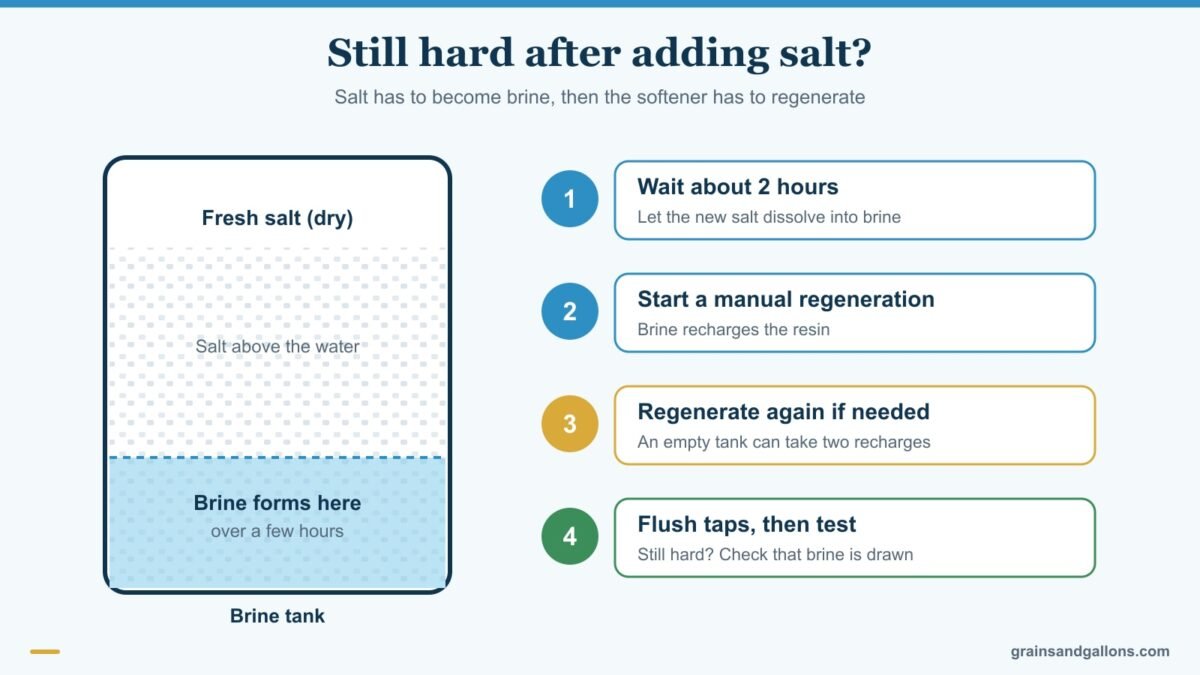
Quick Answer: A water softener not working after adding salt is usually just early. Salt has to dissolve into brine first (give it about two hours), and then the softener has to regenerate before the resin can soften anything. Start a manual regeneration once the brine has formed, run a second one the next day if the tank sat empty for a long time, and flush your taps before testing. If the water is still hard after that, check that the brine level actually drops during regeneration.
You noticed the spots, lifted the lid, found an empty brine tank and poured in a couple of bags. That was yesterday, and the water still feels hard. If your water softener is not working after adding salt, it's tempting to think something broke while the tank was empty.
Probably nothing did. Most of the time this is timing: you fixed the cause, but the softener hasn't had a chance to act on it yet. Here's what happens inside the tanks hour by hour, how long you should expect to wait, and what to check if the timeline runs out and the water is still hard.
In this guide
- Why adding salt doesn't soften the water by itself
- Wait for brine, then regenerate by hand
- Why the first regeneration may only partly recharge the resin
- How long after adding salt will water be soft?
- Flush the pipes and water heater before you test
- Water softener not working after adding salt and two regenerations?
- Prove the softener is actually drawing brine
- Brine first, two regenerations, then the brine-draw test
- FAQ
Why adding salt doesn't soften the water by itself
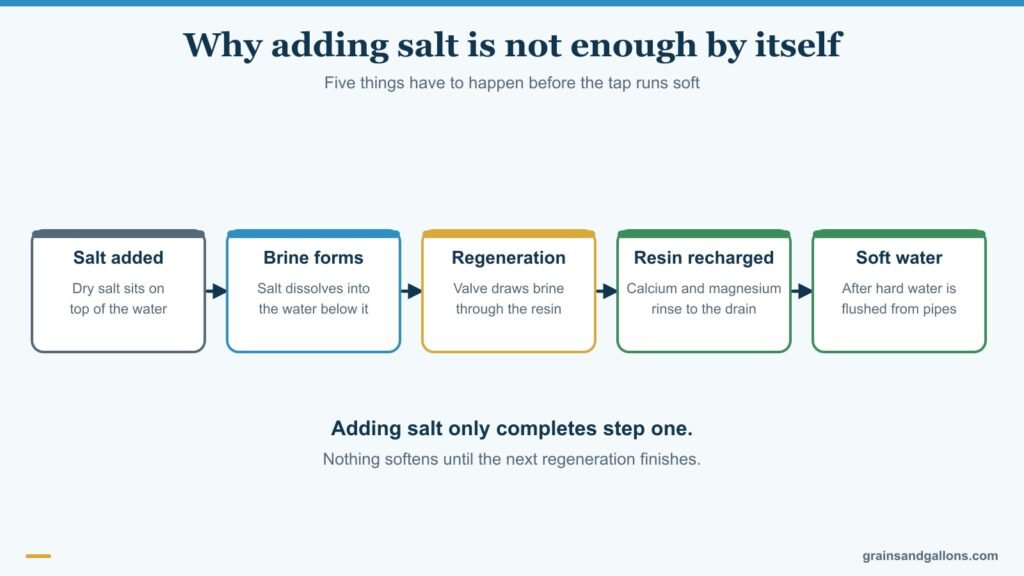
The salt never touches your drinking water directly. A softener works by passing water through a tank of resin beads that trade sodium for calcium and magnesium. Once every exchange site on the beads is holding hardness, Penn State Extension notes, the resin is spent and will no longer soften water until it's recharged.
Recharging is what regeneration does. The control valve pulls salty water (brine) out of the brine tank, runs it through the resin to strip off the hardness, rinses it to the drain and refills the brine tank for next time. So when the tank ran out of salt, the softener kept regenerating, but with plain water. The resin went into the next cycle still loaded with hardness, and hard water went straight through to the house.
Adding salt fixes the supply. It doesn't recharge the resin that's already exhausted. That only happens at the next regeneration that has proper brine to work with.
Wait for brine, then regenerate by hand
Dry salt sitting on top of water does nothing for the resin. The softener needs a saturated salt solution at the bottom of the brine tank, and fresh salt poured onto a tank of plain water takes time to get there. Pentair's 5600SXT owner's manual gives a useful benchmark: after freeing up salt that wasn't reaching the water, wait two hours and then start a regeneration. If you start one the moment the bags are empty, you may get a weak recharge.
While the lid is off, look for water in the bottom of the brine tank. Many softeners keep several inches of water under the salt between regenerations; some refill only right before brining. If the tank is bone dry and stays that way after a cycle, you have a different problem, covered in no water in the brine tank.
Don't wait for the softener's own schedule. A metered valve might regenerate tonight, but a timer unit could be days away. Trigger a manual regeneration instead: most valves have a "regen" button or a dial you turn by hand, and our guide on how to manually regenerate a water softener covers the common types.
A regeneration typically takes an hour or two. During that time the valve sends untreated water to the house, so avoid running the dishwasher, laundry or showers until it finishes. Starting it in the evening, when the house is quiet, works well.
Why the first regeneration may only partly recharge the resin
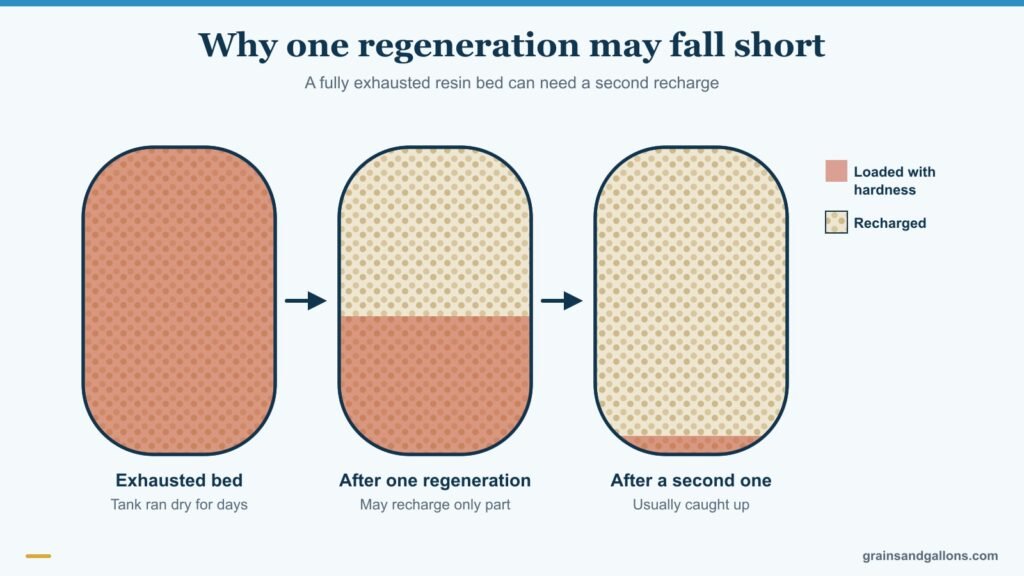
A normal regeneration is sized to recharge a resin bed that has been used up to its programmed capacity. A bed that has been running with no brine for a week or two is loaded with calcium and magnesium all the way down, and one brine dose doesn't always catch it up.
Pentair says it plainly: after the salt problem is fixed, "a second recharge may be needed to fully recondition the media." That's why the usual advice is one regeneration as soon as the brine is ready, and a second one the following day if the first doesn't get you to soft water.
Two regenerations use a little more salt and water than one, but it's cheaper than calling someone out to tell you to wait.
How long after adding salt will water be soft?
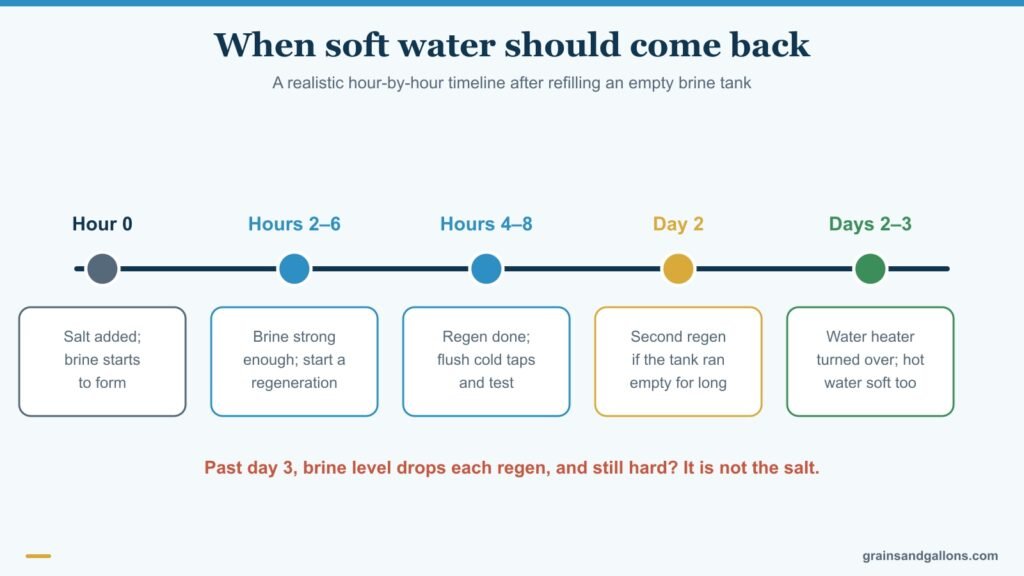
Here is a realistic timeline when the brine tank had run empty and you've just refilled it:
| When | What should be happening |
|---|---|
| Hour 0 | Salt added; water at the bottom of the tank starts to saturate |
| Hours 2–6 | Brine is strong enough; a good time to start a manual regeneration |
| Hours 4–8 | Regeneration finished; softened cold taps improve after flushing |
| Day 2 | Second regeneration if the tank sat empty for a long time |
| Days 2–3 | Water heater has turned over; hot water feels soft too |
The cold taps come back first. Hot water lags because your water heater is full of hard water that went in while the softener wasn't working, and it only gets replaced as you use it. Pentair's troubleshooting table lists "hot water tank hardness" as its own cause of hard water, with repeated flushing of the heater with treated water as the fix.
If you're past day three, the brine level drops during each regeneration, and the softened tap still tests hard, the problem isn't the salt.
Flush the pipes and water heater before you test
The water in your pipes right after a regeneration is the hard water that sat there while the softener was out of action. Test it straight away and you'll get a hard reading even if the resin is fully recharged.
- Run a cold tap for a few minutes after the regeneration ends. A kitchen tap is fine if it's on softened water; some kitchens are plumbed to bypass the softener, so check.
- Test with a hardness strip or drop kit. A softened tap should read close to zero. Our guide on how to test water hardness at home explains strips versus titration kits.
- Compare with an unsoftened tap, such as an outdoor spigot. If both read the same, the softener isn't treating the water at all, which points to the bypass or the valve.
- Speed up the hot side. Running a hot bath or a load of laundry turns the water heater over faster than waiting for normal use.
Skin feel and soap lather are poor tests on day one. Spots on glassware take a few washes to fade even after the water is soft.
Water softener not working after adding salt and two regenerations?

Work through these in order. The first one that fails is usually your answer.
Is the bypass in the service position?
It sounds obvious, but bags of salt get set down on bypass handles, and people sometimes put the softener in bypass while they deal with the tank. Pentair lists an open bypass valve as the first cause of hard water. If an unsoftened tap and a softened tap test the same, start here.
Does the valve have power and the right time?
A softener that lost power can sit with a blank display, or come back with the clock reset so it regenerates at 2 p.m. instead of 2 a.m. Check the plug, outlet and breaker, and reset the time of day.
Is the new salt sitting on a salt bridge?
If you poured fresh salt onto an old crust, the crust can stay in place with a hollow gap underneath, and the new salt never reaches the water. Push a broom handle down through the salt and feel for a hard shelf. Pentair's advice is to pound the bridge until the pellets collapse, wait two hours, then regenerate. It also notes that the salt tank works best below half full, because overfilling is what encourages bridging. Our full guide to a water softener salt bridge covers clearing a stubborn one.
Did you use the right salt?
Softener pellets, evaporated crystals and solar salt all work. Pentair warns that rock salt and snow-melting salt contain dirt and chemicals that affect the softener. If you grabbed the wrong bag, read used rock salt in a softener? what to do now. Our salt pellets vs crystals comparison and best water softener salt picks explain which forms bridge and mush less. If the trouble started right after you changed brands or types, see softener stopped working after a salt change.
Is the hardness setting still right?
A power loss rarely wipes the hardness setting, but a reset or a new control board can. If the softener regenerates and draws brine but runs out early, check the setting against a fresh test of your raw water. Our guide on how to set hardness on a water softener walks through it.
Was the empty tank a symptom, not the problem?
Sometimes the salt ran out because something else is wrong. A softener regenerating too often burns through salt quickly, and a brine valve that sticks open can send brine down the drain. If you're refilling much sooner than you used to, look into it before the tank empties again.
Prove the softener is actually drawing brine
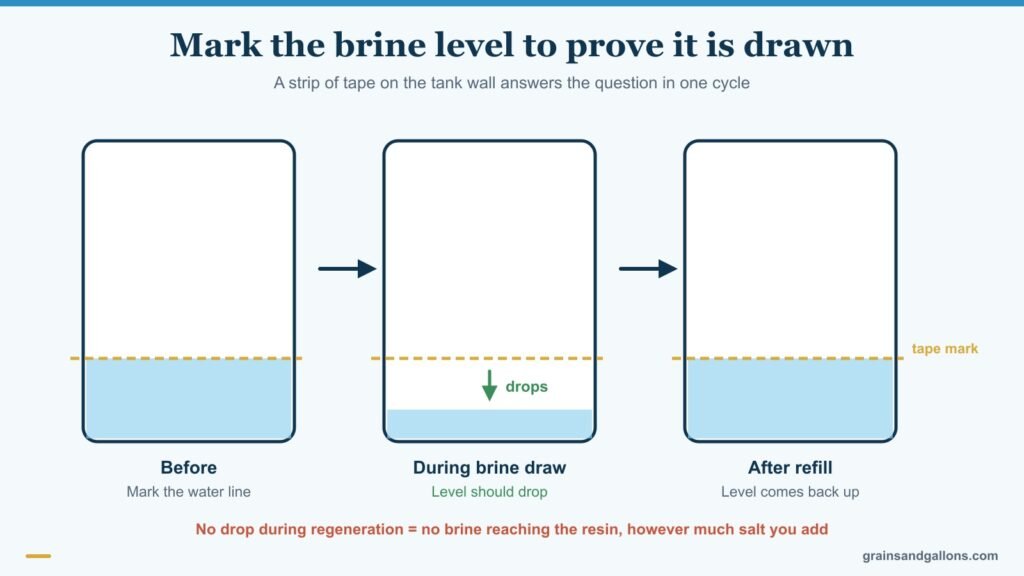
This is the test that separates "not enough time" from "something is broken." Put a strip of tape on the outside of the brine tank at the water line (or on the brine well inside it), start a manual regeneration, and check during the brine draw step and again at the end.
- Level drops, then refills: the softener is pulling brine. Salt delivery is fine; look at settings, resin age and iron fouling.
- Level never moves: no brine is reaching the resin, and adding more salt won't change that.
When the level doesn't move, Pentair's troubleshooting table points to a plugged injector or injector screen, a plugged drain line flow control, an internal valve leak, or line pressure below 20 psi. A cracked or loose brine line that sucks air instead of brine does the same thing. Start with the cheapest fixes: clean the softener injector and check for a clogged brine line. Those two cover most brine-draw failures on home units.
Call a service tech if the injector and brine line are clean and the level still doesn't drop, if the valve shows an error code, or if the resin is old enough that it may simply be worn out. Penn State Extension notes that resin fouled by iron or sediment sometimes can't be cleaned and has to be replaced.
Brine first, two regenerations, then the brine-draw test
A water softener not working after adding salt usually needs patience plus a manual nudge: let the brine form for a couple of hours, regenerate, regenerate again the next day if the tank was empty for long, and flush the pipes and water heater before you judge. If it's still hard after that, the tape test tells you whether brine is reaching the resin, which points you straight at the bypass, the injector, the brine line or the settings.
To stop it happening again, check the salt monthly, keep the tank no more than about half full so it doesn't bridge, and break up any crust you find. More on what else running dry can affect is in what to do when your water softener ran out of salt.
FAQ
How long after adding salt will water be soft again?
Usually within a day. Give the salt about two hours to form brine, then run a manual regeneration, which takes an hour or two. Cold softened taps should test soft after a few minutes of flushing. If the tank sat empty for a long time, a second regeneration the next day may be needed, and hot water can take two to three days while the water heater turns over.
Do I need to regenerate my softener after adding salt?
If the brine tank ran empty, yes. The resin is exhausted and won't recharge until the next regeneration with real brine. Waiting for the scheduled cycle works too, but a manual regeneration gets you soft water sooner. If you only topped up a tank that still had salt in it, no extra regeneration is needed.
Why is my softener using no salt even though the tank is full?
The salt level only drops when the softener draws brine. If it never goes down, either a salt bridge is keeping the salt above the water, or the softener isn't pulling brine because of a plugged injector, a blocked brine line or low water pressure. Mark the water level and watch it during a regeneration to tell which.
Can I add too much salt to a water softener?
Too much salt won't make the water saltier, because the softener only draws a measured amount of brine. Overfilling does make salt bridges more likely, though. Pentair notes its salt tank works best below half full, and you should always keep the salt above the water level.
Can running out of salt damage a water softener?
Not usually. The softener simply passes hard water until it gets brine again. The resin, valve and tanks are fine. The real cost is the scale that hard water leaves in your water heater, fixtures and appliances while it runs, which is why it's worth refilling and regenerating promptly.