

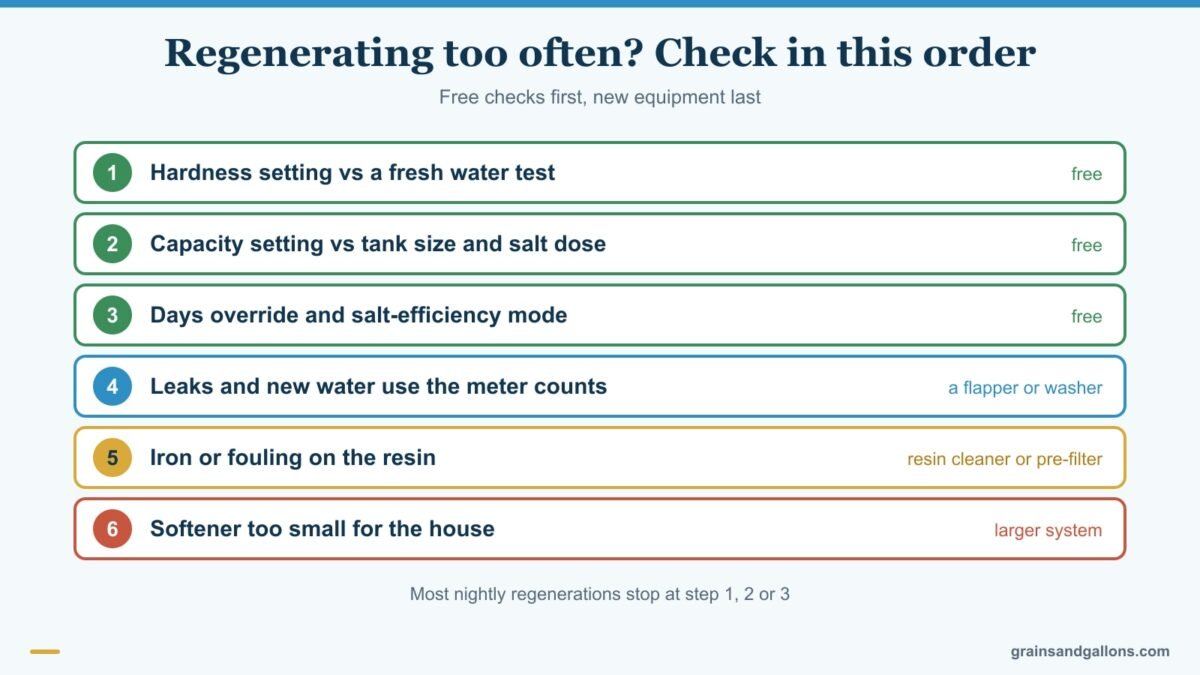
Quick Answer: A water softener regenerating too often almost always has a setting problem. The hardness entry is too high, the capacity is too low, or the days override is set to 1 or 2. Retest your raw water with a drop-count kit like the LaMotte Total Hardness Test Kit and correct the settings. Then look for leaks the meter counts, like a running toilet. Iron-fouled resin and an undersized softener come last.
Disclosure: As an Amazon Associate, Grains & Gallons earns from qualifying purchases.
You notice the salt dropping faster than it used to, or you keep hearing the drain run at 2 a.m. Before you decide your water softener is regenerating too often and failing, work out what "normal" looks like for your house. Then you'll know whether it's really cycling too much or just doing its job.
In this guide
Work out what normal looks like for your house
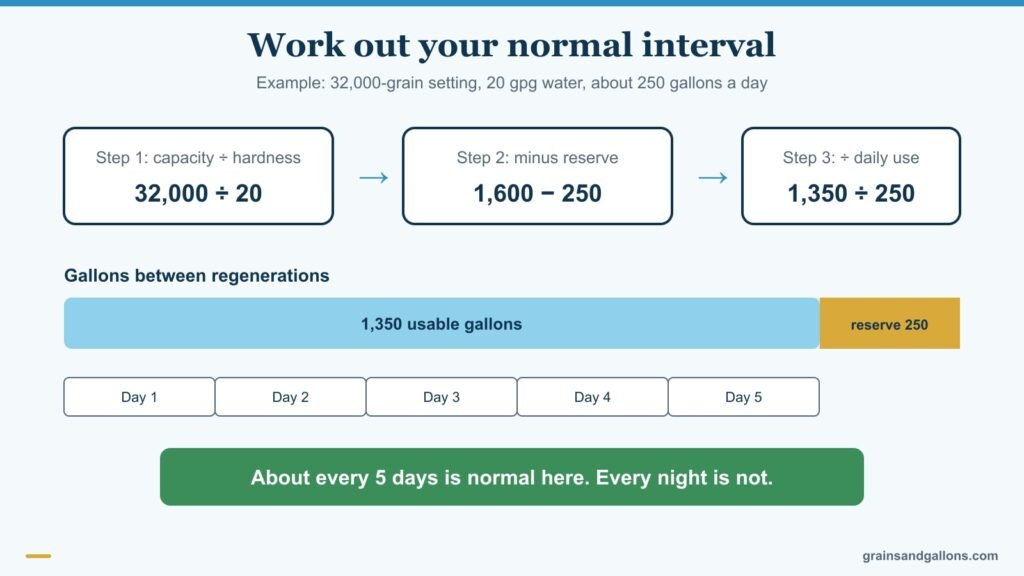
A metered softener regenerates after it has treated a set number of gallons. That number comes from a simple division:
Gallons between regenerations = capacity (grains) ÷ hardness (grains per gallon), minus any reserve the control holds back.
Say a softener is set to 32,000 grains, the water is 20 gpg, and the house uses about 250 gallons a day.
- 32,000 ÷ 20 = 1,600 gallons
- Hold back about 250 gallons as reserve: roughly 1,350 usable gallons
- 1,350 ÷ 250 = about 5 days between regenerations
Penn State Extension's water softening guide runs the same kind of math: a 20,000-grain unit in a home using 3,000 grains a day regenerates about every 6 to 7 days. If your house regenerates roughly when the math says it should, it's fine. If it goes every night, something is off. Your water bill shows daily use, and the settings screen shows capacity and hardness. Our guide on how often a softener should regenerate has more examples.
Settings behind a water softener regenerating too often
Hardness set higher than your water
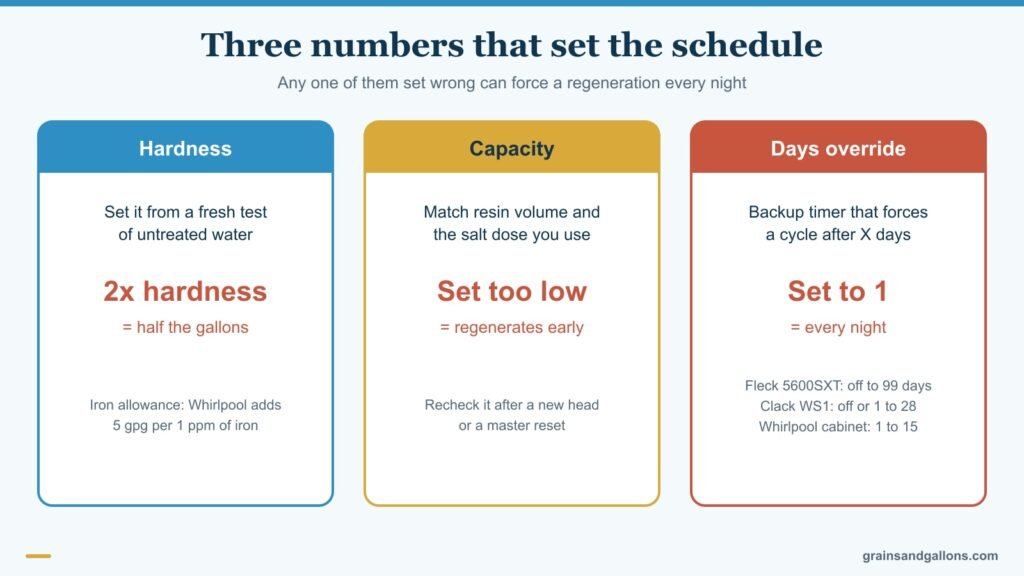
This is the most common cause. Installers sometimes enter a high number "to be safe," add a generous iron allowance, or use a number from an old city report. Double the hardness setting and you halve the gallons between regenerations.
Test raw water from a tap before the softener, or with the softener in bypass. Test strips give you a range. A drop-count kit gives you a number to the grain. If you have iron, follow your manual's allowance. Whirlpool's cabinet softener manual adds 5 gpg for every 1 ppm of iron. Our guide on how to set hardness on a softener walks through it, and our picks for the best water hardness test kits compare strips with drop kits.
Capacity set too low for the tank
The capacity number should match your resin volume and salt dose. A 1 cubic foot tank is often rated around 32,000 grains at a high salt dose, and noticeably less at a low one. If someone set capacity well below what the tank can do, it regenerates early. After a new control head or a master reset, check that capacity didn't go back to a default. Your tank's spec sheet lists capacity at each salt dose, so match it to the dose you actually use.
Days override set short
Most metered controls have a backup timer that forces a regeneration after a set number of days, even if the gallons haven't run out. The Fleck 5600SXT manual calls it DO, with a range of off to 99 days. A Clack WS1 allows off or 1 to 28 days, and Whirlpool cabinet models allow a maximum of 1 to 15 days. If it's set to 1, 2 or 3, the softener regenerates that often no matter what. See our explainer on the days override setting.
Salt-efficiency mode does it on purpose
Some controls have a salt-saving mode that uses smaller salt doses more often. Whirlpool's manual says turning Salt Efficiency on "may initiate more frequent recharges," and California requires it to be on. You get more regenerations but use less salt overall. If salt use is fine and only the frequency bothers you, this may not be a problem.
Hidden water use the meter still counts
The meter counts every gallon that passes through it, including ones you never notice. Common culprits:
- A toilet with a worn flapper. The EPA's Fix a Leak Week page suggests putting a few drops of food coloring in the tank. If color shows up in the bowl after 10 minutes, the toilet leaks.
- A dripping outdoor spigot or an irrigation line plumbed after the softener.
- A water heater relief valve that drips.
- New water use: a guest, a pool fill, a new appliance, or a reverse osmosis system sending water to drain.
To check, turn off every fixture and watch the control. On a 5600SXT the flow indicator flashes whenever there's outlet flow, and the FR display shows the flow rate. A Clack WS1 shows treated water flow on its user display. If it shows flow with everything off, there's a leak somewhere after the softener.
When real capacity is short: fouled resin or an undersized tank
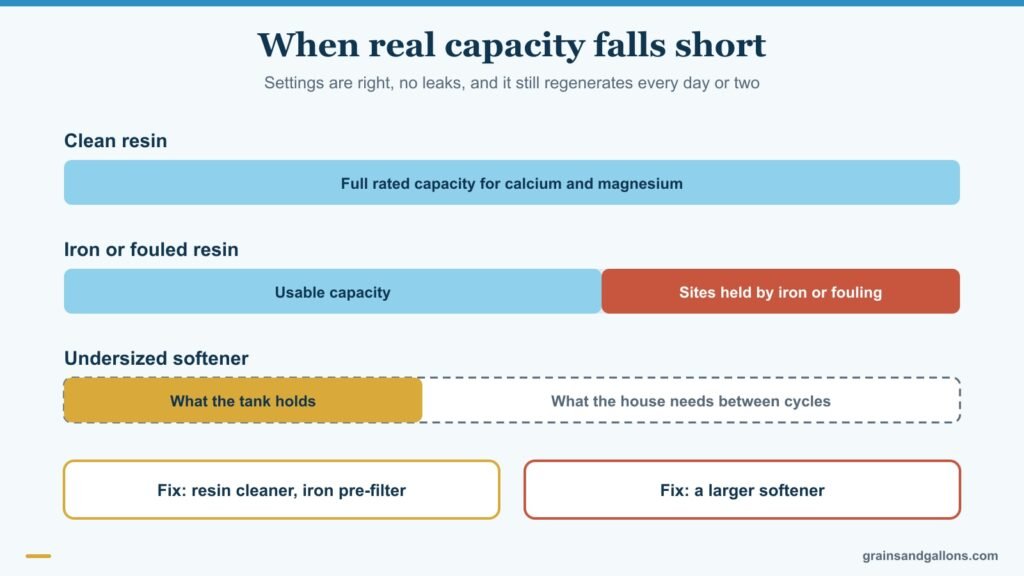
Iron and fouling. Penn State calls iron fouling "a common maintenance problem," and notes that oxidized iron "will clog the resin." Fouled resin can't hold its rated capacity, so the water turns hard early in each cycle even when the settings are sensible. A resin cleaner, an iron pre-filter, or both can bring capacity back.
An undersized system. If every setting is right, there's no leak, and it still regenerates every day or two, the softener may simply be too small. A 24,000-grain unit on 25 gpg water serving a family of five will work very hard. Our guide to signs a softener is undersized covers what to look for.
Match the symptom to the likely cause
| What you see | Most likely cause |
|---|---|
| Regenerates every night, salt use high, water soft | Hardness too high, capacity too low, or days override short |
| Every night since a power outage or reset | Settings went back to defaults |
| Frequency jumped suddenly | Leak, new water use, or a changed setting |
| Regenerates often and water still turns hard | Fouled resin, iron, or an undersized system |
| More regenerations, same or lower salt use | Salt-efficiency mode doing its job |
If what you're hearing is two cycles in one night rather than one every night, see our guide to a softener that regenerates twice.
Fix the numbers before you buy a bigger softener
A water softener regenerating too often is usually fixed by retesting the water and correcting three settings, not by buying new equipment. Leaks come next, then resin condition. Penn State notes that timer models "regenerate whether the resin needs it or not." So if yours runs on a calendar, a metered unit from our list of the best on-demand water softeners will cut cycles on its own. If the house truly needs more capacity, start with our picks for the best 48,000-grain water softeners for a typical 3 to 4 person home.
FAQ
How often should a water softener regenerate?
It depends on capacity, hardness and water use. Divide the capacity in grains by your hardness, subtract the reserve, and divide by daily gallons. Many homes land somewhere between every few days and once a week.
Is it bad if my water softener regenerates every day?
It wastes salt and water, and it adds wear to the valve over time. Unless the softener is deliberately sized and set for daily cycles, nightly regeneration means a setting, a leak or a capacity problem.
Why is my softener using so much salt all of a sudden?
A sudden jump usually comes from more regenerations. That points to a leak, new water use, or a setting that changed after a reset. If regenerations haven't increased, check the salt dose setting and look for a brine tank that keeps refilling.
Can a bad flow meter cause too many regenerations?
A meter that misreads can throw off the count, but it's less common than a wrong setting or a real leak. Watch the flow display with all fixtures off. Flow with nothing running means a leak. A display that never shows flow while water runs points to the meter.
Does iron in water make a softener regenerate more?
Indirectly, yes. Iron takes up room on the resin and can foul it, so the softener runs out of capacity sooner. Most manufacturers have you add to the hardness setting for iron, which also shortens the interval.