


Quick Answer: The water softener days override setting is a backup timer on a metered softener. It sets the maximum number of days the unit can go without regenerating, even if the meter says capacity is left. The meter still triggers regeneration whenever the gallons run out first. Set it a few days longer than your normal meter interval so it acts only as a backstop, or shorter for a reason such as iron in the water. A setting of 1 to 3 days usually means wasted salt.
Think of a metered softener as having two alarm clocks. The meter counts gallons and rings when the resin is close to used up. The water softener days override setting rings after a set number of days no matter what. Whichever rings first triggers regeneration that night.
In this guide
- Why a metered softener still needs a day count
- Day override names, ranges and button paths
- A worked example of which trigger fires first
- How to choose a water softener days override setting
- It waits for regeneration time and survives short outages
- When a short override wastes salt every night
- FAQ
- Set it longer than your meter interval
Why a metered softener still needs a day count

In a household that uses very little water, a metered softener might go weeks without regenerating. That sounds efficient, but resin sitting in still water for a long time has downsides:
- Bacteria and odor. Still water in a warm tank can grow bacteria and develop smells.
- Iron fouling. Iron in the water builds up on the resin between regenerations. Whirlpool's softener manual suggests forcing a regeneration every few days when the supply has clear-water iron, "to keep the resin bed clean."
- A packed bed. Resin that never gets backwashed can compact and channel.
The days override caps the gap, so the resin gets refreshed on a regular schedule no matter how little water you use.
Day override names, ranges and button paths
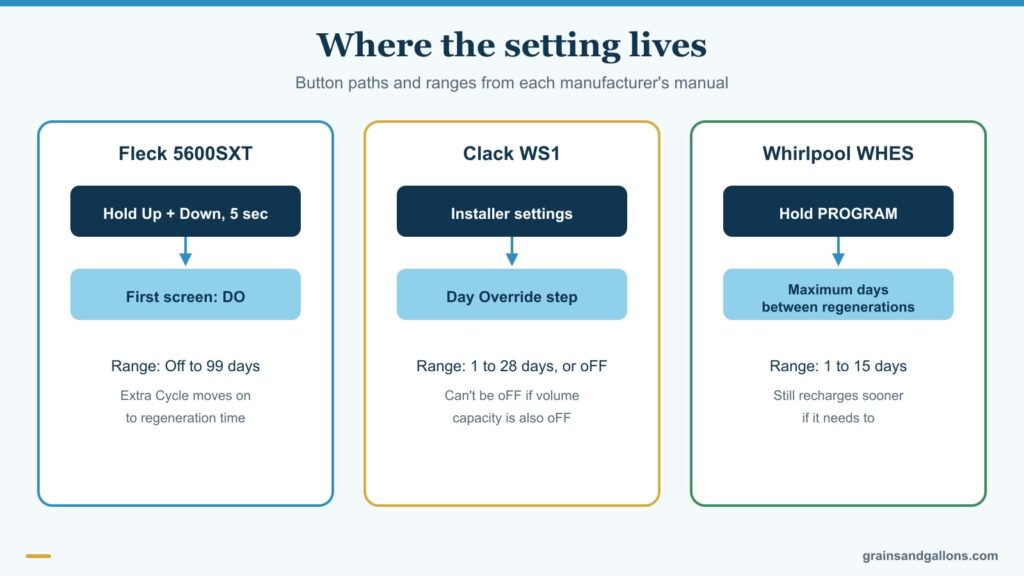
Names and ranges differ by brand. These come straight from the manufacturers' manuals.
| Control | Setting name | Range | How to reach it |
|---|---|---|---|
| Fleck 5600SXT | DO (Day Override) | Off to 99 days | Hold Up + Down for 5 seconds; DO is the first screen |
| Clack WS1 | Day Override | 1 to 28 days, or oFF | Installer settings, Day Override step |
| Whirlpool WHES series | Maximum days between regenerations | 1 to 15 days | Hold PROGRAM until the settings screen appears |
The Fleck 5600SXT manual says DO "specifies the maximum number of days between regeneration cycles," that a metered system "will regenerate regardless of usage" once that many days pass, and that "OFF" disables it. On a timer-type control, the same setting is the only trigger. The Clack WS1 programming manual says a numeric day override calls for regeneration "on that day even if sufficient volume was not used," and that day override and volume capacity "cannot be set to oFF at the same time." Set volume capacity to oFF and a Clack acts as a plain time clock. The Whirlpool manual adds that the softener "will recharge on its own if needed, even if it is before the set number of days."
Our Fleck 5600SXT programming guide walks through the full menu.
A worked example of which trigger fires first

Say your softener has these settings:
- Capacity: 30,000 grains
- Hardness: 15 gpg
- Reserve: 300 gallons
- Days override: 10
Usable gallons between regenerations: 30,000 ÷ 15 = 2,000 gallons, minus the 300-gallon reserve = about 1,700 gallons.
A family using 300 gallons a day reaches 1,700 gallons in about 5 to 6 days. The meter fires first every time, and the days override never comes into play.
A couple using 120 gallons a day would take about 14 days to reach 1,700 gallons. The days override fires first, at day 10, with capacity left over.
A cabin used one weekend a month might take months to use 1,700 gallons. The days override fires every 10 days, occupied or not.
That's the whole decision. The override should be longer than your normal meter interval so it only acts as a backstop. If it's shorter, you regenerate more often than needed and waste salt and water each time.
How to choose a water softener days override setting

Work out how many days your meter normally takes to reach zero, as in the example. Then:
- City water with no iron: set the override a few days longer than your meter interval, or leave a long value. Dealers commonly use 14 days or more here. If your meter normally fires every 5 days, a 10- to 14-day override won't interfere.
- Well water: around 7 days is a common dealer default, because well water is more likely to carry iron, manganese or bacteria.
- Clear-water iron or manganese: a shorter override, even every few days as Whirlpool suggests, helps keep the resin clean. Follow your installer's guidance for your iron level.
- Cabin or seasonal home: 7 to 14 days keeps the resin fresh while the house sits empty, at the cost of some salt. Our guide to water softener care for seasonal homes covers the rest of the closing routine, and our picks for the best water softeners for cabins favor metered units for this use.
- Timer-only valve: the day count is the only trigger, so it does all the work. Divide usable capacity by daily use and round down.
It waits for regeneration time and survives short outages

A day override doesn't start a regeneration the instant the count runs out. The Fleck 5600SXT manual says both meter-delayed and meter-immediate controls start the day-override regeneration "at the programmed regeneration time," usually the middle of the night. So a 10-day override on a unit set for 2 a.m. fires in the early hours of day 10, not mid-afternoon.
Power cuts don't usually reset the count either. Per its manual, the SXT has a power backup that "continues to keep time and the passage of days for a minimum of 8 hours." The Clack WS1 manual says that once its backup battery is depleted, "the only item that needs to be reset is the time of day," because other values sit in nonvolatile memory. After a long outage, check the clock first. A wrong clock shifts every regeneration, day-override ones included, to the wrong hour.
When a short override wastes salt every night
The most common complaint is a softener that regenerates far more often than expected. Often the cause is a days override of 1, 2 or 3 days, left over from a factory setup or an installer's default. You'll see:
- Regeneration every night or every couple of nights.
- High salt use for how much water you use.
- Plenty of capacity left at each regeneration.
On a Fleck SXT, the diagnostic screens include VU, the volume used since the last regeneration. If it's small when regeneration happens, the days override is firing, not the meter. Our checklist for a softener regenerating too often covers the other causes.
The opposite problem is rarer but worse. If the override is off and the meter stops counting, the softener may never regenerate, which is a good reason to keep a sensible value even on a metered unit. While you're in the menu, check capacity and reserve too. Our guide to setting capacity and reserve explains how the numbers fit together, and how often a softener should regenerate gives typical intervals.
FAQ
What should the day override be on a water softener?
For most metered softeners, a few days longer than your normal meter-triggered interval, often 7 to 14 days. Use a shorter value only for a reason such as iron. On a timer-only softener, it's the main schedule, so base it on capacity and daily water use.
Should I turn the day override off?
Usually not. Turning it off means the softener regenerates only when the meter says so, which can leave resin sitting for weeks in a low-use home. Clack won't let you turn both day override and volume capacity off at once.
Does the day override waste salt?
Only when it's shorter than your meter interval. Then every regeneration happens with capacity left, which wastes salt and water. Set it as a backstop and it rarely fires in a busy home.
Is day override the same as days between regenerations?
Yes, mostly. Fleck calls it DO, Clack calls it Day Override, and Whirlpool calls it maximum days between regenerations. On a timer-only valve, it's simply the regeneration schedule.
My softener has no meter. What does the days setting do?
It's the only trigger, so the softener regenerates on schedule whether the resin needs it or not. If you're replacing an old timer unit, a metered on-demand softener regenerates by gallons and uses the day count only as a safety net.
Set it longer than your meter interval
The water softener days override setting is a safety net, not the main trigger. Work out how many days your meter normally takes, set the override a few days longer, and shorten it only for iron, a well or a home that sits empty. If the softener is regenerating every night, check this setting first.