

Quick Answer: How to set softener capacity and reserve in two moves: enter the capacity your resin actually delivers at the salt dose you use (Pentair rates a 1.5 cu ft Fleck system at 46,600 grains with 13.5 lb of salt but only 17,900 grains with 4.5 lb), then set reserve to about one day of your household's water use, as a fixed volume or a percentage. Hard water before regeneration means capacity is too high or reserve too low.
On a metered softener, the "gallons remaining" display comes from three settings: hardness, capacity and reserve. Hardness is your water; our guide to setting hardness covers it. This page is about how to set softener capacity and reserve, the two settings most often left at a default that doesn't fit the house.
In this guide
- How to set softener capacity and reserve: start with the math
- Set capacity to match your salt dose
- Size the reserve to about one day of water
- Fixed, percentage or automatic reserve?
- Add a day override as a backstop
- Symptoms of a wrong capacity or reserve setting
- FAQ
- Match capacity to the salt, and reserve to one day
How to set softener capacity and reserve: start with the math

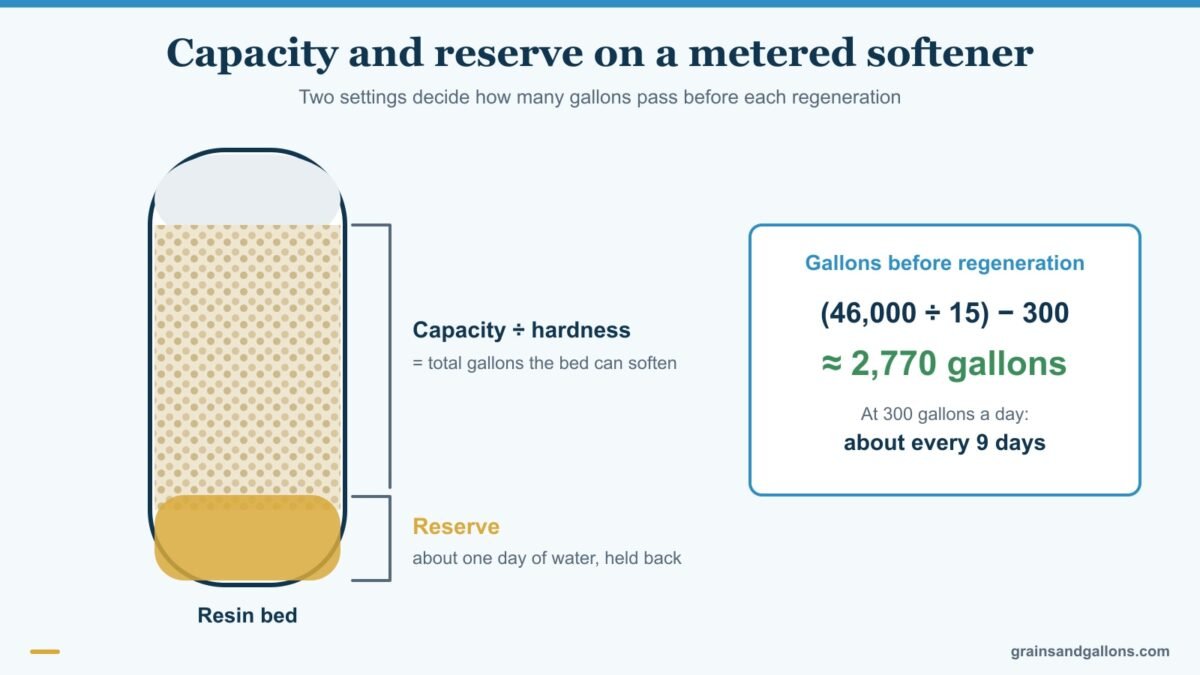
Pentair's 5600SXT manual describes it plainly: the control divides unit capacity by feedwater hardness and subtracts the reserve.
(Capacity in grains ÷ hardness in gpg) − reserve = gallons before regeneration
Our running example: 4 people at about 75 gallons each per day (the per-person figure Penn State Extension uses in its own sample calculation) is 300 gallons a day, with 15 gpg hardness and a 1.5 cu ft Fleck 5600SXT.
Set capacity to match your salt dose

Capacity isn't fixed. It depends on how much salt each regeneration uses. Pentair's performance data:
| Salt per regeneration | 1.0 cu ft | 1.5 cu ft | 2.0 cu ft |
|---|---|---|---|
| Low dose | 11,900 @ 3.0 lb | 17,900 @ 4.5 lb | 23,900 @ 6.0 lb |
| Medium dose | 31,100 @ 9.0 lb | 46,600 @ 13.5 lb | 62,200 @ 18.0 lb |
| High dose | 35,400 @ 15.0 lb | 53,100 @ 22.5 lb | 70,700 @ 30.0 lb |
Enter the number that matches your brine refill. If you've dialed salt down for efficiency, capacity has to come down with it, or the softener runs out before it regenerates. See what grain capacity means for why box ratings mislead.
On the Fleck 5600SXT, capacity is C in Master Programming, entered in grains, and appears only when the valve is set to a metered mode. On the Clack WS1 you enter the salt dose and then capacity in grains; Clack defers to the equipment maker's testing for that figure. See our Fleck and Clack programming guides.
Example: 13.5 lb of salt, capacity 46,000 grains. 46,000 ÷ 15 = about 3,070 gallons.
Size the reserve to about one day of water

On a meter-delayed valve, reserve covers the water used between the moment the meter trips and the regeneration that night. Pentair says it should keep treated water flowing until that regeneration time. Since most units regenerate in the early morning, plan for one day's use. Meter-immediate valves regenerate right away and generally skip the reserve.
Example: one day is 300 gallons, about 10% of 3,070. That leaves about 2,770 gallons between regenerations, roughly every 9 days.
Fixed, percentage or automatic reserve?

The Fleck 5600SXT offers two:
- SF (safety factor): a percentage of capacity, 0 to 50%. It moves automatically if you change capacity or hardness.
- RC (fixed reserve): a set number of gallons, no more than half the calculated capacity, and unchanged by other settings.
Some valves add a variable reserve based on recent use, and Clack's AUTO option estimates reserve from actual use. Our reserve capacity explainer compares them in more depth.
Add a day override as a backstop

A day override forces a regeneration after a set number of days even if the meter hasn't tripped. On the Fleck it's DO, from off to 99 days; Clack has a similar setting in its installer menu. In a low-use house, resin that sits too long can foul or grow bacteria. Many installers choose something around 7 to 14 days; check your manual.
Symptoms of a wrong capacity or reserve setting
| What you notice | Likely cause | Try |
|---|---|---|
| Hard water the day before regeneration | Capacity too high or reserve too low | Lower capacity 10% or raise reserve |
| Regenerating every 2 to 3 days with normal use | Capacity too low, hardness too high or reserve too big | Recheck all three against the math |
| Salt use far above expected | Salt dose high for the capacity you need | Lower salt and capacity together |
| Fine for weeks, then hard during visits | Reserve too small for peak days | Switch to percentage or automatic reserve |
If hardness keeps showing up early, see hardness returning before regeneration. If the unit cycles constantly, regenerating too often covers mechanical causes like a stuck meter or a leak.
FAQ
What should I set my water softener capacity to?
The grains your resin delivers at your salt dose, from the maker's data. For a 1.5 cu ft Fleck system, Pentair lists 46,600 grains at 13.5 lb of salt.
How much reserve should a water softener have?
About one day of water use. For four people at 75 gallons each, that's 300 gallons, or roughly 10% of a 3,000-gallon cycle.
Should I use a fixed reserve or a percentage?
Fixed works for steady use. A percentage or automatic reserve handles weekend guests and laundry days better.
Do I change capacity if I switch to potassium chloride?
Usually not. Manufacturers such as Whirlpool and EcoWater put the adjustment in the hardness setting, raised by 25%.
Match capacity to the salt, and reserve to one day
That's how to set softener capacity and reserve: take capacity from the maker's salt-dose table, hold back about one day of water as reserve, and add a day override. If you're still shopping, our Fleck valve softener and Clack valve softener guides cover systems with well-documented programming.