


Quick Answer: What does grain capacity mean? It's how much hardness a softener's resin can hold before it has to regenerate. A "32,000-grain" softener can remove about 32,000 grains of calcium and magnesium, but only when regenerated with the maximum salt dose. At normal salt-saving settings the usable number is closer to two-thirds of the label. Multiply your daily water use by your hardness in grains per gallon, then divide the usable capacity by that number to get days between regenerations.
You're looking at two softeners that seem identical except one says 32,000 and the other says 48,000, and the bigger one costs more. Before you decide bigger is better, here's what that number counts, what it assumes and how to turn it into days between regenerations.
In this guide
- What does grain capacity mean in plain terms?
- The label number assumes the heaviest salt dose
- Run the numbers for a family of four on 15 gpg water
- Four ways the grain number gets misread
- Rough sizes by household at 15 gpg
- Specs to read alongside grain capacity
- FAQ
- Size by daily grains and salt dose, not the box
What does grain capacity mean in plain terms?
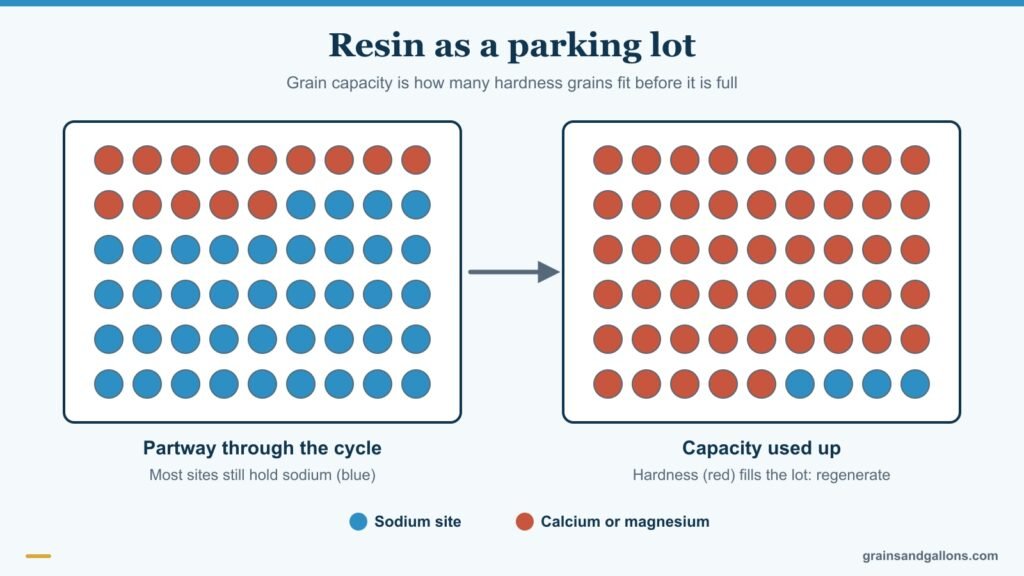
Inside the mineral tank is a bed of small plastic beads, the resin. Each bead has sites that hold a sodium ion. When hard water flows through, calcium and magnesium push the sodium out and take those sites. Once most sites hold hardness, the water coming out starts turning hard again.
Think of the resin as a parking lot. Grain capacity is the size of the lot: how many grains of hardness fit before it's full. Regeneration is the tow truck. Brine floods the tank, pushes the calcium and magnesium off, reloads every site with sodium and sends the hardness down the drain.
One grain is an old unit of weight, 1/7,000 of a pound, or about 65 mg. Hardness is measured in grains per gallon (gpg). Penn State Extension notes that one gpg equals approximately 17 mg/L, or ppm (Penn State Extension, Water Softening), so divide a ppm or mg/L hardness result by about 17.1 to get gpg. Our guide to water hardness units walks through the conversions.
The label number assumes the heaviest salt dose

This is the part most listings skip. A softener's rated capacity is the most it can do when regenerated with the heaviest salt dose. Resin gets less efficient at the top end: refilling the last sites takes far more salt than the first ones.
Typical figures for one cubic foot of standard resin:
| Salt per cubic foot of resin | Approximate capacity per cubic foot | Grains removed per pound of salt |
|---|---|---|
| 6 lb | about 20,000 grains | about 3,300 |
| 10 lb | about 25,000–27,000 grains | about 2,600 |
| 15 lb | about 30,000–32,000 grains | about 2,100 |
Even the maximum is below the resin's theoretical total. A common potable softening resin, Purolite C100E, lists a minimum total capacity of 41.5 kilograins per cubic foot (Purolite C100E data sheet); real regenerations never reload every site.
So a "32,000-grain" softener usually holds one cubic foot of resin, a "48,000" about 1.5 cubic feet, and a "64,000" about 2 cubic feet. Run any of them at a moderate salt setting and you get roughly two-thirds to three-quarters of the label, while using much less salt per grain removed. Your manual's table matching salt settings to capacity for that model is the number to use, not the box.
Run the numbers for a family of four on 15 gpg water

Step 1. Daily water use. Penn State uses 75 gallons per person per day as an average. Four people means about 300 gallons a day.
Step 2. Grains removed per day. 300 gallons × 15 gpg = 4,500 grains per day.
Step 3. Add iron if you have it. Iron uses resin capacity too. A common rule of thumb adds about 4 gpg for every 1 ppm of iron; sizing guides range from 3 to 5. City water usually has close to none. See how iron changes water softener sizing.
Step 4. Compare with capacity at a sensible salt setting.
- A 32,000-grain unit (1 cubic foot) at about 8 lb of salt gives roughly 24,000 usable grains. 24,000 ÷ 4,500 = about 5 days between regenerations.
- A 48,000-grain unit (1.5 cubic feet) at about 12 lb of salt gives roughly 36,000 grains. 36,000 ÷ 4,500 = about 8 days.
Many installers aim for a regeneration every 7 to 10 days on a metered softener, which keeps the resin in regular use without burning salt. Here the 48,000 lands in that range; the 32,000 would work but regenerate more often, closer to its limit. That's why our best 48,000-grain water softeners list targets three- and four-person homes.
Four ways the grain number gets misread

Buying the biggest number "to be safe." A softener far too large for the house can sit for weeks between regenerations. Some valves force a regeneration after a set number of days anyway, which wastes salt. More in is a higher grain rating always better.
Reading capacity as a lifetime number. Grain capacity isn't how long the softener lasts. A 48,000-grain softener doesn't wear out after 48,000 grains; it regenerates and starts again.
Forgetting the reserve. A metered valve holds back part of the capacity so you don't run hard before the overnight regeneration. If capacity is 36,000 and the reserve is 4,500 (one day's use), the valve treats it as 31,500 usable grains. See how to set softener capacity and reserve.
Entering a capacity and salt dose that don't match. Many digital valves ask for both. Enter the full rated capacity with a low salt dose and the valve counts gallons as if the resin holds more than it does, so you get hard water for the last day or two of each cycle. That's one of the classic signs a water softener is undersized when it really isn't. Use the capacity your manual lists for the salt dose you chose.
Rough sizes by household at 15 gpg
These assume 75 gallons per person per day, city water with no iron, and moderate salt settings.
| People | Grains per day | Size that lands near 7–10 days |
|---|---|---|
| 1–2 | 1,125–2,250 | 24,000–32,000 |
| 3–4 | 3,375–4,500 | 40,000–48,000 |
| 5–6 | 5,625–6,750 | 64,000 or larger |
Above 20 gpg, or with iron, move up a size and check with the formula. For a family of four, our roundup of the best water softener for a family of 4 groups options by hardness, and the full method is in how to size a water softener.
Specs to read alongside grain capacity

Same-capacity softeners can still perform differently. Check:
- Service flow rate (gpm). How much water can pass at once before softening drops off. Capacity doesn't tell you this.
- Regeneration type. Metered (demand) valves regenerate after a set number of gallons, as Penn State describes; timer-only models regenerate on a schedule whether needed or not and usually use more salt and water. Penn State estimates about 50 gallons of water per regeneration.
- Salt efficiency at your setting. Grains removed per pound of salt, often on the performance data sheet.
FAQ
What does a 32,000-grain water softener mean?
It can remove about 32,000 grains of hardness between regenerations when run at its maximum salt dose, which usually means about one cubic foot of resin. At 10 gpg, that's roughly 3,200 gallons before it needs to regenerate; at lower salt settings, expect closer to 20,000–27,000 grains.
How many grains of capacity do I need?
Multiply people × 75 gallons × your hardness in gpg (plus iron adjustment) to get grains per day, then multiply by 7 to 10 days. Pick the size whose capacity at a moderate salt setting covers that number.
Is a bigger grain capacity better?
Not automatically. A moderately larger unit can run at a more salt-efficient setting and regenerate less often, but one far too big sits idle, may force time-based regenerations and wastes salt. Size it to land near 7 to 10 days.
Does grain capacity change with the salt setting?
Yes. Capacity depends on how much salt each regeneration uses. Less salt per cubic foot means fewer grains per cycle but more grains per pound of salt. Your manual's capacity table for each salt setting is the number to program.
Size by daily grains and salt dose, not the box
So, what does grain capacity mean when you're shopping? It's the hardness the resin holds per regeneration at a given salt dose, and the box number is the best case. Work out your daily grains from people, gallons and hardness, use the capacity your manual lists for a moderate salt setting, and choose the size that regenerates about every 7 to 10 days.