

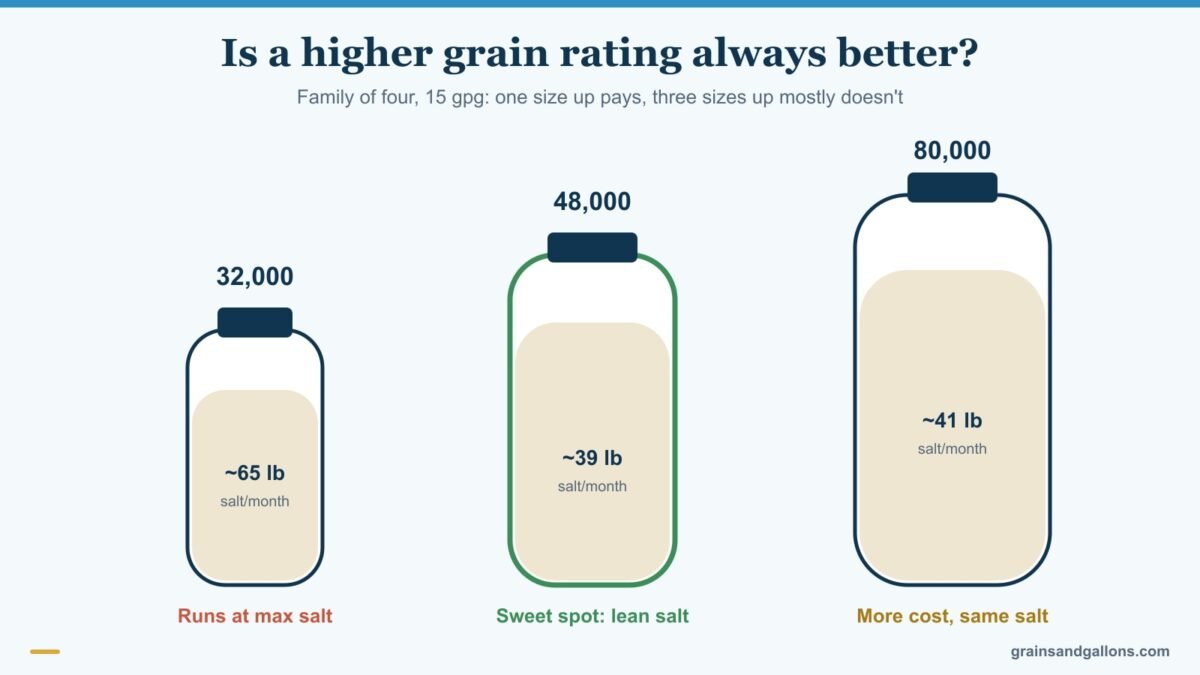
Quick Answer: Is a higher grain rating always better? No. Going one size up from the bare minimum usually is better, because a slightly bigger softener can run at a low, salt-efficient setting and still go about a week between regenerations. Past that, a higher grain rating mostly costs more money, space and backwash flow, and in a small household a days-override setting can force regeneration before the resin is spent. Aim for about 7–10 days between regenerations at an efficient salt dose.
The bigger number on the box feels like a safe bet. Sometimes it is. Sometimes it means paying for 80,000 grains to soften water for two people. Running the numbers for two homes shows the difference.
In this guide
Grain ratings are measured at the salt-hungry maximum
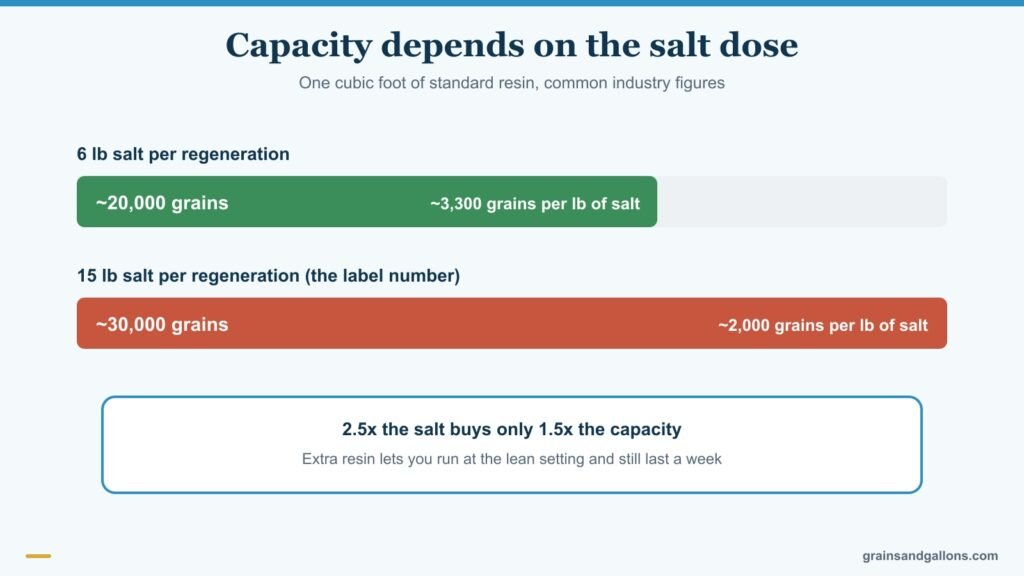
A softener's grain rating is a maximum at a high salt dose. Chemaqua's technical bulletin on calculating softener capacity uses the standard figure of 15 lb of salt per cubic foot of resin for 30,000 grains. Spec sheets such as CustomCare's C43 series list separate minimum, medium and maximum capacities at 6, 10 and 15 lb per cubic foot. The common industry figures:
| Salt per cubic foot of resin | Capacity per cubic foot | Grains per pound of salt |
|---|---|---|
| ~6 lb | ~20,000 grains | ~3,300 |
| ~15 lb | ~30,000 grains | ~2,000 |
A "32,000-grain" softener (usually 1 cubic foot) reaches its label only at the wasteful setting. A "48,000-grain" unit (about 1.5 cubic feet) delivers 30,000 grains at the lean one. That's the whole case for sizing up: extra resin lets you run lean on salt. It's also the limit. More on capacity in what grain capacity means.
Four people at 15 gpg: where one size up pays
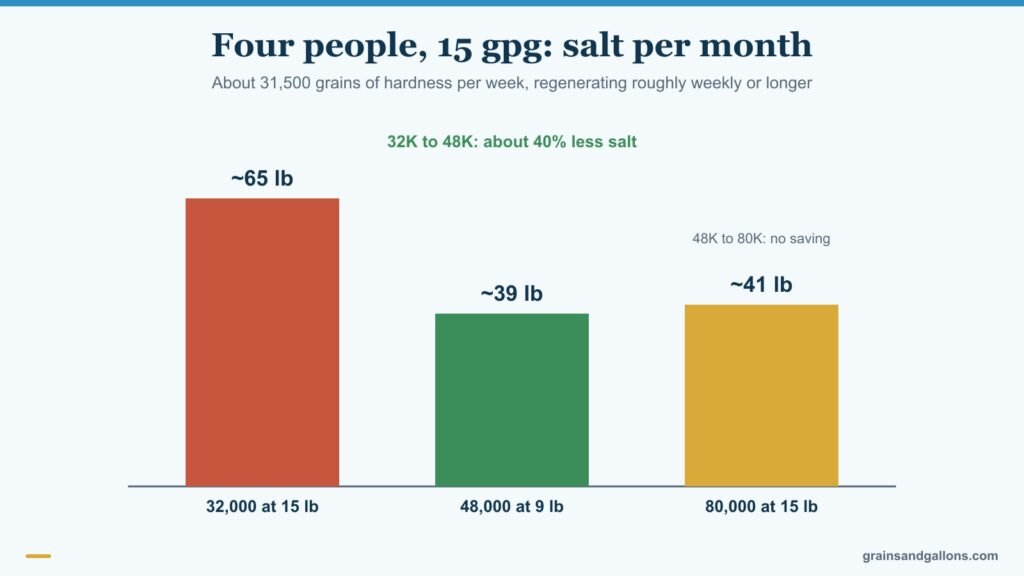
Penn State Extension's water softening guide sizes on about 75 gallons per person per day. Four people use 300 gallons/day, which at 15 gpg is 4,500 grains/day, about 31,500 grains/week.
| Option | Setting | Usable capacity | Days between regens | Salt per month (approx.) |
|---|---|---|---|---|
| "32,000-grain" (1 cu ft) | 15 lb (max) | ~30,000 | ~6–7 | ~65 lb |
| "48,000-grain" (1.5 cu ft) | 9 lb (6 lb/cu ft) | ~30,000 | ~6–7 | ~39 lb |
| "80,000-grain" (2.5 cu ft) | 15 lb (6 lb/cu ft) | ~50,000 | ~11 | ~41 lb |
Reserve capacity shortens real intervals a little, but the comparison holds. Going from 32K to 48K cuts salt by roughly 40% on the same schedule. Going from 48K to 80K saves almost nothing and adds cost, a taller tank and a higher backwash flow requirement, which matters on a well. That's why most families of three or four land in the best 48,000-grain softeners.
Two people at 15 gpg: where a big tank wastes salt
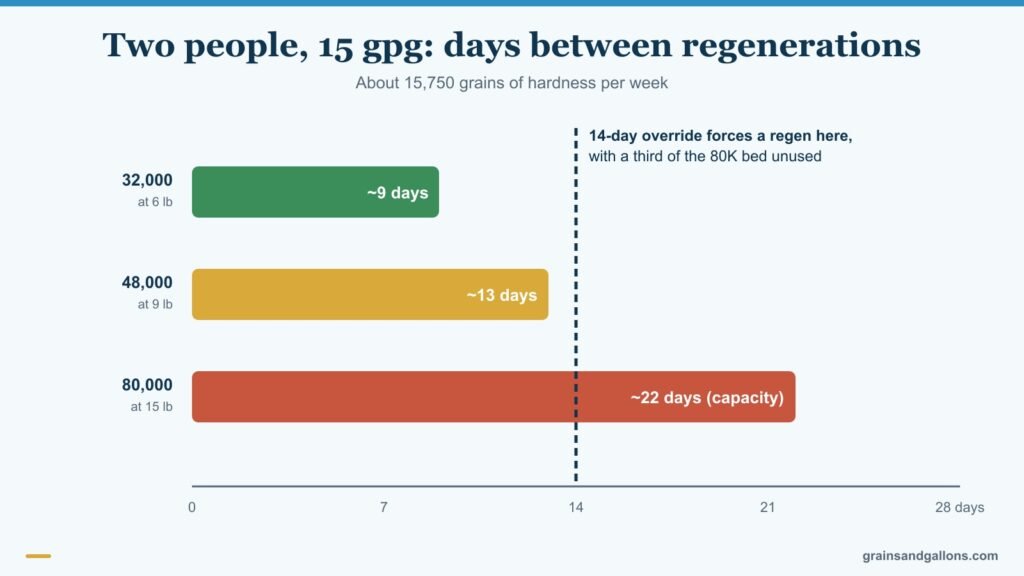
Two people use 150 gallons/day, about 15,750 grains/week. The 32K unit at its lowest salt setting (~20,000 grains) already lasts about 9 days. A 48K at 9 lb lasts about 13. The 80K at 15 lb would go about 22 days.
That sounds great until you look at the days override. Many valves force a regeneration after a set number of days regardless of gallons, to keep the bed from sitting stagnant, which matters more on well water. Set it to 14 days and the 80K regenerates with about a third of its capacity unused, burning a full salt dose each time. (See the days override setting explained.) For two people at this hardness, a smaller unit, or one from our best 40,000-grain softeners if you want a margin, does the job.
When a bigger softener really is the right call

Bigger is better when the load is big:
- Very hard water. At 30+ gpg, even a modest household burns through capacity fast.
- Large households or high use. Five or more people, big soaking tubs, livestock lines.
- Iron on top of hardness. Iron adds to the load, and the margin helps.
- Peak flow. Larger tanks often support higher service flow. With several showers running at once, flow can matter as much as capacity.
The downsides of going too big are higher cost, a stronger backwash requirement, a taller tank that may not fit, and stale resin in low-use homes. For the full list, see can a water softener be too large. For high-load homes, start with the best 80,000-grain water softeners.
Pick the size in five steps
- Test your hardness (and iron, if you're on a well).
- Estimate daily use: 60–80 gallons per person if you don't have a water bill.
- Multiply by hardness for daily grains, then ×7 for weekly.
- Choose the size that covers 7–10 days at a low salt setting.
- Check that its service flow covers your peak use and its backwash fits your water supply.
Our sizing guide walks through a full example.
FAQ
Is a higher grain rating always better if my water is very hard?
It's more often justified. Very hard water burns through capacity quickly, so a larger bed keeps regenerations near weekly at a lean salt setting. Still size from your actual weekly load, not the biggest box.
Is 48,000 grains too big for two people?
Usually more than needed, but not harmful. At 15 gpg it lasts about 13 days at a lean setting; just check the days override.
Does a bigger water softener use more salt?
Not necessarily. A bigger softener set to a lean dose can use less salt per month than a small one run at maximum. Salt use climbs when an oversized unit regenerates on a timer before its capacity is spent.
How often should a water softener regenerate?
About every 7 to 10 days is a common target. Much more often suggests the unit is undersized or set to a high salt dose. Much less often in a low-use home can leave resin sitting idle.
Size up one step, not three
So, is a higher grain rating always better? Only up to a point. One step above the minimum lets you run a lean salt dose and still regenerate about weekly, and that saves real salt. Beyond that, you're buying cost, height and backwash demand you won't use, unless your water is very hard, your household is large, or iron and peak flow push the load up.