


Quick Answer: Here is how iron changes water softener sizing: iron uses up resin capacity just like hardness, and it's harder to strip off, so you add it to your hardness before you size. A common rule is about 4 gpg for every 1 ppm of iron (some dealers use 3 or 5), plus the same for manganese. That "compensated hardness" raises your daily grain load. Iron also calls for regenerating every 3–4 days, so the right size is the capacity that fits that shorter cycle, not just a bigger number.
Disclosure: As an Amazon Associate, Grains & Gallons earns from qualifying purchases.
Your well test came back with hardness and iron, and every sizing calculator you've found asks only for hardness. So what do you do with the iron number? Ignore it and you'll buy a softener that looks right on paper, runs out early and leaves orange stains to go with the hard water.
Below is what iron does to the math, a worked example you can follow with your own numbers, and the point where no softener size will fix an iron problem.
In this guide
Why iron gets "extra" grains
A softener can remove dissolved (ferrous, "clear-water") iron with the same ion exchange it uses for calcium and magnesium. But iron is a heavier user of the resin:
- It's held more tightly. Iron ions cling to exchange sites harder than calcium does, so a normal regeneration doesn't strip them off as easily.
- It oxidizes. If dissolved iron meets oxygen or chlorine, it turns into rust particles that coat beads and block sites. Penn State Extension's guide to iron and manganese in private water systems is blunt about it: oxidized iron and manganese will foul softener resin.
- Capacity ratings assume calcium and magnesium. A "48,000-grain" rating is a hardness number, so iron has to be translated into equivalent hardness before it means anything.
That translation is compensated hardness:
Compensated hardness = hardness (gpg) + 4 × iron (ppm) + 4 × manganese (ppm)
It's a rule of thumb, not chemistry you can derive exactly, and the multiplier varies by dealer (more on that below). For sizing basics without iron, start with how to size a water softener.
How iron changes water softener sizing: a worked example

The water test:
- Hardness: 18 gpg
- Iron: 2.0 ppm (ferrous, clear when drawn)
- Manganese: 0.3 ppm
The household: four people at roughly 70 gallons each per day = 280 gallons per day. (Many sizing guides, including Penn State Extension's water softening fact sheet, use 75 gallons per person; use your meter readings if you have them.)
Step 1: Compensated hardness
18 + (4 × 2.0) + (4 × 0.3) = 18 + 8 + 1.2 = about 27 gpg
Iron and manganese have pushed the effective hardness up by half.
Step 2: Daily grain load
- Ignoring iron: 280 × 18 = 5,040 grains/day
- With iron: 280 × 27 = 7,560 grains/day
Step 3: Pick a cycle length
Without iron, a 7-day cycle is normal. With 2 ppm iron, most installers want the resin regenerated every 3–4 days so iron doesn't sit in the bed long enough to oxidize and foul it. Plan on 4 days, with one day of reserve.
Capacity needed per cycle: 7,560 × (4 + 1) = 37,800 grains
Step 4: Turn that into a tank size
Real capacity depends on salt dose. At a moderate salt setting of roughly 8–9 lb per cubic foot, standard resin delivers about 24,000 grains per cubic foot.
- 1.5 cu ft (sold as a "48,000-grain" unit) at a moderate dose: about 36,000 grains. Just under the target; workable at a slightly higher salt dose.
- 2 cu ft ("64,000-grain" unit) at the same dose: about 48,000 grains. Comfortable, with room for guests.
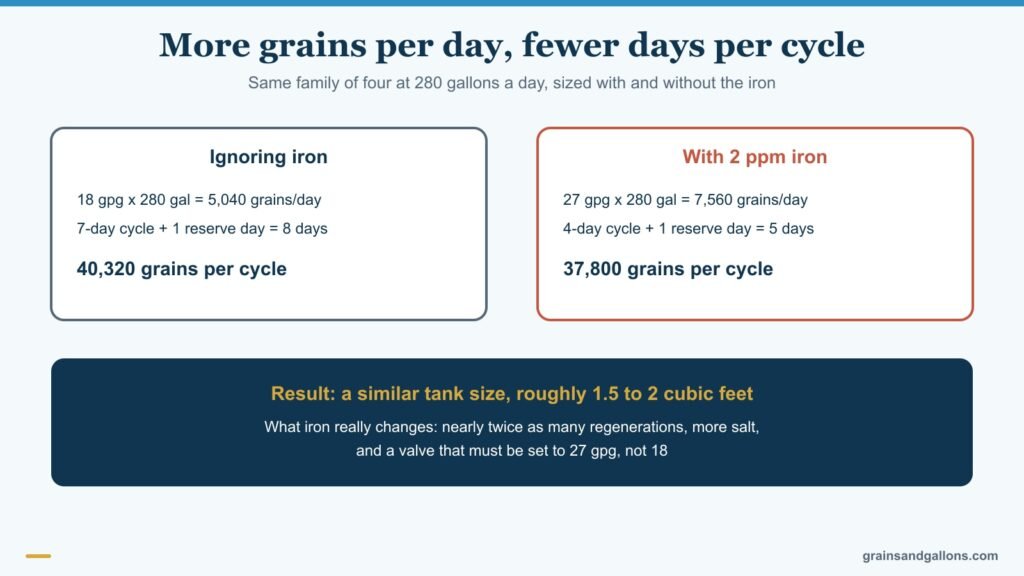
Now compare the no-iron case: 5,040 × 8 days (7 + 1 reserve) = 40,320 grains. Almost the same capacity per cycle.
That's the surprising part. Iron doesn't always mean a much bigger tank. Your daily load goes up and your cycle gets shorter, and those can land on a similar tank size. What really changes is salt use (nearly twice as many regenerations) and how carefully the valve has to be programmed. A 1.5 to 2 cubic foot softener is the right class for this home; our picks for 48,000-grain water softeners cover the smaller end.
Step 5: Program the compensated number
Set the valve's hardness to 27, not 18. If you enter 18, the valve thinks it can soften 50% more water than it really can, and the resin runs out early every cycle. Metered valves calculate the reserve from hardness and capacity; many also let you set a maximum number of days between regenerations, which is the setting that keeps iron cycles short even when the house is empty.
Three, four or five grains per ppm?

Dealers don't agree on the iron multiplier. Many sizing guides add 5 gpg per ppm, others use 4, and a few use 3. Some also add a little extra for manganese or high pH. Run the example above with each:
- 3 per ppm: about 25 gpg compensated, roughly 35,000 grains per 5-day cycle.
- 4 per ppm: about 27 gpg, roughly 38,000 grains.
- 5 per ppm: about 30 gpg, roughly 41,000 grains.
The spread is about 6,000 grains, which is enough to move you across a tank size. Two practical rules follow. First, if your numbers sit near the boundary between two sizes, round up to the larger one, because iron also slowly fouls some capacity between cleanings. Second, program the valve with the same multiplier you sized with. Don't oversize wildly to compensate, though: a tank far too big for the household regenerates on the day limit with mostly unused resin, which wastes salt and can encourage channeling. Our guide to whether a water softener can be too large explains the trade-off.
Where a bigger tank won't help with iron

There's a point where a softener stops being the right tool, no matter its size. Penn State Extension says softeners are generally only recommended for iron when the water's pH is above 6.7, hardness is between 3 and 20 gpg, and dissolved iron is below 5 mg/L, and the raw water must not contact air or chlorine before the softener. Watch for these:
- Iron that's already oxidized. If the water comes out cloudy, orange or brown, or turns color in a glass, the iron is a particle, not an ion. Resin can't exchange it; it just clogs.
- Iron bacteria. Slime, an oily sheen or a swampy smell means iron bacteria in the well, which foul resin fast.
- High iron. Each softener also has a published maximum for clear-water iron; check the spec sheet. Beyond it, put an iron filter before the water softener. Our guide to what a softener can and can't do with iron covers the cut-offs.
- Air in the system. An aerator, air-injection filter or air-charged pressure tank upstream can oxidize iron before it reaches the resin.
For context, the EPA's secondary drinking water standards set 0.3 mg/L for iron and 0.05 mg/L for manganese, the levels where staining and metallic taste start. A softener sized for compensated hardness should keep you below them; if it doesn't, see why a softener stops removing iron.
Some softeners are designed for higher-iron well water, with resin, settings and cleaning features aimed at it. Our SoftPro Iron Master review looks at one.
Get the iron number right before you do any math

The whole calculation hinges on an accurate iron reading. A certified lab test is best, but a home color-disc kit like the Hach IR-20 gives a usable iron number, and it reads manganese too, with all the reagents and apparatus packed in a carrying case. Test fresh water drawn straight from a cold tap before any treatment, and if you can, test both total and dissolved iron so you know how much is already oxidized. Our step-by-step guide to testing well water for iron covers sampling, and the best iron test kits for water compares options.
Also test manganese if you see black staining. It adds to compensated hardness and fouls resin even in small amounts. Retest the raw water once a year, because well iron changes with seasons, drought and pump work.
FAQ
How many grains of hardness does 1 ppm of iron add?
Most dealers use 4 or 5 gpg per ppm of iron, and a few use 3. There's no single official figure, so pick one, use it for both sizing and programming, and round up if you land near a size boundary.
What size softener do I need for 18 gpg hardness and 2 ppm iron?
For a family of four, compensated hardness is about 26–28 gpg. With a 4-day cycle that needs roughly 38,000 grains per cycle, which points to a 1.5 cubic foot unit at a higher salt dose or a 2 cubic foot unit at a moderate dose.
Should I set my softener to hardness or compensated hardness?
Compensated hardness. Entering only the raw hardness makes the valve think each cycle can treat more water than it really can, so hardness and iron break through before the next regeneration.
How often should a softener regenerate with iron?
Most installers aim for every 3–4 days when iron is present, even if capacity would allow a longer cycle. Short cycles stop iron from sitting in the bed long enough to oxidize and foul the resin.
Do I need a resin cleaner if I have iron?
Usually yes. Regeneration leaves some iron behind, and a resin cleaner added to the brine tank or fed automatically strips it out. See water softener resin and iron cleaners for how to use them.
Size for compensated hardness and a shorter cycle
The short version of how iron changes water softener sizing: convert iron and manganese into extra grains, multiply by your daily water use, and size for a 3–4 day cycle instead of a week. That often lands on a similar tank to the no-iron answer, but with more frequent regenerations, more salt, a resin cleaner in the routine and a valve programmed with the compensated number. If your iron is oxidized, bacterial or above the softener's rated limit, stop sizing and add an iron filter first.