

Quick Answer: Here's how to test well water for iron: draw a sample from a tap before any treatment equipment, test it within a minute or two, and read total iron in mg/L (same as ppm). Total iron strips like the ITS WaterWorks 481623-V give a quick 0–5 mg/L range. Anything above 0.3 mg/L can stain. If you're about to buy an iron filter, also send a sample to a certified lab, because pH, manganese and hardness decide which filter works.
Disclosure: As an Amazon Associate, Grains & Gallons earns from qualifying purchases.
Orange rings in the toilet, rusty streaks under the shower, a white load of laundry that came out peach. You already suspect iron. Learning how to test well water for iron comes down to two answers: how much there is, and what form it's in. Those two answers decide whether a softener can handle it, whether you need a dedicated iron filter, or whether something else, such as iron bacteria, is going on.
Iron gets into well water from the soil and rock it passes through, and sometimes from a corroding steel casing. Rust stains, a metallic taste, clogged aerators and water that turns yellow after sitting are the usual clues. Black stains point to manganese, which often travels with iron, so test for both.
In this guide
Start with a free overnight jar test

Before you buy anything, fill a clear glass or jar from the kitchen cold tap and leave it on the counter overnight.
- Water comes out clear, turns yellow or orange, and a rusty layer settles by morning: that's dissolved iron (ferrous, or "clear-water iron") reacting with air. It's the most common form in wells. Penn State Extension notes that dissolved iron is most common in water with a pH below 7.0 (Penn State Extension on iron and manganese).
- Water comes out already cloudy or orange: some iron has already oxidized (ferric, or "red-water iron"), often in the pressure tank or the pipes.
- You see a slimy film, an oily sheen or reddish-brown slime in the toilet tank: suspect iron bacteria in well water. They need a different plan, and a basic iron number won't reveal them.
A jar won't give you a number, but it tells you what to look for once you do test.
How to test well water for iron with a kit or a lab
| Method | What it tells you | Good for |
|---|---|---|
| Total iron strips | A color-matched range, usually 0–5 mg/L | A first look, checking that a filter is working |
| Color disc or comparator kit | A finer reading; some kits read ferrous iron specifically | Splitting ferrous from total, tracking changes |
| Certified lab test | Exact total iron, plus manganese, pH, hardness and more | Choosing and sizing treatment |
Strips are fine for "a little or a lot," but color matching gets harder at the high end and in tinted water. A color disc kit such as the Hach IR-20 iron and manganese kit takes the guesswork out of matching a strip, and it comes with all the reagents and apparatus it needs in a rugged carrying case. It tests manganese as well, which helps if your stains look more brown-black than orange. To split dissolved (ferrous) iron from already-rusty iron, use a kit or reagent made for ferrous iron and compare the two results. Our guide to the best iron test kits compares strip, disc and digital options.
If you're about to spend real money on treatment, get a lab test. Iron filters are picky: some need a pH above roughly 7, manganese changes the media choice, and hardness affects softener sizing. A home strip gives you only one of those numbers. Our roundup of well water test kits includes mail-in lab panels that cover them all on one report, and the EPA keeps a list of state certification programs and certified drinking water labs if you'd rather use a local lab.
Where and how to take the iron sample
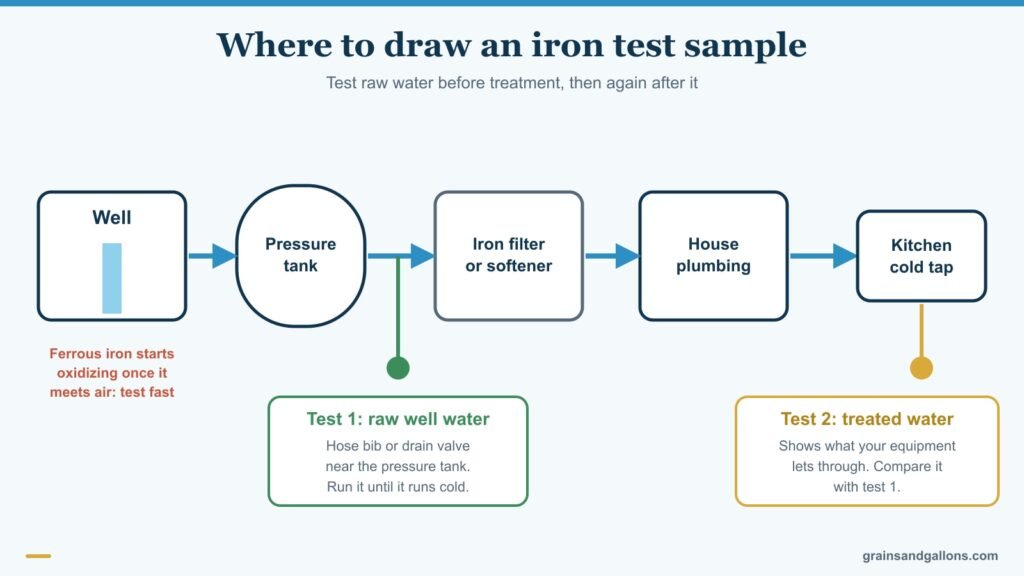
Where you draw water matters as much as which kit you use.
- Find a tap before treatment. Most wells have a hose bib or small drain valve near the pressure tank. Testing at the kitchen faucet after a softener or filter tells you what the equipment lets through, not what the well delivers.
- Run it a few minutes. You want water from the well, not water that has sat in the pipes. When the temperature drops and stays steady, you're getting fresh water.
- Test fast. Ferrous iron starts turning to ferric as soon as it meets air. If your kit separates the two, test within a minute or two of filling the cup. For total iron, timing matters less, but don't let the sample sit for hours.
- For a lab: use the bottle they send and follow their instructions exactly. Metals bottles often contain a small amount of preservative, so don't rinse them out, and ship the sample promptly.
Then test a second time after your treatment equipment, at the kitchen cold tap. Comparing the two shows whether the system works.
How much iron in well water is too much?

The EPA's secondary (non-health-based) standard for iron is 0.3 mg/L (EPA secondary standards). Secondary standards cover taste, color and staining, not health. Iron at these levels isn't considered a health threat, but it is a real nuisance. Private wells aren't covered by federal drinking water rules, so treat these numbers as guidelines.
- Under 0.3 mg/L: usually no visible staining. Nothing to do unless you see stains anyway.
- 0.3 to about 1 mg/L: light staining builds over time. A softener may handle some clear-water iron at this level if it's set up for it.
- About 1 to 3 mg/L: obvious staining and a metallic taste. A softener alone is a stretch; many homes move to a dedicated iron filter or a combination unit.
- Above about 3 mg/L: heavy staining, orange laundry, possible clogging. Plan on an oxidizing iron filter ahead of any softener, as covered in our guide to an iron filter before a water softener.
Manufacturers list their own limits for iron, pH and flow, so check the spec sheet for any system you're considering. Our explainer on whether a water softener can remove iron explains why the ferrous and ferric split matters, and how iron changes softener sizing shows how to add iron to your hardness number.
Reading the iron line on a lab report

Lab reports list iron as "Fe" or "Iron, total," usually in mg/L. A few details trip people up:
- A "<" value, such as "<0.02," means the iron was below what the lab can detect. That's a good result, not a missing one.
- Some labs report in µg/L (micrograms per liter). Divide by 1,000 to get mg/L, so 450 µg/L is 0.45 mg/L.
- Look at manganese on the same page. Penn State lists a recommended maximum below 0.05 mg/L, far lower than iron's limit, and it changes which filter media will work.
- Check pH next to iron. Low pH keeps iron dissolved and limits some filter types; Penn State lists softeners as working for dissolved iron only when pH is above 6.7.
Ask the lab whether the iron number is total or dissolved. If it's dissolved only, iron that has already rusted won't be in the figure.
FAQ
Can I test well water for iron at home?
Yes. Total iron test strips and color disc kits work at home and give results in minutes. They're good for a first look and for checking a filter, but a certified lab gives a more exact number plus the pH, manganese and hardness readings you need before buying treatment.
Is iron in well water safe to drink?
At the levels found in most wells, iron is treated as a nuisance rather than a health problem. The EPA's 0.3 mg/L figure is a secondary standard for taste, staining and color. High iron can still make water taste bad and can feed iron bacteria, so it's worth treating.
How do I know if I have ferrous or ferric iron?
Do the jar test. Water that comes out clear and turns orange as it sits has ferrous (dissolved) iron. Water that comes out already cloudy or orange has ferric (oxidized) iron. A ferrous-specific test kit compared against a total iron reading gives you the split in numbers.
How often should I test my well for iron?
Test at least once a year, and again whenever stains or taste change, after pump or well work, or after a long dry or wet spell. Test before and after any new treatment equipment to confirm it's working.
Do iron test strips work on well water?
They work as a screening tool. Strips are less precise than a color disc kit or lab, especially at high readings and in cloudy or tinted water. Use them to tell low from high iron, not to size equipment.
A two-point test beats a single number
If you're deciding how to test well water for iron, don't stop at one reading. Run a jar test to see the form of iron, use a strip or disc kit at the tap before treatment, and get a lab panel before you spend money on a filter. Then test again after treatment and once a year, since iron levels shift with seasons, drought and pump work. If a softener that used to keep up starts leaving stains, see why a water softener stops removing iron.