


Quick Answer: Lift the toilet tank lid. Reddish-brown or orange slime that smears like jelly on the tank walls, with a swampy smell, is the classic sign of iron bacteria in well water. They aren't known to cause disease, but they foul plumbing, pumps, softeners and filters. The usual first step is shock chlorinating the well and plumbing with the softener bypassed, and you should expect to repeat it. Test for coliform bacteria first, since slime can hide other problems.
Plain rusty water leaves orange stains. Iron bacteria in well water leave slime. If the stains feel greasy, the toilet tank has a gel-like coating, and the water smells like a swamp or a ditch after it sits overnight, you're likely dealing with a living problem, not just a chemical one.
In this guide
- What iron bacteria are and how they get into a well
- Signs of iron bacteria in well water, spot by spot
- Slime or plain rust? Telling them apart
- Are iron bacteria harmful, and what should you test?
- How to shock chlorinate a well for iron bacteria
- Why iron bacteria wreck softeners and iron filters
- Stopping iron bacteria from coming back
- FAQ
- Catch iron bacteria early and keep shocking on schedule
What iron bacteria are and how they get into a well
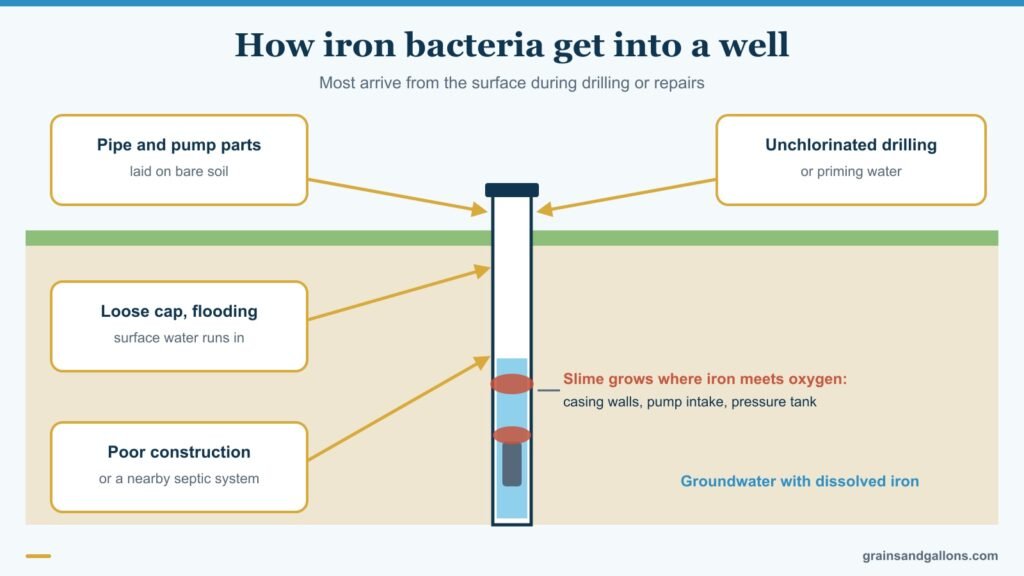
Iron bacteria are naturally occurring microorganisms common in soil, surface water and shallow groundwater. They get their energy by combining dissolved iron (or manganese) with oxygen. The by-product is rust-colored deposits wrapped in a sticky slime.
They rarely come from deep in the aquifer. The Minnesota Department of Health's page on iron bacteria in well water notes that they're present in most Minnesota soils, and that drilling, repairs and other service work can introduce them into a well. The University of Georgia Extension adds a few common routes:
- Pumps, pipe and tools laid on bare ground during installation or repair.
- Drilling or priming water that wasn't chlorinated.
- Poorly sealed or flooded wells, and wells close to septic systems.
Once inside, they thrive on the casing, pump intake and pressure tank.
Signs of iron bacteria in well water, spot by spot
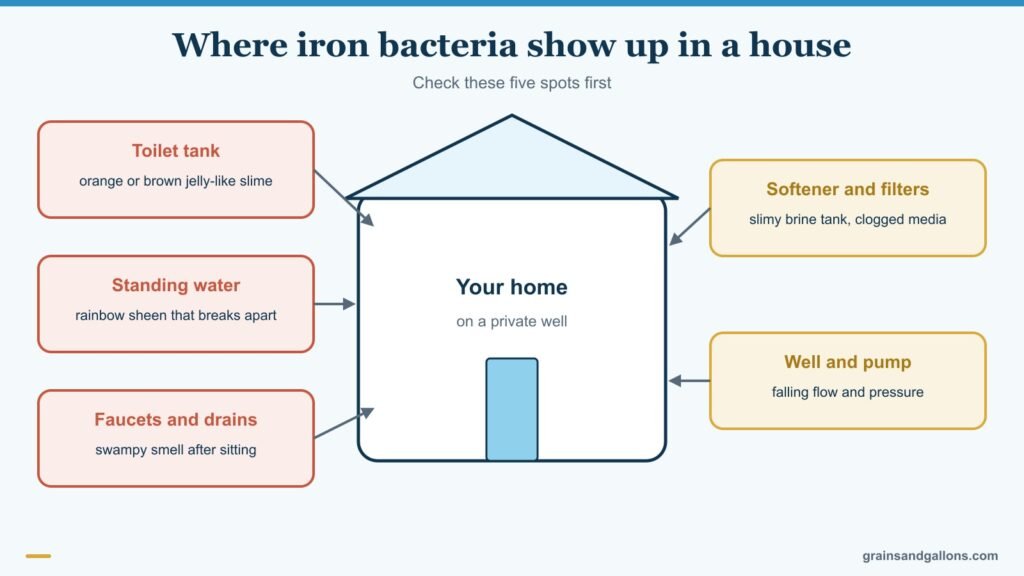
MDH groups the signs into taste and odor, color, and slime. In practice you'll notice them here:
- Toilet tank. Sticky orange, brown, yellow or gray slime on the walls and flapper, sometimes with "feathery" growths.
- Standing water. A rainbow, oil-like sheen in a sink, tub or bucket.
- Faucets. A swampy, oily, cucumber, sewage or musty odor, stronger after the water sits overnight.
- Softener, filters and pump. Slime in the brine tank, clogged media, and flow or pressure that drops over time.
If the only symptom is orange staining with no slime or odor, the cause is more likely plain dissolved iron. See orange stains from well water for that case.
Slime or plain rust? Telling them apart

Many wells carry both dissolved iron and iron bacteria, so this table is about which one is driving your symptoms:
| What you notice | Plain dissolved iron | Iron bacteria |
|---|---|---|
| Orange/red stains | Yes | Yes |
| Slimy, jelly-like coating in the toilet tank | Rare | Typical |
| Swampy, oily, sewage or musty odor, worse after water sits | No | Common |
| Rainbow, oil-like sheen on standing water | No | Common |
| Feathery or stringy growths | No | Yes |
| Problem started after well or pump work | Sometimes | Often |
The finger test for sheen: poke the film with a finger or a stick. A bacterial film shatters into flat pieces. Real oil or fuel swirls back together. If it swirls, read our guide to oily film on water, because petroleum contamination is a different, more serious problem.
Are iron bacteria harmful, and what should you test?

The short answer is no, not directly. MDH says iron bacteria are not known to cause disease, and UGA's fact sheet iron bacteria are not dangerous, but control can be extremely difficult notes that there are no drinking water standards for them because they haven't been shown to pose health risks.
That doesn't make the water automatically safe. MDH notes iron bacteria can create conditions where disease-causing organisms grow, and the gaps that let them in can let surface water in too. Test for:
- Coliform bacteria, every year and whenever taste, odor or appearance changes, per MDH. Our guide to testing well water for coliform explains the steps.
- Nitrate, yearly, per MDH. It matters most for infants.
- Iron and manganese, which decide the treatment you'll need afterward. A simple iron test kit gives you a starting figure.
- Iron bacteria themselves, if unsure. UGA says a visual check is usually enough; MDH says a lab test confirms it.
How to shock chlorinate a well for iron bacteria

The slime protects the bacteria, so there's rarely a one-and-done fix. Shock chlorination, circulating strong chlorine through the well and plumbing, then flushing it out, is the standard first step.
- Bypass the water softener and any filters. Chlorine at shock strength can damage softener resin, and you don't want slime and dislodged iron flushed into your treatment system. Our guide to shock chlorination with a water softener covers what to bypass and when to bring it back online.
- Pump the well until it runs clear, or have it physically cleaned first. Debris and slime use up chlorine.
- Add chlorine. MDH advises a concentration close to, but not above, 200 ppm, because stronger solutions are less effective. Guidance varies: UGA's fact sheet cites 500 ppm for iron bacteria. Follow your state health department's instructions for your well.
- Recirculate. Run chlorinated water back into the well through a clean hose to wash down the casing walls.
- Run every tap, hot and cold, until you smell chlorine, then let the system stand for the contact time in your state's instructions.
- Flush. Run the water outdoors first, away from the septic system, lawns and streams, until the chlorine smell is gone. Then flush indoor lines.
- Test for coliform once the chlorine is gone, then return the softener to service.
Safety: wear gloves and eye protection, ventilate, and never mix chlorine with acids or other cleaners. Don't drink the water until it's flushed and tests clear.
When a heavy infestation needs a contractor
For heavily infested wells, MDH describes physical cleaning first: a licensed contractor pulls and cleans the pump and scrubs the casing, then follows with chemical treatment that only trained professionals should handle. Pasteurization, holding the well water at 140°F for 30 minutes, also works but is expensive. UGA notes that controlling a severe infestation is costly and only partly successful. MDH generally doesn't recommend continuous chlorination for iron bacteria, since it may mask other bacterial contamination and can cause corrosion.
Why iron bacteria wreck softeners and iron filters

Slime and oxidized iron coat resin beads, plug the distributor and grow in the brine tank and drain line, so capacity and pressure drop. A softener can't kill the bacteria, and the resin gives them a large surface to colonize. Iron filter media gets slimed the same way.
Watch for hardness returning early and slime in the brine tank. See softener resin fouling for cleaning and how to tell when resin is beyond saving.
After a successful shock:
- Clean the resin with a resin cleaner suited to iron, and sanitize the brine tank.
- Recheck iron levels. Our guide to putting an iron filter before a water softener explains when that's worth it.
- Retest at intervals with a well water test kit or a lab, so you catch the return early.
Stopping iron bacteria from coming back
Prevention is far easier than cure. MDH and UGA both list the same basics:
- Keep the well cap sealed and watertight. MDH says the casing should extend at least 1 foot above the ground.
- Insist on clean well work: disinfected water only for drilling or priming, and pipe and pump parts kept off the ground.
- Disinfect after every repair. Shock the well, pump and plumbing whenever the system is opened.
- Shock on a schedule if your well is prone to it. UGA suggests shock chlorination twice a year for early-stage problems.
- Flush seldom-used lines and fixtures. Standing water is where odors build.
UGA Extension's bulletin on iron, manganese and sulfur bacteria in your well water has more detail.
FAQ
Can you drink water with iron bacteria?
Iron bacteria aren't known to cause illness, and there's no health standard for them. The water may taste or smell bad, though, and the conditions that let iron bacteria in can also let in harmful bacteria. Test for coliform before deciding the water is safe to drink.
Will a water softener remove iron bacteria?
No. A softener can remove some dissolved iron, but it doesn't kill bacteria. Iron bacteria can colonize the resin and brine tank and make the softener's performance worse over time. Treat the well first, then clean the softener.
How often should I shock chlorinate for iron bacteria?
There's no single schedule. UGA suggests twice a year for early-stage problems, while others shock only when the slime and odor return. If symptoms come back within weeks, the infestation likely needs physical cleaning by a well contractor.
Does iron bacteria smell like rotten eggs?
Not usually. Iron bacteria give off a swampy, oily, musty or sewage-like odor. A strong rotten-egg smell points to hydrogen sulfide or sulfur bacteria, which often show up in the same wells and respond to similar treatment.
Catch iron bacteria early and keep shocking on schedule
Iron bacteria in well water are a nuisance, not a poison, but they're stubborn. Confirm the slime, test for coliform, bypass the softener and shock the well properly. Then keep the cap sealed, disinfect after every repair and shock again when the odor returns.