

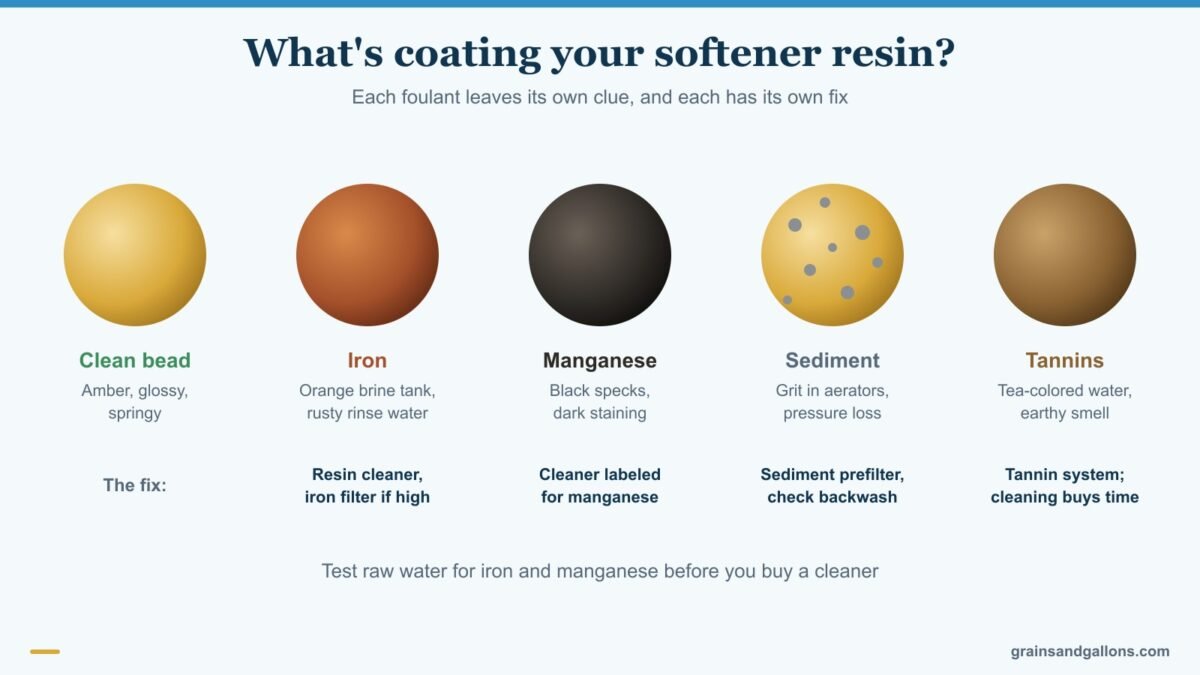
Quick Answer: Water softener resin fouling is a coating of iron, manganese, sediment or organic matter that covers the beads so they can't grab hardness. If soft water runs out sooner each month and salt, brine draw and settings all check out, fouling is the likely cause, and on well water it's usually iron. Test your raw water for iron and manganese, deep-clean with a resin cleaner and a manual regeneration, then measure capacity. If it comes back, set up a routine. If it doesn't, the resin may be past saving.
Fouling is the slow kind of softener failure. Nothing breaks. The softener regenerates on schedule, the brine tank empties and refills, and the display looks normal. But each bead is a little more coated than last month, and a coated bead can't grab calcium. So the soft water runs out earlier and earlier, until you're testing hard water two days before regeneration and wondering if the whole system is shot.
Usually it isn't. But the fix depends on what's doing the coating.
In this guide
Fouled beads versus damaged beads
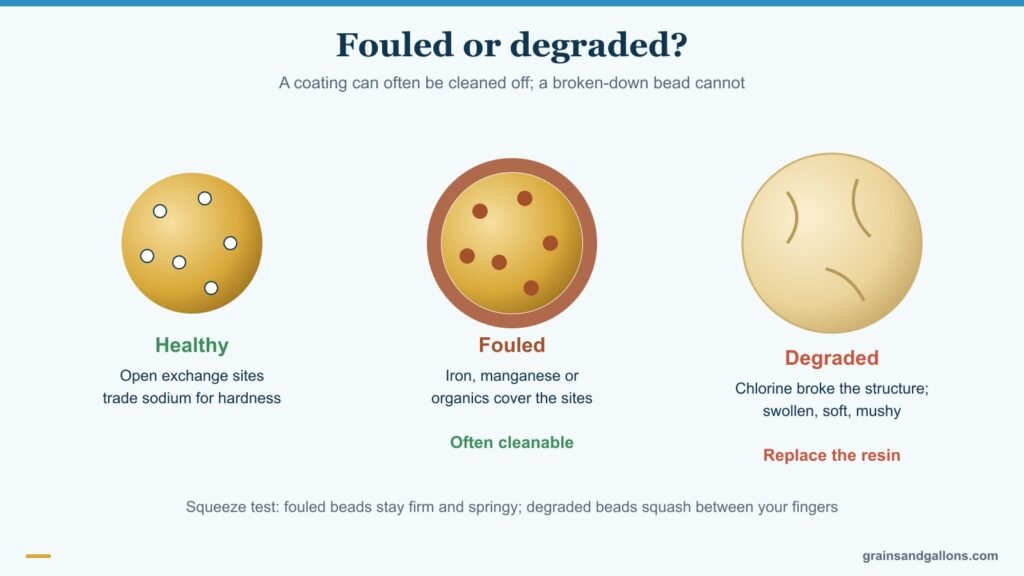
Softener resin is millions of tiny plastic beads, each covered in sites that hold a sodium ion. Hard water flows past, calcium and magnesium trade places with the sodium, and the water comes out soft. Regeneration floods the beads with brine and pushes the hardness back off.
Fouling is anything that sits on or in those beads and either blocks the exchange sites or won't come off with brine. The resin isn't destroyed, just smothered. That's the key difference from resin degradation, where the bead itself breaks down, swells or cracks, usually from chlorine. Degraded resin needs replacing. Fouled resin often can be cleaned.
A quick way to tell: pull a small sample and squeeze a few beads. Fouled beads are dark but still firm and springy. Degraded beads are pale, swollen and squash between your fingers. If that's what you find, read mushy, swollen softener resin and how chlorine damages resin instead; those are a different problem.
Water softener resin fouling, foulant by foulant
Start by testing your raw, unsoftened water for iron and manganese; how to test well water for iron covers kits and lab tests. Then work down this list, most common first.
1. Iron: orange, rust, and a capacity that keeps shrinking
Clues: an orange or brown ring in the brine tank, rusty-looking water going to drain during regeneration, orange staining in toilets despite the softener, and capacity loss that's gradual over months.
Why it happens: Penn State Extension says conventional softeners are sometimes effective for removing iron and small amounts of manganese, which then come off in backwash and regeneration. But it adds that softeners are generally only recommended when the water's pH is above 6.7 and dissolved iron is below 5 mg/L, and that "oxidized forms of iron and manganese will foul the softener resin." Any air or chlorine that reaches the raw water ahead of the softener turns clear iron into rust particles that stick to the beads and don't rinse off with salt.
What to do: deep-clean with a resin cleaner and regenerate. Our guide to resin and iron cleaners covers which type to use and how to dose it. If your discharge runs rusty during regeneration, brown water after regeneration explains what that means.
2. Manganese: dark specks and black staining
Clues: dark brown or black particles, black staining in the brine tank or on fixtures, and capacity loss similar to iron.
Why it happens: manganese behaves much like iron but oxidizes more slowly, so it can travel deeper into the bed before it drops out. It often shows up alongside iron in well water. Penn State recommends drinking water carry less than 0.05 mg/L, so even small amounts stain.
What to do: the same cleaner routine works if the product is labeled for manganese; some liquid cleaners are, so check before you buy. If manganese is high, a dedicated filter ahead of the softener is the long-term fix.
3. Sediment: grit, slow flow, pressure loss
Clues: pressure through the softener drops over time, you find fine grit in faucet aerators, and the problem gets worse after a well pump replacement or after the city flushes hydrants.
Why it happens: sand, silt and fine scale get trapped in the resin bed. Backwash is supposed to lift the bed and carry light debris to drain, but heavy sediment packs down faster than backwash can clear it. For mud and clay, Penn State Extension's water softening guide suggests slowly stirring the resin during the backwash cycle.
What to do: cleaners don't do much here. A spin-down sediment filter ahead of the softener catches sand and grit and can be flushed without changing cartridges. Also check that backwash is actually happening; a plugged drain flow control limits how well the bed is cleaned.
4. Organics (tannins): tea-colored water
Clues: a yellow or tea tint that the softener doesn't remove, an earthy smell, and resin that looks darker over time. Common in shallow wells near swampy or wooded ground, where water picks up compounds from decaying leaves.
Why it happens: tannins are large natural organic molecules. Softener resin isn't designed for them; they lodge in the beads and are slow to come back off.
What to do: this one's hard to fix with a softener alone. Some liquid cleaners claim to help with organics, but heavy tannin water generally needs a dedicated tannin system or a dealer's specialty cleaning. Here, cleaning buys time rather than solving the problem.
5. Bacteria and slime
Clues: slime in the brine tank or drain line, a musty or sulfur odor, and sometimes iron bacteria (a reddish, gelatinous film) on well systems.
What to do: this is a sanitizing job, not an iron-cleaning job, and it often goes along with cleaning the brine tank. Penn State mentions periodic cleaning with chlorine bleach for bacteria, but says to read the manufacturer's instructions before adding any chemical, since too much chlorine damages resin.
Clean it, then check whether capacity came back
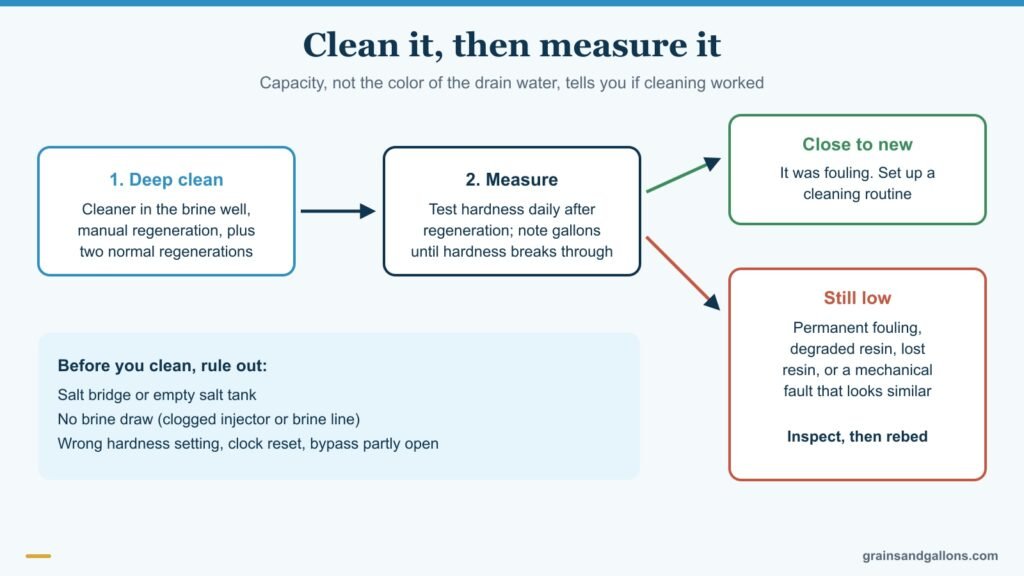
Rule out the cheap stuff first, because a regeneration problem looks exactly like fouling. Check for a salt bridge or an empty salt tank, confirm the brine level drops during regeneration (no brine draw means a clogged injector or brine line), and make sure the hardness setting, clock and bypass are right.
Then give cleaning a fair try: one good deep clean plus two normal regenerations. After the next regeneration, test a cold softened tap each day, or every few hundred gallons on a metered unit, until hardness breaks through. If soft water now lasts close to what it did when the softener was new, the resin was fouled and it's recovered.
If capacity stays low, a few possibilities remain:
- The fouling is permanent. Years of heavy iron or organics can leave resin that never fully recovers.
- It wasn't fouling. The resin may have degraded, or there's a mechanical problem (a cracked distributor, a brine draw issue) that looks similar.
- Some resin is gone. If beads have washed out to drain, there's simply less resin to work with.
At that point, rebedding the tank with new resin is often the cheapest real fix, especially on a good valve. Our list of the best replacement water softener resin covers 8% versus 10% crosslink and fine-mesh options for iron-prone water.
Keep the next layer off

- Test raw water once a year for iron and manganese. Well chemistry shifts, especially after a new pump or a drought.
- Keep oxidizers away from the raw water. Penn State stresses that water feeding a softener for iron removal shouldn't contact air or chlorine first. If you aerate or chlorinate ahead of the softener, a filter has to remove the oxidized iron before it gets there.
- Keep a cleaning routine if you have any iron at all, even a fraction of a ppm.
- Add pretreatment when the numbers call for it: sediment filtration for grit, an iron filter for iron above roughly 1 ppm or any oxidized iron, a tannin system for colored water.
- Use clean salt. Low-grade salt carries insoluble material that ends up in the brine tank and, eventually, the bed.
FAQ
What are the signs of fouled softener resin?
Soft water running out sooner than it used to, more frequent hardness breakthrough before regeneration, an orange, brown or black ring in the brine tank, rusty discharge during regeneration, and sometimes lower pressure. The settings and salt look fine, but capacity keeps dropping.
Can fouled water softener resin be cleaned?
Often, yes, especially iron and manganese fouling caught early. A sulfite powder or acid-based resin cleaner followed by a manual regeneration can bring capacity back. Heavy, years-old fouling and tannin fouling are harder, and degraded (mushy) resin can't be cleaned at all.
How long does it take resin to foul?
It depends on how much iron, manganese, sediment or organic matter reaches the softener. Water with a trace of clear iron may take years; water with oxidized iron or several ppm can foul a bed in months. Testing your raw water is the only way to know your pace.
Is resin fouling the same as resin degradation?
No. Fouling is a coating on otherwise sound beads and can often be cleaned off. Degradation is damage to the beads themselves, usually from chlorine, which makes them swell, soften or crack. Degraded resin has to be replaced.
Will a bigger softener stop fouling?
Not by itself. More resin takes longer to lose capacity, but the same foulant still builds up. Pretreatment that removes iron, sediment or tannins before the softener is what stops fouling.
Most fouled resin can be saved if you stop the source
Water softener resin fouling is usually reversible: test the raw water, match the cleaner to the foulant, and measure capacity afterward instead of guessing. What makes it permanent is letting the same iron, sediment or tannins keep arriving. Clean the bed once, then put the right pretreatment or cleaning routine in place so you aren't fighting the same coating every few months.