

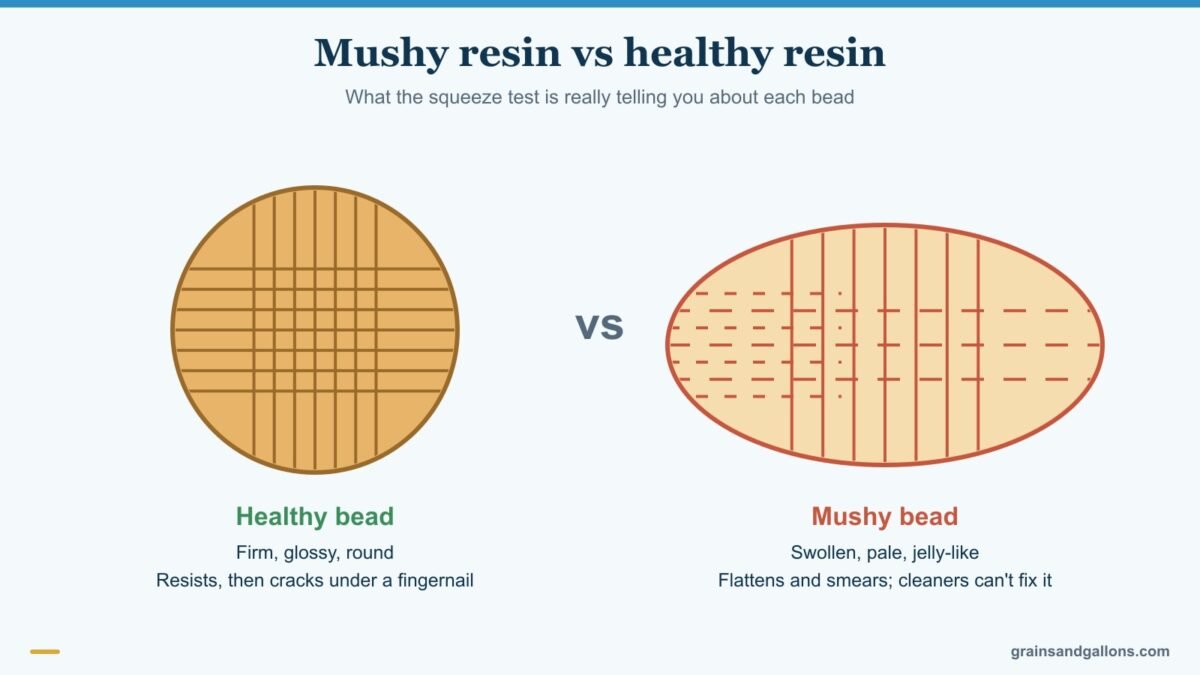
Quick Answer: Mushy resin is softener resin that chlorine or chloramine has broken down. The beads swell, go soft, and flatten when you press them between two fingernails. The swollen bed packs tight and cuts water pressure, and no cleaner can repair it. The fix is to replace the resin with a chlorine-tolerant 10% crosslink resin such as ResinTech CNS10. On city water, add a carbon filter ahead of the softener too, or the new bed will fail the same way.
Disclosure: As an Amazon Associate, Grains & Gallons earns from qualifying purchases.
Healthy softener resin feels like tiny hard plastic marbles. Mushy resin feels more like fish eggs. The beads are soft, swollen and pale, and they smear when you squeeze them. Over the same months the bed usually rises in the tank and the water pressure gets worse. Hard water may start slipping through between regenerations too.
It's almost always a city-water problem, and it happens slowly, over years. This guide shows you how to confirm it with a squeeze test and rule out problems that look similar. Then it covers what to buy and install so the next bed lasts. If you've already decided to rebed, our guide to the best replacement water softener resin compares the chlorine-tolerant options.
In this guide
What mushy resin is, bead by bead
Each resin bead is a sponge of polystyrene chains tied together by divinylbenzene (DVB) crosslinks. Standard softener resin has about 8% crosslinking. Premium grades have 10%. The crosslinks are what keep a bead firm and round.
Chlorine and chloramine are oxidizers, and they slowly cut those crosslinks. As the network loosens, each bead soaks up more water, swells and goes soft. New resin already holds a lot of water. ResinTech's CG10 data sheet lists 39 to 45% moisture retention for its 10% crosslinked gel. A degraded bead holds even more water, with less exchange capacity left.
That's why mushy resin can't be cleaned back to health. Resin cleaners remove coatings like iron, manganese and organics from the bead surface, but they can't rebuild broken crosslinks. Once a bead has gone soft, it stays soft. Our explainer on how chlorine damages softener resin goes deeper into the chemistry.
How to run the resin squeeze test

You need a sample from the tank itself. Beads caught in a faucet aerator are a different clue. They usually mean a cracked distributor or riser, not bad resin.
- Bypass and depressurize. Put the softener in bypass, unplug it, and open a softened faucet to release the pressure in the tank.
- Take a sample. Unscrew the control valve from the tank and scoop a tablespoon of beads from the top of the bed. The top layer gets the most chlorine, so it shows damage first.
- Rinse and look. Rinse the beads in clean water. Healthy resin is glossy, uniform and amber to dark brown. Mushy beads tend to be paler, swollen, uneven in size, and some look almost clear or jelly-like.
- Press. Squeeze a single bead between two fingernails. Healthy resin resists, then cracks or pops. A mushy bead flattens easily and smears.
- Judge the sample. A few soft beads in a firm bed is normal aging. If most of the sample flattens, the resin is mushy.
While the valve is off, look at the bed height. Compare it with the fill line or with what you remember from installation. A bed sitting noticeably higher than before has swollen.
Symptoms that point to mushy resin

Swollen, soft beads squeeze together and close the gaps that water normally flows through. The bed starts acting more like a sponge than a pile of marbles. You'll usually notice some combination of these:
- Water pressure drops, especially when two fixtures run at once. The simplest check is to compare flow with the softener in bypass and then in service. A big difference points at the bed.
- Hardness leaks through. A packed bed channels, so water runs down a few paths instead of through all the resin. Soft water fades sooner after each regeneration.
- The bed rises toward the top of the tank and can press against the upper screen.
- Fines show up. Broken-down resin sheds small amber particles. They collect in screens or wash out to the drain during backwash.
- Salt use stays normal but results don't. If the softener is drawing brine and using salt and you still get hard water, the resin is the prime suspect. If it isn't using salt at all, look at the valve, injector or brine line first.
Low pressure has other causes too, such as a clogged prefilter, an undersized valve or a stuck bypass. Our guide to low water pressure after a water softener walks through them.
Fouled, cracked or mushy? Tell them apart

Several softener problems get called "bad resin," and only one of them is mushy resin. Each has a different fix.
| Problem | How the beads feel | What you see | Fix |
|---|---|---|---|
| Mushy resin | Soft, flatten and smear | Pale, swollen, some clear | Replace the bed |
| Fouled resin | Firm | Rust-brown or dark coating | Resin cleaner |
| Cracked resin | Hard but broken | Sharp fragments, chips | Replace the bed |
| Salt mushing | Beads are fine | Sludge in the brine tank | Clean the brine tank |
Fouled resin is the most common mix-up. Penn State Extension's water softening guide notes that oxidized iron clogs resin and that commercial cleaners exist for fouled beds. The beads underneath are still firm, which is the key difference. See water softener resin fouling for the cleaning routine.
Cracked resin breaks into hard fragments instead of going soft, often after freezing or pressure shocks. Our guide to cracked water softener resin covers it.
Salt mushing sounds similar but happens in the brine tank, not the resin tank. Fine salt recrystallizes into sludge at the bottom. Your beads can be perfectly healthy. See salt mushing in a brine tank.
Why chlorine is almost always the cause

On city water, mushy resin is nearly always disinfectant damage. Utilities keep a chlorine or chloramine residual in the water so it stays safe all the way to your tap. Your softener sits right in that stream. The EPA says more than one in five Americans drinks water treated with chloramines. Chloramine works more slowly on resin than free chlorine, but it is harder to remove and does the same damage over time. Our guide to how chloramine affects a water softener explains the difference.
The odds of mushy resin go up when:
- The softener has standard 8% crosslink resin.
- The utility does an annual free-chlorine "burn" to clean its pipes.
- The softener sits somewhere warm, like a hot garage, or hot water back-feeds into it.
- Someone bleached the brine tank often, or the softener has a built-in chlorinator.
- On a well, the well was shock-chlorinated without bypassing the softener.
On a well with no chlorine history, mushy resin is rare. If your well-water beads are soft, think back to any past sanitizing or a chlorine feeder on the system.
Rebed with resin that can take chlorine
A resin cleaner won't revive mushy resin. Some owners stretch a failing bed by lengthening backwash, but pressure and capacity keep falling. Rebedding is the real fix, and it's a reasonable DIY job if the tank and valve are sound. Our step-by-step guide to loading resin into a water softener tank covers the work.
What to get right:
- Choose 10% crosslink resin for any chlorinated or chloraminated supply. The extra crosslinking resists oxidation better than standard 8%. The trade-off is a slightly less efficient regeneration. On untreated well water, 8% is usually fine.
- Match the volume. Your manual or tank label lists the cubic feet the softener was built for. Don't fill to the top, because the bed needs room to expand during backwash. ResinTech's CG10 sheet lists 25 to 50% backwash expansion.
- Inspect the riser tube and distributors while the tank is empty. A swollen bed puts stress on them.
- Use only silicone lubricant on the valve and riser O-rings. Petroleum grease makes rubber seals swell.
Rebed, or replace the whole softener?
Fresh resin only makes sense if the rest of the softener is worth keeping. Check three things before you order. First, the control valve should still cycle and keep time reliably. Second, the resin tank should have no cracks, bulges or weeping at the seams. Third, the bypass and O-rings should seal without leaks. If the valve is failing as well, or the tank is damaged, a new softener may cost little more than resin plus a valve rebuild. Our guide to water softener resin life and replacement goes through that decision in more detail.
Put carbon ahead of the new bed

New resin on the same chlorinated water will go soft too, just more slowly with 10% crosslink. The lasting fix is a carbon filter installed before the softener. Standard granular carbon handles free chlorine. Chloramine needs catalytic carbon and more contact time. Our picks for whole house filters for chloramine focus on that harder case. Our guide to running a carbon filter and water softener together covers plumbing order and sizing.
Carbon has its own replacement schedule. Once it's spent, chlorine reaches the resin again, so put the change date on your calendar the day you install it.
FAQ
Can mushy resin be cleaned or restored?
No. Resin cleaners remove iron, manganese and organic coatings from the bead surface. They can't rebuild the crosslinks that chlorine has broken. A mushy bed only gets worse, so replace it.
How long does softener resin last on city water?
It depends on chlorine levels, temperature and the resin grade, and published figures vary widely. Resin makers' data sheets don't give a service life. Standard 8% resin on chlorinated water wears out faster than 10% crosslink resin or resin protected by a carbon prefilter.
Does mushy resin cause low water pressure?
Yes. Swollen, soft beads pack together and close the gaps water flows through, so pressure drops, especially when several fixtures run at once. Compare flow in bypass and in service to confirm the softener is the restriction.
Is 10% crosslink resin worth it?
On chlorinated or chloraminated city water, usually yes, because it resists oxidation better than standard 8% resin. On a private well with no chlorine, the benefit is small.
Can I mix new resin with my old mushy resin?
It's better not to. The old beads keep packing and shedding fines, which drags down the new resin's flow and capacity. Remove the whole bed, rinse the tank, and refill with fresh resin.
Mushy resin is a replace-and-protect job
If the squeeze test shows soft, flattening beads, the cause is settled, and so is the fix. Mushy resin can't be cleaned, so rule out fouling, cracking and salt mushing, then rebed with 10% crosslink resin. On city water, put a carbon filter ahead of the softener and keep it changed. Skip that step and the new resin will slowly go mushy too.