


Quick Answer: A carbon filter and water softener together is one of the most common home setups, and on chlorinated city water the carbon filter goes first. Carbon strips out chlorine (or chloramine) before it reaches the softener, which protects the resin from slow oxidation and gives you better-tasting water at every tap. The softener then handles hardness. On a private well with no chlorine, carbon can go last. Pick catalytic carbon if your utility uses chloramine.
Running a carbon filter and water softener together makes sense because each tank fixes something the other can't touch. Maybe you've got a quote with two tanks in it, or you already own a softener and someone told you a carbon tank "should go in front." Both are reasonable places to be. Here's how the pair works, which order to use, and how to size and plumb it.
In this guide
Two tanks, two completely different jobs

A softener is an ion exchanger. Its resin beads trade sodium (or potassium) for calcium and magnesium. It doesn't adsorb chlorine, it doesn't fix taste, and it does little for organic odors.
Activated carbon is the reverse. It grabs chlorine, many taste and odor compounds, and some organic chemicals onto its surface. It does nothing to hardness. Run hard water through a carbon tank and hard water comes out.
Do you need both?
Only if you have both problems. The Minnesota Department of Health's water softening fact sheet suggests a softener may be worth it above 7 grains per gallon (120 mg/L) and notes there's no requirement to soften. That gives a simple rule:
- City water, 7 gpg or harder: both, carbon first.
- City water, softer than that: a carbon tank alone may be all you need.
- Hard well water with no taste, odor or chlorine: a softener alone.
- Well water with iron, sulfur or low pH: treat those first; carbon may or may not be part of it.
Why carbon goes in front on city water
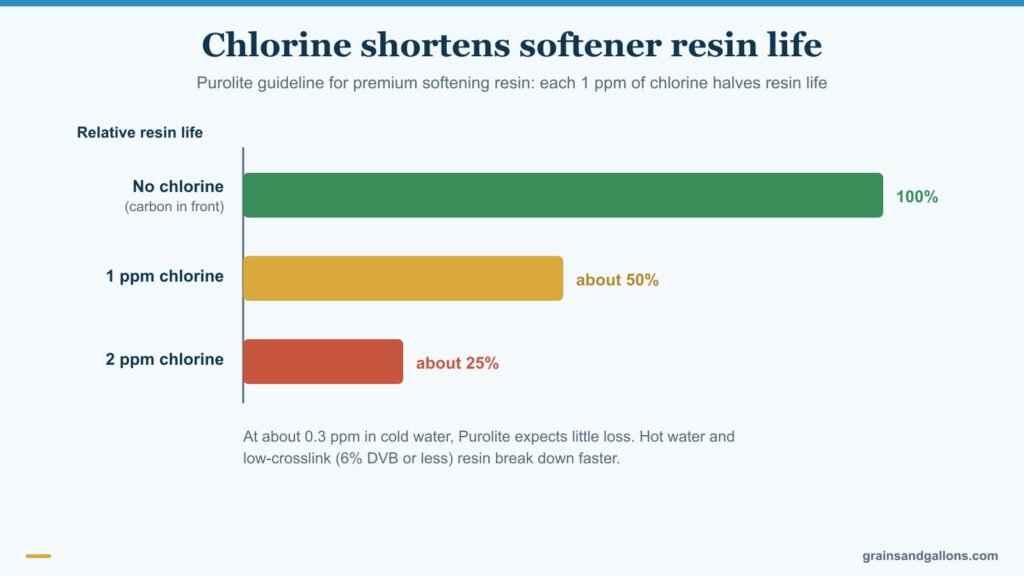
Free chlorine is an oxidizer, and softener resin is a plastic (polystyrene crosslinked with divinylbenzene). Over years, chlorine breaks those crosslinks. The beads swell, soften, hold more water and lose capacity. You eventually see mushy resin, a growing pressure drop, and hardness slipping through sooner than it used to.
Resin maker Purolite puts rough numbers on it. In its guide to factors affecting softening resin life, about 0.3 ppm of free chlorine in cold water causes little loss, but each 1 ppm in the incoming water cuts the life of a premium resin by about half, and each further ppm halves it again. Warmer water and lower-crosslink resin break down faster. We cover the mechanism in how chlorine damages softener resin.
Putting carbon first means the resin sees dechlorinated water for its whole life. It also means every downstream tap, hot side included, gets the cleaner water.
A common counterargument: "Shouldn't the softener go first so the carbon doesn't scale up?" In practice, carbon isn't harmed much by hardness at normal household temperatures. Scale is mostly a hot-water problem, and both tanks sit on the cold line before the water heater. Resin protection is the bigger deal.
When the order flips on a well

On a private well with no chlorination, there's no oxidizer for the carbon to remove, so the resin isn't at risk. Many well owners add carbon for taste or odor, such as a faint earthy taste, and put it after the softener as a polishing stage.
The exceptions on wells:
- If you shock-chlorinate the well, bypass both tanks during the shock and flush thoroughly afterward.
- If you run a chlorine-injection system for iron or sulfur, carbon belongs right after the retention tank to remove the residual chlorine, which puts it in front of the softener again.
- If there's sediment, iron or low pH, the sediment filter, iron filter or neutralizer goes ahead of the softener. See why a sediment prefilter protects a softener and our full well water treatment train order.
Chloramine changes which carbon you need
Check your utility's water quality report, or call and ask: "Do you disinfect with chlorine or chloramine?" The answer decides the media. According to the EPA's chloramines page, chloramines usually form when ammonia is added to chlorine, they give longer-lasting disinfection in the pipes, and more than one in five Americans drink water treated with them. Our guide on how to test water for chlorine and chloramine shows how to check at the tap.
Standard granular activated carbon handles free chlorine well. Chloramine is more persistent and needs more contact time. Catalytic carbon is the usual answer because its treated surface breaks chloramine down far more effectively. If you buy a plain carbon tank for chloramine water, it may seem to work at first, then the smell creeps back much sooner than expected.
Chloramine is gentler on resin than free chlorine, but not harmless over the long haul; see how chloramine affects a water softener. For chloramine-specific systems, see our best whole house filters for chloramine.
Three ways to set up a carbon filter and water softener together

| Setup | How it works | Good fit | Watch out for |
|---|---|---|---|
| Separate upflow carbon tank, then softener | Carbon tank with an in/out head, no control valve, no drain | Most city homes; simplest | No backwash, so not for water with sediment; media gets replaced every few years |
| Separate backwashing carbon tank, then softener | Carbon tank with its own control valve that backwashes on a schedule | Larger homes, higher flow, some sediment | Needs a drain and an outlet; uses some water to backwash |
| Combo: carbon layer on top of the resin in one tank | One tank, carbon sits above the resin | Tight spaces, small households | Less carbon, shorter contact time; every regeneration disturbs it; replacing it means rebedding |
If you're comparing packaged pairs, our guide to the best water softener and carbon filter combos covers systems that ship both tanks. If you already own a softener and just need the carbon side, start with our best whole house catalytic carbon filters.
Sizing and plumbing the pair
A sizing example with real household numbers
Say you have a three-bathroom house, four people, city water on chlorine, and 14 grains per gallon of hardness.
- Peak flow. Two showers plus a dishwasher at once can easily hit 6 to 8 gallons per minute. Both tanks need to handle that without a big pressure drop.
- Softener. Size it from hardness and daily use: 4 people × roughly 75 gallons each × 14 gpg is about 4,200 grains a day, so a unit that regenerates about weekly needs around 30,000 usable grains at an efficient salt setting. Confirm its rated service flow covers 6 to 8 gpm.
- Carbon tank. Check the rated service flow and the media volume in cubic feet. More media means more contact time, which matters more for chloramine than for chlorine. If the rated flow is right at your peak, go up a size.
- Pipe size. If your main line is 1 inch, don't choke it with 3/4-inch heads unless the rated flow still covers you.
Treat gallon ratings as estimates; they vary with chlorine level and flow.
The plumbing order
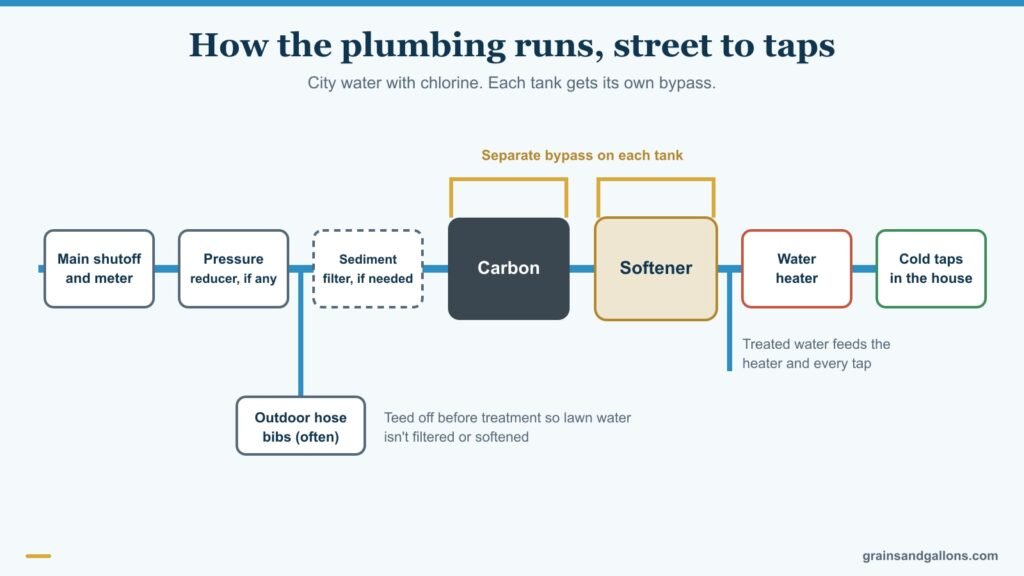
From the street: main shutoff and meter, pressure-reducing valve if you have one, sediment filter if needed, carbon tank, softener, then the split to the water heater and house. Outside hose bibs are often teed off before both tanks so you're not treating lawn water. Give each tank its own bypass so you can service one without shutting off the house. For every possible stage, see filter before or after a water softener.
One honest downside: once chlorine is gone, nothing downstream is disinfected. In a house with normal use that's rarely an issue, but water sitting for weeks, as in a vacation home, can go stale. Flush the lines when you return and sanitize the softener at its normal maintenance interval.
Maintenance for both tanks
- Carbon: upflow tanks don't regenerate, so the media wears out. When you start to smell chlorine at the tap again, it's done. Many owners check a cold tap with chlorine strips every few months. Our guide to replacing carbon filter media walks through the swap.
- Softener: keep salt in the brine tank and check hardness at a tap now and then. With chlorine removed up front, the resin should last noticeably longer than on raw city water.
FAQ
Can I put the carbon filter after the softener on city water?
It will still fix taste, but the resin takes the chlorine hit for its whole life, which shortens its life. On chlorinated water, carbon in front is better.
Does the carbon tank need a drain?
Upflow (non-backwashing) tanks don't. Backwashing tanks do, along with an outlet if they have an electronic valve.
Will a carbon filter remove the salt taste from softened water?
No. Carbon doesn't remove sodium. If a salty taste bothers you, an under-sink reverse osmosis unit handles it; see reverse osmosis and a water softener together.
Is a whole-house carbon filter worth it if I already have a softener?
On chlorinated city water, usually yes. It protects the resin and removes chlorine taste and smell at every tap, including showers, which a softener alone doesn't do.
Does regular carbon work for chloramine?
Not well. Chloramine needs more contact time, and plain carbon wears out against it quickly. Use catalytic carbon and size the tank generously.
Put carbon first on chlorinated water
Run a carbon filter and water softener together when you have both chlorine and hardness, and on city water put the carbon first so the resin never sees chlorine. Choose catalytic carbon if your utility uses chloramine, give each tank its own bypass, and on a chlorine-free well let the carbon polish the water at the end instead.