

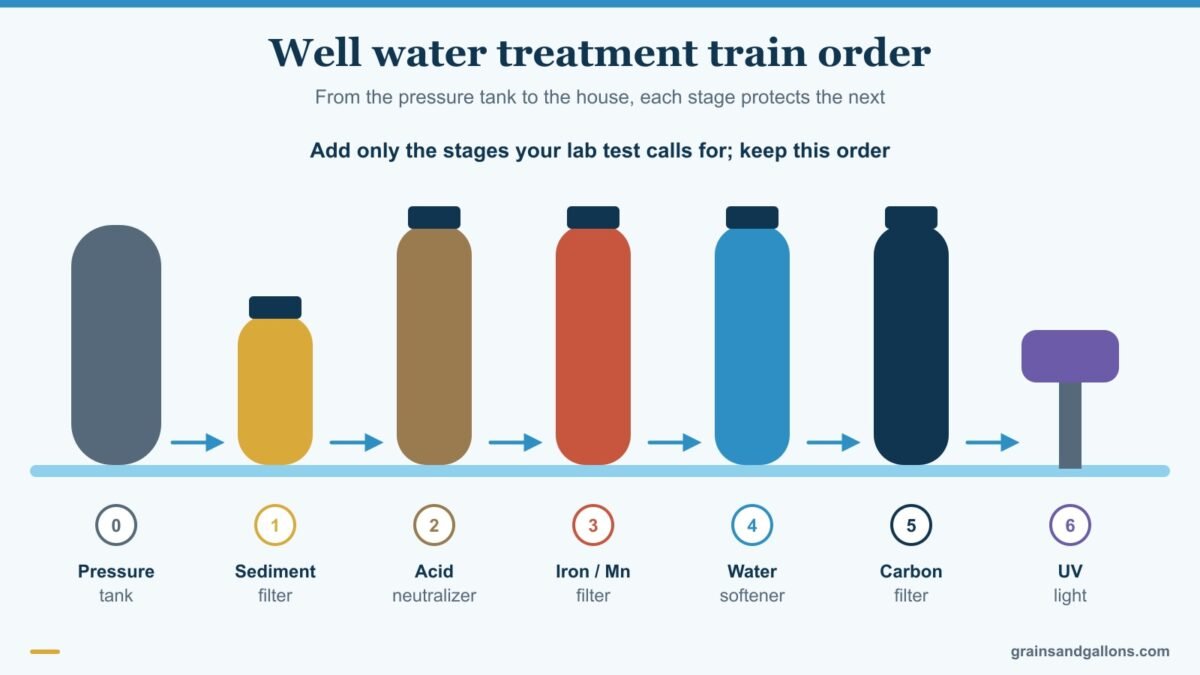
Quick Answer: The standard well water treatment train order, starting after the pressure tank, is: sediment filter, acid neutralizer (only if pH is low), iron/manganese/sulfur filter, water softener, carbon filter (if needed), UV disinfection last, and reverse osmosis at the kitchen sink. Each stage protects the one after it. Your lab results decide which stages you actually need, so test first with a full well panel such as the Tap Score Advanced Home Water Test.
Disclosure: As an Amazon Associate, Grains & Gallons earns from qualifying purchases.
It's tempting to treat well equipment as a shopping list: one box for iron, one for hardness, one for bacteria. In practice the well water treatment train order turns it into an assembly line, where every stage changes the water the next stage receives. Put them in the wrong order and the expensive piece at the end either fouls quickly or quietly stops doing its job.
In this guide
The well water treatment train order at a glance
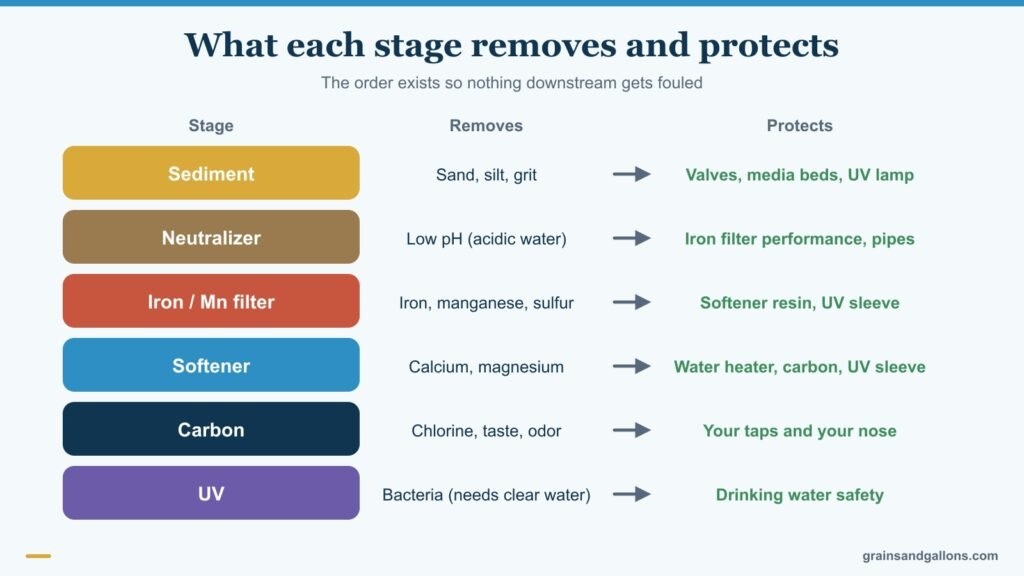
| Position | Stage | Add it when your test shows | Why it sits here |
|---|---|---|---|
| 0 | Pressure tank | Always (it's part of the well) | Treatment goes after it so the pump and pressure switch work normally |
| 1 | Sediment filter | Sand, silt, grit, cloudiness | Protects every valve, media bed and lamp downstream |
| 2 | Acid neutralizer | pH below about 7 | Many iron filters need higher pH; also stops corrosion |
| 3 | Iron, manganese, sulfur filter | Iron, manganese, rotten-egg smell | Oxidized iron clogs softener resin and coats UV sleeves |
| 4 | Water softener | Hardness | Keeps scale off the water heater, carbon and UV sleeve |
| 5 | Carbon filter | Taste, odor, chlorine from injection, some chemicals | Removes leftovers from earlier stages |
| 6 | UV disinfection | Coliform bacteria or no barrier for a vulnerable well | Needs the clearest water, so it goes last on the main line |
| 7 | Reverse osmosis | Nitrate, arsenic, sodium, dissolved solids | Point-of-use at the kitchen tap for drinking water |
Not every house needs every stage. A well with only hardness might need just sediment plus a softener. The order stays the same; you simply skip the stages your water doesn't call for.
Follow one drop from the pressure tank to the tap
Start after the pressure tank
The drop arrives from the pump and fills the pressure tank. Whole-house treatment belongs after the tank, not between the pump and the tank. A filter in that spot adds pressure drop right where the pressure switch reads, and as the cartridge clogs, the pump can short-cycle.
Sediment comes off first
The drop is carrying sand, silt and grit. A spin-down screen or cartridge sediment filter catches it first, because everything downstream suffers when grit gets through: valve seals score, resin beds pack, and UV lamps get shadowed. Sandy wells often use a coarse spin-down followed by a finer cartridge. See our picks for the best spin-down sediment filters.
Raise the pH before the iron filter
If the lab says pH is below about 7, the water can dissolve copper and attack fixtures, and it makes many iron and manganese filters work poorly. NDSU Extension notes that greensand filters probably won't remove iron and manganese adequately below pH 6.8 (NDSU Extension). A calcite or calcite/corosex neutralizer goes ahead of the iron filter for that reason. One catch: calcite dissolves into the water and adds hardness, so a neutralizer upstream means the softener has more to remove. Size the softener for the higher number. Our guide to the best acid neutralizer filters covers media options.
Iron, manganese and sulfur before the softener
Next, the drop meets an oxidizing filter: air injection, a manganese dioxide or greensand bed, or chlorine or peroxide injection with a contact tank. These turn dissolved iron, manganese and hydrogen sulfide into particles and trap them.
This stage goes ahead of the softener because a softener handles only limited iron. Penn State Extension warns that iron already exposed to air or chlorine "will clog the resin" and recommends filtration ahead of the softener (Penn State Extension, Water Softening). NDSU likewise says that when iron and manganese exceed the softener maker's limits, a prefilter is needed before softening. Our guide to putting an iron filter before a water softener covers the thresholds, and black fixture stains are explained in well water black stains from manganese. These filters need strong backwash flow, so check well pump flow and backwashing before you buy.
Softener, then carbon
The drop, now free of grit and iron, passes through softener resin that swaps calcium and magnesium for sodium or potassium.
Carbon usually follows the softener. It handles taste, odor, many organic chemicals and, critically, leftover chlorine if you inject chlorine for iron or bacteria. NDSU points out that chlorinating water with organic matter can form trihalomethanes, which an activated carbon filter can remove, so carbon must sit downstream of any chlorine injection. Some systems place carbon before the softener to protect resin from chlorine; our guide to a carbon filter and water softener together explains both layouts.
UV goes last on the main line
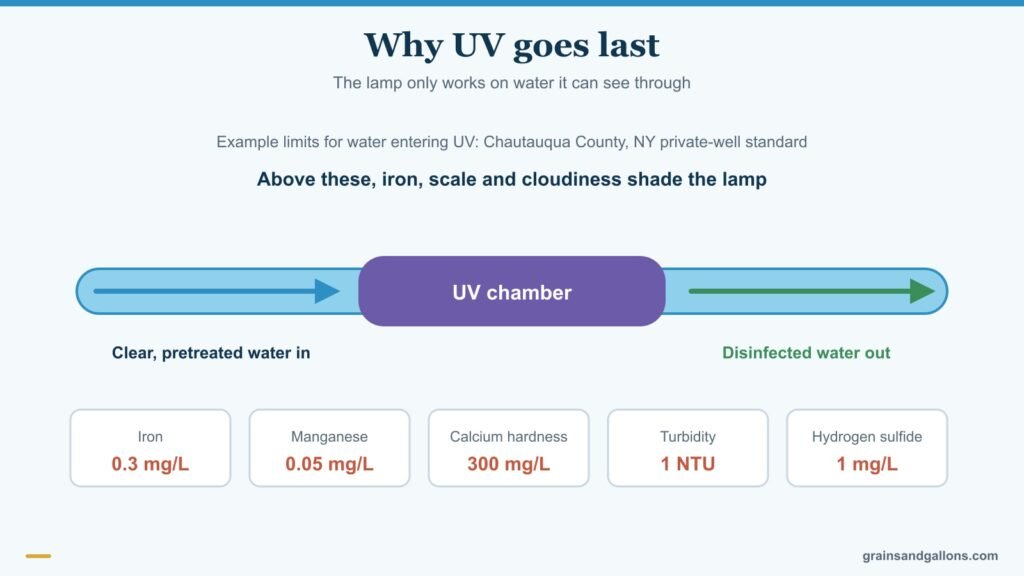
UV kills bacteria as the drop passes the lamp, but only if light reaches every organism. Iron, manganese, hardness and cloudiness coat the quartz sleeve or block the light. The Chautauqua County (NY) Health Department's private-well UV standard requires water entering the unit to be at or below 0.3 mg/L iron, 0.05 mg/L manganese, 300 mg/L calcium hardness, 1 NTU turbidity and 1 mg/L hydrogen sulfide, and notes that "pre-treatment such as a softener is usually required" (Chautauqua County UV standard). Other states set their own limits, and manufacturers publish theirs, so check both.
That same standard calls for sizing the UV unit to the pump's capacity, disinfecting the plumbing with chlorine after installation, and testing for bacteria once the chlorine is flushed out. Many UV makers also require a fine pre-filter (often around 5 microns) directly ahead of the lamp. Our guide to UV purifiers for well water lists model limits.
Reverse osmosis at the kitchen tap
For drinking and cooking water, an under-sink RO system finishes the job, reducing nitrate, arsenic, fluoride, dissolved solids and much of the sodium the softener added. It lasts longer on softened, iron-free water. More in reverse osmosis and a water softener together.
Six setups where the usual order changes
| Situation | What changes |
|---|---|
| Very high iron, or iron plus bacteria | Chlorine or peroxide injection and a contact tank come right after sediment; carbon follows to remove leftover chlorine |
| Very hard water with mild iron | Some installers soften first so scale doesn't foul a filter's media, if the softener is rated for the iron |
| Tannins | A tannin (anion) unit, typically after the softener; manufacturers vary |
| Arsenic or uranium treated for the whole house | Dedicated media placed per its maker's instructions, usually after iron removal |
| Low-yield well | A holding tank and booster pump may come before the train |
| Outdoor spigots and irrigation | Branch off after sediment (or after the iron filter) and before the softener |
Penn State notes outside spigots can be left unsoftened; our guide on whether outdoor faucets should bypass a water softener covers how to plumb that branch. Anything beyond a simple sediment-plus-softener setup is worth running past a well contractor or water treatment specialist with your lab report in hand.
What goes wrong when stages are swapped

| Mistake | What you'll notice |
|---|---|
| UV ahead of the iron filter or softener | Sleeve coats quickly; bacteria tests may fail even though the lamp is on |
| Softener ahead of a heavy iron load | Resin fouls, hardness bleeds through, orange water after regeneration |
| No sediment stage on a sandy well | Scored valve seals, clogged injectors, short cartridge life downstream |
| Neutralizer after the iron filter | Iron filter underperforms on low-pH water |
| Carbon before chlorine injection | Chlorine and its byproducts reach the taps |
| Filter between pump and pressure tank | Pump short-cycling as the filter loads up |
The worst trains are assembled without data: a UV system on water with several ppm of iron, a softener fighting manganese it was never meant to handle, a carbon filter added for "smell" that turns out to be iron bacteria. A full lab panel should cover at least bacteria, hardness, iron, manganese, pH, nitrate, arsenic, sulfate and total dissolved solids. Our comparison of the best well water test kits covers lab-mailed panels versus at-home strips.
Plumbing details that keep the train serviceable
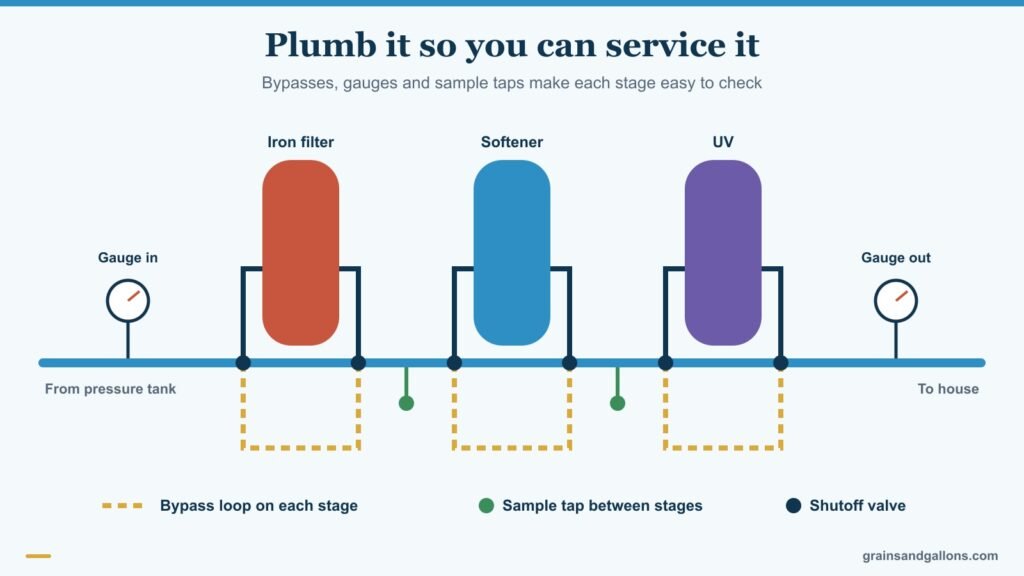
- A bypass on every stage so you can service one unit without shutting off the house.
- Pressure gauges before and after the train (or before and after the sediment filter) to spot clogging early.
- Sample taps between major stages so you can test what each one is actually removing.
- Staggered backwash times. If you have an iron filter and a softener, set them to regenerate at different hours so they don't compete for the well's flow.
- Wall space and drain access for a stage you may add later, plus a drain that can take backwash flow.
- Retesting. Test after installation and then periodically, since well water shifts with seasons, drought and nearby work. Our guide on why well water chemistry changes explains what drives it.
FAQ
Does the iron filter go before or after the water softener?
Before. A softener can remove small amounts of dissolved iron, but iron that has oxidized clogs the resin. Put the iron filter ahead of the softener whenever your iron or manganese exceeds what the softener manufacturer allows.
Does a water softener go before or after the pressure tank?
After. All whole-house treatment belongs downstream of the pressure tank so the pump and pressure switch see normal pressure and backwashing units have stored water to clean with.
Where does a UV light go in a well water system?
Last on the main line, after sediment, iron removal and softening, so the water reaching the lamp is clear and won't coat the sleeve. Reverse osmosis, if you have it, sits separately at the kitchen sink.
Should the carbon filter go before or after the softener?
Usually after, especially if you inject chlorine for iron or bacteria, because carbon removes leftover chlorine and its byproducts. Some systems place carbon first to shield softener resin from chlorine; either works if carbon is downstream of the chlorine source.
Do I need every stage in a well water treatment train?
No. Add only what your lab results call for. Many wells need just sediment filtration and a softener; others need iron removal or UV. The order stays the same, you just skip unneeded stages.
Build the train from your lab report, not a catalog
The well water treatment train order is simple once you see the logic: remove grit, fix pH, take out iron and manganese, soften, polish with carbon, then disinfect with UV on clear water, with RO only at the drinking tap. Each stage protects the next. Get a full lab panel first, add only the stages it calls for, keep them in this order unless an installer has a specific reason to change it, and retest after installation to confirm every stage is doing its job.