

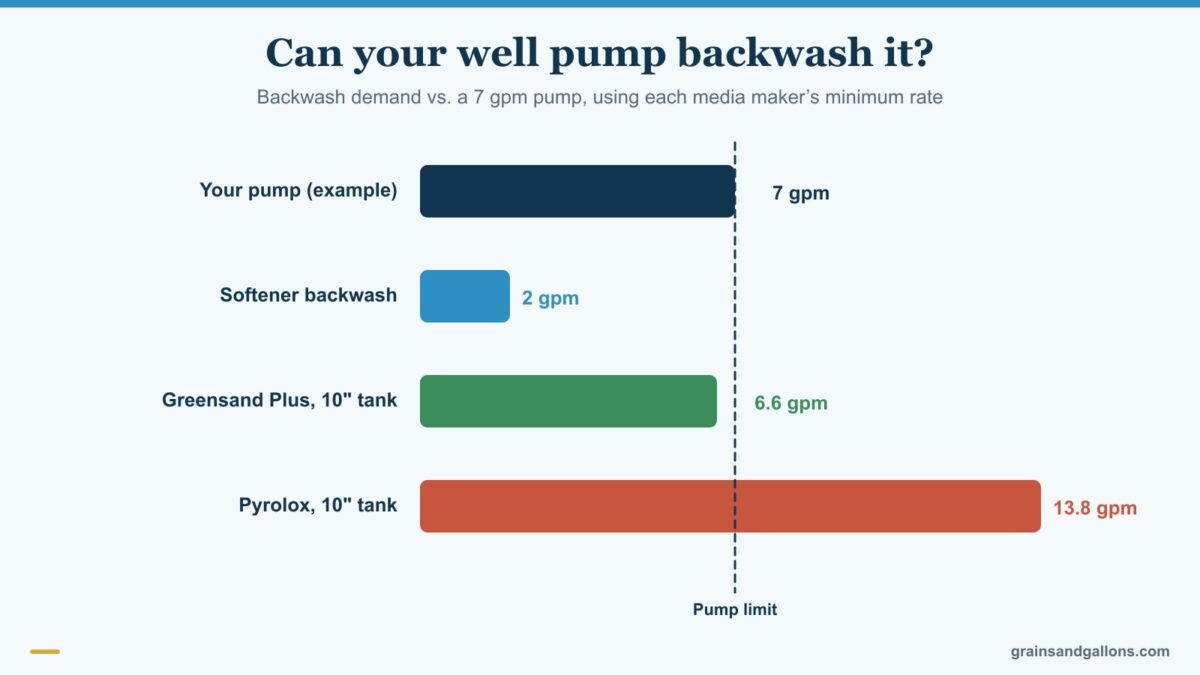
Quick Answer: Well pump flow and backwashing have to match: a backwashing filter needs a set flow in gallons per minute, held for the whole backwash, and on a well your pump is the limit. Bucket-test the pump's sustained gpm, multiply the media's backwash rate (gpm per square foot) by the tank's area, and size the tank to the pump, not the other way around.
The salesperson asked, "What does your pump put out?" and you said, "It seems fine?" That's how a lot of well households end up with an iron filter that worked for six months and then started bleeding orange water. On city water, backwash flow is rarely a problem. With well pump flow and backwashing, the pump sets the ceiling, and the heavier the filter media, the more it asks for.
In this guide
What backwashing asks of a well pump

A backwashing filter (iron, manganese, sulfur, carbon, acid neutralizer, and to a lesser degree a softener) is a tank of granular media. Service water flows down through it. Periodically the control valve reverses flow, pushing water up from the bottom and out the drain. That upward flow has two jobs:
- Lift and loosen the bed so it doesn't pack into channels.
- Carry away what the media trapped, such as oxidized iron and sediment.
Media makers specify the expansion they want. Clack's Greensand Plus data, for example, calls for about 40% bed expansion for 8 minutes or until the drain runs clear. Too little flow and the bed barely moves, trapped material stays put, water channels through cracks, and iron passes straight through. You see it months later, not right away.
How well pump flow and backwashing rates fit together

Media makers give backwash as a rate per square foot of tank cross-section. Multiply that by the tank's area to get the flow your pump must deliver.
| Tank diameter | Area | Greensand Plus (12 gpm/sq ft) | Pyrolox (25 gpm/sq ft) |
|---|---|---|---|
| 8 inch | 0.35 sq ft | about 4 gpm | about 9 gpm |
| 10 inch | 0.55 sq ft | about 6.6 gpm | about 14 gpm |
| 12 inch | 0.79 sq ft | about 9.5 gpm | about 20 gpm |
| 13 inch | 0.92 sq ft | about 11 gpm | about 23 gpm |
| 14 inch | 1.07 sq ft | about 13 gpm | about 27 gpm |
The rates come from the makers: Clack lists a minimum of 12 gpm/sq ft at 55°F for Greensand Plus, the Pyrolox data sheet lists 25–30 gpm/sq ft, and Watts lists 16–30 gpm/sq ft for Filox. Dense manganese dioxide media need far more flow than lighter media, and the expansion charts show the needed rate changes with water temperature. Use the spec sheet for the exact media you're buying, not a forum rule of thumb.
Softeners are gentler. A small drain line flow control in the valve sets their backwash, often around 2 gpm for a 10-inch residential tank, so most working wells handle a softener easily. The problem cases are heavy-media iron, manganese and sulfur filters, and several tanks backwashing on the same night.
Bucket-test your pump's sustained flow

The number on the pump label isn't what reaches your filter. Pipe size, well depth, pressure switch settings and wear all cut into it. What matters is sustained flow at normal pressure, after the pressure tank's stored water is gone. You need a 5-gallon bucket, a stopwatch and a helper.
- Use a tap near the pressure tank with no filters downstream, such as a hose bib or the drain at the tank tee.
- Run water until the pump kicks on. That empties the stored water, which would otherwise inflate the result.
- With the pump running, adjust the tap until the pressure gauge holds steady. You're now drawing what the pump produces.
- Time the bucket. 5 gallons in 40 seconds is 7.5 gpm; 5 gallons in 60 seconds is 5 gpm.
- Repeat a couple of times and note the pressure you held.
Test again in late summer or a drought if you can, since some wells drop.
When the pump comes up short
Pump comfortably exceeds the backwash rate. You're fine. Keep some margin, because the house may draw water during a backwash and pumps wear.
Pump is close to the backwash rate. Choose the smaller tank diameter or a lighter media, and give each tank its own backwash time.
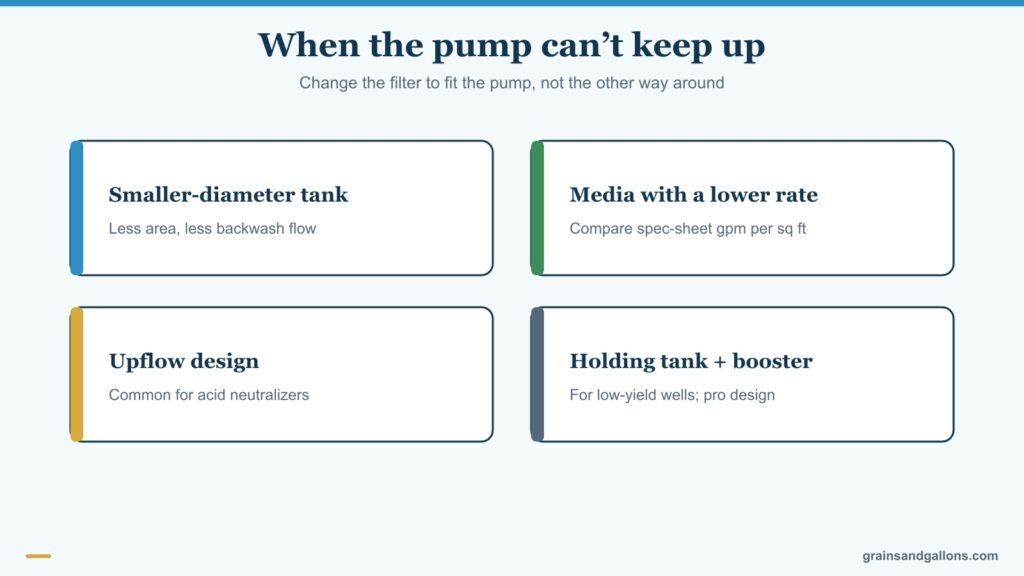
Pump falls short. Your options:
- Smaller-diameter tank. Less area means less backwash flow, at the cost of some service flow and capacity.
- Media with a lower backwash rate. Compare spec sheets; air-injection and chlorine-plus-carbon systems have their own needs.
- Upflow or non-backwashing designs where they fit. Acid neutralizers come in upflow versions for weak wells; our guide to acid neutralizer filters notes which.
- Holding tank and booster pump for very low-yield wells, designed by a well contractor.
Shopping for a manganese or iron filter on a modest pump? Check backwash gpm before price. Our best manganese filters guide lists tank sizes.
Stagger backwashes on a multi-tank system

If a sediment filter, iron filter, softener and carbon filter all backwash at 2 a.m., they compete for one pump. Stagger them by at least one backwash cycle and give the most demanding tank its own slot. Where each piece sits in the line matters too; see well water treatment train order.
FAQ
How many gpm does a well pump need to backwash an iron filter?
It depends on the media and tank size. Multiply the media's backwash rate by the tank area: a 10-inch Greensand Plus tank needs about 6.6 gpm, while the same tank of Pyrolox needs about 14 gpm.
What happens if my well pump can't backwash the filter?
The bed never fully lifts, so trapped iron and sediment stay in it. The media cakes, water channels around it, and iron, manganese or smell slowly break through, usually months after installation.
Does a water softener need as much backwash flow as an iron filter?
No. A softener's backwash is limited by a small drain line flow control, often around 2 gpm on a 10-inch residential tank, so most wells handle it easily.
How can I tell if my filter's backwash is falling short?
Common signs: the filter worked for a few months and then iron crept through, drain flow during backwash is weak or never runs clear, house pressure sags and the pump short-cycles during backwash, or the media looks caked when opened.
Size the tank to the pump, then stagger the schedule
Getting well pump flow and backwashing right starts with a measured gpm, not a guess, and a tank sized to it. If a softener is showing symptoms, see backwash cycle not working. If trouble started right after a pump replacement, flow or pressure probably changed; see softener problems after a new well pump.