

Quick Answer: For most well homes, the VIQUA VH410 is the one to buy. VIQUA rates it at 18 gpm at a 30 mJ/cm² dose (14 gpm at 40 mJ/cm²), it has a 9,000-hour lamp, and it alarms if the lamp fails. Smaller house or cabin? The Viqua VH200-F10 adds a built-in sediment pre-filter and is rated at 9 gpm (7 gpm at 40 mJ/cm²). If you're watching costs, the iSpring UVF55FS (12 gpm, 55 W, flow sensor) is the value pick. Whatever you choose, UV only works on clear water. Pretreatment comes first.
Disclosure: As an Amazon Associate, Grains & Gallons earns from qualifying purchases.
Maybe your well test came back positive for total coliform. Maybe the lender wants a clean bacteria result before closing. Or maybe you just know the well is shallow and the neighbor runs cattle. In any of those cases, a UV system is the standard, chemical-free way to keep it from being a problem every day. It doesn't add anything to the water. It hits whatever flows past the lamp with UV light so microbes can't reproduce.
What it can't do is see through dirty water. That one fact decides whether a UV system protects you or just glows in the basement.
In this guide
The water reaching the lamp has to be clean
Vermont's drinking water program publishes UV design guidelines (written for public systems, but they're a good yardstick for any well). They set 40 mJ/cm² as the minimum dose and call for NSF/ANSI 55 Class A devices. They also list the most the water feeding the UV unit should carry:
| Parameter | Design limit at the UV inlet |
|---|---|
| Iron | 0.3 mg/L |
| Manganese | 0.05 mg/L |
| Hardness (as CaCO₃) | 120 mg/L (about 7 gpg) |
| Turbidity | 1.0 NTU |
| Color | 15 APHA units |
| Suspended solids | 10 mg/L |
| UV transmittance | 75% |
| Hydrogen sulfide | Non-detectable |
| pH | 6.5–9.5 |
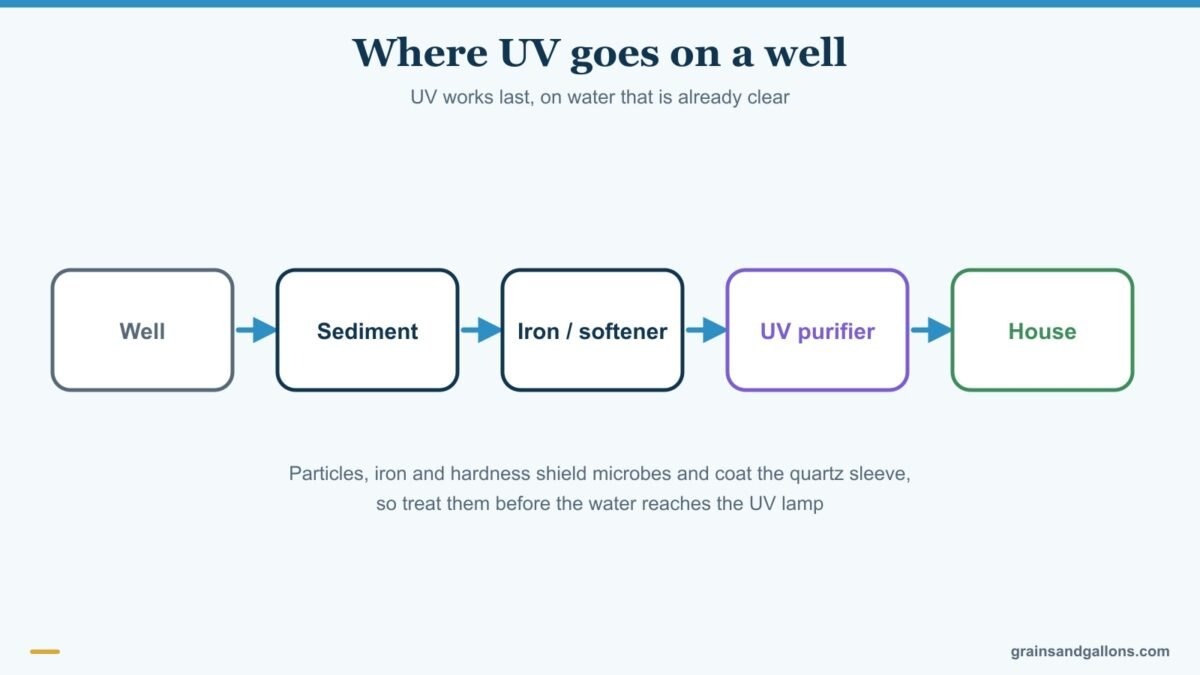
The same guideline recommends a 5-micron pre-filter. Above these levels, iron and hardness coat the quartz sleeve and particles shade bacteria from the light. If your water is hard or carries iron, the softener or iron filter goes before the UV, and the UV is always the last stage. Our well water treatment train order guide shows the full sequence.
Size it by flow, not by bathroom count
UV units are rated in gallons per minute at a given dose, and that's the number that matters. Go over the rating and the water moves past the lamp too fast to get a full dose.
Here's a quick way to size it. Add up what can run at once on a busy morning: two showers at about 2 gpm each, a kitchen faucet at around 1.5 gpm, and a washing machine filling at maybe 3 gpm comes to roughly 8–9 gpm. Look at the label on your fixtures, since showerheads list their gpm. Then pick a unit rated at or above that number at the dose you want. Note that VIQUA quotes different flows for different doses on the same unit, so compare like with like.
Our five picks
VIQUA VH410: best overall
VIQUA's specs: 18 gpm at 30 mJ/cm², 14 gpm at 40 mJ/cm², and 34 gpm at 16 mJ/cm². The lamp is rated for 9,000 hours, power draw is 60 W, and ports are a 3/4"–1" MNPT combo. The controller alarms if the lamp fails, and it has an audible lamp-replacement reminder and a digital countdown timer. The chamber is stainless steel, about 23½" long.
That 14 gpm at 40 mJ/cm² is what makes it our pick. It covers a typical three- or four-bathroom home at the dose Vermont's guideline uses, with headroom left over.
Downside: VIQUA's product page didn't list a specific NSF/ANSI 55 certification for this model. If you need one, for a lender or a local code, check the certification listing for the exact model number before you buy. VIQUA also sells a VH410-F20 version with a built-in pre-filter.
Viqua VH200-F10: best for smaller homes and cabins
Same family, smaller lamp. VIQUA rates the VH200 at 9 gpm at 30 mJ/cm² and 7 gpm at 40 mJ/cm², with a 9,000-hour lamp, 35 W draw, a 3/4"–1" MNPT combo and the same lamp-failure alarm and countdown. The F10 version on the listing adds an integrated sediment pre-filter, so the UV and its first line of defense come as one unit.
Who it's for: one- or two-bathroom homes, cabins and ADUs.
Who should skip it: anyone who regularly runs two showers and a washer at once. At 7 gpm for the higher dose, it doesn't have much headroom.
VIQUA VH410M: when you want a UV sensor watching the lamp
The VH410M is the monitored version of the VH410, rated to treat up to 18 gpm. The difference is a built-in UV sensor that gives continuous feedback on lamp intensity, so you find out if a fouled sleeve or a weak lamp is cutting the dose, not just whether the lamp is on. It's also solenoid-ready: pair it with a normally closed solenoid valve (sold separately) and it can shut the water off during a system error. VIQUA lists a 10-year chamber warranty, 3 years on electronics and hardware, and 1 year on the lamp, sleeve and sensor. It runs on 100–240 V.
Worth it if: your well has a history of positive bacteria tests, someone in the house is vulnerable, or you're treating water with iron or hardness near the limit, where sleeve fouling is likely. It costs more than the plain VH410, and the sensor is one more part to replace.
iSpring UVF55FS: the value pick
A 55 W whole-house UV unit rated at 12 gpm with 1" MNPT ports. Its "smart flow sensor switch" is the interesting part: per iSpring, it senses when water is flowing. The replacement lamp is the UVB55FS.
Who it's for: buyers who want a name-brand unit with easy parts and a lower upfront cost than VIQUA's line.
What to check: iSpring lists the flow rating without a dose figure in the listing title. Compare it to VIQUA's dose-specific ratings with that in mind. iSpring also sells bundles that pair this UV with its WGB32B pre-filter system, which is handy if you have no pretreatment yet.
Bluonics 55W, 12 gpm: budget, with eyes open
The listing describes a 12 gpm, 55 W, 110 V unit with 3/4" MNPT ports and two spare bulbs included.
Our honest take: for a vacation cabin, or as a secondary safeguard on a well that already tests clean, it's a reasonable buy. For a home where someone is immunocompromised, or where the well has a documented bacteria history, spend more on a unit with a published dose rating and certification. We couldn't find either for this model.
Lamps don't burn out when they stop working
A UV lamp's rating is in hours, not "until it goes dark." VIQUA says its lamps put out consistent output over the full 9,000-hour lamp life. Past that point the lamp isn't rated anymore, even if it still glows. There are 8,760 hours in a year, so plan on changing the lamp about once a year. Clean or replace the quartz sleeve at the same time. Our step-by-step on replacing a UV lamp and sleeve covers it.
A good system also tells you when something's wrong. Vermont's guideline calls for an audible alarm and an automatic shut-off valve on the inlet that closes if the dose drops or the power goes out. The VIQUA models here include the lamp-failure alarm. We didn't see an automatic shut-off valve listed as included with any of the five, so plan for it separately. If you can't stand the thought of drinking untreated water during an outage without knowing it, budget for one.
What it costs to keep the light on
A UV system runs around the clock, so its power draw is easy to work out. Using VIQUA's figures, the VH410's 60 W comes to about 525 kWh a year (60 W × 24 h × 365 days). The VH200's 35 W comes to about 307 kWh. Multiply by your electric rate to see the yearly cost. Add a lamp each year and a sleeve when it can't be cleaned, and you have the full running cost. The iSpring and Bluonics units are both listed at 55 W, which works out to about 482 kWh a year.
Before you install: disinfect the plumbing
UV treats water as it passes the lamp. It does nothing for bacteria already living in your pipes, pressure tank or water heater. Shock-chlorinate the well and plumbing first, flush thoroughly, then install the UV. Doing it the other way around is the classic reason people see positive tests after buying a UV. If you have a softener, read shock chlorination and your water softener first, because the resin needs special handling.
Then retest. Our guide on testing well water for coliform bacteria explains where and how to take the sample after the UV.
One more catch: slimy orange or brown growth in toilet tanks is often a separate problem with its own fixes. See iron bacteria in well water.
A few more questions
Does UV change how my water tastes or smells? No. UV adds nothing to the water. If you have a taste or smell problem, that's a carbon or oxidation job further upstream.
What happens during a power outage? The lamp goes off and water passes through untreated. If your well pump is on the same power, you may have no water anyway. A shut-off valve tied to the UV controller makes sure no water gets through while the lamp is off.
Do I need UV if my last bacteria test was clean? Not necessarily. Many wells test clean year after year. UV is worth it if you've had a positive test, if the well is shallow or near livestock or septic fields, or if someone in the house is especially vulnerable. Otherwise, regular testing may be enough.