


Quick Answer: Can you use reverse osmosis and water softener together? Yes, and the softener goes first. The softener treats the whole house by swapping calcium and magnesium for sodium. An under-sink RO system then treats only the drinking water and removes most of that added sodium, plus other dissolved solids. Softened feed water also protects the RO membrane, because hardness is one of the main things that scales it.
A whole-house softener plus an under-sink RO system is one of the most common home water setups in the US, and a lot of people first hear about it as an upsell. The softener quote arrives with a line for a "drinking water system," and it's fair to ask whether that's real value or just a second sale. Short answer: the two machines do different jobs, and each one covers a weakness of the other. The sections below explain the order, what happens to the sodium, how to plumb the RO feed, and when you can skip one of them.
In this guide
- What each machine removes, and what it leaves behind
- Why the softener goes before reverse osmosis
- Does RO remove the sodium from softened water?
- Softened or hard water to the RO feed line?
- Keep the RO's carbon prefilter even with soft water
- Why RO water can taste flat after softening
- What running both systems costs in upkeep
- Choosing an RO system to pair with a softener
- Prove the pair is working with a TDS meter
- When you might not need both
- FAQ
- Soften the house, then purify the kitchen tap
What each machine removes, and what it leaves behind

A water softener is an ion exchanger. Resin beads hold sodium (or potassium) and trade it for the calcium and magnesium in your water. Penn State Extension's water softening guide describes the process and the regeneration cycle that flushes the hardness out with brine. That protects pipes, water heaters, fixtures and appliances from scale, and it's why soap lathers better. It does not purify water. Lead, nitrate, arsenic, PFAS and most chemicals pass right through, and softened water carries a bit more sodium than it started with.
A reverse osmosis system pushes water through a very tight membrane that holds back most dissolved solids. University of Nebraska Extension's reverse osmosis guide (G1490) lists arsenic, fluoride, lead, nitrate, sodium, calcium, magnesium, radium and uranium among the contaminants household RO can practically treat. It also notes what RO doesn't stop: dissolved gases such as hydrogen sulfide, and some pesticides, solvents and VOCs, which is why most units add carbon filters.
RO is slow. The same guide puts a typical home membrane at roughly 10 to 35 gallons of treated water per day, and it sends part of the feed water down the drain. That's why RO is almost always a point-of-use system under one sink rather than a whole-house unit.
Put them together and you get scale protection for the whole house, plus low-mineral, low-sodium water at the one tap where people drink and cook.
Why the softener goes before reverse osmosis

You'll sometimes see someone ask whether RO could go before the softener. For a home, it doesn't make sense: the RO would only treat a few gallons a day, and the rest of the house would still be hard. The normal order is:
Main line → (sediment or iron filter if needed) → softener → house plumbing → under-sink RO at the kitchen
If you also have a whole-house carbon or sediment filter, our guide on whether to put a filter before or after the water softener covers where each one belongs.
Feeding the RO with softened water helps it in three ways:
- Less scaling on the membrane. As water passes through the membrane, the minerals left behind concentrate on the reject side. Calcium and magnesium are among the first to form scale there. With them mostly gone, the membrane stays cleaner.
- Steadier production. A scaled membrane makes less water and lets more dissolved solids through. Softened feed slows that decline.
- Longer membrane life. The Nebraska guide says it plainly: for relatively hard water, pretreatment by a softener can increase the life of the membrane. Exactly how much longer depends on your water and how much you use, so treat any number printed on a box as a best case.
Does RO remove the sodium from softened water?

This is the question behind most searches for this pairing, so here's a worked example.
A softener adds sodium in proportion to the hardness it removes. Penn State puts it at 7.5 mg per quart for each grain per gallon removed, which works out to roughly 8 mg per liter per gpg. So:
- Water at 15 gpg of hardness, fully softened, picks up roughly 120 mg/L of sodium.
- An 8-ounce glass (about a quarter liter) carries around 30 mg of that sodium.
- A residential RO membrane removes most of it. Even at a conservative 90 percent, that same glass drops to something like 3 mg.
The exact numbers depend on your starting hardness, your softener settings and your specific membrane, so check the RO system's performance data sheet if this matters to you. We go deeper on the health side, including who might want to talk to a doctor, in our guide to sodium in softened water. If someone in the house is on a sodium-restricted diet, RO at the kitchen tap is one of the most practical answers. Switching the softener to potassium chloride is the other.
Softened or hard water to the RO feed line?
Under the kitchen sink, the cold line is either softened or not, depending on how your softener was installed. Some installers leave the kitchen cold on a hard-water bypass so drinking water stays unsoftened. Others soften everything.
If you're adding RO, feeding it softened water is the better choice for the membrane, for the reasons above. The regular cold faucet next to it can stay softened or hard, depending on your preference. We walk through those options and the trade-offs in should a kitchen tap bypass the softener.
A few practical points for the install:
- Drain and air gap. RO needs a drain connection and an air gap or air-gap faucet where local plumbing code requires it. Our under-sink RO installation guide covers the drain saddle and air gap step by step.
- Space. Plan room for the filter housings and the storage tank, or choose a tankless design.
- Feed pressure. RO output drops when pressure is low, and a softener adds a little pressure drop of its own. If your home runs on the low side, look at a model with a booster pump or a tankless unit rated for lower pressure.
- Renters. If there's no room under the sink or you can't drill the counter, a countertop unit avoids most of this plumbing.
Keep the RO's carbon prefilter even with soft water
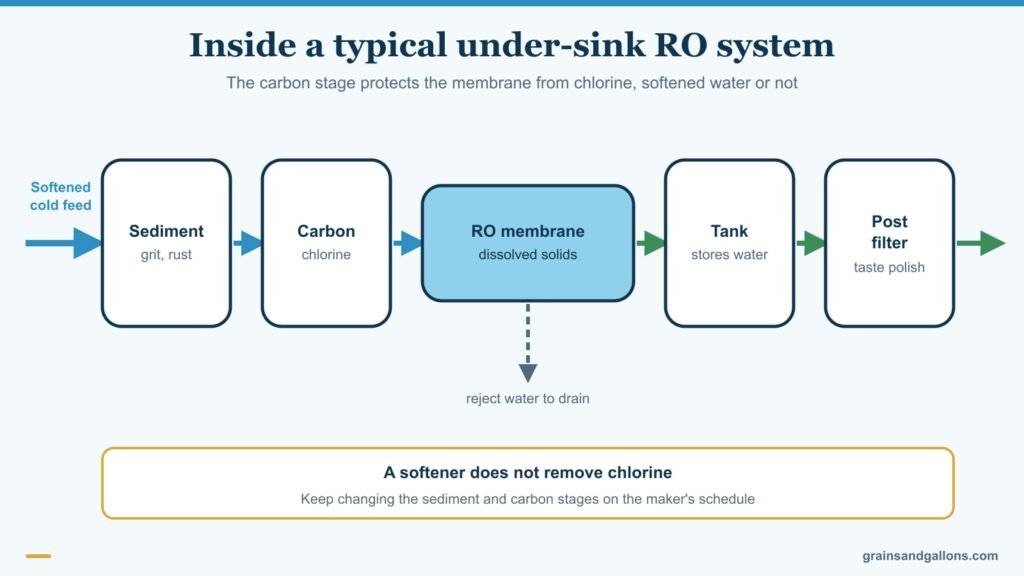
Most under-sink RO units use a sediment filter and one or two carbon filters ahead of the membrane. The carbon is there because chlorine damages the thin-film composite (TFC) membranes used in most home systems. The Nebraska guide notes that TFC membranes deteriorate in chlorinated water and need a carbon prefilter when the feed is chlorinated.
A softener doesn't remove chlorine, so don't skip or stretch those carbon changes just because the water is already soft. If your city uses chloramine, check that the RO's carbon stage is rated for it, since chloramine is harder for ordinary carbon to break down. Change intervals and steps are in our guide to changing RO filters and the membrane.
The softener isn't fully off the hook either. Chlorine slowly wears down softener resin too, which is one reason some city-water homes add a whole-house carbon filter ahead of everything.
Why RO water can taste flat after softening

Removing almost all minerals leaves water that some people find bland. With a softener in front, the RO is starting from water that already lost its calcium and magnesium, so the result is about as mineral-free as tap water gets.
A remineralization stage adds a small amount of calcium and magnesium back after the membrane. It's a taste preference, not a requirement. See our picks for remineralization filters for RO water if that's you. If the taste is off in a different way (plastic, metallic, rotten egg), that's a separate problem with its own causes, usually old filters or the storage tank.
What running both systems costs in upkeep
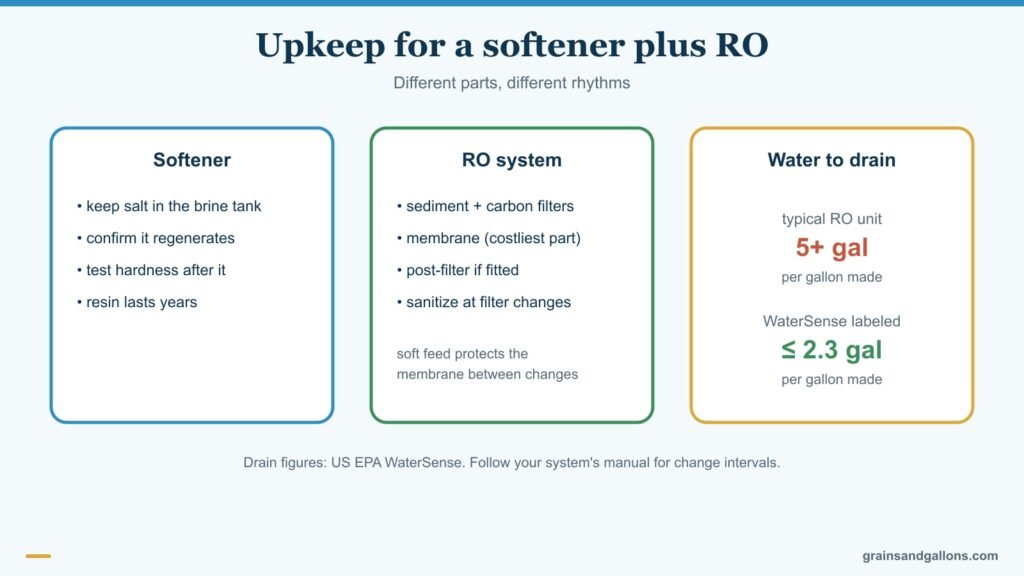
The two systems have very different maintenance rhythms, and it helps to know both before you buy.
The softener needs salt in the brine tank on an ongoing basis, plus an occasional check that it's regenerating on schedule. Resin lasts many years on city water if chlorine is moderate.
The RO system needs its prefilters, membrane and any post-filter replaced on the maker's schedule. The membrane is the expensive part, and it's the part soft feed water protects. Many makers also suggest sanitizing the housings at filter changes; our guide on how to sanitize a reverse osmosis system covers the steps.
Water to drain. RO uses extra water to flush away what the membrane rejects. Nebraska Extension says most household systems are designed with a 20 to 30 percent recovery rate, meaning only a fifth to a third of the feed becomes drinking water. The EPA's WaterSense page on point-of-use RO systems says a typical unit sends five gallons or more down the drain for every gallon it makes, while WaterSense-labeled models must send 2.3 gallons or less. If you're comparing models, the label is a quick way to find the efficient ones. Soft feed water helps here too, because a cleaner membrane keeps its rated output longer.
Choosing an RO system to pair with a softener
There's no special "softener-compatible" RO. What matters is the usual list:
- Certified performance. NSF/ANSI 58 is the standard for RO drinking water systems. Look for certification from NSF, WQA or IAPMO, and read the performance data sheet for the specific contaminants you care about.
- Daily output. A membrane rated for your drinking and cooking needs, keeping in mind that cold water lowers output.
- Filter costs. Price out a year of replacement filters before you buy, not after.
- Tank or tankless. Tankless units save space and often waste less water; tank units deliver a faster pour.
- Minimum feed pressure. Compare it with your home pressure after the softener.
If you're stuck between two of the most common brands, our Waterdrop vs iSpring RO comparison lays out the trade-offs.
Prove the pair is working with a TDS meter

A cheap TDS meter tells you whether both machines are doing their jobs. Test the regular cold tap and the RO faucet on the same day.
- Softened tap water will not read lower than hard water. A softener swaps one mineral for another, so TDS stays about the same or even climbs a little. That's normal and doesn't mean the softener failed. Use a hardness strip to check the softener.
- The RO faucet should read far lower. Divide the difference by the tap reading to get the rejection rate. A healthy membrane usually keeps it high, and a steady slide over months means the prefilters or membrane need attention.
Our guide on how to use a TDS meter walks through the rejection math and the common mistakes.
When you might not need both

- Soft or barely hard water. If your hardness is low, you may only need RO for drinking water, or nothing at all.
- You only care about scale. If your drinking water tests fine and you don't mind the small sodium increase, the softener alone may be enough.
- You only care about drinking water. If your water isn't hard enough to scale the house, RO alone does the job, though very hard feed water will wear the membrane faster.
Test first, then decide. A hardness test and a look at your utility's Consumer Confidence Report (or a lab test for a private well) will tell you which camp you're in.
FAQ
Can you use reverse osmosis and water softener together?
Yes. They do different jobs: the softener removes hardness for the whole house, and RO purifies drinking water at one tap. Running them as a pair also helps the RO, because softened feed water is less likely to scale the membrane.
Should a reverse osmosis system go before or after a water softener?
After. The softener goes on the main line so the whole house gets soft water, and the RO goes under the kitchen sink on a branch line. That order also feeds the RO membrane soft water, which reduces scaling.
Does reverse osmosis remove sodium from softened water?
Yes, most of it. Residential RO membranes reject the large majority of dissolved sodium, so a glass that would carry around 30 mg from softened 15 gpg water drops to a few milligrams. Check your system's performance data sheet for its tested reduction.
Can hard water ruin an RO membrane?
Hard water won't ruin it overnight, but calcium and magnesium can scale the membrane over time, cutting output and letting more dissolved solids through. University extension guidance notes that softening relatively hard water ahead of RO can lengthen membrane life.
Do I still need RO prefilters if I have a water softener?
Yes. The softener doesn't remove chlorine or sediment, and chlorine damages the thin-film membranes used in most home RO systems. Keep replacing the sediment and carbon stages on schedule.
Will a softener make my RO system waste more water?
No. If anything, softened feed water helps the membrane keep its rated output longer. The amount sent to drain depends mainly on the RO system's design and your water pressure.
Soften the house, then purify the kitchen tap
If you want to use reverse osmosis and water softener together, the setup works because each covers what the other can't. The softener protects every pipe and appliance in the house from scale, and the RO turns one tap into low-sodium, low-TDS drinking water while getting a gentler, softened feed that keeps its membrane cleaner. Put the softener first, feed the RO softened water, keep up with the carbon prefilters, and check the result with a TDS meter now and then. If your water test shows only one problem, you may only need one machine.