

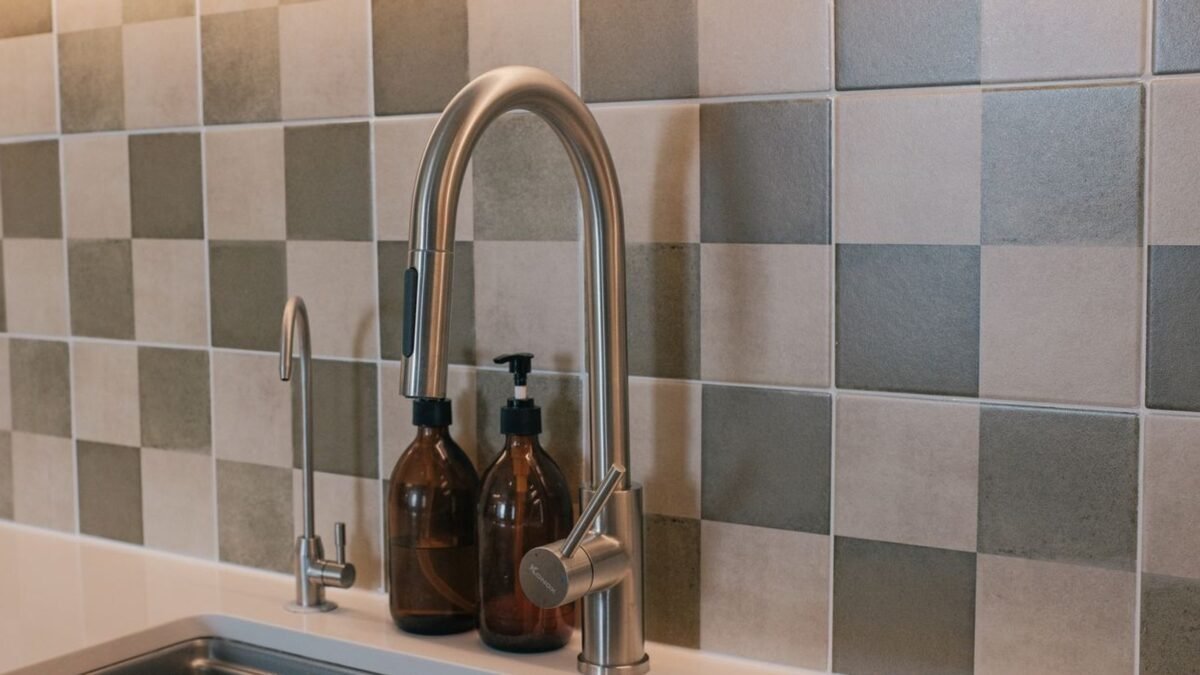
Quick Answer: Should a kitchen tap bypass the softener? It's optional, not required. A dedicated unsoftened cold line at the kitchen sink makes sense if someone in the house is watching sodium, if your water is very hard (so softening adds more sodium), or if you simply prefer the taste. If none of that applies, softened drinking water is fine for most healthy adults. A reverse osmosis faucet fed by softened water is often the better upgrade, because it cuts the added sodium and much more.
The plumber is standing in your basement, pipe cutter in hand, and asks: "Do you want the kitchen cold left hard?" Whether a kitchen tap should bypass the softener is easy to decide while the pipes are open and annoying to change later. Here's how to think it through, with real sodium numbers, before you answer.
In this guide
- How much sodium softening adds to a glass
- Three reasons people keep the kitchen cold unsoftened
- What a hard kitchen tap costs you
- Should a kitchen tap bypass the softener in your house?
- Three ways to get lower-sodium water at the sink
- How to tell if your kitchen cold is already hard
- Bypass the kitchen tap only when sodium or taste matters
- FAQ
How much sodium softening adds to a glass
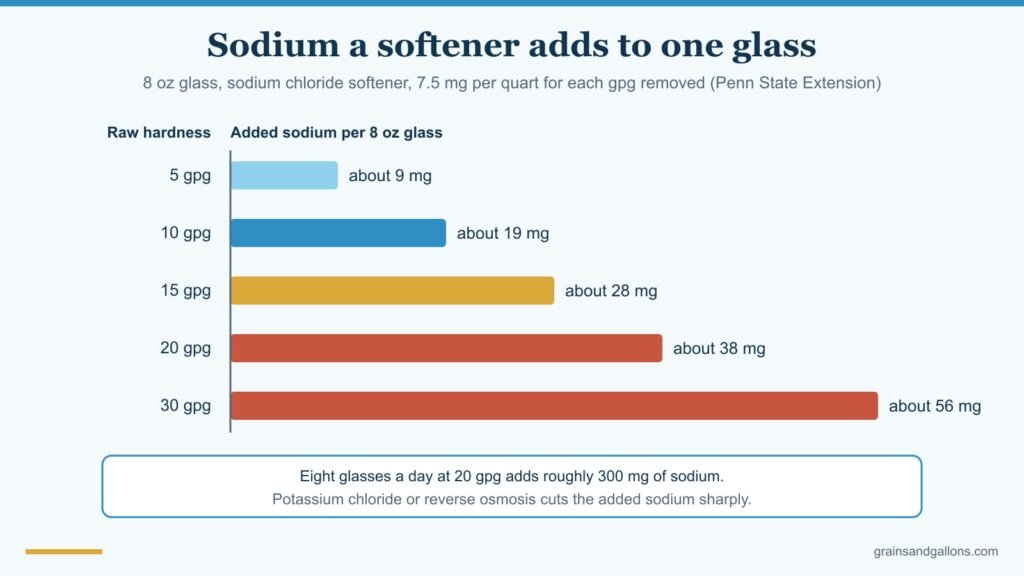
A sodium chloride softener trades each grain of calcium and magnesium for sodium. Penn State Extension puts the swap at about 7.5 milligrams of sodium per quart for each grain per gallon (gpg) of hardness removed. Divide by four and you get roughly 1.9 mg per 8-ounce glass per gpg.
| Raw water hardness | Sodium added per 8 oz glass | Per quart |
|---|---|---|
| 5 gpg | about 9 mg | about 38 mg |
| 10 gpg | about 19 mg | 75 mg |
| 15 gpg | about 28 mg | about 113 mg |
| 20 gpg | about 38 mg | 150 mg |
| 30 gpg | about 56 mg | 225 mg |
At moderate hardness, that's small next to a slice of bread or a bowl of soup. At very hard levels and eight glasses a day, it adds up to a few hundred milligrams, which is where people on a prescribed low-sodium diet start paying attention. Our guide to sodium in softened water goes further into the math, and softeners for low-sodium diets covers what to ask your doctor.
Three reasons people keep the kitchen cold unsoftened
1. Sodium. This is the main health reason. The Minnesota Department of Health notes that a salt-based softener raises the sodium in the water you drink and suggests keeping an unsoftened tap for drinking and cooking if that's a concern.
2. Taste. Some people find softened water flat or faintly salty, especially at high hardness. Others can't tell the difference in a blind glass. If you're in the first group, a hard cold tap fixes it for the cost of a pipe run.
3. Cooking and coffee preferences. A few cooks like the mineral content of unsoftened water for coffee, tea or bread dough. That's a preference, not a rule, and it shouldn't drive the decision on its own.
In some regions this is simply how houses get plumbed. Many installers leave the kitchen cold on hard water by default, so check before assuming yours is softened.
What a hard kitchen tap costs you
Scale at the busiest fixture. Hard water spots the faucet, crusts the aerator and leaves film on anything you rinse and air-dry. If your water is hard enough to need a softener, a hard kitchen cold brings part of that problem back to the sink you use most, along with scale in the kettle and coffee maker.
Mixed water at one faucet. With a single-handle faucet, the hot side is softened (the water heater sits downstream of the softener) and the cold side is hard. Lukewarm water is a blend, so you get partly hard water for washing dishes.
Iron and manganese come back. Many softeners also take out some dissolved iron and manganese. If yours is doing that job on well water, a bypassed tap brings orange or black staining back to the sink. Our page on whether a softener can remove iron explains the limits.
The extra plumbing. In new construction a separate line is cheap. In a finished house, it can mean opening walls or ceilings.
Should a kitchen tap bypass the softener in your house?
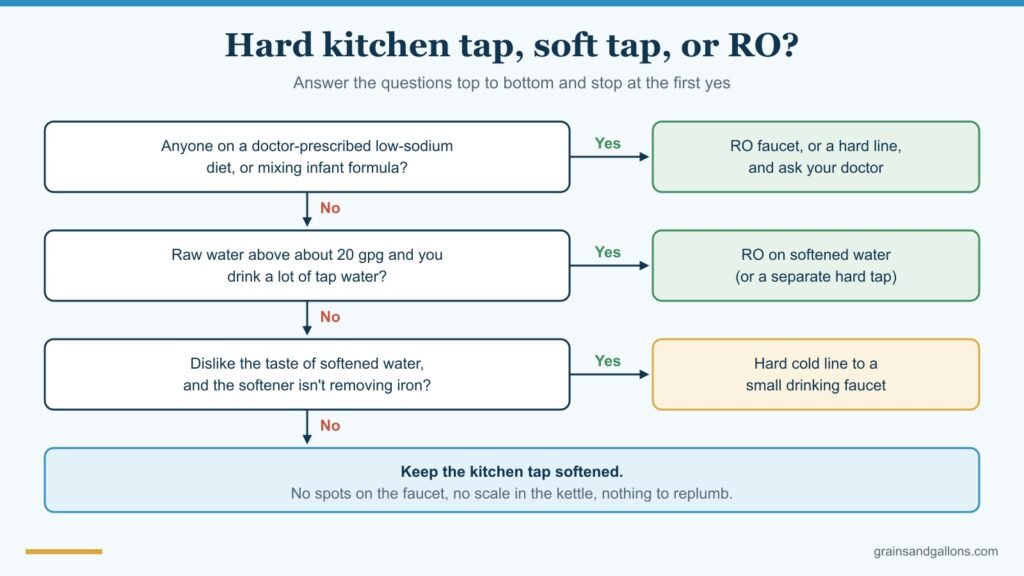
Work down this list and stop at the first one that fits:
- Someone is on a sodium-restricted diet, or you're mixing infant formula: bypass the kitchen cold or add RO, and talk to your doctor or pediatrician about what's right for your household. Our guide to softened water for baby formula has more on the formula question.
- Hardness above roughly 20 gpg and you drink a lot of tap water: worth doing, since the added sodium scales with hardness.
- You dislike the taste and the softener isn't removing iron: a hard line to a small drinking faucet keeps the main faucet soft.
- Moderate hardness, nobody restricting sodium, taste is fine: no need. Keep the sink scale-free.
- You want lower sodium and fewer other contaminants: skip the hard line and put an RO faucet on softened water.
Three ways to get lower-sodium water at the sink

Run a dedicated hard cold line
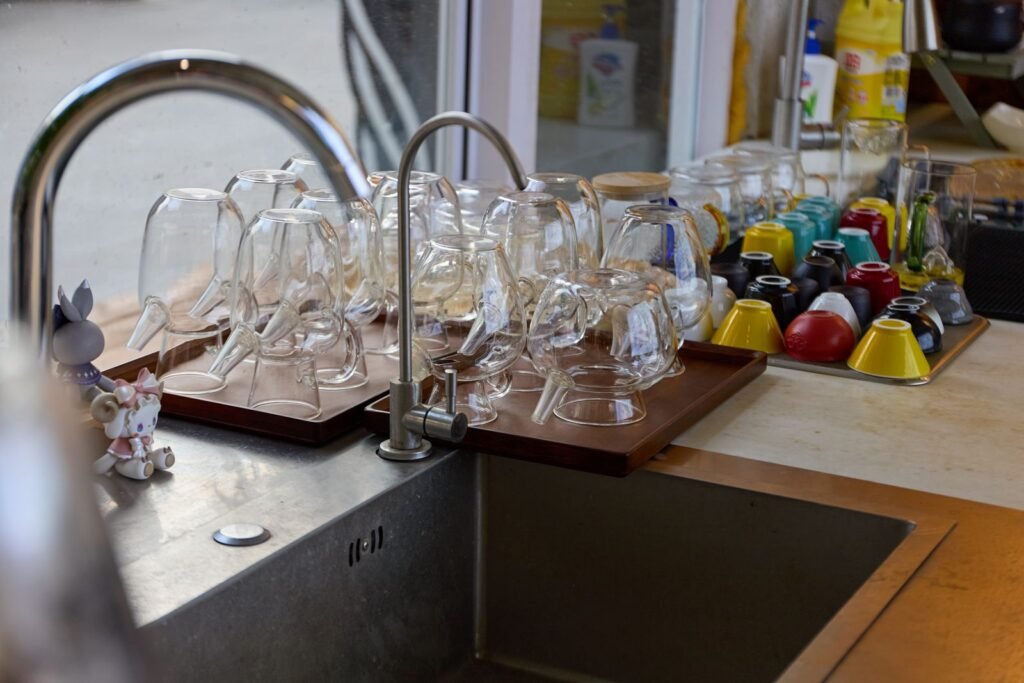
The plumber tees off the main line before the softener and runs a separate pipe to the kitchen. You can feed the main faucet's cold side, or a small separate drinking faucet so the main faucet stays fully softened. The second layout avoids the scale problem and is the one we'd pick. The branch has to leave the main before the softener and before its bypass valve, or it will still carry softened water.
Feed a reverse osmosis faucet with softened water
An RO system, under the sink or on the counter, removes most dissolved solids, including much of the sodium the softener added. Softened water is a good feed for RO because hardness is what scales and wears out membranes. Our page on running reverse osmosis and a softener together explains why that order works. If you rent or don't want to drill the countertop, our picks for countertop reverse osmosis systems need no plumbing at all.
Switch the softener to potassium chloride
Potassium chloride softens the same way but swaps hardness for potassium instead of sodium, and the Minnesota health department lists it as a sodium-reducing option. It costs more per bag, and people with kidney problems or on certain medications should check with their doctor about potassium. Our guide to the best potassium chloride softener salt also covers the settings changes it may need.
If the whole house is already softened
You don't have to open walls. The cheapest fixes, in order: add RO (countertop, or under-sink with its own faucet), switch to potassium chloride, or have a plumber look for a reachable cold line near the softener. In a basement with open joists, a new line to the kitchen can be a half-day job; in a finished slab home it can be much more.
How to tell if your kitchen cold is already hard
Plenty of people own a hard kitchen tap without knowing it. Three quick checks:
- Test it. Run the kitchen cold for a minute and dip a hardness strip, then test a bathroom sink. If the kitchen reads near your raw water hardness and the bathroom reads near zero, the kitchen is already bypassed. Our roundup of water hardness test kits compares strips and drop-count kits.
- Look at the faucet. White crust at the base of the spout or on the aerator, while the bathroom fixtures stay clean, is a strong hint.
- Trace the pipe. At the softener, look for a branch that tees off the main before the softener inlet. It often runs to the kitchen and the hose bibs.
While you're there, decide the outside faucets too. Those usually belong on the hard side for different reasons, covered in should outdoor faucets bypass a water softener.
Bypass the kitchen tap only when sodium or taste matters
So, should a kitchen tap bypass the softener? Only when someone's sodium intake matters, your water is very hard, or you really dislike the taste. Otherwise a softened kitchen tap keeps the sink, kettle and glasses free of scale. If lower sodium is the goal, an RO faucet on softened water usually beats a hard line, and a small separate drinking faucet beats making the whole kitchen cold hard.
FAQ
Is it normal for the kitchen cold tap to be unsoftened?
Yes. Many installers leave the kitchen cold on hard water by default, often on the same branch that feeds the hose bibs. Test both the kitchen and a bathroom sink with hardness strips to see how yours is plumbed.
Is softened water safe to drink?
For most healthy adults, yes. The concern is the added sodium, which grows with your raw water hardness. People on a doctor-prescribed low-sodium diet should ask their doctor and consider RO, a hard drinking tap or potassium chloride. See is softened water safe to drink for more.
Does a reverse osmosis system remove the sodium from softened water?
It removes most of it. RO membranes reject the majority of dissolved salts, including sodium, which is why an RO faucet on softened water is a common alternative to running a separate hard line.
Can I bypass only the kitchen tap using the softener's bypass valve?
No. The bypass valve at the softener sends hard water to the whole house. A single tap needs its own pipe teed off the main line before the softener.
Does a hard kitchen line affect the hot water at the sink?
No. Hot water comes from the water heater, which sits after the softener, so the hot side stays softened. Only the cold side, or a separate drinking faucet, carries hard water.