

Quick Answer: Don't use softened water for baby formula if you can avoid it, especially when your water is hard. A salt-based softener adds sodium in proportion to the hardness it removes, and infants need very little sodium beyond what formula already supplies. Use an unsoftened cold tap, reverse osmosis water, or low-sodium bottled water, and on a private well, test the water first.
If there's a softener in the basement, softened water for baby formula is a fair worry at 3 a.m. The fix is simple, and you set it up once.
In this guide
Why softened water for baby formula is the one to skip
Formula is built to deliver a set balance of nutrients, sodium included, once mixed with water that adds little of its own. A salt-based softener changes that by swapping calcium and magnesium for sodium, about 8 mg per liter for every grain per gallon (gpg) of hardness removed.
| Raw water hardness | Sodium the softener adds |
|---|---|
| 5 gpg | ~40 mg per liter |
| 10 gpg | ~80 mg per liter |
| 20 gpg | ~160 mg per liter |
| 30 gpg | ~235 mg per liter |
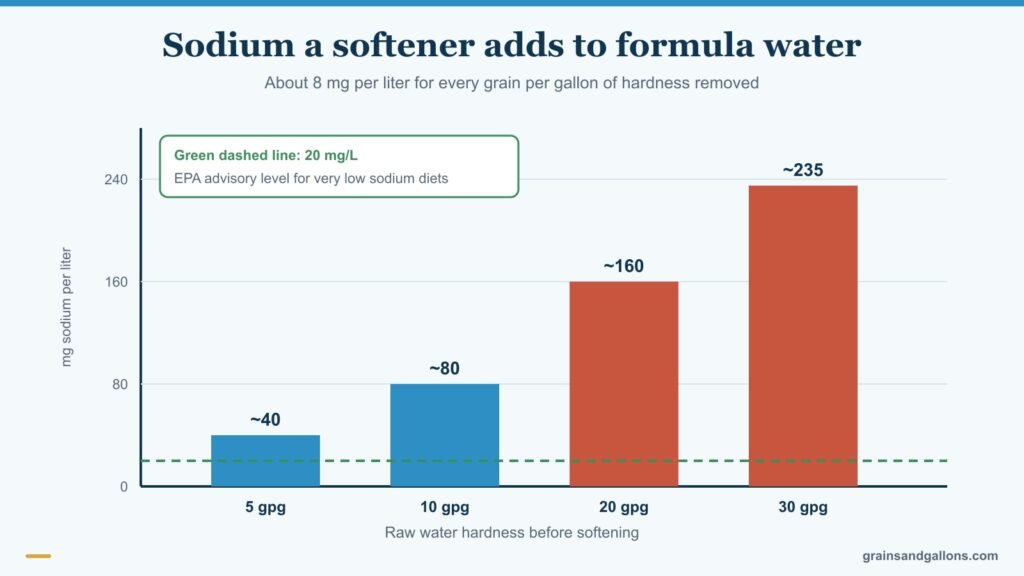
The National Academies' adequate intake of sodium for babies up to 6 months is about 110 mg a day, and formula already covers it. The EPA's sodium advisory suggests no more than 20 mg/L in drinking water for people on very low sodium diets; softened hard water lands far above that. The UK's NHS tells parents not to use artificially softened water to make up feeds. See sodium in softened water and is softened water safe to drink for adults.
A few bottles made with softened water aren't an emergency; there's just no benefit, so switch.
Three safer water sources for the bottle
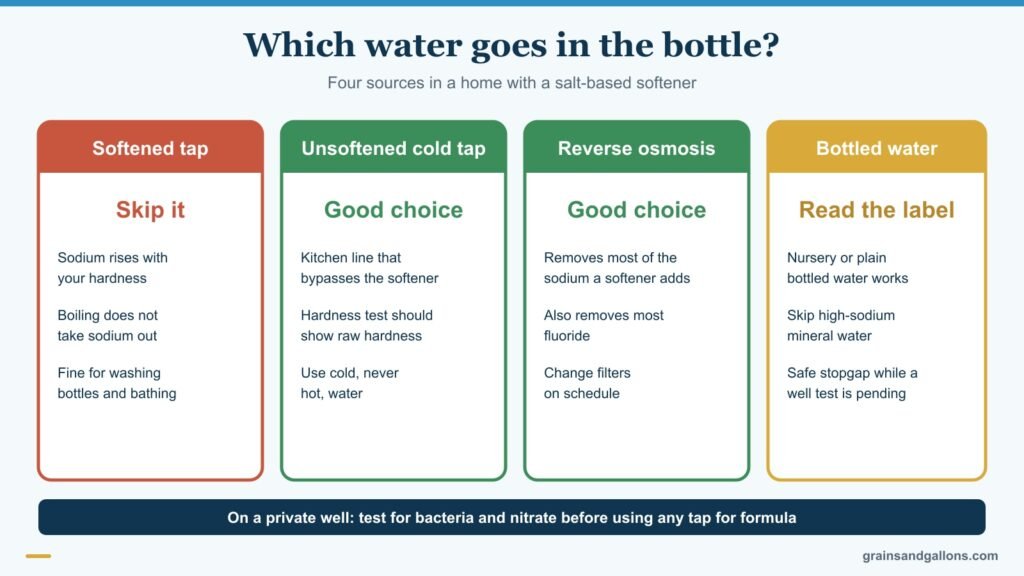
An unsoftened cold tap. Many kitchens have a cold line that bypasses the softener. If yours doesn't, see whether a kitchen tap should bypass the softener. A hardness test confirms it: softened water reads near zero. Use cold water, never hot, since a water heater adds more from the tank and pipes.
Reverse osmosis water. RO removes most dissolved solids, including most of the sodium a softener adds. It also removes most fluoride, which some pediatricians prefer for formula and others consider unnecessary, so ask yours. A countertop RO system needs no plumbing.
Bottled water. Nursery water or plain bottled water works. Check the label for sodium and skip mineral waters, which can be high in sodium and other minerals.
Softened water is still fine for washing bottles and bath time.
Private well? Test before any tap
On a well, nitrate, bacteria and arsenic matter far more than sodium, and a softener doesn't reliably remove them. The EPA's private well contaminant guide notes that nitrate is especially dangerous for babies under six months. Until a certified lab clears the water, use bottled water.
Start with our guide to testing water for nitrates; a well water test kit is useful for screening between lab tests.
Does boiling make softened water OK?
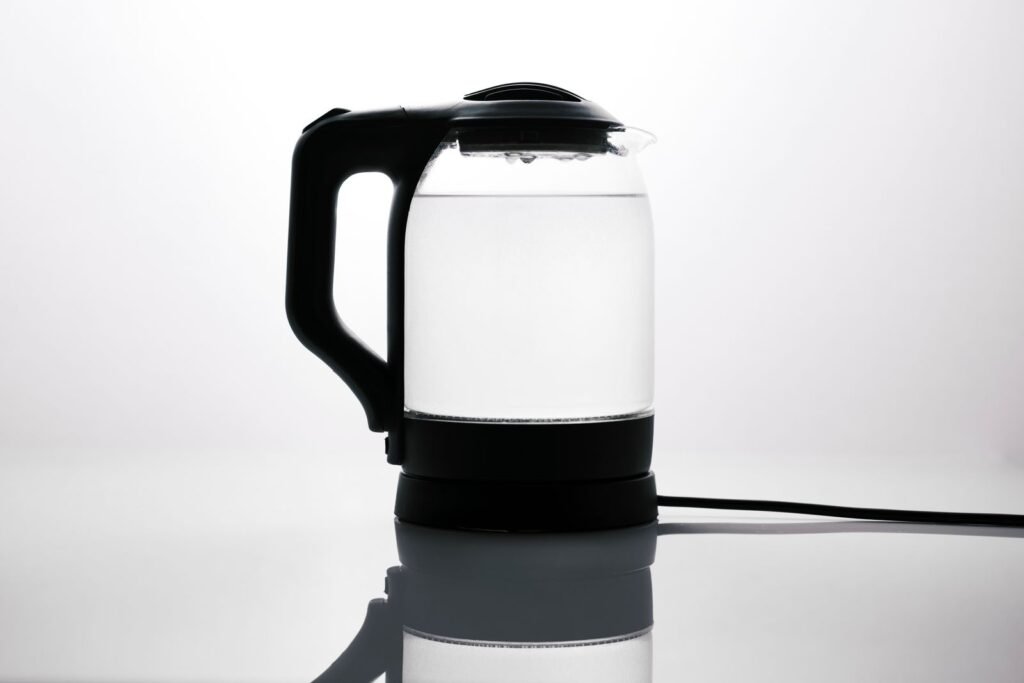
No. The CDC says powdered formula can usually be made with tap water, and recommends boiling and cooling the water for babies under 2 months, preemies and babies with weakened immune systems. Boiling kills germs but slightly concentrates sodium and nitrate, so boil water from a better source.
FAQ
Can you use softened water for baby formula in an emergency?
Yes, briefly. A bottle or two won't harm a healthy baby. Switch to an unsoftened tap, RO or bottled water as soon as you can.
Does a potassium chloride softener make the water safe for formula?
It adds potassium instead of sodium. Most parents still use an unsoftened tap or RO water for the bottle.
Is hard water safe for baby formula?
On city water, generally yes. The calcium and magnesium in hard water are not a known risk for infants in normal amounts.
What age can babies drink softened water?
There's no official cutoff. Once your child eats solid food and drinks plain water, ask your pediatrician; for babies on formula, keep using unsoftened water.
Should I boil RO or bottled water for formula?
Follow your pediatrician and the CDC: boil and cool it for babies under 2 months, preemies or babies with weak immune systems.
Keep softened water out of the bottle, not out of the house
Keep the softener. Pick one source, an unsoftened cold tap, an RO faucet or bottled water, and label it so sitters use it too. On a well, test for bacteria and nitrate first. Softened water for baby formula is the one use to drop.