


Quick Answer: How to test water for nitrates depends on who drinks it. If a baby under six months will drink formula made with your well water, send a cold, untreated sample to a state-certified lab (or use a mail-in lab kit like the Tap Score Advanced test). For a routine yearly check, a home kit with a nitrate strip, such as the Watersafe Original kit, is fine. Before you compare the result to the 10 mg/L limit, check whether it reads "nitrate" or "nitrate-N".
Disclosure: As an Amazon Associate, Grains & Gallons earns from qualifying purchases.
Nitrate has no color, smell or taste. A glass from a well with 30 mg/L of nitrate looks exactly like one with zero. So learning how to test water for nitrates comes down to three things: which water you sample, what units the result is in, and how sure you need to be. Get any of those wrong and a test can falsely reassure you or send you into a panic over a number that's actually fine.
In this guide
- Why nitrate in well water is a health test, not a taste test
- Match the test to who drinks the water
- Nitrate vs nitrate-N: the units trap
- How to test water for nitrates with strips, step by step
- Taking a nitrate lab sample that holds up
- What your nitrate number means
- When to test: spring rain, floods and new neighbors
- Tracking down where the nitrate comes from
- Treatment that actually removes nitrate
- FAQ
- Test raw water in spring and read the units twice
Why nitrate in well water is a health test, not a taste test

The EPA's drinking water limit is 10 mg/L of nitrate measured as nitrogen, plus a separate 1 mg/L limit for nitrite. Those limits exist to protect infants. Babies under about six months who drink formula mixed with high-nitrate water can develop methemoglobinemia, or "blue baby syndrome," where the blood carries less oxygen. Oregon State University Extension's nitrate guide also lists pregnant people and people with weakened immune systems as groups to protect.
Public water systems must meet that limit. Private wells don't have to, and nobody tests them for you. Oregon State Extension estimates about 1 in 5 households on private wells have nitrate above the public water limit. The EPA's private well guidance puts nitrate on the yearly test list for every well.
On city water, read your utility's Consumer Confidence Report first. Public systems already test for nitrate and publish the results.
Match the test to who drinks the water

Who's drinking the water matters more than which kit you buy.
| Your situation | Best test | Why |
|---|---|---|
| Infant under 6 months, pregnancy, or a past reading near the limit | Certified lab | You need a real number. "Somewhere between 5 and 20" isn't good enough. |
| Yearly check on a well with a clean history | Home strip kit | Strips catch a big change, and you retest with a lab if one shows up. |
| After a flood, new fertilizer nearby or a septic problem | Lab, then strips to track it | Get a solid baseline, then cheap follow-ups. |
| City water | Consumer Confidence Report first | The utility already tests. |
If someone in the house is pregnant or caring for an infant and the result is anywhere near the limit, talk to your pediatrician or doctor about which water to use while you sort it out.
Nitrate vs nitrate-N: the units trap

This is where most home results get misread. Nitrate can be reported two ways:
- Nitrate-nitrogen (NO3-N, or "nitrate as N"): counts only the nitrogen. The EPA limit of 10 mg/L uses this unit.
- Nitrate (NO3): counts the whole molecule, nitrogen plus three oxygens. The same water reads about 4.4 times higher in this unit, so the limit becomes roughly 44 to 45 mg/L.
A worked example: your strip reads 20 on a scale labeled "NO3 (ppm)." Divide by 4.4 and you get about 4.5 mg/L as N. That's under the limit but high enough to watch. Now say the strip reads 20 and the scale says "NO3-N." That's twice the limit, and the water shouldn't go into formula.
Most lab reports use "as N." Strip kits use either one. Check the label on the color chart or bottle before you panic or relax. If neither the chart nor the instruction sheet says, treat the result as a rough screen only.
How to test water for nitrates with strips, step by step
- Pick the right tap. Use one that gets untreated water. If you have a softener, anion resin filter or RO system, sample before them, at an outdoor spigot or a laundry sink fed straight from the pressure tank. Treated water tells you what the treatment is doing, not what the well is giving you.
- Run the water for a minute or two so you get fresh water from the well, not water that sat in the pipes.
- Fill a clean glass or the kit's cup. Don't use a cup that held juice, or anything that touched garden fertilizer.
- Dip the strip for exactly the time printed on the instructions, then hold it flat. Nitrate pads often take a minute or so to develop, and reading too early gives a low result.
- Compare the pad to the chart in daylight. Kitchen LEDs shift the pinks and purples most nitrate pads use.
- Write down the number, the unit, the date and the tap. A history is what lets you spot a trend.
Strips have real limits. The color blocks are coarse, often something like 0, 1, 2, 5, 10, 20, 50, and reading between blocks is guesswork. Old or humid-stored strips read wrong, so check the expiry date and keep the cap on. Many strips have a second pad for nitrite; read it too.
What about color-wheel kits and meters? A step up from strips are reagent kits that turn the sample pink or red and compare it to a color wheel or comparator. The EPA's volunteer monitoring manual notes that color comparators are only suited to readings above about 1 mg/L, which is fine for checking a well against the 10 mg/L limit. Nitrate electrodes and photometers read more precisely, but a meter and probe run hundreds of dollars and need regular calibration, so for a household a certified lab is the cheaper route to a reliable number. If the water is cloudy or silty, let it settle or filter it before any color test, because turbidity skews the reading.
Taking a nitrate lab sample that holds up

A lab test costs more, but the number comes with a detection limit and a unit you can trust. Oregon State Extension puts typical nitrate lab tests at $35 to $60, and some extension offices run free screenings. Your state health department or county extension office can point you to certified labs. Our guide to well water test kits compares mail-in lab kits with home strip kits.
Whichever lab you use:
- Use the bottle the lab sends. Some nitrate bottles contain a preservative, so don't rinse it.
- Keep the sample cold and ship it on the lab's schedule. Unpreserved nitrate samples generally need to be analyzed within 48 hours, and labs may reject late arrivals. Avoid shipping on a Friday.
- Note the sampling point on the form, such as "raw well water, outdoor spigot before softener."
- Add a bacteria test. Oregon State advises testing for coliform bacteria whenever nitrate is elevated, since both can come from the same surface or septic source. Our guide on how to test water for bacteria covers that sample.
On the report, look for "Nitrate as N" or "Nitrate-N," with a value, a reporting limit and a units column. If the rest of the report is confusing, see our guide on how to read a well water lab report.
What your nitrate number means
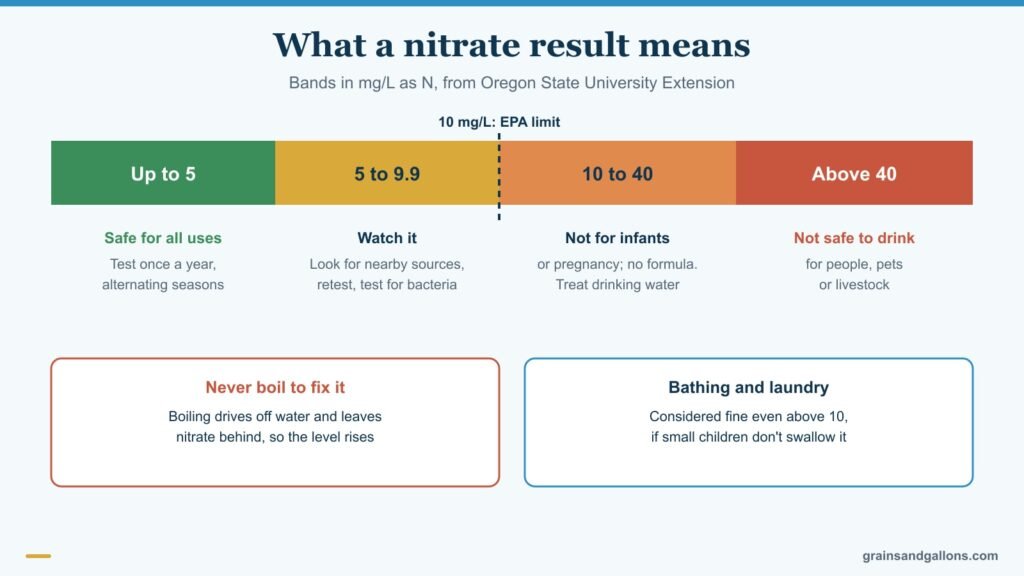
Oregon State Extension uses these bands, in mg/L (ppm) as N:
- Up to 5: safe for all uses. Test yearly.
- 5 to 9.9: under the limit, but something is adding nitrogen. Learn what's nearby, retest in a few months, and test for coliform bacteria.
- 10: the public water system limit.
- 10 to 40: not safe for infants, pregnant people or people with weakened immune systems. Don't use it for formula.
- Above 40: not safe for people, pets or livestock to drink.
Even above 10, bathing, laundry and watering the garden are considered fine, as long as small children don't swallow the water. Boiling doesn't help. It drives off water and leaves nitrate behind, so the level goes up. Use bottled water or another safe source for drinking and formula until the water is treated.
When to test: spring rain, floods and new neighbors

Nitrate levels in a well move with the seasons. They often peak after spring rain or snowmelt, when water carries nitrogen down through fertilized fields, manure or septic drain fields. One clean result in a dry August doesn't settle it. Oregon State recommends yearly tests that alternate wet and dry seasons, and sampling in both fall and spring once levels are elevated.
Test outside the normal schedule after a flood that covered the wellhead, a septic backup, new fertilizer or manure spreading upslope, or any work on the well. Our article on why well water chemistry changes explains the seasonal swings, and our well testing schedule shows when a retest makes sense.
Tracking down where the nitrate comes from

A high result is two jobs: find the source and treat the water. Fixing the source can help more than any filter. Check:
- The wellhead. A cracked cap, damaged casing or a wellhead at ground level can let surface water in. Oregon State recommends the wellhead sit at least 12 inches above ground.
- Distance to the septic system and any manure. Oregon State advises keeping septic systems and manure piles at least 50 feet from the well, and having a typical four-person household's septic tank pumped every three to four years.
- Fertilizer use, your own lawn and garden included, and any change in what neighbors spread upslope.
- Well depth. Shallow and older dug wells pick up surface water more easily than deep drilled wells.
Wells a few hundred feet apart can draw from different depths, so a neighbor's result doesn't stand in for yours. If nitrate and a coliform test both come back high, the well is probably taking in surface water or septic effluent, and repairing the wellhead comes before buying any nitrate filter.
Treatment that actually removes nitrate
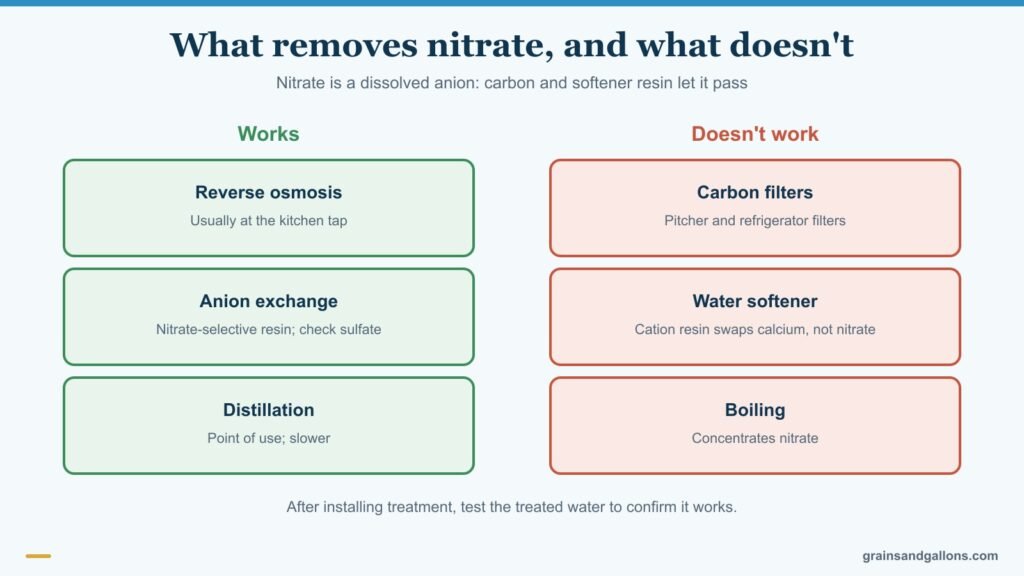
Nitrate doesn't stick to carbon, so pitcher and refrigerator filters won't remove it. A standard softener won't either: its cation resin swaps calcium and magnesium, while nitrate is an anion and passes straight through. The options that work:
- Reverse osmosis at the kitchen tap. The common choice when only drinking and cooking water needs treating.
- Anion exchange with nitrate-selective resin, usually whole-house. Sulfate in the water affects the resin choice, so bring your lab report.
- Distillation at the point of use, slower but effective.
Our guide to the best nitrate removal filters walks through RO and anion systems and what to check on your lab report before buying. After installing anything, test the treated water to confirm it's working, then keep testing the raw water yearly.
FAQ
Are nitrate test strips accurate enough?
For a routine screen, yes. For a decision about infant formula or treatment, no. Strip color blocks are coarse and reading between them is guesswork. Confirm anything near 5 to 10 mg/L as N with a certified lab.
Can a TDS meter detect nitrate?
No. A TDS meter reads total dissolved solids and can't tell nitrate apart from calcium or sodium. Our TDS meter guide explains what those readings do and don't show.
Does a water softener remove nitrate?
No. A standard softener's cation resin removes calcium and magnesium. Nitrate is an anion, so it passes through. Nitrate removal needs anion resin, reverse osmosis or distillation.
Is it safe to shower in water with high nitrate?
Generally yes. Oregon State Extension considers bathing, laundry and garden use acceptable even above 10 mg/L as N, as long as small children don't drink the water. The risk is from swallowing it.
Should I test for nitrite too?
It's worth it. Nitrite has its own EPA limit of 1 mg/L as N. Many strip kits include a nitrite pad, and most lab nitrate tests can add nitrite for little extra cost.
How often should I test well water for nitrates?
At least once a year, alternating wet and dry seasons. Test more often if a past result was elevated, if you live near cropland, livestock or a septic field, or if an infant drinks the water.
Test raw water in spring and read the units twice
The core of how to test water for nitrates is simple: sample raw well water before any treatment, test in the wet season when levels peak, and confirm whether the result is nitrate or nitrate-N before comparing it to 10 mg/L. Strips are fine for a yearly screen. A certified lab is the test to trust when a baby, a pregnancy or a treatment purchase depends on the number.