


Quick Answer: How often to test well water depends on the contaminant. Test every year for total coliform bacteria and nitrate, and add pH and total dissolved solids if you can; that's the EPA and CDC baseline for private wells. Run a full lab panel (metals including arsenic and uranium, hardness, iron, manganese) when you first get the well, then every 3–5 years. Retest right away after flooding, well or pump work, or any change in taste, smell or color, and before anyone pregnant or an infant starts drinking the water.
City water is tested by the utility on a federal schedule. With a private well, the schedule is whatever you set, and in plenty of homes nothing has been tested since closing day. Knowing how often to test well water comes down to how fast each contaminant can change, so here's a realistic calendar built that way.
In this guide
- How often to test well water for bacteria and nitrate
- Metals and minerals: a full panel every 3 to 5 years
- Once, then only if land use nearby changes
- Events that reset the clock
- After shock chlorination: the timing that trips people up
- A sample 10-year calendar
- FAQ
- Put the yearly bacteria test on the calendar first
How often to test well water for bacteria and nitrate
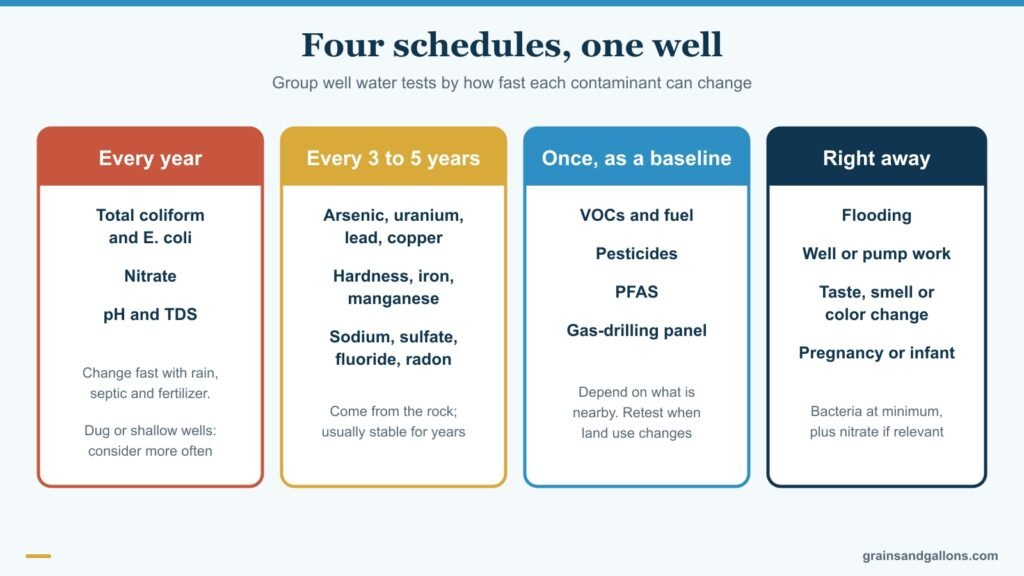
These can change between one summer and the next, driven by rain, septic systems, livestock, fertilizer or a cracked well cap.
| Test | Why yearly | Good timing |
|---|---|---|
| Total coliform / E. coli | Bacteria get in through surface water, damaged caps or flooding. Contamination can be sudden. | Spring or early summer, after wet weather |
| Nitrate (and nitrite) | Rises with fertilizer, manure and septic loading. Can swing seasonally. | Same sample trip, ideally after spring rains |
| pH | Low pH means corrosive water that eats copper and fixtures. | Any time |
| Total dissolved solids (TDS) | A cheap trend line. A jump says something changed. | Any time |
The EPA's private well guidance lists these four for yearly testing. Bacteria and nitrate are the two that hurt people quickly, so if you only do two tests a year, do those. Dug wells, shallow wells and wells with short casing are more exposed to surface water; testing them for bacteria more than once a year is reasonable. Our guides to testing for coliform bacteria and testing for nitrates walk through sampling for each.
Metals and minerals: a full panel every 3 to 5 years
Metals and minerals come from the rock. They usually stay steady for years, but pumping changes, drought and well deepening can all shift them; our explainer on why well water chemistry changes covers how. On a 3–5 year cycle, run a full lab panel:
- Arsenic, uranium and other metals (lead, copper, manganese)
- Hardness, iron and manganese. These also decide whether your softener and iron filter are still sized and set correctly; see how to test well water for iron.
- Sulfate, chloride, sodium, fluoride
- Radon in water if your area is known for it. Your state geological survey or health department will say.
Some extension services go further: UGA Extension recommends an expanded chemistry test every year alongside bacteria. If any result came back near a health limit last time, shorten the cycle to yearly until you know it's stable.
Once, then only if land use nearby changes

Some tests are about what's around you, not the rock under you. Run them once as a baseline, then again when land use nearby changes:
- VOCs and petroleum near gas stations, fuel tanks, landfills or industrial sites, or if you ever smell fuel or solvent.
- Pesticides and herbicides near orchards, row crops or golf courses.
- PFAS near airports, military bases, firefighting training sites, or fields where sewage sludge was spread.
- Gas drilling–related tests (methane, chloride, barium, strontium) before drilling starts nearby, so you have a "before" number.
A good mail-in panel bundles many of these. Our comparison of well water test kits shows which kits include metals, VOCs and bacteria in one shipment.
Events that reset the clock
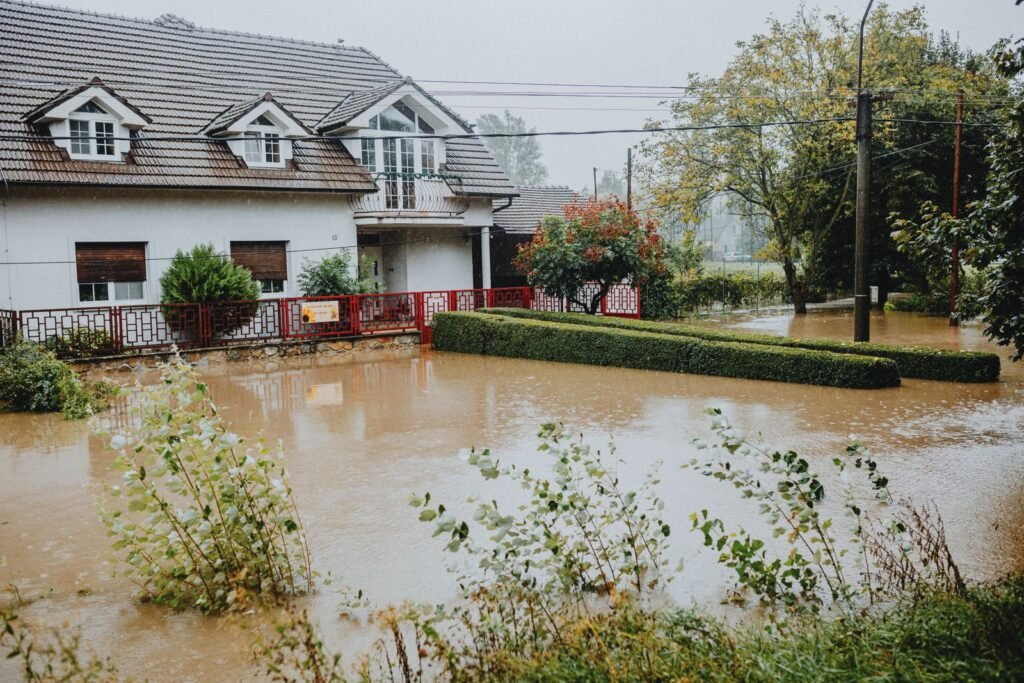
Don't wait for the annual test after any of these. Test for bacteria at minimum, plus the extras where they apply:
- Flooding near the wellhead, or a well cap that was under water. Assume contamination until a test says otherwise.
- Well, pump or pressure tank work. Opening the well can introduce bacteria. Disinfect, then test.
- A change in taste, smell, color or cloudiness. Rotten egg, metallic, earthy, fuel or sudden staining all count.
- A new baby, a pregnancy or someone with a weakened immune system in the home. Add nitrate and bacteria if they're not current.
- Repeated stomach illness in the household without another obvious cause. Test, and see a doctor.
- Buying or selling the house. Lenders often require bacteria and nitrate; do the full panel for your own sake.
- After installing treatment. Test the treated water a few weeks in to confirm the system works.
After shock chlorination: the timing that trips people up

Testing too soon after disinfecting gives a false "all clear", because leftover chlorine kills bacteria in the sample bottle. Run water until you can no longer smell chlorine, or a chlorine strip reads zero, before you sample. Many health departments suggest a first test once chlorine is gone and a second a week or two later. Read our note on shock chlorination and your softener before you pour chlorine down the casing.
If coliform keeps coming back after repeated disinfection, the problem is likely structural (a bad cap, cracked casing, poor grout seal) or ongoing, and continuous treatment is the answer. Our guide to well water systems for bacteria covers UV and chlorination options.
A sample 10-year calendar

For a typical rural well with no known problems:
- Year 1 (move-in): full lab panel + bacteria + nitrate
- Years 2–4: bacteria + nitrate + pH + TDS each spring
- Year 5: full panel again + bacteria + nitrate
- Years 6–9: yearly bacteria + nitrate + pH + TDS
- Year 10: full panel
- Any year: event-triggered tests as above
Keep every report in one folder. Trends matter more than any single number: a nitrate level climbing from 2 to 4 to 6 mg/L over three springs tells you more than one result of 6 does.
FAQ
Do I need to test if my well water looks and tastes fine?
Yes. Bacteria, nitrate, arsenic and most other health-related contaminants have no taste, smell or color. Clear, good-tasting water says nothing about whether it's safe, which is why the yearly test is the baseline.
What's the best time of year to test well water?
Spring or early summer, after wet weather, when surface water is most likely to reach the well. A sample then catches the worst case for bacteria and nitrate.
Should I use a home kit or a certified lab?
Home strips are fine for tracking pH, hardness or TDS between lab tests. For bacteria, nitrate and metals, use a state-certified lab; your county health department or extension office can point you to one and often supplies the bottles.
Do I still need to test if I have a filter or UV system?
Yes. Treatment can fail without anything you'd notice: a UV lamp past its rated life, used-up arsenic media, an RO membrane slowly losing rejection. Test the raw water on the schedule above and the treated water at least yearly.
Put the yearly bacteria test on the calendar first
If you remember one thing about how often to test well water, make it this: bacteria and nitrate every year, a full panel every three to five years, and an extra test whenever something changes. Pick a month, set a reminder and keep the reports together.