


Quick Answer: Filter before or after water softener? Most filters go before. Sediment comes first (a spin-down like the iSpring WSP-50 is the usual choice on well water), then carbon for chlorine or chloramine, then any pH or iron filter, then the softener. The two common exceptions go after: reverse osmosis for drinking water, and UV disinfection, which needs clear, soft water to work.
Disclosure: As an Amazon Associate, Grains & Gallons earns from qualifying purchases.
The softener's on the floor, the filter housing is still in its box, and you've got one length of pipe to decide on. The logic is short: anything that protects the softener goes in front of it, and anything that needs soft, clean water to do its job goes behind it. Every rule below follows from that. As the Minnesota Department of Health puts it in its home water treatment guidance, no single unit removes everything, so multi-problem water needs units combined into a system, and order matters.
In this guide
- Filter before or after water softener? The rule that decides
- Why sediment filtration comes first
- Carbon before the softener, and sometimes after too
- When iron and manganese need their own filter
- RO and UV belong after the softener
- Pressure tank, water heater and backwash flow
- Three proven equipment trains
- FAQ
- Protect the softener up front, polish the water behind it
Filter before or after water softener? The rule that decides
| Filter | Before or after? | Why |
|---|---|---|
| Spin-down / sediment | Before | Sand and grit wear valve seals, foul resin and plug the injector |
| Whole-house carbon (chlorine) | Before, usually | Chlorine slowly breaks down softener resin |
| Catalytic carbon (chloramine) | Before | Same reason; chloramine needs more contact time to remove |
| Acid neutralizer (calcite) | Before | It adds hardness, which the softener then removes |
| Iron / manganese / sulfur filter | Before | Oxidized iron and manganese foul resin |
| Arsenic, PFAS or lead media | Varies by product | Follow the maker; some media prefer softened water |
| Reverse osmosis (under sink) | After | Softened feed water helps the membrane last longer |
| UV disinfection | After, and last | UV needs clear, low-hardness water; scale on the sleeve blocks the light |
Skip any stage your water test doesn't call for. A city home with low sediment may need nothing but carbon in front of the softener; a well with clean, iron-free water may need only a sediment filter.
Why sediment filtration comes first
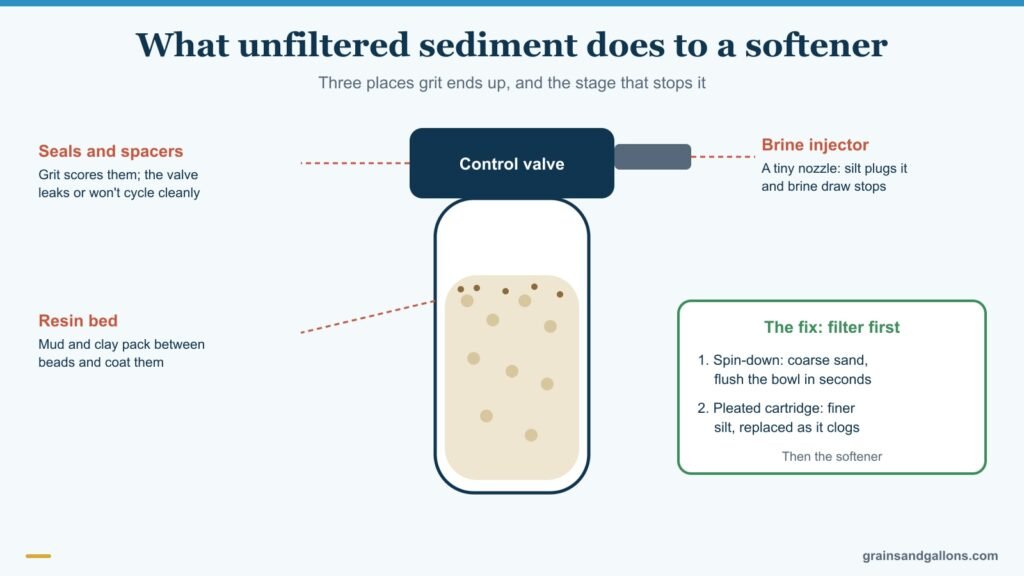
Sand, silt and pipe scale are the cheapest problems to stop and the most annoying to fix later. Grit scores the control valve's seals and spacers, lodges in the brine injector and packs into the resin bed. Penn State Extension's water softening guide notes that turbid water can clog resin with mud and clay, and recommends filtering it before the softener. On well water, the sediment filter is the first thing after the pressure tank.
A spin-down filter with a clear bowl and a flush valve works well as the first stage because you can see what it's catching and flush it in seconds. Pleated cartridges catch finer particles but need replacing. Many homes use both: spin-down first, cartridge second. Our guide to sediment prefilters before a softener covers micron ratings, and our roundup of the best spin-down sediment filters compares sizes and flush designs.
Carbon before the softener, and sometimes after too
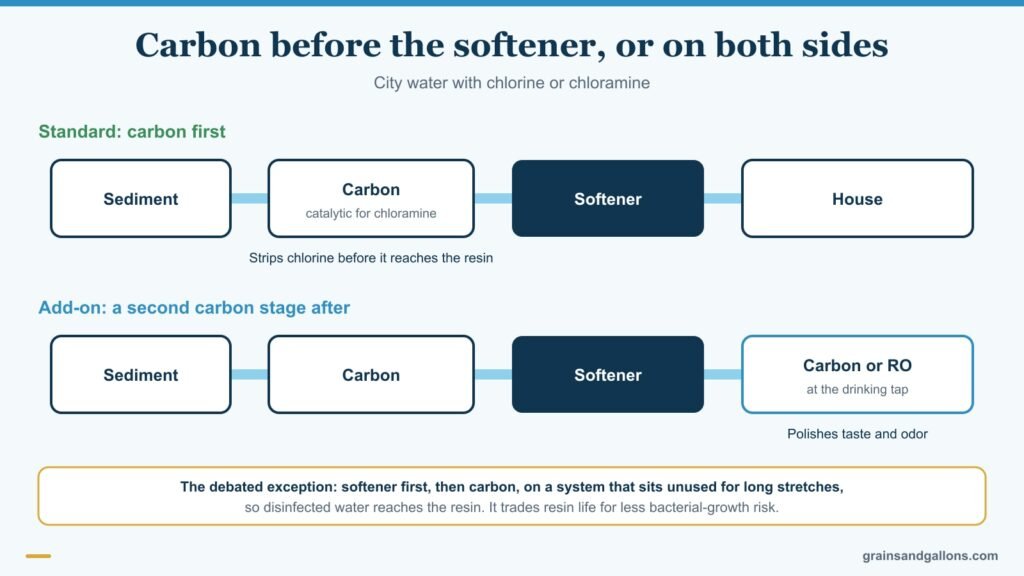
On city water, the standard order is carbon, then softener. Chlorine attacks the resin's structure over time, so beads swell, turn mushy and lose capacity; taking it out first protects them. If your utility uses chloramine, you'll need catalytic carbon and a bigger bed, because plain carbon removes it slowly. Our picks for the best whole-house filters for chloramine are sized with that in mind.
Some homes add a second, smaller carbon stage or an RO unit after the softener at the kitchen tap, purely for taste and odor. That's an add-on, not a replacement for the first stage.
The exception people argue about: once chlorine is gone, the water sitting in the softener tank has no disinfectant. On a system that sits unused for long stretches, some installers prefer softener first, then carbon, so disinfected water reaches the resin. That trades resin life for a little less bacterial-growth risk. For most busy households on city water, carbon first is the better call. Our article on using a carbon filter and water softener together goes into both arguments.
When iron and manganese need their own filter

A softener can remove some dissolved, clear-water iron, but only within limits. Penn State Extension's guide to iron and manganese in private water systems says softeners are generally only recommended when pH is above 6.7 and dissolved iron is under 5 mg/L, and that oxidized iron and manganese will foul the resin. The raw water also mustn't meet air or chlorine before the softener, since that oxidizes the iron.
So if your water runs orange, carries manganese or iron bacteria, or smells of sulfur, a dedicated filter goes ahead of the softener and takes the load off. Hydrogen sulfide filters usually sit in the same spot. With low pH, the acid neutralizer typically comes before the iron filter, since many iron media need near-neutral water; some Birm-type media want pH of at least 6.8 for iron. Our guide to the iron filter before a water softener covers media choices.
RO and UV belong after the softener
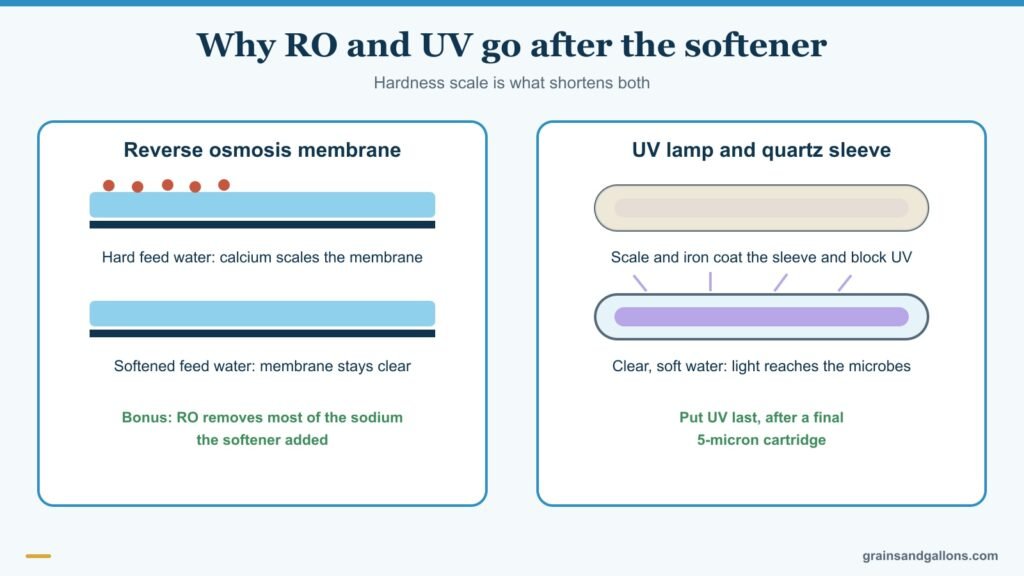
Reverse osmosis is a drinking-water system, usually under one sink, so it lives after the softener by default. Soft feed water is gentler on the membrane, because calcium is a common cause of membrane scaling. RO also removes most of the sodium the softener added, which is why many people pair them. See reverse osmosis and a water softener together.
UV goes last, after every filter and the softener. UV only kills what the light reaches. Cloudy water, iron staining and hardness scale on the quartz sleeve all block it, and a softener in front keeps the sleeve clear longer. A final 5-micron cartridge just before the UV catches any resin fines. Our guide to the best UV water purifiers for well water lists each unit's pre-treatment requirements.
Pressure tank, water heater and backwash flow
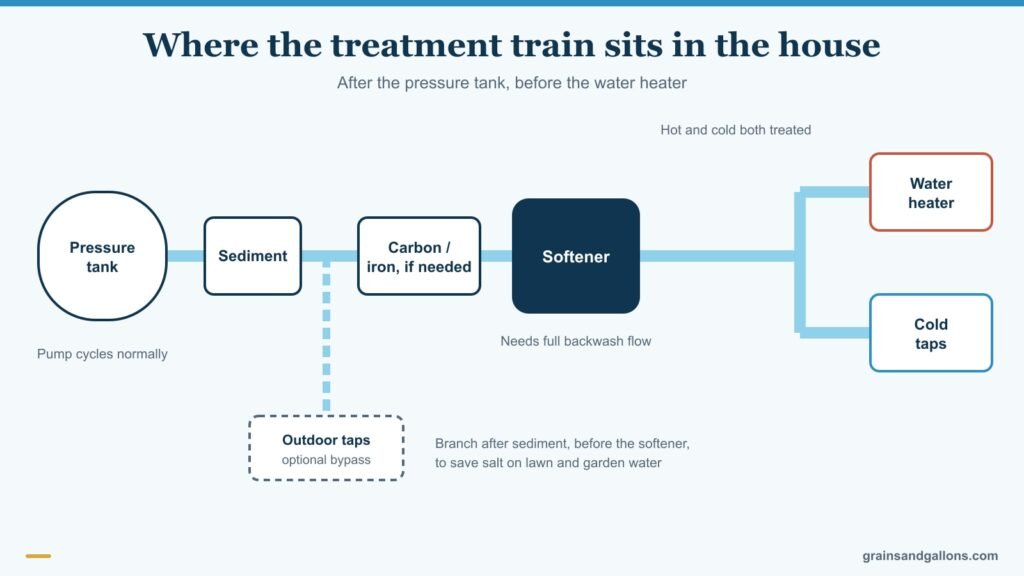
Pressure tank. On a well, the treatment train normally starts after the pressure tank, so the pump cycles normally and every stage sees steady pressure. A sediment filter right after the tank also protects everything downstream.
Water heater. The softener and its filters go upstream of the water heater, so both hot and cold lines get treated water and the heater is protected from scale. Penn State notes that scale buildup shortens a water heater's useful life.
Outdoor taps. Penn State also lists outside spigots and toilets among the lines that can be left unsoftened. Branch them off before the softener if you want to save salt, but after the sediment filter if grit is the problem.
Backwash flow. A softener needs enough flow to backwash its resin bed. A clogged or undersized filter in front of it can starve that flow, so size prefilters generously and replace cartridges before they choke.
Three proven equipment trains

City water, chlorine or chloramine: main shutoff → sediment cartridge → carbon or catalytic carbon → softener → house (optional RO at the kitchen sink).
Well water with iron and low pH: pressure tank → spin-down sediment → acid neutralizer → iron filter → softener → house.
Well water with bacteria concerns: pressure tank → sediment → neutralizer or iron filter if needed → softener → 5-micron cartridge → UV → house.
Two things people forget on every train:
- Give each stage its own bypass, or at least shutoff valves, so you can change cartridges and service the softener without killing water to the house.
- Watch pressure drop. Each stage costs a few psi, more under heavy flow. Put a gauge before and after the filter bank so you can see when cartridges clog.
For long well-water trains, including where gauges and bypasses go, see our well water treatment train order guide.
FAQ
Does a sediment filter go before or after a water softener?
Before. Its job is to protect the softener's valve and resin from grit. A small cartridge after the softener sometimes catches resin fines, but that's a different job.
Should a carbon filter go before or after a water softener?
Before, on chlorinated or chloraminated city water, so chlorine doesn't degrade the resin. A second carbon or RO stage after the softener for drinking water is optional.
Do I need a filter before the softener on city water?
Not strictly, but a sediment cartridge is cheap insurance after water main work, and carbon helps resin last longer.
Does a water softener go before or after the pressure tank?
After. The pressure tank comes first, then sediment filtration, then the rest of the train.
Can a water softener remove iron without a separate filter?
Sometimes. Penn State says softeners can work when dissolved iron is under 5 mg/L and pH is above 6.7. Oxidized iron or manganese needs a dedicated filter in front.
Protect the softener up front, polish the water behind it
The answer to filter before or after water softener comes down to one rule: sediment, carbon and iron or pH treatment go before the softener to protect it, while RO and UV go after because they work best on soft, clear water. Test your water, add only the stages it needs, and give each one a bypass and a pressure gauge.