

Quick Answer: If you're on a well, or you've ever seen sand, grit or rust flakes in a faucet screen, yes: install a sediment prefilter before a softener, on the main line just ahead of it. A reusable spin-down screen around 50 to 100 microns catches sand and grit with very little pressure loss; add a finer cartridge only if you have silt. On clean city water with no visible sediment, it's optional, though it's cheap insurance for the control valve.
A sediment prefilter before a softener exists because the softener's resin bed will trap some dirt, and that's the problem. Resin is built to swap hardness minerals, not to filter. The control valve has tight seals and a tiny injector that hate grit, and every bit of sand that gets in either wears something down or has to be backwashed out again. A prefilter takes that job off the softener's hands.
In this guide
How grit wears out the valve, injector and resin

Sediment causes trouble in three places:
- The control valve. Sand scores the seals and piston. Fleck's 5600SXT service manual lists foreign material in the control as a fault and tells you to remove the power head, inspect the bore and clean it. It also blames lost water pressure on an inlet "plugged due to foreign material broken loose from pipes by recent work done on plumbing system."
- The injector. The injector has a small nozzle and a screen. The same manual lists a plugged injector or injector screen as a reason the unit won't draw brine, and a plugged injector system as a cause of excess water in the brine tank.
- The resin bed. Penn State Extension's water softening guide warns that turbid water can clog resin with mud and clay, and that oxidized (red) iron fouls it too; it recommends filtering before softening. A dirty bed channels water around the clogged spots and softens less. Our guide to water softener resin fouling covers cleaning a bed that's already coated.
Who needs a sediment prefilter before a softener?
Answer four questions:
1. Is your water from a private well? Then almost certainly yes. Wells can pull sand, especially during heavy use, after pump work, or as the well ages.
2. Have you seen grit, sand or rust specks in faucet aerators, the toilet tank or a filter screen? Then yes, whatever your source. If you're not sure whether the white bits in an aerator are scale or sand, the vinegar test in our guide to scale on faucet aerators tells them apart.
3. Does your city have frequent main breaks or old cast-iron mains? Main work can send a slug of rust and debris through the system. A prefilter catches it before it reaches the softener.
4. Is your water clean city water with nothing visible, ever? A prefilter is optional. A spin-down is still cheap insurance.
Signs that sediment is already reaching an unprotected softener include cloudy or discolored water, grit in fixture screens, pressure that slowly falls, and the brine faults above: salt that stops dropping or a brine tank that keeps filling. If you're on a well, also have the water tested for iron. A sediment screen catches particles, not dissolved iron, and iron above what your softener is rated for needs its own filter in the line.
Choosing a micron rating without choking the flow
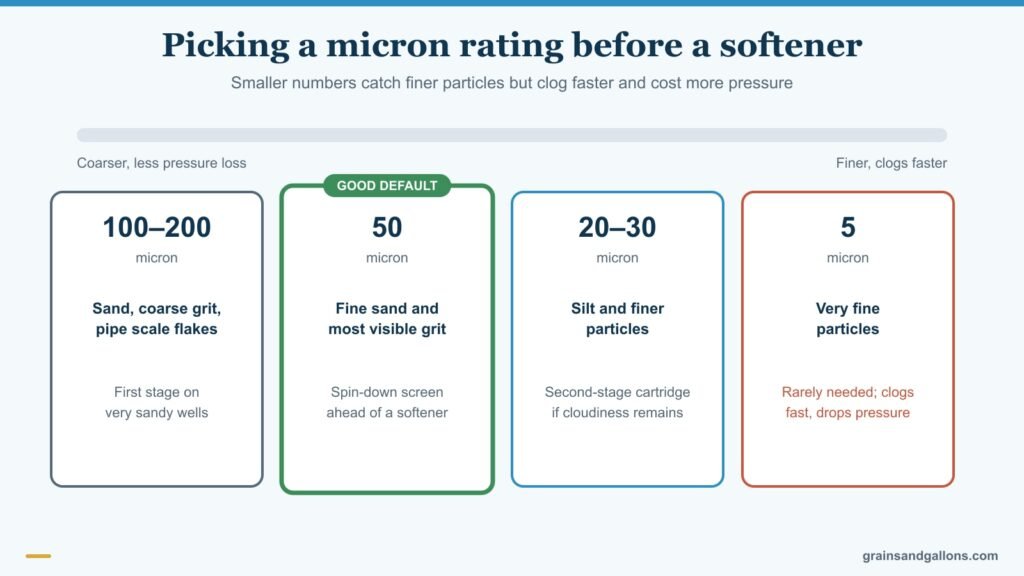
A micron rating is the particle size the filter is designed to catch. Smaller numbers catch finer particles but clog faster and cost more pressure.
| Micron range | What it catches | Good for |
|---|---|---|
| 100–200 | Sand, coarse grit, pipe scale flakes | Well water with visible sand; first stage on very dirty water |
| 50 | Fine sand and most visible grit | The most common choice ahead of a softener |
| 20–30 | Silt and finer particles | Second stage if you still see cloudiness after a coarse screen |
| 5 | Very fine particles | Rarely needed before a softener; clogs fast and drops pressure |
A good default: a 50-micron spin-down screen. On dirty well water, put a coarser screen first and a finer cartridge second, so the fine stage doesn't clog in weeks.
Going too fine is the most common mistake. A 5-micron cartridge alone in front of a softener on sandy well water can clog quickly, and a clogged filter starves the softener of flow and pressure. That matters because a softener needs adequate pressure to backwash and draw brine; Fleck's manual lists low line pressure as a cause of failure to draw brine and says to increase it to 20 psi.
Spin-down screen or pleated cartridge?

Spin-down filters use a washable mesh screen in a clear housing. You see sediment build up and flush it out through a bottom valve, with no cartridges to buy. Our roundup of the best spin-down sediment filters compares models.
Cartridge filters use a disposable pleated or spun cartridge in a housing. They catch finer particles and swap easily, but you'll keep buying cartridges. A large 4.5 x 20-inch housing holds much more dirt than a slim 10-inch one before pressure starts dropping. See our picks for Big Blue whole house filter housings.
Many well setups use both: spin-down first for sand, cartridge second for silt.
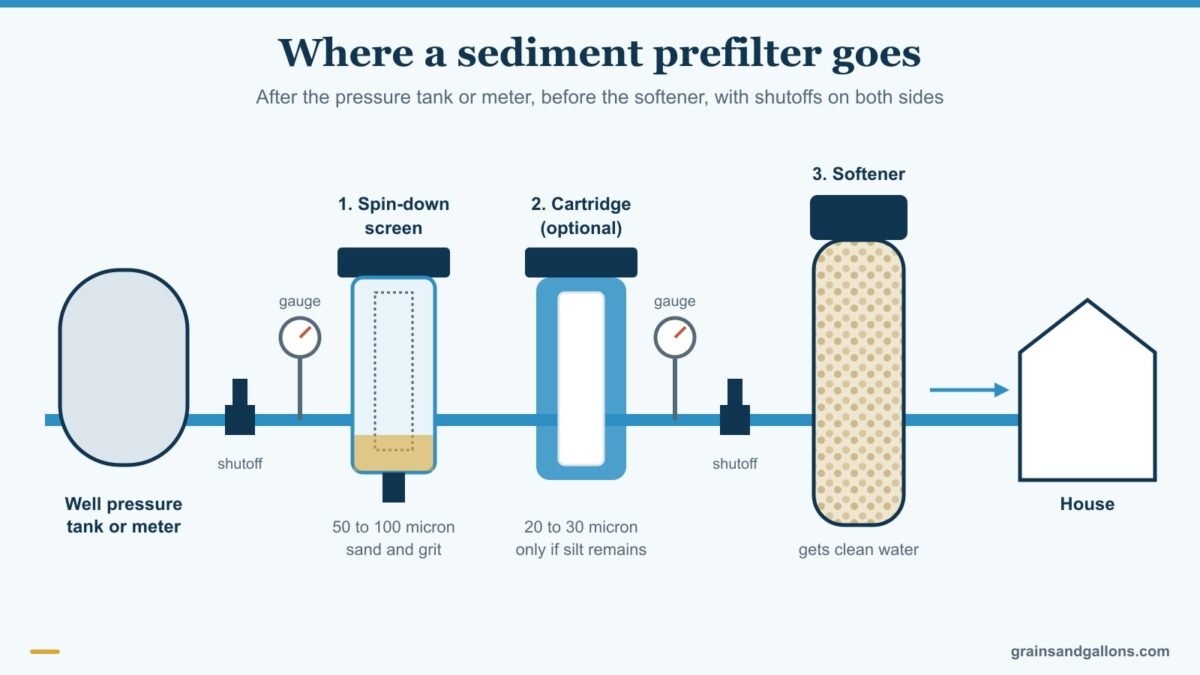
Plumb it after the pressure tank, ahead of the softener
The prefilter goes after the pressure tank (on a well) or after the main shutoff and meter (on city water), and before the softener, as in the diagram at the top of this page. If you also have iron filtration, an acid neutralizer or UV, the order matters: our guide to well water treatment train order walks through the full sequence, and filter before or after a water softener covers where carbon and other filters belong.
A few installation tips:
- Install shutoff valves on both sides of the filter, or a bypass loop, so you can service it without shutting off the whole house.
- Leave clearance below the housing to unscrew the bowl or open the flush valve.
- Run the flush valve to a drain or bucket. Spin-down flush water is gritty and briefly high-flow.
- Add pressure gauges before and after the filter if you can. The gap between them tells you when it's clogging.
Flush the prefilter so it never becomes the bottleneck

A neglected sediment prefilter before a softener can choke flow worse than the sediment ever would have. Flush spin-down screens regularly, weekly to monthly on dirty wells and less often on clean water, and replace cartridges when the pressure gap between the gauges grows or the cartridge is visibly discolored.
If pressure drops after a filter and softener go in together, check the filter first; bypass it briefly and see whether flow returns. Our guide to water softener pressure drop helps sort out which component is responsible. Kept clean, a prefilter costs far less than rebuilding a control valve or replacing fouled resin.
FAQ
Do I need a sediment filter before a water softener on city water?
Usually not, if you've never seen grit in aerators or toilet tanks. Most utilities treat water to remove particles before it reaches you. Add one if your area has frequent main breaks, old cast-iron mains or recent plumbing work that sends debris through the lines.
What micron sediment filter should go before a softener?
A 50-micron spin-down screen is a good default. On sandy wells, use a coarser screen (100 to 200 micron) first and a 20 to 30 micron cartridge second if silt remains. Avoid a lone 5-micron cartridge; it clogs fast and starves the softener of pressure.
Does the sediment filter go before or after the pressure tank?
On a typical well, after the pressure tank and before the softener. Some very sandy wells also get a coarse screen ahead of the pressure tank to protect it.
Will a sediment prefilter remove iron?
Only iron that has already oxidized into particles. Dissolved (clear-water) iron passes through a sediment screen. If your water test shows more iron than your softener is rated for, you need a dedicated iron filter ahead of the softener.
How often should I flush a spin-down filter?
Whenever you see a layer of sediment in the bowl or the gauges show a growing gap: weekly to monthly on dirty wells, every few months on clean water.