

Quick Answer: To clear scale on faucet aerators, unscrew the aerator from the faucet tip (by hand, or with pliers wrapped in a cloth), take it apart, and soak the metal and plastic pieces in white vinegar for an hour or two until the white crust softens. Scrub with an old toothbrush, clear the holes with a toothpick, rinse, and reassemble in the same order. If the bits in the screen don't fizz or soften in vinegar, they aren't scale.
If the kitchen faucet now splits into three streams, sprays sideways or runs weak, scale on faucet aerators is the usual cause in a hard water house: the screen-and-insert assembly in the tip gets packed with limescale. It's 15 minutes of work plus soaking time.
In this guide
- How scale on faucet aerators splits the stream
- Know which aerator you have before you grab pliers
- Unscrew a stuck aerator without scratching the finish
- Is it scale or something else in the screen?
- Soak, scrub and clear every hole
- Reassemble and check the spray
- Scale on faucet aerators comes back until the water changes
- FAQ
How scale on faucet aerators splits the stream
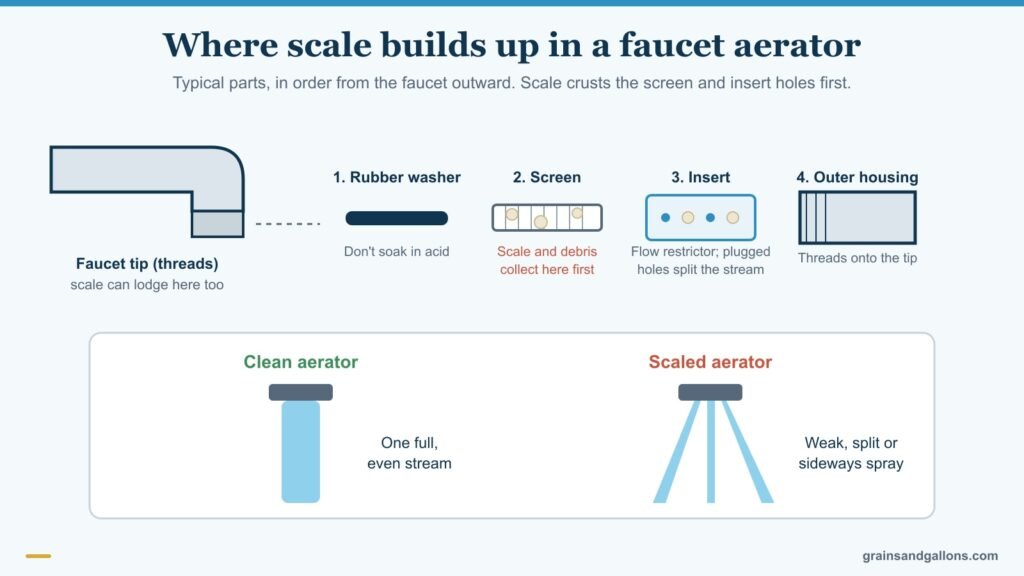
Every time hard water dries on the tip, a thin layer of calcium carbonate stays on the screen and around the tiny holes of the insert (the flow restrictor). Once a few holes plug, water squeezes through the open ones at an angle, so the spray fans out or veers sideways.
The screen also catches whatever else moves through your pipes. The EPA notes that sediment, debris and lead particles can collect there and recommends regularly cleaning the aerator, even before the stream goes wrong.
Know which aerator you have before you grab pliers

- Male-threaded aerator: threads on the outside of the aerator screw into the faucet tip.
- Female-threaded aerator: threads inside the aerator screw over the outside of the tip.
- Hidden (cache) aerator: recessed in the spout with no flats to grip. It needs the small plastic aerator key that came with the faucet; the maker or a hardware store can supply a matching one.
- Pull-down sprayer: the spray face often unscrews, or a screen sits where the hose connects. Check the instructions before prying.
Unscrew a stuck aerator without scratching the finish

Close the sink drain or lay a towel in it first. Aerator parts are small and love to disappear.
Looking up from underneath, turn the aerator counterclockwise by hand. If it won't budge, wrap it in a cloth or masking tape and grip gently with pliers. Too much force dents the housing or scratches the plating.
If scale has cemented it, fill a plastic bag with vinegar, slip it over the tip so the aerator is submerged, hold it with a rubber band and wait about an hour. The same bag trick is your fallback for an aerator that can't come off at all.
Is it scale or something else in the screen?

Lay the pieces out in the order they came out and snap a phone photo for reassembly. Then look at what's clogging the screen.
| What you see | What it probably is | What to do |
|---|---|---|
| White or tan crust, hard and chalky | Limescale (calcium carbonate) | Soak it off (next section) |
| Hard white chips that don't soften in vinegar | Plastic from a deteriorating water heater dip tube | See white particles in tap water |
| Sand, grit or rusty-orange specks | Sediment or rust from the main, well or old pipes | Flush the lines, especially after plumbing work or a main break |
| Black, rubbery specks | Degrading rubber from a washer or supply hose | Replace the worn part |
Drop a few bits into vinegar: limescale fizzes and softens within an hour or so; plastic and sand don't change. Some 1990s water heaters had dip tubes that broke down into white plastic flakes, so with an older tank heater, ask a plumber to check it.
Soak, scrub and clear every hole
Put the metal and plastic parts in white vinegar; leave the rubber washer out. Light haze clears in under an hour, thick crust may need a few hours or overnight. Citric acid works the same way.
Scrub with an old toothbrush and push a toothpick through blocked holes. Avoid metal picks on plastic inserts; widened holes ruin the spray pattern. Rinse well.
Faster than vinegar: a dedicated descaler works quicker on heavy buildup; see CLR vs Lime-A-Way and our limescale removers for faucets. Keep acids off matte black, brushed brass and oil-rubbed bronze faucet bodies; many makers recommend only mild soap and water there.
Reassemble and check the spray

Reassemble in the order of your photo with the washer seated flat. Thread it on by hand and snug it slightly; overtightening is what makes it stick next time.
Run hot and cold: you want a full, even stream. Drips at the threads mean the washer isn't flat or needs replacing. A clean but weak stream means the restriction is upstream, such as a valve, cartridge or house-wide pressure (see low water pressure after a water softener).
Corroded or cracked? Replace it; take the old one to the store to match size and thread. The EPA's WaterSense program labels bathroom aerators that use at most 1.5 gallons per minute, versus the standard 2.2 gpm.
Scale on faucet aerators comes back until the water changes
In hard water, aerators scale up again within a few months, and showerheads too (the hard water clogged showerhead fix is the same soak). If you're clearing scale on faucet aerators that often and wiping white spots on faucets, test your water hardness to see whether a softener is worth it. Until then, a vinegar soak every few months keeps the stream straight.
FAQ
How long should I soak a faucet aerator in vinegar?
An hour or two for most visible crust; thick, layered scale may need several hours or overnight.
How do I clean an aerator that won't come off?
Tie a vinegar-filled bag over the tip for about an hour, then scrub the face and run the water. This often loosens it enough to unscrew afterward.
Can I use CLR on a faucet aerator?
Yes, on the removable parts, following the label's contact time and rinsing well. Check the faucet maker's care instructions before using it on a special-finish faucet body.
What tool removes a hidden faucet aerator?
A plastic aerator key sized to that aerator. One usually ships with the faucet; the manufacturer or a hardware store can supply a replacement.
Why is there white stuff in my aerator that won't dissolve?
It isn't limescale. Hard white chips are often plastic from a failing water heater dip tube; grit or orange specks point to sediment or rust.