

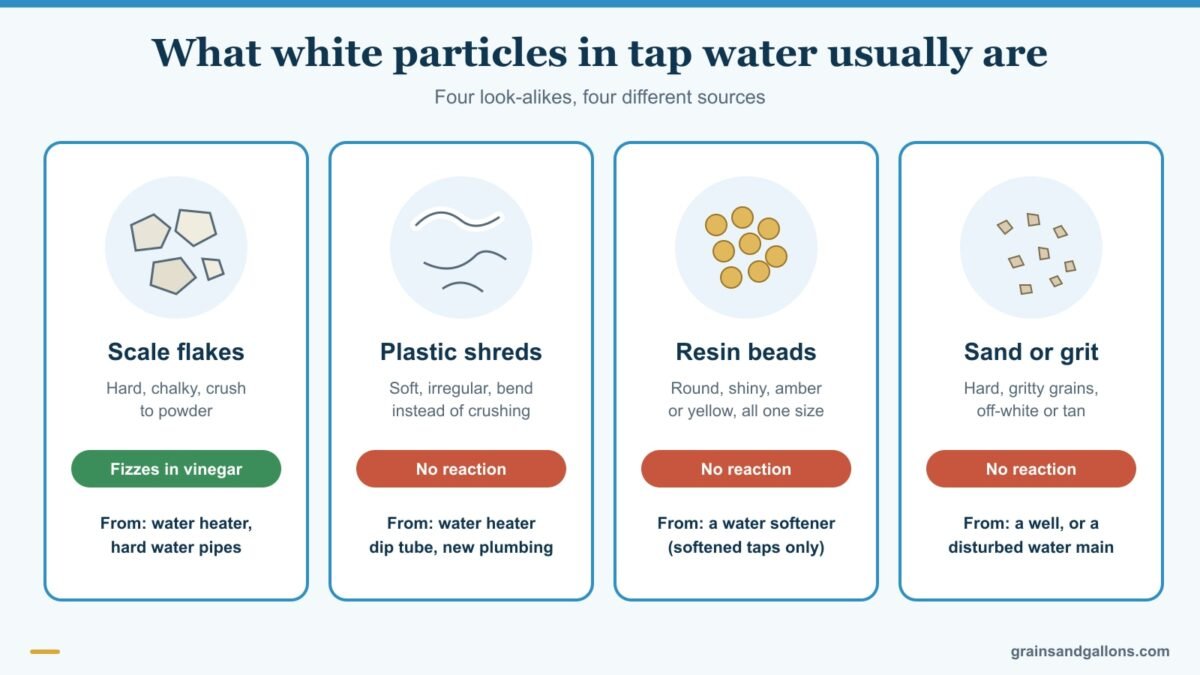
Quick Answer: White particles in tap water are usually calcium carbonate scale shed by the water heater. Drop a few in white vinegar: if they fizz or dissolve within a few hours, it's scale, and flushing the heater plus cleaning the aerators fixes it. If they don't react and they're soft and plasticky, suspect a broken water heater dip tube. Small, round amber or yellow beads are water softener resin, and hard gritty grains are sand from a well or the water main.
You unscrewed a clogged aerator and found a little pile of white crumbs. Or there are white specks floating in a glass, or white bits in the bottom of the kettle. White particles in tap water come from several very different sources that look almost identical at that size, and each one has a different fix. Instead of guessing, spend ten minutes identifying them.
In this guide
- Catch a sample from the aerator first
- Sort white particles in tap water with a vinegar test
- Why scale flakes come from the hot side
- Soft plastic shreds mean a failing dip tube
- Round amber beads: resin escaping the softener
- Gritty grains: sand from a well or the main
- Is it safe to drink?
- FAQ
- Identify the white particles in tap water, then fix the source
Catch a sample from the aerator first
Unscrew the aerator from the worst faucet, usually the kitchen, and tap the debris onto a white saucer. If the aerator is clean, run the hot tap into a clear glass for a few seconds, let it settle, and pour off the top.
Before you test anything, note two clues:
- Hot only, cold only, or both? Particles mostly on the hot side point to the water heater.
- Softened taps only, or everywhere? Debris that only shows up at softened faucets points to the softener. An outdoor spigot that bypasses the softener makes a handy comparison.
Sort white particles in tap water with a vinegar test
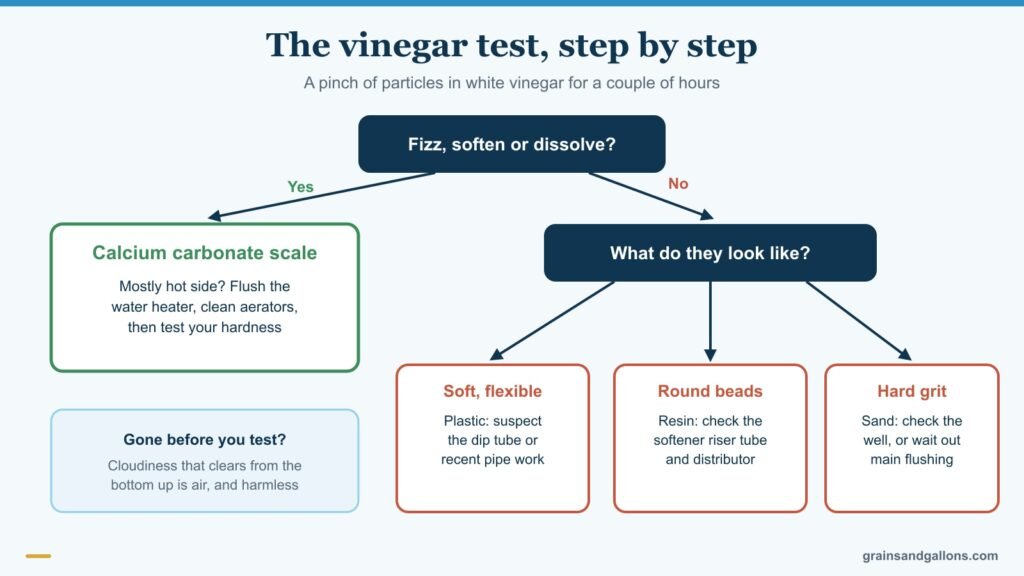
Put a pinch of the particles in a few tablespoons of white vinegar and leave it for a couple of hours. Two quick extra checks help: scale is brittle and crushes to powder between your fingers, while dip tube plastic bends instead of crumbling.
| What you see | What it probably is | Where it's coming from |
|---|---|---|
| Fizzes, softens, dissolves | Calcium carbonate scale | Water heater, or hard water pipes and fixtures |
| No change. Flakes are soft, irregular, a bit flexible | Plastic | Water heater dip tube, or shavings from recent plumbing work |
| No change. Hard, perfectly round beads, amber, yellow or off-white | Ion exchange resin | Your water softener |
| No change. Hard, gritty, sand-like grains | Sand or silica | Well, or sediment from the main after work on the street |
| Disappears on its own before you even test | Air bubbles (cloudy water clearing from the bottom up) | Dissolved air, harmless |
Why scale flakes come from the hot side
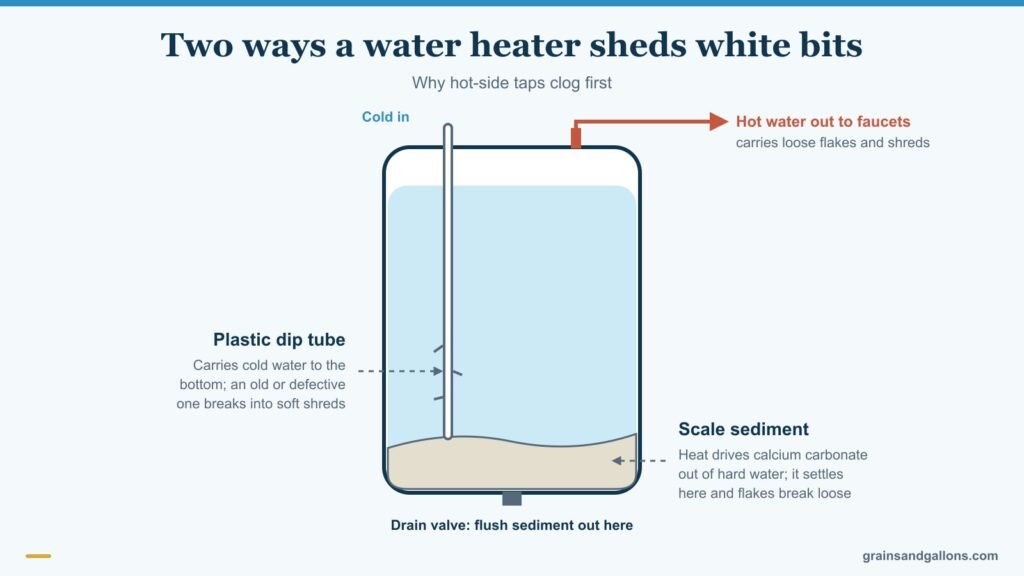
Scale is by far the most common answer. Heating hard water drives calcium carbonate out of solution, so it settles in the bottom of the water heater, and flakes break loose and travel to the faucets. The Water Quality Association notes that dissolved calcium and magnesium are responsible for most scaling in pipes and water heaters. Our explainer on why hot water causes more scale covers the chemistry.
- Flush the water heater. Turn off the power, or set the gas control to "pilot" or "vacation." Close the cold supply, attach a hose to the drain valve, and drain until the water runs clear. A New York State maintenance checklist for electric water heaters lists exactly this as a yearly task. Follow your heater's manual, and remember the water is scalding.
- Clean the aerators. Soak them in vinegar, scrub and reinstall. Our guide to scale on faucet aerators shows how to get stubborn ones apart.
- Deal with the hardness. A water hardness test kit tells you in minutes how hard your water is. Flakes at the tap usually mean the heater has been collecting deposits for years.
If you already have a softener and still get scale, test the hot and cold water at a softened tap. Fresh scale shouldn't form if it's working, but old scale in the heater can keep shedding for a while after the softener goes in.
Flakes in the kettle and in ice cubes
Crusty white bits in a kettle and flakes floating in melted ice are the same scale, just formed in a different place. See our guides to limescale in kettles, coffee makers and irons and flakes in melted ice cubes.
Soft plastic shreds mean a failing dip tube
Soft, white, irregular plastic flakes that clog aerators, mostly on the hot side, are the classic sign of a disintegrating dip tube. That's the plastic tube that carries incoming cold water to the bottom of a tank water heater. Many heaters built in the mid-1990s got defective dip tubes that crumbled, but any dip tube can crack or degrade with age. Dip tube plastic also tends to float, while scale sinks.
A plumber can pull and inspect the dip tube, and replacing it is a modest job on most heaters. Then flush the tank and every aerator. If the heater is near the end of its life anyway, replacing the whole unit may make more sense.
If the plastic appeared right after plumbing work, it may just be PEX or PVC shavings or bits of thread tape. Run each faucet with the aerator off and it usually clears.
Round amber beads: resin escaping the softener
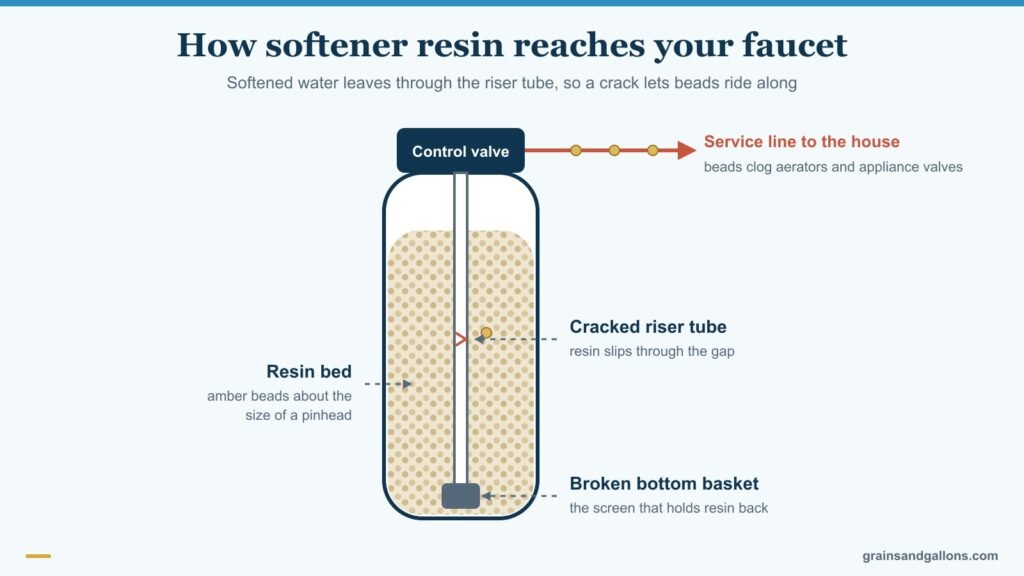
Ion exchange resin looks like tiny, uniform, shiny beads, a little smaller than a pinhead, usually amber or yellow. Finding them at the tap means something inside the softener is letting resin into the service line, typically a cracked riser (distributor) tube or a broken bottom basket, occasionally a damaged valve part. You'll only see them at softened taps.
Resin beads aren't toxic, but you don't want them in faucets, toilets and appliance valves. Put the softener in bypass if there are a lot of them, and see our guide on a broken riser tube for the symptoms and repair. Once it's fixed, clean every aerator and flush the lines.
Gritty grains: sand from a well or the main

Hard grains that don't react to vinegar, off-white or tan, are usually sand or silt. On a well, it can mean the pump is set too low, a well screen is failing, or the well is being pumped harder than it can supply. On city water, it's often stirred-up sediment after a main break or hydrant flushing, and it should clear in a day or two.
For a well, a spin-down sediment filter at the start of the system catches sand before it reaches the softener, the water heater and your faucets, and our page on a sediment prefilter before a softener explains where it goes. If the amount of sand suddenly jumps, call a well contractor, since that can mean a pump or casing problem.
Is it safe to drink?

Scale, dip tube plastic and resin beads aren't considered acute health hazards; they're a nuisance for faucets and appliances. Unknown particles are different. If you see particles you can't identify, especially with a new color, taste or smell, or right after a flood, well work or a nearby main break, drink bottled water until the water is tested. Well owners are responsible for their own testing; the EPA recommends testing a private well every year and after any change in taste, odor or appearance. City customers can call the utility, which can tell you about main work or flushing in your area.
FAQ
Are white particles in tap water harmful?
Usually not. The most common white particles are calcium carbonate scale, which is the same mineral that makes water hard. Plastic from a dip tube and softener resin aren't acute hazards either, but they should be fixed. Get the water tested if the particles come with a new taste, odor or color.
Why do I only see white flakes in hot water?
Because the water heater is the source. Heat makes calcium carbonate drop out of hard water, so scale builds up in the tank and breaks loose. A failing plastic dip tube also only affects the hot side. Cold-only particles point to the supply, the softener or the pipes instead.
How do I tell scale from dip tube plastic?
Put some in white vinegar. Scale fizzes and dissolves within a few hours and crushes to powder between your fingers. Dip tube plastic doesn't react, bends rather than crumbles, and tends to float.
Can a water softener cause white particles?
Yes, in two ways. Broken internals can release small round resin beads at softened taps. And a softener installed after years of hard water won't stop old scale that's already in the water heater from flaking off until the tank is flushed.
How often should I flush my water heater to stop white flakes?
Once a year is the usual maintenance interval for a tank heater, and more often with very hard water. Check your heater's manual for its specific procedure.
Identify the white particles in tap water, then fix the source
Cleaning aerators only treats the symptom. Ten minutes with a saucer and some vinegar tells you whether the white particles in tap water are scale, plastic, resin or sand, and that points straight at the water heater, the softener or the well. Flush or repair the source, then clean the aerators once more and the problem stays gone.