

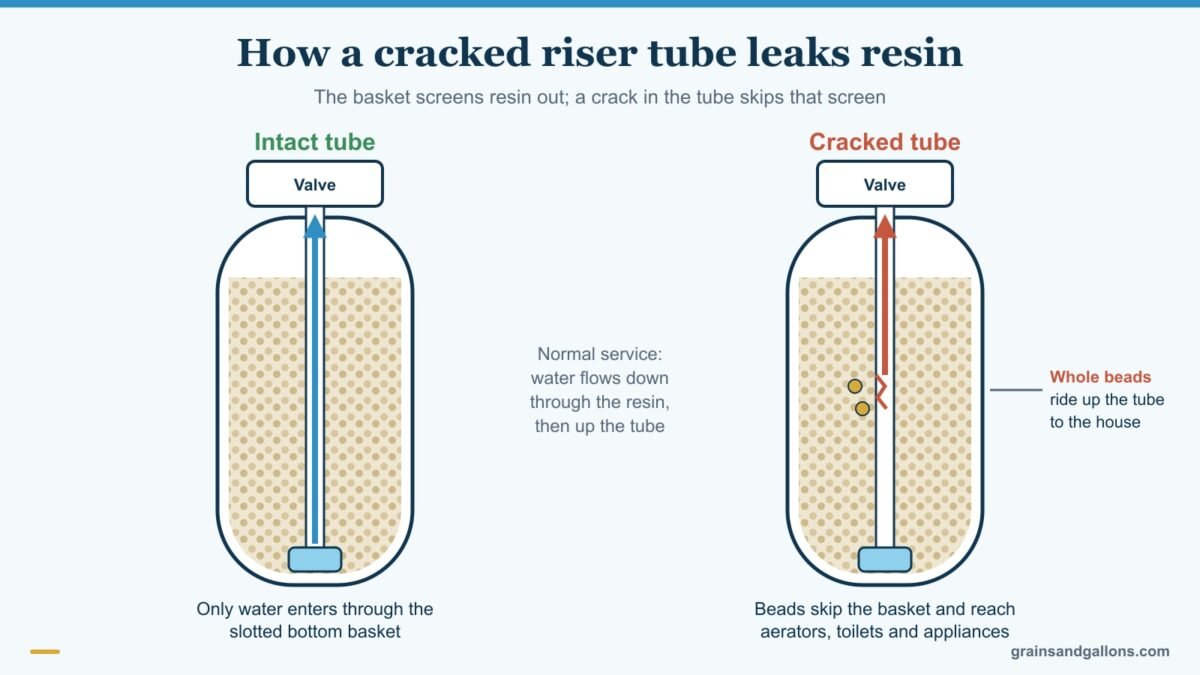
Quick Answer: A water softener riser tube broken anywhere along its length shows up as whole, round amber resin beads in faucet aerators, toilet tanks or appliance screens. Put the softener in bypass right away so no more beads reach your plumbing. Then pull the valve, check the tube, its O-ring and the bottom basket, and fit a new tube cut to your valve's specified height. Lube the O-rings with a silicone grease such as Molykote 111, never petroleum jelly.
Disclosure: As an Amazon Associate, Grains & Gallons earns from qualifying purchases.
A cracked riser is one of the few softener failures that spreads into the rest of the house. The riser, also called the distributor tube, is the plastic pipe down the center of the resin tank. In a typical downflow softener, water enters at the top, flows down through the resin, enters the slotted basket at the bottom and travels back up the riser to the valve and your pipes. The basket slots are narrow enough to hold resin back. The tube itself has no slots, so a crack lets beads skip the basket and head straight for your fixtures.
In this guide
Water softener riser tube broken? Confirm it before you drain the tank
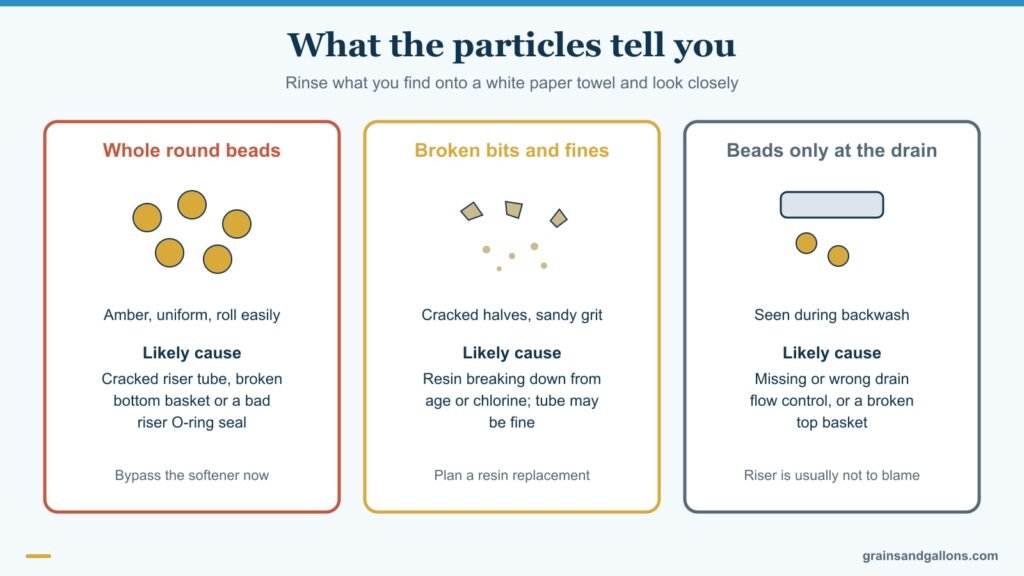
Draining a tank is a messy afternoon, so make sure the riser is the likely culprit first. Rinse whatever you found in an aerator or toilet tank onto a white paper towel. Whole, uniform, amber beads in your service water almost always mean a cracked riser, a broken bottom basket or a riser O-ring that isn't sealing. Irregular broken pieces and sandy grit are a different problem: the resin itself is breaking down, covered in our guide to cracked softener resin.
| What you're seeing | Riser tube broken? | Other likely causes |
|---|---|---|
| Round amber beads in aerators, toilet tanks or appliance screens | Very likely, or a broken bottom basket | Few others. Whole beads in service water point to the riser, basket or riser O-ring. |
| Beads in the drain line during backwash only | Unlikely | Missing or wrong drain flow control, broken top basket, overfilled tank |
| Hard water, capacity seems to drop fast | Possible, since water can bypass the resin | Brine draw problems, fouled resin, wrong settings |
| Pressure drop or sputtering at fixtures | Possible, from beads lodging in screens and the valve | Clogged prefilter, mushy resin |
| Water leaking to drain or valve not holding position | Possible, from beads scoring the piston and seals | Worn seals and spacers |
| Riser sits loose or lifts out with the valve | Yes, or it was cut too short |
The Fleck 5600SXT service manual lists "leak at distributor tube" as a cause of hard water and tells you to make sure the tube isn't cracked and to check the O-ring and tube pilot. If beads only appear at the drain, see resin beads in the softener drain line instead.
Four places resin slips past, and why tubes crack
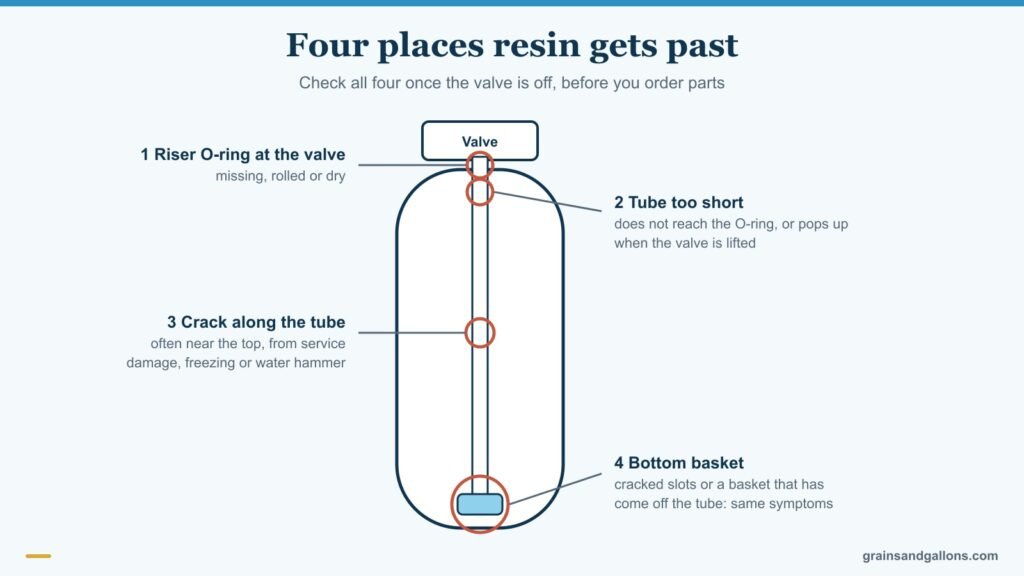
When the valve is off, check all four of these. Any one of them produces the same symptoms.
- The riser O-ring. The tube seals into the bottom of the valve with an O-ring. If it's missing, rolled or dry, beads leak past even with a perfect tube.
- Tube length. A tube cut too short doesn't reach the O-ring, so water and beads bypass the seal at the top. A tube that's too long can stop the valve from threading down fully.
- A crack in the tube. Run your fingers along the full length and flex it gently. Cracks often start near the top.
- The bottom basket. Cracked slots, or a basket that has come off the tube, let beads straight in. See broken bottom distributor basket for that repair.
Why the plastic fails in the first place:
- Age. Years under pressure make the tube more brittle.
- Freezing. Ice in an unheated garage or crawl space can split both the tube and the basket.
- Pressure shocks. Water hammer flexes the tube at the valve connection. If pipes bang when valves close, read water hammer after a water softener. The Fleck manual says water pressure must not exceed 125 psi; if yours runs high, a pressure regulator protects the softener and everything else.
- Service damage. Lifting a valve off at an angle, or dropping it back onto an off-center tube, can snap the top.
Replace the riser tube in nine steps

Bypass the softener first. Every gallon that runs through carries more beads into your pipes, water heater and appliances. Clean fixture screens after the repair, not before.
Gather parts. You need a riser tube of the right diameter for your valve, a new bottom basket if it's part of the same assembly or looks worn, a new riser O-ring and silicone grease. Clack's WS1 manual, for example, lists a 1.05-inch OD distributor tube and a 2.5-inch tank thread connection. Check your own valve's manual or take the old parts to a supplier. If the resin is old, mushy or fouled, replace it now too; our guide to the best replacement softener resin helps you size it.
- Shut down and relieve pressure. Put the softener in bypass, unplug it and open a softened cold tap until flow stops. Disconnect the brine and drain lines and loosen the plumbing so the valve can come off.
- Remove the valve. Unscrew it counterclockwise and lift it straight up so you don't snap the tube. A strap wrench on the tank collar helps if it's tight.
- Empty the tank. Scoop or siphon out the water and resin. If you're reusing the resin, keep it wet in a clean bucket. Keep any gravel underbed separate. How to load resin into a mineral tank covers getting the old bed out cleanly.
- Pull the old tube and basket. Note how the basket attaches (threaded, snapped on or one piece with the tube) and find the crack.
- Cut the new tube to length. The Clack WS1 service manual says the tube can be cut from 1/2 inch above to 1/2 inch below the top of the tank thread. The Fleck 5600SXT manual tells you to use the cutting height on the spec sheet. Cut square and smooth the edge so it won't tear the O-ring.
- Set the tube. Attach the basket and stand the tube in the center of the tank, resting on the bottom. Tape or cap the open top so no resin falls in.
- Refill. Add a few inches of water first so the media settles gently, then gravel (if used) and resin, keeping the tube centered. Leave the recommended empty space at the top, then remove the tape.
- Lube and reinstall the valve. Fleck says to lubricate the distributor and tank O-rings with silicone lubricant only. Clack warns that hydrocarbon lubricants such as petroleum jelly damage its O-ring components. Lower the valve straight down over the tube and thread it on as your manual directs.
- Start up slowly. Reconnect everything, ease the bypass toward service so the tank fills gradually, bleed air at a cold tap and run a full manual regeneration. Follow your own valve's start-up steps.
If the valve has been chewing on beads, its seals and spacers may be scored. Leaks to drain in service or a valve that won't hold position are signs of that; servicing a water softener control valve shows the fix.
Clean every fixture the beads reached

Beads that got past the softener stay in your plumbing until you remove them. Work through the house in order, cold side first:
- Faucets and showers. Unscrew every aerator and showerhead screen, then run each tap with the aerator off to flush loose beads.
- Toilets. Check the fill valve screen. A toilet that keeps running often has a bead stuck under the valve seal.
- Appliances. Clean the washer's inlet hose screens, the dishwasher inlet, and the fridge or ice maker supply.
- Water heater. Beads settle at the bottom of a tank heater. Turn it off following the maker's steps for gas or electric, drain and flush it from the drain valve, refill completely before turning it back on, then flush the hot lines and aerators again.
- Recheck in a week. A few stragglers are normal. If beads keep coming, the repair didn't seal, so recheck the O-ring, tube length and basket.
Fix the tube or replace the softener?
A riser tube and basket are inexpensive parts, and on most residential tanks the job takes an afternoon. Replacing the whole softener makes more sense when several things are failing at once: old or fouled resin, a valve with worn seals and hard-to-find parts, or a tank that's leaking. If the valve is the weak link, compare the best replacement control valves before buying a whole new system. Either way, the plumbing cleanup is the same.
Bypass now, then the repair is simple
A water softener riser tube broken at the top, along its length or at the basket all comes down to the same fix: stop the flow, pull the valve, inspect four parts and replace what failed. The tube itself is cheap. The real work is getting every bead out of your aerators, toilets, appliances and water heater, so bypass the softener the moment you spot beads and the cleanup stays small.
FAQ
How do I know if my water softener riser tube is broken?
Whole, round amber resin beads in faucet aerators, toilet tanks or appliance screens are the clearest sign. You may also see pressure loss, hard water or a valve that leaks to drain. Confirm by removing the valve and checking the tube, its O-ring and the bottom basket.
Can I still use water if softener resin got into my pipes?
Put the softener in bypass so you have unsoftened water while you fix it. Resin beads are small plastic (polystyrene) spheres and mostly a nuisance, but they clog aerators, toilet fill valves and appliance inlets, so clean those screens after the repair.
How do I get softener resin out of my water heater?
Turn the heater off following its gas or electric shutdown steps, attach a hose to the drain valve and flush until the water runs clear of beads. Refill the tank completely before restoring power or gas, then flush the hot water lines and clean the aerators again.
What size riser tube does my water softener need?
It depends on the valve. A Clack WS1 uses a 1.05-inch OD tube, while larger valves such as the WS1.25 use bigger tubes. Length depends on your tank height and the valve's cutting spec, so check the manual or measure the old tube before cutting.
Can a riser tube be glued or taped instead of replaced?
No. A patched tube under constant pressure and flow won't stay sealed, and any gap lets beads back into your plumbing. A new tube costs far less than the cleanup from a failed repair.