


Quick Answer: The reason why hot water causes more scale is simple chemistry. Most hardness in tap water is calcium bicarbonate dissolved in water, and heat upsets that balance two ways: warm water holds less carbon dioxide, and calcium carbonate is one of the few minerals that gets less soluble as temperature rises. So when water heats up, calcium drops out as solid calcium carbonate, the chalky scale on heating elements, kettle bottoms and tankless heat exchangers. The hotter the surface, the faster it builds. Lowering hardness before the water is heated is the only fix that stops it at the source.
Your cold kitchen tap has a little white crust on the aerator. Your kettle has a thick, rocky shell. Same water, same house. The difference is temperature, and it explains why hot water causes more scale.
In this guide
- Why hot water causes more scale than cold
- Scale starts around 95°F and speeds up as the water gets hotter
- Why the scale sticks to the hottest surface
- A rough sense of scale (with real numbers)
- "Temporary" vs "permanent" hardness, and why boiling isn't a cure
- What actually reduces scale in hot water
- Why your cold faucets still get crust
- FAQ
- Soften the water before it's heated
Why hot water causes more scale than cold
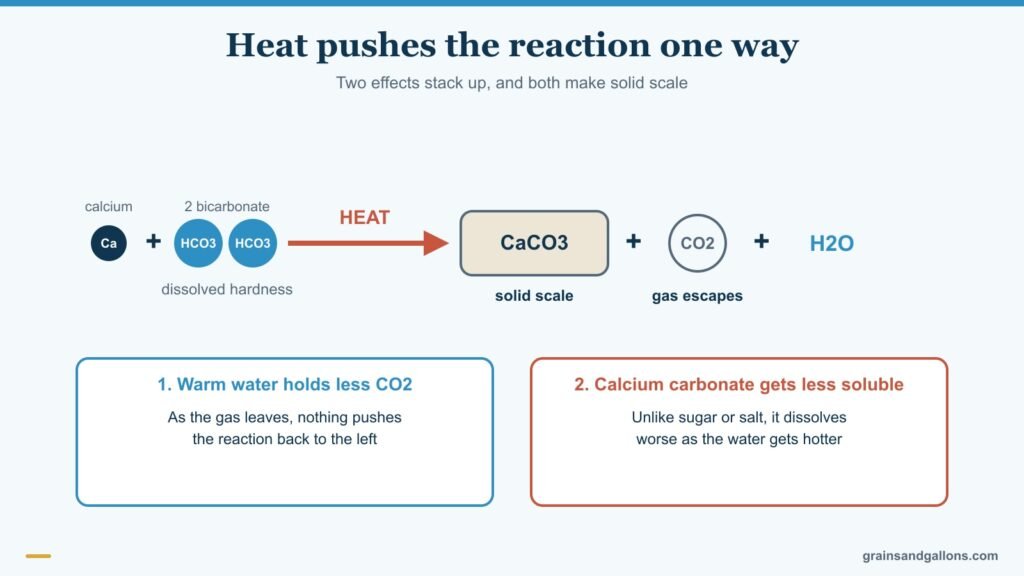
Hard water doesn't carry little flakes of limestone. The calcium is fully dissolved, held in solution mostly as calcium and bicarbonate ions. That pairing is stable only as long as there's enough dissolved carbon dioxide in the water to keep it that way.
Here's the reaction, written left to right in the direction heat pushes it:
Ca²⁺ + 2 HCO₃⁻ → CaCO₃ (solid scale) + CO₂ (gas) + H₂O
Two things happen when you heat water:
- CO₂ escapes. Gases are less soluble in warm water (that's why a warm soda goes flat faster). As CO₂ leaves, the reaction has nothing holding it back, so it keeps sliding to the right and making solid calcium carbonate.
- Calcium carbonate itself becomes less soluble. Sugar and table salt dissolve better in hot water. Calcium carbonate does the opposite. Chemists call this retrograde, or inverse, solubility. Hot water simply can't hold as much of it.
Both effects push the same way, which is why heat is so good at making scale.
Scale starts around 95°F and speeds up as the water gets hotter

There's no single switch-on point, but building engineers use a practical rule. A CIBSE Journal training module on limescale in hot-water systems notes that calcium carbonate precipitation starts at roughly 35 to 40°C (about 95 to 104°F) and gets progressively worse as temperatures rise.
That has a practical upshot for the thermostat. A heater set hotter tends to scale faster. University of Florida extension guidance on energy-efficient water heaters calls 120°F the optimum setting for both efficiency and function, and notes that higher temperatures raise energy costs and scalding risk. That setting also takes some pressure off scaling compared with running much hotter. Check your heater's manual before changing it.
Turning the thermostat down slows scale. It doesn't stop it. The calcium is still there, and anything above that 95°F-ish threshold still pushes it out of solution at hot surfaces.
Why the scale sticks to the hottest surface

Scale doesn't form evenly throughout a tank of hot water. It forms fastest wherever the water is hottest, and that's right at the metal doing the heating: the electric element in a tank heater, the bottom of a gas tank, the narrow heat-exchanger passages in a tankless unit, the base plate of a kettle.
Crystals that form there seed more crystals, so buildup snowballs. That explains a few things you may have noticed:
- Electric water heater elements grow a crust and can fail early, because the scale insulates the element and it runs hotter than designed.
- Tank heaters collect loose flakes in the bottom that rattle, pop or rumble when the burner fires.
- Tankless heaters are especially touchy. Their passages are small and the water is heated very fast, so a modest layer of scale can restrict flow and trigger error codes. Our article on scale in a tankless water heater covers the warning signs and flushing.
- Kettles and coffee makers scale quickly because they boil the same small volume of water over and over, and every boil drops a little more mineral. Our guide to limescale in kettles, coffee makers and irons covers cleaning them.
A rough sense of scale (with real numbers)

Say your water is 15 grains per gallon, which is about 257 mg/L as calcium carbonate. A household that runs 50 gallons of hot water a day sends:
- 15 grains × 50 gallons = 750 grains of hardness a day
- 750 grains × 64.8 mg per grain ≈ 48.6 grams a day
- ≈ 17.7 kg, or about 39 pounds, of hardness through the water heater in a year
Not all of that turns into scale; much of it goes down the drain. But even a modest fraction is a lot of rock on one element or heat exchanger, which is why a heater on very hard water can be noisy and sluggish within a few years.
"Temporary" vs "permanent" hardness, and why boiling isn't a cure

The bicarbonate kind of hardness described above is sometimes called temporary hardness, because heat can force it out as scale. Hardness tied to sulfate or chloride (for example, from gypsum in the ground) is called permanent hardness, because boiling doesn't remove it.
That naming trips people up. "Temporary" doesn't mean harmless. It's the type that coats your appliances. And boiling water to "soften" it only works by turning dissolved calcium into the crust you're trying to avoid, so you've just moved the problem into the pot. We go deeper on that in does boiling or filtering soften water.
What actually reduces scale in hot water
Since heat is the trigger and calcium is the fuel, you have three ways to approach it:
| Approach | What it does | Where it fits |
|---|---|---|
| Ion-exchange water softener | Removes calcium and magnesium before the water reaches the heater | Whole-house fix for heaters, fixtures and appliances; the only option here that actually lowers hardness |
| Salt-free conditioner (TAC/NAC media) | Changes calcium into tiny crystals meant to stay suspended rather than stick | Some evidence of reducing scale on heating surfaces; hardness stays the same, and results vary with water chemistry |
| Descaling on a schedule | Dissolves scale after it forms, with an acid such as citric acid or vinegar | Kettles, coffee makers, tankless flushes; treats the symptom, not the cause |
If you're protecting a tankless heater in particular, our guide to the best water softeners for tankless water heaters lists systems sized for the flow rates those units need. If a softener isn't practical, read about salt-free conditioning for tankless heaters and boilers before buying, because manufacturer warranties sometimes have specific hardness limits or treatment requirements.
For small appliances, regular descaling is often enough. A citric-acid descaler works well on kettles; our roundup of the best kettle descalers compares the options.
Why your cold faucets still get crust

Scale on cold fixtures comes from a different route. When a drop of hard water sits on a faucet and evaporates, the water leaves and the minerals stay behind. That's evaporation, not heat-driven chemistry, so it shows up as thin white spots rather than thick rock. It's annoying but slow, and a soak in vinegar usually clears it; see our guide to scale on faucet aerators. Inside pipes and heaters, the hot-water reaction is what does the real damage.
FAQ
Does hot water cause limescale?
Hot water doesn't create the minerals, but it is what turns dissolved hardness into solid limescale. Heating drives off carbon dioxide and lowers how much calcium carbonate the water can hold, so the calcium drops out on the hottest surfaces. Cold hard water mostly leaves only thin spots where it evaporates.
At what temperature does limescale form?
Building-services guidance puts the practical start at about 35 to 40°C, roughly 95 to 104°F, with scaling getting worse as the water gets hotter. Water heaters, kettles and coffee makers all run well above that range.
Does lowering my water heater temperature reduce scale?
It slows it. Cooler water deposits scale more slowly, and 120°F is a common recommended setting for efficiency and scald safety. But the calcium is still in the water, so the heater will still scale over time unless the hardness itself is reduced.
Will a water softener stop scale in my water heater?
Yes, for new scale. An ion-exchange softener removes the calcium and magnesium before the water is heated, so there's little left to precipitate. It won't instantly dissolve heavy scale that's already there, so an old heater may still need flushing or descaling.
Soften the water before it's heated
That is why hot water causes more scale: heat strips out carbon dioxide and makes calcium carbonate less soluble, so the calcium crusts whatever surface is hottest. Turning the heater down to around 120°F slows the process, and descaling cleans up after it, but only removing hardness before the water reaches the heater stops scale at the source.