


Quick Answer: For limescale in kettles and drip coffee makers, citric acid is the easiest fix: about 1 to 2 tablespoons of food-grade powder such as Milliard Citric Acid per half-full kettle or per quart in the reservoir dissolves white scale without a vinegar smell. Steam irons are different: use the built-in self-clean or anti-calc function, and keep acids out of the tank unless your manual allows them. In hard water, descale kettles every few weeks.
Disclosure: As an Amazon Associate, Grains & Gallons earns from qualifying purchases.
Three appliances, one problem. Anything that heats water in a hard-water home ends up with chalky crust, and these three get hit hardest because they boil or steam water over and over. The cleanup is simple, but it isn't the same for all three, and the method that's perfect for a kettle can ruin an iron.
In this guide
- Why limescale in kettles builds up so fast
- Descale a kettle with citric acid, vinegar or lemon
- Drip and pod coffee makers need the acid run through them
- Steam irons: self-clean first, acids only if the manual says so
- Match the descaling schedule to your hardness
- Slow the buildup between cleanings
- FAQ
- Citric acid for the kettle, the manual for the iron
Why limescale in kettles builds up so fast

Limescale is mostly calcium carbonate, with some magnesium. Heat pushes it out of solution, so every boil leaves a thin layer on the floor and element. Why hot water causes more scale explains the chemistry. Penn State Extension's water softening guide rates water above 7 grains per gallon (gpg) as hard and above 10.5 gpg as very hard. At those levels a kettle can crust over within weeks.
Is it harmful? No. Penn State notes that calcium and magnesium have no adverse health effects, and Keurig's use and care guide calls scale "nontoxic." The problem is performance. Scale insulates the element, so boiling slows down, flakes float into your tea, and coffee makers lose heat and flow.
Descale a kettle with citric acid, vinegar or lemon
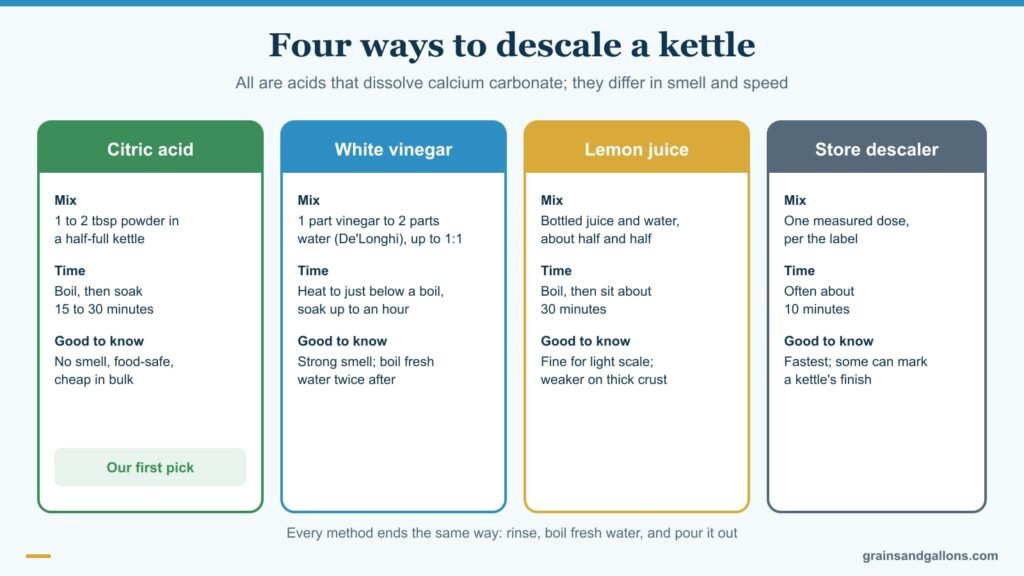
Citric acid (our first pick)
- Fill the kettle about halfway with water and bring it to a boil.
- Switch it off, unplug it and stir in 1 to 2 tablespoons of citric acid. Use the larger amount for thick crust.
- Let it sit 15 to 30 minutes. You'll see it fizz as the scale dissolves.
- Pour it out, rinse, and wipe loose scale with a soft cloth. Don't scrape the element with metal.
- Boil a kettle of fresh water and throw it away.
White vinegar. De'Longhi's kettle descaling advice uses one part white vinegar to two parts water. Heat it until just before it boils, switch off, and let it soak as long as the scale needs. Then boil and empty fresh water twice. Many people use a stronger 50/50 mix. Either works; your kitchen will just smell like pickles for a while.
Lemon juice. Bottled lemon juice mixed about half and half with water, boiled and left for 30 minutes, handles light scale. If the crust doesn't budge, use more lemon or switch to citric acid, which is the same acid in a stronger dose.
Store-bought descalers are measured doses of citric, sulfamic or lactic acid. They're the fastest, often working in about 10 minutes, but read the label. De'Longhi warns that some proprietary kettle descalers can damage a kettle's finish, and stronger products call for gloves. Our picks for the best kettle descalers compare the main types.
Drip and pod coffee makers need the acid run through them

Scale in a coffee maker builds where you can't see it: inside the heating tube. The signs are slower brewing, coffee that isn't as hot, louder gurgling, or a descale light.
Basic drip coffee maker
- Empty the carafe and the filter basket.
- Fill the reservoir with a 50/50 mix of white vinegar and water, or water plus 1 to 2 tablespoons of citric acid per quart.
- Start a brew cycle. Halfway through, switch off and let it sit 30 to 60 minutes.
- Finish the cycle and dump the solution.
- Run two or three full reservoirs of plain water to rinse.
Pod machines have their own procedure. Keurig's guide says to descale every 3 months, or sooner when the descale light comes on, and to use the full descale mode so the light resets. If yours won't clear, see the Keurig descale light that won't turn off.
Espresso machines are the cautious case. Many makers say not to use vinegar, and some void warranties for unapproved descalers, because boilers, seals and valves are more sensitive than a drip machine's parts. Use the product your manual names. The best coffee maker descalers notes which products suit espresso machines.
Steam irons: self-clean first, acids only if the manual says so

Irons are where people do the most damage trying to descale. The signs are white flakes or chalky water spitting from the soleplate, or steam that sputters and fades.
- Use the self-clean or anti-calc function. Most irons have a button or setting that flushes scale out of the steam chamber through the soleplate. Typically you fill the tank, heat the iron, hold it over a sink and press the button. Steps vary by model.
- Rinse or replace the anti-calc cartridge or valve if your iron has one.
- Don't pour vinegar or descaler into the tank unless your manual allows it. Some manuals permit a diluted descaler; others say to add nothing to the tank. Acid can damage internal parts and stain clothes.
- Check which water the manual wants. Some say plain tap water is fine, some suggest mixing tap with distilled water in very hard areas, and some advise against chemically softened water. These rules differ by brand.
Clean the soleplate when it's cool with a damp cloth and a little baking soda paste, and clear the steam holes with a cotton swab. Still spitting white after a self-clean? Steam iron spitting white flakes covers what to try next, and the best steam irons for hard water compares anti-calc designs.
Match the descaling schedule to your hardness

The chart gives starting points for daily kettle and coffee use and weekly ironing, using Penn State's hardness bands. Adjust based on the scale you actually see.
De'Longhi's own guidance fits this: descale monthly with particularly hard water and about every three months with very soft water. If you don't know your hardness, a test strip or your utility's annual water quality report will tell you.
Slow the buildup between cleanings
Empty the kettle after each use. Water left sitting keeps dropping scale, and reboiling it adds more. Boil only what you need.
Fill with filtered water. A filter made for hardness reduction cuts scale in kettles and coffee makers. Standard carbon pitchers mostly improve taste and chlorine and do little for hardness, so check the claims. Our guide to the best water filters for kettle scale separates the two.
Soften the house. If you're descaling every couple of weeks, your water heater and fixtures are getting the same treatment. Penn State notes softened water protects appliances and saves cleaning time. Kettles and coffee makers work fine on softened water. Irons are the one to double-check, since some manuals prefer you not use it.
Stay safe. Unplug before you open or empty anything, rinse well so no acid ends up in your next cup, never mix vinegar or any acid with bleach, and don't use bathroom limescale removers inside kitchen appliances.
FAQ
Is limescale in a kettle harmful to drink?
No. It's mostly calcium and magnesium carbonate, and Penn State Extension notes those minerals have no adverse health effects. Flakes are unpleasant and slow the kettle down, but they aren't toxic.
Is citric acid or vinegar better for descaling?
Both dissolve scale. Citric acid has no smell and rinses out easily, so it's the better choice for kettles and drip coffee makers. Vinegar works too but takes extra rinse cycles to clear the taste.
Can I put vinegar in my steam iron?
Only if your iron's manual allows it. Many irons are designed to be cleaned with their self-clean or anti-calc function, and acids in the tank can damage parts or stain clothes.
How do I know my coffee maker needs descaling?
Brewing slows down, the coffee isn't as hot, the machine gurgles more, or a descale light comes on. Keurig recommends descaling every 3 months even without those signs.
Does a water softener stop limescale in kettles?
Yes. A softener removes the calcium and magnesium that form scale, so kettles and coffee makers stay clean much longer. Check your iron's manual before using softened water in it.
Citric acid for the kettle, the manual for the iron
Limescale in kettles and drip coffee makers comes off easily with citric acid or vinegar, followed by a good rinse. Pod and espresso machines get the brand's own descale routine, and irons get their self-clean function rather than acid. Set a schedule by your water hardness, and if you're descaling every few weeks, treat the water itself.