

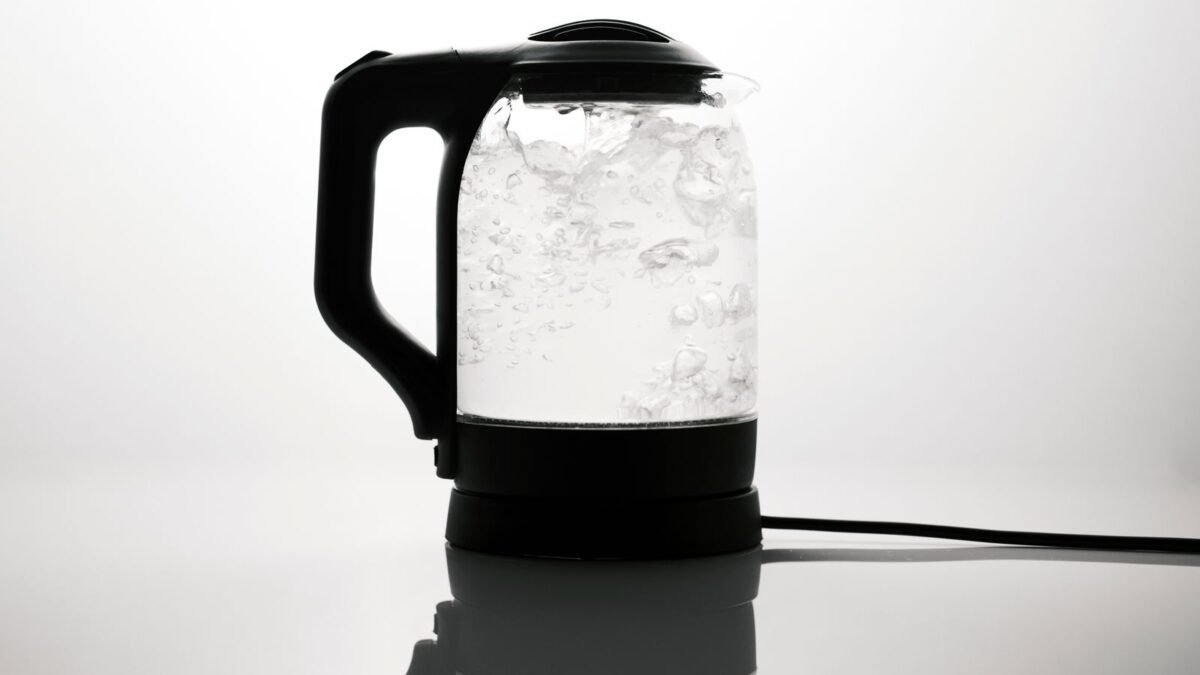
Quick Answer: To stop kettle scale, a filter has to remove calcium and magnesium. Standard carbon pitchers don't. The cheapest thing that actually works is the ZeroWater 10-cup pitcher, but on very hard water its filters run out quickly. If you boil water several times a day, a countertop RO unit like the Waterdrop C1S costs less to run over time and makes kettle scale basically go away. If you want to skip the kettle entirely, the Waterdrop WD-A2G dispenses RO water hot.
Disclosure: As an Amazon Associate, Grains & Gallons earns from qualifying purchases.
You can descale a kettle with citric acid in about ten minutes. If you're doing it every two weeks and the crust keeps coming back, the problem isn't the kettle. It's the water going into it, and the filter you're probably already using isn't built to change that.
In this guide
Why your current pitcher isn't helping
Most "water filter pitchers" use activated carbon. Carbon is excellent at chlorine taste and smell and decent at some metals, but calcium and magnesium are dissolved ions, and carbon doesn't hold onto them. So your tea tastes better, but the kettle still crusts over at the same rate.
Kettle scale is mostly calcium carbonate, and heat is what drives it out of the water. That's why the kettle, coffee maker and water heater scale up faster than your cold taps do. Our guide on why hot water causes more scale explains the chemistry in plain terms.
To stop it, you need one of two technologies:
- Ion exchange resin that grabs hardness. ZeroWater's 5-stage filters use ion exchange to strip out nearly all dissolved solids. It works, but the resin has a fixed capacity, so the harder your water, the fewer gallons each filter lasts.
- Reverse osmosis. A membrane rejects the vast majority of dissolved minerals. The filters last months instead of weeks, whatever your hardness.
(Boiling and pouring off doesn't work either. Does boiling or filtering soften water? covers that myth.)
Pick by how much water you boil
Before you look at products, be honest about volume:
| Your kettle habit | Water hardness | What makes sense |
|---|---|---|
| 2–4 cups a day, one person | Any | ZeroWater pitcher |
| A few full kettles a day, family | Under ~10 gpg | ZeroWater can work; RO is easier |
| A few full kettles a day, family | Over ~10 gpg | Countertop RO |
| You also want filtered water for coffee, cooking, ice | Any | Under-sink RO |
| You'd rather not own a kettle | Any | Hot-water RO dispenser |
If you don't know your hardness, test it before you buy. Testing water hardness at home takes five minutes with strips, and the number really does change which pick makes sense.
Only the ones that actually remove minerals
My shortlist rule was simple: if a product couldn't show it removes dissolved solids (ion exchange that targets TDS, or an RO membrane), it was out, however good it looks. After that I looked at certifications, filter life, how much water each one wastes, and how annoying daily use is. Every listing below was confirmed on Amazon.
ZeroWater 10-Cup Ready-Pour Pitcher: best low-cost fix
The only pitcher on this list, and the only common pitcher brand built specifically to bring TDS down toward zero. ZeroWater's 5-stage filter uses ion exchange, and the brand says it removes 99.9% of total dissolved solids. The 10-cup Ready-Pour model's listing says it's certified to reduce lead, chromium and PFOA/PFOS. A TDS meter comes in the box. Swap the filter when the meter reads 006 on filtered water, which is ZeroWater's replacement point.
The catch on hard water: ion exchange resin has a fixed capacity. A filter that lasts weeks on soft water might last days on 15 gpg well water. Think of it as roughly proportional. Triple the hardness and you get about a third of the gallons. That's why it's my "low-cost fix" pick and not my overall pick. The pitcher is cheap, but on very hard water the replacement filters add up quickly.
Good fit: one or two people, moderate hardness, mostly tea and pour-over coffee.
Waterdrop C1S Countertop RO: best overall for daily tea and coffee drinkers
What you get (per listing): 6-stage countertop reverse osmosis, a 3:1 pure-to-drain ratio, a touch screen that shows TDS and filter life, five dispense volumes, a detachable 34 oz pure-water tank and no installation.
This is the sweet spot for most kettle-scale sufferers. You fill the tank from the tap, the unit runs the water through an RO membrane, and you draw finished water from the front. No plumbing, no drilling, and a composite filter Waterdrop rates for 12 months instead of gallons-per-hardness. A 3:1 ratio is efficient for RO. For every four gallons that go in, about three come out as drinking water. The live TDS readout is handy here, since it shows you at a glance how much mineral is left to scale your kettle.
Downsides: it takes up real counter space, needs an outlet, and you have to empty the wastewater tank. It only makes room-temperature water, and Waterdrop says not to use it with well water. If you live alone and drink one cup a day, it's overkill. Get the pitcher.
Bluevua RO100ROPOT (UV): best glass-carafe RO
Same idea as the Waterdrop C1S, but the finished water goes into a glass carafe rather than sitting in a plastic tank. That's a small thing that tea people seem to care about, and it's easier to pour straight into the kettle. Bluevua lists NSF/ANSI 58 certification and remineralization on its site, and the "UV" in this model's name refers to its UV stage.
Worth knowing: remineralization puts a small amount of minerals back in for taste. That's far less than your tap water carries, so your kettle will still be dramatically cleaner, but if you want the absolute minimum scale, pick a model or filter option without remineralization.
Downside: carafe-based systems make water in batches. If four people want tea at once, someone is waiting.
Waterdrop WD-A2G Hot and Cold RO: best if you'd rather ditch the kettle
The most direct answer to kettle scale is not owning a kettle. The WD-A2G is a plug-in countertop RO unit that heats water to 203°F and cools it to 59°F, per Waterdrop, with a Favorite mode that remembers your preferred temperature and volume. The listing describes 6-stage filtration with a 0.0001-micron RO membrane, a 3:1 pure-to-drain ratio and an included 40 oz portable pitcher. You fill the feed tank and plug it in, so there's no plumbing.
Worth knowing: it adds a small amount of minerals back after the RO stage (Waterdrop names strontium and silicic acid). That's a tiny fraction of what hard tap water carries, so the hot water inside stays far cleaner than a kettle on tap water would.
Why it's not my #1: it's a big appliance that needs an outlet, it costs a lot more than the C1S, and it's overkill if you already have a kettle you like.
Good fit: tea drinkers who also want chilled water, and people tired of descaling anything.
Waterdrop G3P600 Tankless Under-Sink RO: best permanent fix
If you're going to filter for the kettle, you'll probably end up wanting the same water for coffee, rice, soup and ice. An under-sink system covers all of it from a dedicated faucet. The G3P600 is a tankless unit rated for 600 GPD, with a 2:1 pure-to-drain ratio, 8 stages, and NSF/ANSI 42, 58 and 372 certification according to Waterdrop. Filter life is 6 months for the composite filter, 12 months for the carbon block and 24 months for the RO membrane. The faucet shows TDS and filter status.
Downsides: you need to drill or use an existing sink hole for the faucet, the unit needs power, and on very hard water without a softener, expect the membrane to wear out sooner than the 24-month rating. Renters should stick with the countertop picks.
Yes, three of the five are Waterdrop. That's not a sponsorship. Waterdrop simply happens to sell a countertop RO, a hot-water RO and a well-documented tankless unit with published specs, which made them easy to verify.
The same water fixes your coffee maker and iron too
Once you have mineral-free water on hand, use it everywhere heat meets water in your kitchen and laundry room:
- Drip coffee makers and espresso machines. The heating element scales just like a kettle, and a scaled element brews cooler, weaker coffee. Some espresso machine makers advise against completely demineralized water for certain machines, so check your manual. If it calls for some minerals, blend RO water with a little tap water.
- Steam irons and garment steamers. Scale flakes are what leave white specks on dark clothes. Many iron makers specifically allow distilled or demineralized water, but again, check the manual.
- Humidifiers. Ultrasonic humidifiers turn hardness into white dust on furniture. RO or ZeroWater water nearly eliminates it.
Running cost, roughly
This is where the picks really separate. A ZeroWater pitcher costs very little up front, but on hard water you're buying filters often, because the hardness itself is what uses them up. A countertop RO unit costs more on day one, but its filters are rated in months, whatever your hardness. As a rule of thumb, the harder your water and the more you boil, the sooner RO pays for itself. Light users on moderately hard water usually never get there and should stay with the pitcher.
A two-week kettle test you can run yourself
You don't need to take my word for any of this:
- Descale the kettle completely (citric acid, then rinse well).
- Use only filtered water for two weeks.
- Look inside. With ZeroWater or RO you should see little or no new white crust, maybe a faint film if the filter is near the end of its life.
- If you see crust coming back, test the filtered water with a TDS meter. Rising numbers mean the filter is spent.
For a deeper walk-through of cleaning what's already built up, see limescale in kettles, coffee makers and irons.
Short answers to common questions
Will a whole-house softener stop kettle scale? Yes, softened water won't leave calcium scale. Many people still prefer RO for drinking water because softened water carries extra sodium.
Does a "limescale" filter cartridge for kettles exist in the US? Some brands sell them abroad. In the US, the options with clear performance claims are ion exchange pitchers like ZeroWater and RO systems.
Is RO water bad for tea? Plenty of tea drinkers prefer it, because without minerals you taste the tea, not the tap. If it tastes flat to you, a remineralizing model (like the Bluevua) splits the difference.