

Quick Answer: To fix a hard water clogged showerhead, fill a plastic bag with white vinegar (a 6% cleaning vinegar like Aunt Fannie's Extra Strength Cleaning Vinegar works a little faster), pull it up so the face is submerged, and secure it with a rubber band. Leave it 30 minutes to overnight, rub the nozzles and run hot water. If the spray is even but weak, take the head off and clean the screen inside the inlet. Check your finish first: skip long acid soaks on brass, bronze, matte black and gold-tone heads.
Disclosure: As an Amazon Associate, Grains & Gallons earns from qualifying purchases.
Half the nozzles spray sideways, a few don't spray at all, and the shower that used to feel like a shower now feels like a leaky garden hose. That's limescale. Hot water drops calcium carbonate faster than cold, and a showerhead's tiny nozzles are where it piles up first (our explainer on why hot water causes more scale covers the chemistry). Here's how to find the clog, clear it, and slow it down.
In this guide
- Signs of a hard water clogged showerhead
- Check the finish before any acid
- Method 1: Soak it in place without removing it
- Method 2: Remove it and clean the inlet screen
- When vinegar isn't enough
- Clean it or replace it?
- How often to descale, and how to keep it clear
- FAQ
- Soak it monthly, soften the water for good
Signs of a hard water clogged showerhead
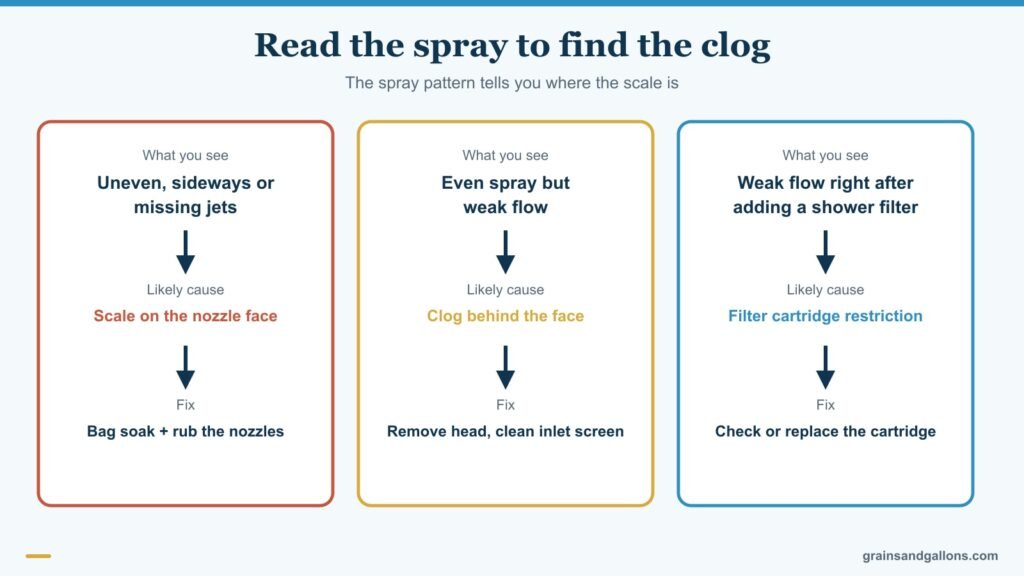
The spray pattern tells you where to look:
- Uneven, sideways or missing jets mean scale on the nozzle face. A bag soak usually fixes it.
- An even spray that's just weak points to a clog behind the face, usually the inlet screen.
- White crust around the nozzles or rim confirms hard water is the cause.
- Weak flow that started right after adding a shower filter is more likely the filter cartridge; see low pressure after installing a shower filter.
Don't expect a fire-hose blast even when it's clean. Standard showerheads flow at up to 2.5 gallons per minute, and EPA WaterSense models use no more than 2.0 gpm, so a new low-flow head can feel gentler by design.
Check the finish before any acid

Skip this and a five-minute clean can turn into a new showerhead.
| Finish | Vinegar soak | Notes |
|---|---|---|
| Polished chrome | Fine, up to overnight | Rinse well; wipe dry |
| Plastic / ABS (often chrome-plated) | Fine | Cheap plastic heads may be easier to replace if badly scaled |
| Brushed nickel / stainless | Usually fine, keep it shorter | Check the maker's care guide |
| Oil-rubbed bronze, matte black, brass, gold tones | Avoid long acid soaks | Many makers recommend only mild soap and water; acids can dull or strip the finish |
Not sure what you've got? Look up the brand's care instructions or test vinegar on the back of the head for 10 minutes. Wear gloves with any acid cleaner and keep the bathroom ventilated.
Method 1: Soak it in place without removing it

This works for most clogs and is the safe choice if the head is stuck on the arm.
- Bag it. Fill a quart bag about halfway with white vinegar. Slide it up until the nozzle face sits fully in the liquid and secure it around the arm with a rubber band or zip tie.
- Wait. About 30 minutes handles light or routine scale. Heavy crust can take 4 to 8 hours or overnight. Fizzing means the vinegar is dissolving calcium carbonate.
- Rub the nozzles. Flexible rubber nozzles push scale out as you run your thumb across them. Use a toothbrush on hard faces.
- Flush. Run the shower hot for a minute or two. Expect a burst of white grit, then a stronger spray.
- Wipe dry so spots don't form right away.
Method 2: Remove it and clean the inlet screen

If the spray is even but weak, the clog is probably behind the face.
- Turn off the shower. You don't need to shut off the house water.
- Unscrew the head counterclockwise by hand. If it's stuck, wrap the nut with a cloth and use adjustable pliers gently; bare jaws scratch the finish.
- Clean the inlet screen. Most heads have a small mesh screen and a flow restrictor (often a colored plastic disc) just inside the inlet. Pull the screen out with tweezers, rinse it and soak it in vinegar if crusted. Rinse the restrictor too, but don't drill it out or remove it: it's there to meet federal flow limits, and removing it can void a warranty.
- Soak the whole head in a bowl of vinegar for at least an hour, up to overnight, depending on scale and finish.
- Clear stubborn nozzles with a toothpick. Never use a metal pin on rubber nozzles; it can tear them.
- Reinstall. Clean the old thread tape off the arm, wrap new PTFE tape clockwise two or three times, and thread the head on by hand. Snug it with pliers and a cloth only if it drips.
When vinegar isn't enough
Thick, rock-hard scale sometimes needs a stronger acid. Commercial removers such as CLR Calcium, Lime & Rust Remover work much faster than vinegar. CLR's own showerhead instructions call for equal parts product and water and a soak of just 2 to 3 minutes, repeated if needed. Follow the label exactly, rinse thoroughly and skip finishes the label excludes. Never mix any acid cleaner with bleach; it releases chlorine gas.
Deciding between the two big names? Our CLR vs Lime-A-Way comparison covers how they differ, and our roundup of the best limescale removers for faucets and fixtures flags which are labeled safe for delicate finishes.
Clean it or replace it?
Replace the showerhead instead of cleaning it again when:
- A cheap plastic head is still scaled after two full soaks.
- Rubber nozzles are torn, hardened or cracked.
- The finish is already peeling or pitted, so acid will only make it worse.
How often to descale, and how to keep it clear

Most guides suggest a vinegar clean every one to two months, more often in very hard water. Let the spray pattern tell you.
- Wipe the face weekly while the nozzles are still wet, before deposits harden.
- Do a short monthly soak. Thirty minutes in a vinegar bag beats an overnight rescue later.
- Pick heads with flexible rubber nozzles. They're far easier to clear by hand.
- Clean faucet aerators at the same time. They scale up the same way; see scale on faucet aerators.
- Treat the water. A whole-house softener is the only thing that stops scale forming. Most shower filters reduce chlorine, not hardness, so they won't keep nozzles clear on their own.
FAQ
How long should a showerhead soak in vinegar?
About 30 minutes for routine upkeep, and 4 to 8 hours or overnight for heavy buildup on chrome or plastic. Keep soaks short on brushed nickel and avoid long soaks on bronze, black, brass or gold finishes.
Can I clean a showerhead without removing it?
Yes. The vinegar bag method works in place and is the better choice if the head is stuck, since forcing it can damage the arm or finish.
Should I remove the flow restrictor to get more pressure?
No. It's there to meet federal flow limits, removing it can void the warranty, and weak flow is usually a clogged screen or nozzles anyway.
Can I put a showerhead in the dishwasher?
Not recommended: detergent and heat can damage finishes and rubber nozzles, and it won't dissolve heavy scale.
Soak it monthly, soften the water for good
A hard water clogged showerhead is almost always fixable with a vinegar bag on the face and a rinse of the inlet screen behind it, as long as you check the finish first and save stronger acids for stubborn crust. Make a short monthly soak a habit and the spray stays strong. If you're descaling every few weeks, the scale will keep winning until you soften the water feeding the shower.