

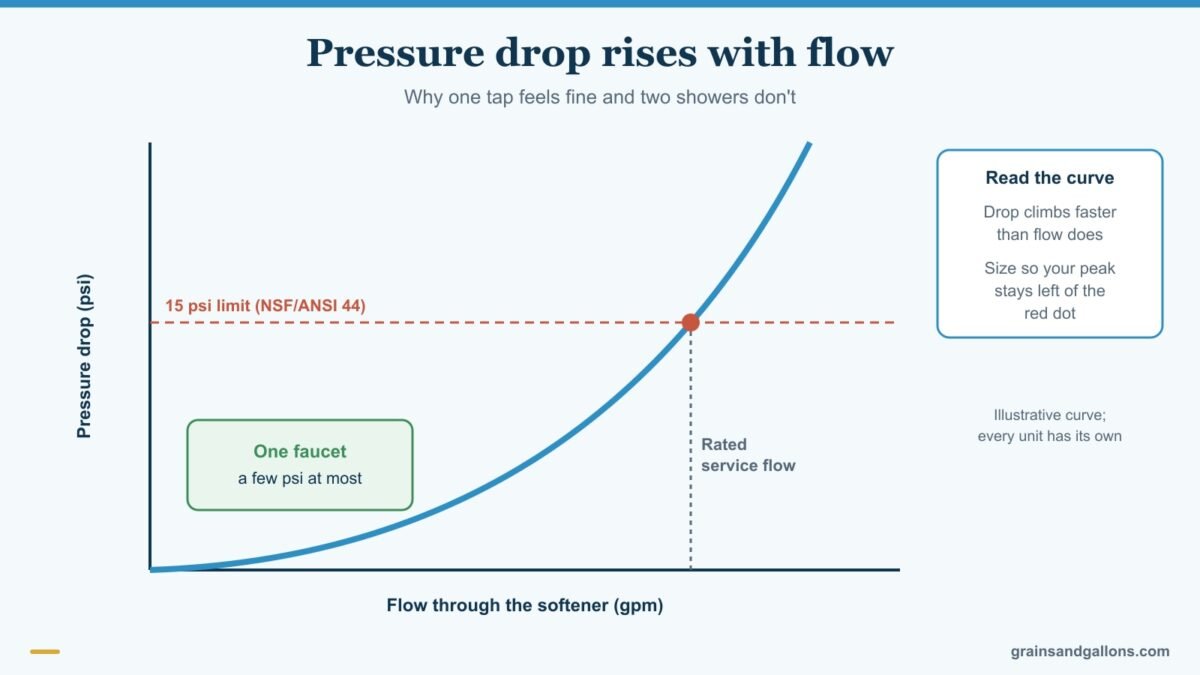
Quick Answer: Some water softener pressure drop is normal, because water has to squeeze through the control valve and a few feet of resin. At everyday flow, a correctly sized softener costs a few psi that most people never notice. Under NSF/ANSI 44, a certified softener can't drop pressure more than 15 psi at its rated service flow. If you lose more than that, or pressure keeps getting worse, the softener is undersized or something inside is plugged.
Water softener pressure drop depends far more on how much water is moving than on anything else. Think of the softener as a sponge you push water through. A trickle barely meets resistance; push a lot of water through fast, and it pushes back hard.
That's why most people with a softener never think about pressure, and a few people with two showers and a dishwasher going at once think about nothing else.
In this guide
Read pressure drop as a curve, not a number

A softener doesn't have a single pressure-drop figure. It has a curve. At 2 gallons per minute it might cost almost nothing; push it far past its rating and the same unit can cost well over 15 psi. In a packed resin bed, doubling the flow typically much more than doubles the drop.
So the useful questions are:
- How many gallons per minute does your house actually pull at peak?
- How much does this softener drop at that flow?
Manufacturers publish a "service flow rate," and the honest ones tell you the pressure drop it was measured at. The industry convention, and the limit in NSF/ANSI 44, is 15 psi. As Water Conditioning & Purification magazine summarizes the standard, pressure-drop testing confirms a certified softener won't drop line pressure more than 15 psi at the manufacturer's rated service flow.
Here's what that looks like on a real data sheet. Pentair's Fleck 5600SXT manual lists three system sizes:
| Resin | Tank | Rated service flow | Drop at that flow |
|---|---|---|---|
| 1.0 cu ft | 9" x 48" | 10.0 gpm | 15 psi |
| 1.5 cu ft | 10" x 54" | 10.8 gpm | 14 psi |
| 2.0 cu ft | 12" x 52" | 12.0 gpm | 14 psi |
Notice that a bigger tank buys more flow at the same drop. Watch for spec sheets that quote a "peak flow" or "max flow" with no pressure figure. That number might have been measured at a much bigger drop, which would feel very different in your shower. Our guide on comparing softener spec sheets shows how to spot it.
Worked example: two showers, one softener
Say a family of four has these fixtures that might run at once on a busy morning:
| Fixture | Typical flow |
|---|---|
| Shower 1 | 2.0 gpm |
| Shower 2 | 2.0 gpm |
| Bathroom sink | 1.2 gpm |
| Toilet refilling | 2–3 gpm |
| Washing machine filling | 3–4 gpm |
Add the realistic overlap, two showers, a toilet and a sink, and you're around 7–8 gpm. Throw in the washer and you might touch 10–12 gpm for a few minutes.
Now compare two softeners:
- Softener A is rated for 8 gpm service flow at 15 psi drop. At 7 gpm it costs maybe 10–12 psi. At 11 gpm it's past its rating, so the drop is above 15 psi, and the second shower noticeably weakens.
- Softener B is rated for 14 gpm at 15 psi drop. At 7 gpm the drop is small. At 11 gpm it's still under 15 psi.
If your incoming pressure is 60 psi, Softener A leaves you with roughly 45 psi or less at peak, minus whatever the piping, water heater and fixtures take. That's where people start saying "the softener ruined my pressure." Softener B leaves you comfortably above 45.
These figures are illustrative; your fixtures and your unit's actual curve will differ. The method is what matters: estimate your peak, then read the softener's drop at that flow, not at some unspecified "max."
How to measure water softener pressure drop at home

You don't have to guess. Two inexpensive hose-thread pressure gauges tell you exactly what the softener costs.
- Put one gauge upstream of the softener (a hose bib or test port between the meter or pressure tank and the softener) and one downstream (a laundry faucet or hose bib fed by softened water).
- Shut off every other water use in the house so you know what's flowing.
- Read both gauges with no water running. They should match. Static pressure doesn't show a drop.
- Open one fixture, then two, then three, and read both gauges each time. The difference is the pressure drop at that flow.
- Repeat in bypass. If the gap mostly disappears, the softener is the restriction; if it stays, look at the piping or other equipment.
The lab version in NSF/ANSI 44 works the same way, just more precisely: WC&P's explainer on the test describes inlet and outlet gauges, steps from 20% to 140% of rated service flow, and an inlet pressure of about 35 psi. Write your readings down. A drop that creeps up over months is the early warning of a fouling bed.
What decides how much a softener drops

- Valve port size. A 1-inch valve passes more water at a given drop than a 3/4-inch valve. If your main line is 1-inch and you have more than two bathrooms, a 1-inch valve matters. Our Fleck softener picks note which models use the 1-inch 2510SXT versus the 3/4-inch 5600SXT.
- Tank diameter and resin volume. A wider bed spreads the flow out, so each part of the resin sees less velocity. Squeezing high flow through a narrow tank is the classic cause of drop.
- Fine mesh resin. Smaller beads have more surface area, which helps with iron, but they also resist flow a bit more. A well-sized fine mesh unit is fine; an undersized one compounds the problem.
- Connections and pipe size. Long runs of 1/2-inch pipe, skinny flexible connectors and a pile of elbows all add friction before and after the softener.
- What's in the line with it. A sediment filter, carbon tank or iron filter each adds its own drop, and three "small" drops add up. If you added a cartridge filter at the same time, read about pressure drop through whole-house filters too.
Normal drop vs a problem

Probably normal:
- You notice a slight difference only when several fixtures run at once.
- The drop has been the same since the day it was installed.
- Pressure at a single faucet feels the same as before.
Probably a problem:
- Pressure was fine at installation and has worsened over months. That points to the resin bed collecting sediment or iron, or crushed beads packing tightly.
- Even one faucet feels weak. A partially closed bypass, a plugged inlet screen, or a broken distributor spitting resin into the plumbing can do that.
- Pressure is fine in bypass and poor through the softener, even at low flow.
That last test is the clearest one you can run. If bypass brings full pressure back at low flow, something inside the softener is restricting. Our troubleshooting guide for low water pressure after a water softener works through those causes in order.
Fixes for a softener that drops too much
Match the fix to the pattern:
- Weak right after installation: check that both bypass handles are fully in service, then look for solder bits, PEX shavings or sediment caught in any inlet screen or strainer.
- Getting worse over time: a fouled bed is the usual cause, especially on well water with iron or manganese. Our resin fouling guide covers cleaners and when resin is beyond saving. Change any sediment prefilter on schedule, too.
- Fine at one tap, weak at peak since day one: the softener or its plumbing is undersized for your flow. Bigger connectors help a little; a larger tank or 1-inch valve fixes it.
- Low everywhere, even in bypass: the softener isn't the problem. If static pressure is already under about 40 psi, look at the well pressure switch, a failing pressure-reducing valve or a partly closed main valve. Our page on water softener pressure requirements covers the operating range.
If you're choosing a softener and pressure matters
Size for both hardness and flow. Many sizing calculators focus only on grains of hardness and household size, which gets the capacity right but says nothing about whether the valve and tank can pass your peak flow. How to size a water softener covers both halves.
For a typical four-person, two-bath house with 1-inch plumbing, that often means a 48,000-grain-class unit on a 1-inch valve rather than the smallest unit that technically meets the hardness math. Our picks for the best water softener for a family of 4 are a good starting list; check each model's published service flow against your own peak before you buy.
FAQ
Does a water softener reduce water pressure?
A little, always. Water has to pass through the valve and resin, so every softener costs some pressure while water is flowing. A properly sized unit costs only a few psi at normal household flow, which most people never notice.
How much pressure drop is normal for a water softener?
NSF/ANSI 44 caps it at 15 psi at the softener's rated service flow. At typical one- or two-fixture flows, a correctly sized softener should drop well under that.
Why did my water pressure drop after installing a softener?
The most common reasons are a bypass not fully in service, installation debris in an inlet screen, or a softener too small for your peak flow. If pressure gets worse over months instead, suspect a fouled or packed resin bed.
How do I measure pressure drop across my softener?
Put a pressure gauge on a hose bib before the softener and another on a fixture after it, shut off all other water use, open a known number of fixtures, and subtract the outlet reading from the inlet reading.
Will a bigger water softener give me better pressure?
Often, yes, if your problem is peak flow. A wider tank and a 1-inch valve pass more water at the same drop, as the Fleck 5600SXT data shows. If pressure is low even in bypass, a bigger softener won't help.
Size for your peak flow and the drop takes care of itself
Water softener pressure drop is normal up to a point, and the point is easy to find: know your peak flow, read the softener's drop at that flow, and stay under the 15 psi line. If the drop is new or growing, a two-gauge test and a bypass check will tell you whether to clean a screen, treat the resin, or step up a size.