

Quick Answer: Here's how to compare water softener spec sheets: ignore the big grain number on the box and line up four things instead: resin volume in cubic feet, rated capacity at a stated salt dose, service flow rate with its pressure drop, and any NSF/ANSI 44 or WQA certification you can verify by model number. Two "48,000-grain" softeners with the same resin volume are basically the same bed. A sheet that gives capacity without a salt dose, or flow without a pressure drop, is telling you less than it looks.
Knowing how to compare water softener spec sheets matters because the numbers on product pages rarely line up. One lists "48K grains," another "45,000 grain capacity," a third "up to 64,000." Here's how to put them on the same footing, and which missing lines should make you suspicious.
In this guide
- What a complete performance data sheet looks like
- Resin volume is the number to anchor on
- Capacity only means something next to a salt dose
- Flow rate is meaningless without the pressure drop
- Certification, regeneration method and water per cycle
- How to compare water softener spec sheets with a worksheet
- FAQ
- Four lines decide it, not the box
What a complete performance data sheet looks like

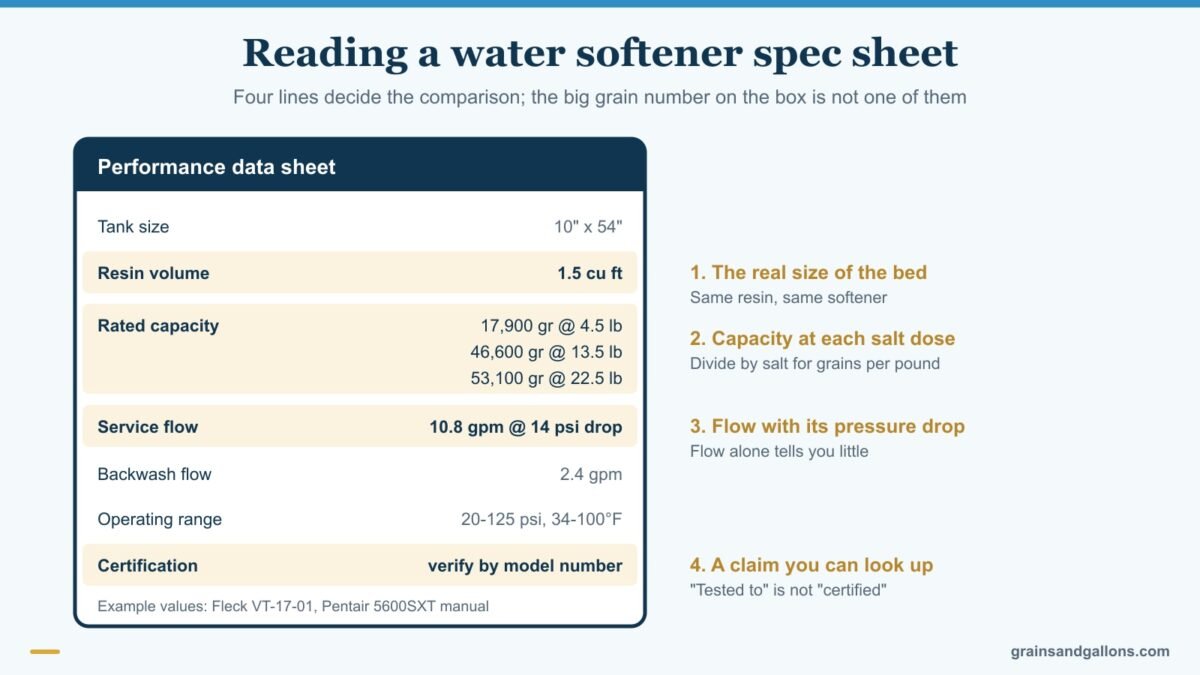
Pentair's installation manual for its Fleck 5600SXT systems includes a full performance data sheet, which makes it a good reference for what you should expect to find. For the middle model:
| Line on the sheet | Value (Fleck VT-17-01) | What it tells you |
|---|---|---|
| Tank size | 10" x 54" | Footprint and bed depth |
| Resin volume | 1.5 cu ft | The real size of the softener |
| Rated capacity | 17,900 gr @ 4.5 lb; 46,600 gr @ 13.5 lb; 53,100 gr @ 22.5 lb | Hardness removed per regeneration at each salt dose |
| Service flow | 10.8 gpm at 14 psi drop | How hard you can run water before pressure suffers |
| Backwash flow | 2.4 gpm | What your drain and well pump must handle |
| Operating range | 20–125 psi, 34–100°F | Installation limits, which also matter for warranty |
Notice there's no single "capacity." There are three, tied to three salt doses. That's how resin actually behaves, and it's the first thing to look for on any sheet.
Resin volume is the number to anchor on
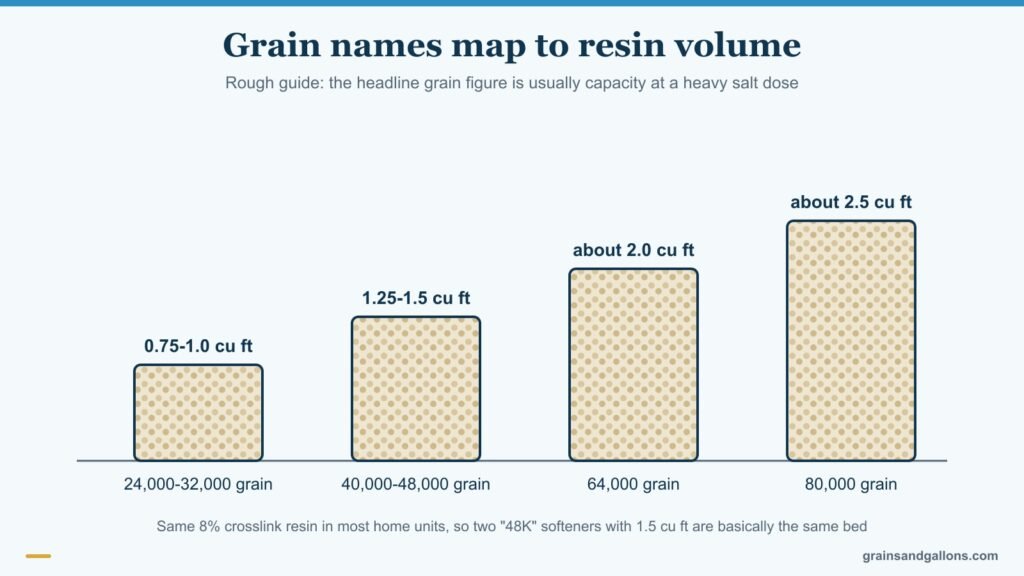
Almost every residential softener uses similar 8% crosslinked cation resin, so the volume of resin is the most direct measure of what you're buying. As a rough rule, the grain names on the market map to resin like this:
- 24,000–32,000 grain: about 0.75–1.0 cu ft
- 40,000–48,000 grain: about 1.25–1.5 cu ft
- 64,000 grain: about 2.0 cu ft
- 80,000 grain: about 2.5 cu ft
Those names are usually the capacity at a heavy, inefficient salt dose (around 15 lb per cubic foot). If a listing gives the grain number but not the resin volume, ask for it or find it in the manual. If it's missing entirely, be wary. Our explainer on what grain capacity actually means walks through why the headline figure overstates everyday capacity, and how to size a water softener shows how much of it your household actually needs.
Capacity only means something next to a salt dose
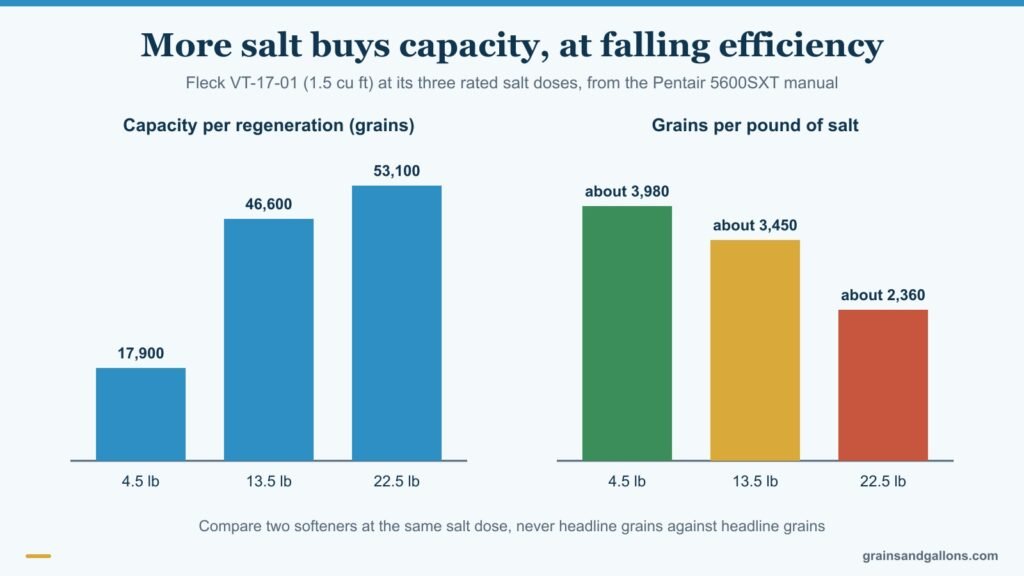
Divide capacity by salt to get grains per pound at each dose the sheet lists. Using the Fleck numbers:
- 17,900 ÷ 4.5 lb = about 3,980 grains per pound
- 46,600 ÷ 13.5 lb = about 3,450 grains per pound
- 53,100 ÷ 22.5 lb = about 2,360 grains per pound
The first pounds of salt do the most work. If one brand advertises 48,000 grains and another 40,000, but you'll run both at a moderate dose, the real gap may be much smaller than the labels suggest. Compare them at the same dose, or as close as the sheets allow.
When you shortlist units, practice on a list where resin volume is already pinned down. Our best 48,000-grain water softeners is a good place to start: check each pick's resin volume before anything else.
Flow rate is meaningless without the pressure drop

"Up to 15 gpm" sounds better than "10.8 gpm." But a flow rating only helps if you know what it costs in pressure. The Fleck sheet says 10.8 gpm at a 14 psi drop. Another maker might quote a higher flow at a 25 psi drop, which you'd feel in every shower.
- Find the flow at a stated pressure drop (15 psi is a common reference point).
- Compare it to your home's realistic peak demand, roughly 6–12 gpm for a typical house with a couple of fixtures running.
- If a sheet lists flow without a pressure drop, treat that flow as unverified.
The water softener pressure drop guide explains what drop you'll notice and why valve size (3/4" vs 1") matters.
Certification, regeneration method and water per cycle

A sheet may say "tested to NSF/ANSI 44" or "WQA Gold Seal." Tested isn't the same as certified, and both claims are easy to check in the certifier's online listings by model number. There's also a separate efficiency rating under NSF/ANSI 44. According to the PNNL Building America Solution Center, an efficiency-rated softener needs at least 3,350 grains per pound of salt, can't use more than 5 gallons of water per 1,000 grains removed, and must regenerate on demand. Time-clock units don't qualify.
That makes the regeneration method a line worth comparing in its own right. A metered (demand-initiated) valve regenerates when the resin is actually used up; a timer regenerates on schedule whether you used the capacity or not. Pair that with water used per regeneration, which matters on septic, a slow well or a metered bill. If saving salt and water is your priority, start with our high-efficiency water softener picks, and see what NSF/ANSI 44 means for what the certification does and doesn't test.
How to compare water softener spec sheets with a worksheet
Some lines are often missing, especially on direct-to-consumer listings. Ask for backwash flow (if your well pump or drain can't keep up, the bed won't clean properly), maximum iron and manganese in ppm, the operating pressure and temperature range, and the valve model. A Fleck or Clack valve means parts and manuals are easy to find later.
Then fill this in for each unit:
| System A | System B | System C | |
|---|---|---|---|
| Resin volume (cu ft) | |||
| Capacity @ lowest and middle salt dose | |||
| Grains per lb at middle dose | |||
| Service flow @ pressure drop | |||
| Backwash gpm / water per regen | |||
| Metered or timer | |||
| Valve brand/model | |||
| Certification (verified?) |
Two units with the same resin volume, valve and certification are close to interchangeable, so warranty, support and price decide. A unit with a big grain number but less resin, an unstated salt dose and no pressure drop is the one to cross off.
FAQ
What is the most important number on a water softener spec sheet?
Resin volume in cubic feet. Most home softeners use similar resin, so the amount of it is the most direct measure of capacity. Grain ratings only make sense once you know the resin volume and the salt dose behind them.
What if two sheets use different test conditions?
They often do. The Fleck sheet notes testing at 35 psi and capacity measured at half the rated flow. A maker that tested under gentler conditions will look better. You can't fully correct for that, but a verified certification puts both on the same test.
Should I trust a "grains per pound" figure from a seller?
Only if it states the salt dose. Efficiency is always highest at the lowest dose, so a single headline number usually comes from the most favorable setting.
Is a higher grain rating always better?
No. An oversized unit at a heavy salt dose wastes salt, and one sized well at a moderate dose can be cheaper to run. Compare at the same salt dose and size to your hardness and water use.
Does a metered softener really save salt?
It regenerates only when the resin's capacity is used, instead of on a fixed schedule, which is why NSF/ANSI 44 requires demand regeneration for its efficiency rating.
Four lines decide it, not the box
That's how to compare water softener spec sheets without getting fooled: anchor on resin volume, compare capacity at the same salt dose, insist on flow with a pressure drop, and verify any certification by model number. When those match, let warranty and price decide.